


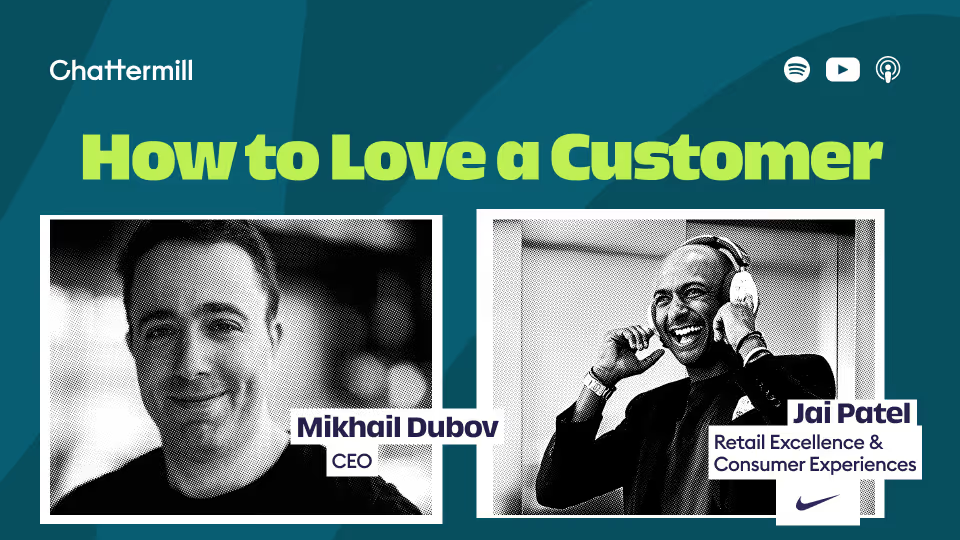
How To Love A Customer: Episode 14 with Jai Patel from Nike


The CX intelligence
platform that's AI-native by design
Book a demoThere's a version of retail customer experience that looks great on paper — journey maps, KPI dashboards, omnichannel frameworks — and falls apart the moment it hits the shop floor.
Jai Patel has spent his career in the gap between those two things. He started at 15, working evenings and weekends at Next in the UK, and has since led retail strategy and store experience across Tommy Hilfiger, Calvin Klein, Zara, Nike, Selfridges, Bicester Village, and Dyson. He's now joining Nike's corporate team to lead partner store strategy. He's seen the same failure mode play out at brand after brand: the people closest to the customer are the last to be asked what they think.
In this episode, our CEO & Co-Founder Mikhail Dubov talks with Jai about how to actually close that gap — and why the answer is more human than most companies expect.
👉 Subscribe & listen to the latest episode here
🔑 Key Takeaways from the Episode
1. Experience Is Not a Department
One of the things Jai kept coming back to throughout the conversation is that customer experience fails when it's treated as someone else's job. At PVH, he watched store associates run through what felt like a mental checklist — greeting, upselling, loyalty program signup — and the human connection just wasn't there. It had been optimised away.
"Experience definitely beats process. Of course, you want processes, you want procedures, but experience is different. I also realised that experience is not a department, and it really needs a solid operating system to be able to bring that together." — Jai Patel
The fix isn't better scripts. It's an operating model that actually connects what the brand wants to deliver with what store teams have the capacity and context to execute.
2. Consumers Remember Intent, Not Efficiency
This was probably the sharpest line in the whole conversation. Jai isn't saying process doesn't matter — he's saying it's not what leaves a mark.
"Consumers will not remember efficiency. They will definitely remember intent." — Jai Patel
A customer who waited 20 minutes for a receipt because the printer broke won't remember the wait as a technical inconvenience. They'll remember whether anyone acknowledged it, took ownership, or just looked embarrassed and carried on. The feeling outlasts the friction.
3. The Store Team Feedback Loop Is Still Broken
When Jai arrived at PVH, head office teams were designing in-store programmes without real visibility into what was actually happening at store level. Good ideas were landing badly because the people delivering them hadn't been part of the build — and had no channel to say so.
He describes walking into a training session in France with 30 store managers who stopped engaging within five minutes. When he asked why, the local team told him: "They've heard this before. And nothing changed."
"We need to give a platform and the space for the people that are in front of the end consumer to share their message. If you don't give them the space, you're gonna keep going around in this vicious circle and nothing will improve." — Jai Patel
The shift Jai made was simple but took time to earn: telling the room he'd been on the floor himself, that he'd been shouted at by customers too, and that he was there specifically to carry their reality back to the people making decisions.
4. The WhatsApp Fix at Bicester Village
One of the most concrete examples in the episode comes from Jai's time at Bicester Village — a luxury outlet destination in Europe. When COVID hit, the challenge became: how do you maintain the high-touch, personal experience that makes Bicester Bicester, without footfall?
The answer wasn't a chatbot. It was WhatsApp for Business. If a shopper had visited a boutique and couldn't find the right size or colour, the store team could pick up the conversation there — a real person, not a widget.
"We found a way to implement WhatsApp for Business. If a shopper went into a boutique and they didn't find the right size or the right color... the store teams could connect with them on WhatsApp and they can start a dialogue and they're physically talking to a human person." — Jai Patel
Getting the luxury brands on board meant mapping out both Bicester's customer journey and each brand's own experience standards — a process that required sitting down with hospitality teams, brand partners, and operations together. The tech was simple. The alignment work wasn't.
5. Firefighting Is Not a Strategy
Jai is direct about what he sees most companies get wrong when something breaks: they fix the problem and move on. They don't ask whether the same problem is about to surface in 50 other locations, or whether the root cause is something structural.
"Too many companies just firefight, firefight, firefight and they're not looking at the bigger thing. You want that foundation for the longer term. Take some time to get the realisation very, very clear before moving forwards." — Jai Patel
His recommendation for anyone starting a new CX or retail role: before trying to fix anything, map the reality clearly. Understand what is actually happening, not what the strategy deck says should be happening. Only then do you have the foundation to make changes that hold.
6. "Omnichannel" Has Lost Its Meaning
Asked what CX trend he'd retire, Jai didn't hesitate: omnichannel. Not because connected retail isn't real — he saw PVH do it well, and experienced it himself as a Nike customer — but because too many brands use the word while keeping e-commerce and retail completely siloed.
"I still hear companies and brands using Omnichannel, but they completely have e-commerce and retail very, very far apart." — Jai Patel
The brands that get it right — PVH, Nike, increasingly Lego and Pandora — treat data from every touchpoint as part of a single customer record. The ones that don't are still asking customers to introduce themselves every time they walk through the door.
💡 The Dyson Moment
Jai also touched on what made Dyson different from the fashion brands he'd spent most of his career in. The product, he says, is genuinely extraordinary — he still finds the engineering impressive. But an extraordinary product on a plinth doesn't sell itself.
"Just by having an amazing product sat on a plinth in a store doesn't mean a shopper is coming to spend 100 euros, 500 euros, a thousand euros. So it's that magic of togetherness — working with stakeholders, giving that excitement to the store teams and putting them together to give that to the shopper." — Jai Patel
The lesson isn't specific to premium appliances. Every product needs a chain of people who understand what makes it worth buying — and who can pass that understanding down to whoever is standing in front of the customer.
🧳 Why This Episode Matters
Jai's career spans five decades of retail change — from the pre-digital sales floor to the omnichannel era to whatever comes next with AI. What hasn't changed, in his view, is this: strategy only works if the people executing it feel like they're part of it.
For CX leaders navigating pressure to automate, personalise at scale, and prove ROI, this episode is a useful corrective. The tech stack matters. The culture of listening matters more.
🎧 Listen to How to Love a Customer
If you work in CX, retail, or insights, this podcast is built for you — real stories, honest takes, and lessons you can use.
👉 Catch the latest episode here
Episode Notes
00:00 — Meet Jai PatelFrom his first retail job at 15 to leading global store strategy at PVH, Bicester Village, Dyson, and now Nike.
05:09 — Learning CX by Living ItWhy starting on the sales floor shapes how Jai thinks about everything that comes after.
09:48 — How Retail Has ChangedThe shift from transaction-led stores to experience-led spaces — and why human connection didn't survive the automation wave intact.
13:17 — The Customer Story That StuckReceipt printers, robotic store teams, and the moment Jai realised process was winning over experience.
16:28 — Connecting Head Office to the Shop FloorTransparency, stakeholder education, and why corporate teams need to work shifts in stores.
21:47 — Getting Store Teams to Actually Speak UpThe training session in France that wasn't working, and what Jai did to turn it around.
24:59 — From Small Signal to Strategic ChangeThe Bicester Village WhatsApp initiative — how one operational challenge became a brand-wide approach to human-led digital.
29:44 — Tools and Techniques for a New RoleUnderstand reality before you build strategy. Stop firefighting. Get the foundation right.
31:27 — Hot Takes: CX EditionRetire "omnichannel." The brands actually doing connected retail well. And why store teams are still the industry's most underused asset.
37:9 — Personal CX MomentsJai on the Nike experience that showed what joined-up retail actually looks like as a customer.
37:45 — What Made Dyson DifferentEngineering, excitement, and the chain of people that turns a great product into a great purchase.



See Chattermill in action on your own feedback
Book a demo


