


How Accurate Is AI-Powered Customer Feedback Analysis? A Buyer's Guide


The CX intelligence
platform that's AI-native by design
Book a demoModern AI feedback analysis is accurate enough to replace manual coding at scale, but a single accuracy percentage tells a buyer almost nothing. What matters is how a vendor measures that accuracy and whether it can prove it.
Quick Summary
Accuracy in AI feedback analytics depends heavily on the underlying approach. The table below summarizes typical sentiment accuracy by method, based on benchmarks compiled by Unthread (2026). Beyond the model type, another key accuracy lever is whether a platform scores sentiment per aspect (aspect-based sentiment analysis) rather than assigning one score per comment.
| Approach | Typical Accuracy | What It Means for Buyers |
|---|---|---|
| Rule-based / lexicon systems | ~72% | Cheap and fast, but miss negation, sarcasm, and context; expect noticeable error on real feedback. |
| Traditional machine learning | ~70–80% | Better than rules on structured data, but sensitive to domain shift and needs labeled training data. |
| Deep-learning (RNN/LSTM) models | ~80–85% | Roughly matches human-level performance; strong on sequence and context. |
| BERT / transformer models | ~90–95% | Highest accuracy; understands context, negation, and nuance across varied language. |
Why Listen To Us
Chattermill is an AI-native customer experience intelligence platform that unifies feedback from every channel and language into one source of truth. We help CX, insights, and product teams consolidate, tag, and analyze feedback, using advanced AI to surface key themes, sentiment, and trends. Because we tie those insights to business metrics like NPS, CSAT, and CES, accuracy is not an academic question for us. It is what makes an insight worth acting on.

What "Accuracy" Really Means In AI Feedback Analysis
Ask most vendors how accurate their platform is and you will get a single number. That number hides more than it reveals.
Start with the two things "accuracy" usually conflates. Sentiment accuracy measures whether the model correctly reads a comment as positive, negative, or neutral. Theme accuracy measures whether it correctly identifies what the comment is actually about, such as delivery times, billing, or onboarding. A platform can be strong at one and weak at the other, and buyers rarely ask which.
There is a deeper problem: accuracy is not a fixed property of the software. Sentiment is subjective. According to Label Your Data (2026), human annotators only agree with each other about 80% of the time. That disagreement sets a ceiling. No model can be "95% correct" against a truth that humans themselves define inconsistently.
Granularity matters just as much as the headline figure. A model that is 95% accurate across three broad buckets tells you far less than one that is 85% accurate across a hundred specific themes. The coarse model looks better on paper and helps you less in practice. The specific model is where real customer feedback analytics lives, because it maps to decisions your team can act on. It is also what separates capable customer insights software from tools that only report a headline number.
How Accurate Each Approach Is: Rule-Based, Machine Learning, And AI
Accuracy scales with sophistication, and the gap between approaches is wide. The same 2026 Unthread benchmarks put rule-based and lexicon systems at around 72%, traditional machine learning at 70–80%, deep-learning models at 80–85% (roughly human-level), and BERT and transformer models at 90–95%.
Why such a spread? Rule-based systems match words against a fixed dictionary. They cannot read the sentence "the app is not slow" as positive, because they see "slow" and score it negative. They miss sarcasm entirely and collapse under context. Traditional machine learning improves on this by learning patterns from labeled examples, but it struggles when your feedback looks different from its training data.
Transformer and large language models changed the ceiling. They read a whole sentence in context, so negation, tone, and nuance survive. The parity is now measurable. A 2026 study in Nature's Humanities and Social Sciences Communications compared leading AI sentiment tools, including ChatGPT, Google Cloud NLP, and NLP Cloud, against ten psychologists and found no statistically significant difference in sentiment scores on the tested texts. The authors are careful to caution that this shows similarity on their dataset, not general interchangeability. Still, it reframes the question. The issue is no longer whether AI can read sentiment, but which AI sentiment analysis tools hold that accuracy on your data.
What Drives Accuracy In AI Feedback Analysis
If the model matters, so do the conditions you run it in. Five factors do most of the work.
Data Quality. Accuracy is downstream of the feedback you feed the model. Duplicate records, mislabeled channels, and untranslated comments degrade results before analysis begins. Unifying feedback from every channel and language into one clean source is the precondition for trustworthy output, not a nice-to-have.
Discovery Approach. There are two ways to find themes. A top-down approach forces feedback into a predefined taxonomy, which is fast but blind to anything you did not anticipate. A bottom-up approach discovers themes from the real language customers use, which surfaces emerging issues you did not know to look for. The second is harder and more accurate, because it reflects what customers actually said rather than what you expected them to say.
Human-In-The-Loop Validation. The most accurate systems let people review and correct the model, then learn from those corrections. Validation is how you close the gap between an 80% baseline and something your team will trust.
Refinement Speed. Feedback shifts as products, seasons, and markets change. A model you can refine in hours stays accurate. One that takes a vendor weeks to retune drifts out of date between quarterly reviews.
Sentiment Granularity. A single comment often carries mixed sentiment across different topics, praising one thing while criticizing another. Scoring sentiment per aspect or theme, an approach called aspect-based sentiment analysis, is more accurate than assigning one score to the whole comment. Comment-level scoring averages those signals away, so you lose the detail that tells you what to fix.
Where AI Feedback Analysis Still Struggles
Honesty about limitations is part of judging accuracy well. Even strong models have blind spots.
- Sarcasm and nuance. "Great, another outage" reads as positive to a literal model. Irony remains one of the hardest problems in language.
- Mixed emotions in one comment. A customer might praise your support team and slam your pricing in the same sentence. Comment-level sentiment flattens this into a single score, while theme-level sentiment keeps the two signals separate. Scoring sentiment per theme is what aspect-based sentiment analysis (ABSA) does, keeping "support" positive and "pricing" negative rather than blurring both into one score. If a vendor only reports one score per comment, you lose half the story.
- Context dependency across industries. "Sticky" is a complaint about a checkout flow and a compliment about a mobile game. Accuracy that holds in one domain can slip in another.
- The testing-to-production drop. This is the gap buyers most often miss. Per Label Your Data (2026), sentiment models can hit around 96% accuracy in testing but fall to roughly 75% in production, because of sarcasm, domain mismatch, and data-quality issues. A demo number and a production number are not the same number.
How To Benchmark Vendor Accuracy Honestly
Here is the payoff: a framework for pressure-testing any accuracy claim before you sign. Whether you are comparing customer feedback tools or narrowing a shortlist, treat each step as a question to put to the vendor.
- Test on your own data, not a demo set. Ask the vendor to run analysis on a sample of your real feedback. A polished demo dataset is tuned to look good. Your messy, mixed, multilingual feedback is what the model will actually face.
- Check theme granularity. Ask how many themes the platform can distinguish and whether it discovers new ones from your language. Broad buckets inflate accuracy scores while hiding the detail you need.
- Demand comment-level traceability. Ask to click any theme or sentiment score and see the exact verbatim comments behind it. If you cannot trace an insight to its source, you cannot verify it.
- Ask who can refine the model. Confirm whether your team can correct mislabeled feedback directly, or whether every change requires a vendor ticket. Ownership determines how accurate the system stays.
- Confirm accuracy improves over time. Ask whether corrections feed back into the model. A platform that learns from your validation gets more accurate; one that does not will drift.
- Ask how the vendor actually measures accuracy. Have them define what their number means: sentiment or theme, which dataset, tested or in production. A vendor who cannot explain their methodology is quoting a number they cannot defend.
- Ask whether sentiment is scored per aspect or per comment. Confirm the platform scores sentiment for each aspect or theme within a comment rather than reducing the whole comment to one score. Per-comment-only scoring is a red flag, because it hides the mixed sentiment inside feedback that praises one topic and criticizes another.
How Chattermill Is Built For Accurate, Trustworthy Insights
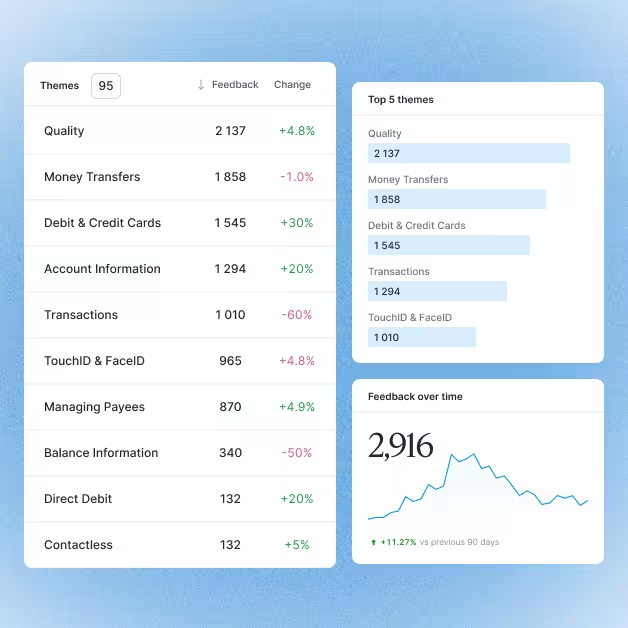
Those seven questions describe how Chattermill is designed to work. We unify feedback from every channel and language into one source of truth, which removes the data-quality problems that quietly erode accuracy. Our AI surfaces themes and sentiment with the underlying evidence attached, so any score traces back to the verbatim comments behind it. Chattermill also reads sentiment with aspect-based sentiment analysis (ABSA), scoring each theme inside a piece of feedback rather than assigning one score to the whole comment. So when a customer praises onboarding and criticizes billing in the same breath, each signal stays intact. That is a core reason the insights hold up on messy, mixed real-world feedback where fixed rule-based and comment-level scoring blur the two together.
Because insights connect directly to customer experience metrics like NPS, CSAT, and CES, your team can see how a theme moves the numbers that matter to the business. And human review is built in, so people can validate and refine what the model finds rather than accept it on faith. That combination of unified data, traceable evidence, business-metric alignment, and human oversight is the foundation of our customer feedback analytics product.
In Practice — How HelloFresh Turned Trusted Feedback Into New Product Revenue Streams
Consider a team that put this into practice. As HelloFresh scaled, it faced large volumes of feedback across many channels. The team used Chattermill's feedback analysis to cut through that volume, trust the themes it surfaced, and act on them, turning customer feedback into new product and revenue opportunities. You can read the full account in the HelloFresh customer story. The lesson generalizes: accurate, trustworthy analysis is only valuable when a team acts on it.
Build A Feedback Program You Can Trust With Chattermill
Accuracy is not a number to chase. It is a property you verify, then protect through clean data, specific themes, traceable evidence, and human validation. Buyers who ask the right questions stop shopping for the highest advertised percentage and start choosing the platform that can prove its claims on their own feedback.
That is the standard Chattermill is built to meet. Book a demo to see how accurate, evidence-backed feedback analysis holds up on your data.
Frequently Asked Questions About AI Feedback Analytics Accuracy
How Accurate Is AI Customer Feedback Analysis?
It depends on the approach. Per Unthread's 2026 benchmarks, rule-based systems reach around 72%, while BERT and transformer models reach 90–95%. Remember that testing accuracy tends to overstate what you will see in production.
Can AI Match Human Accuracy On Sentiment?
On some datasets, yes. A 2026 study in Nature's Humanities and Social Sciences Communications found no statistically significant difference between leading AI sentiment tools and ten psychologists on the texts tested. The authors caution this shows similarity on their dataset, not that AI and humans are generally interchangeable.
What's The Difference Between Sentiment Accuracy And Theme Accuracy?
Sentiment accuracy measures whether the model reads a comment's tone correctly as positive, negative, or neutral. Theme accuracy measures whether it correctly identifies the topic, such as billing or delivery. A platform can be strong at one and weak at the other, so ask about both.
Why Does Accuracy Drop In Production?
Test data is clean and predictable, but real feedback is messy. According to Label Your Data (2026), models can hit about 96% in testing yet fall to roughly 75% in production because of sarcasm, domain mismatch, and data-quality issues. Human annotators also agree only about 80% of the time, which caps what any model can reach.
How Should I Test A Vendor's Accuracy Claims?
Run the platform on a sample of your own feedback rather than a demo set, check whether it distinguishes specific themes, and confirm you can trace any score back to the verbatim comments. Then ask exactly how the vendor defines and measures the accuracy number they quote. For a deeper look at how feedback is parsed, review the vendor's approach to text analytics.



See Chattermill in action on your own feedback
Book a demo


