


Chattermill vs Qualtrics XM: Which Feedback Analytics Platform Fits Your Team?



The CX intelligence
platform that's AI-native by design
Book a demoMost enterprise CX teams default to Qualtrics XM because it covers everything: surveys, employee experience, brand tracking, product research. That breadth is reassuring on a procurement slide — but it creates a specific blind spot. When your unstructured feedback (support tickets, app reviews, social comments, chat transcripts) lives in a separate module behind a separate contract, the richest signal about what customers actually feel gets analysed last, if at all.
This article breaks down where Qualtrics XM and Chattermill genuinely differ — in architecture, analytical depth, multilingual coverage, and speed to insight — so you can match the right platform to the way your team actually works.
Quick Summary
- Analytical approach: Chattermill is AI-native feedback analytics built around its Lyra AI engine (aspect-based sentiment analysis, phrasal analysis, clustering, and generative AI). Qualtrics XM uses Text iQ (rule-based + ML hybrid) for structured feedback and requires XM Discover as a separate module for deep unstructured text analytics.
- Scale: Chattermill analyses feedback across 99+ languages natively without translation. Qualtrics supports 49+ languages for surveys but only 23 for unstructured text analytics, according to Qualtrics product documentation.
- Unique to Chattermill: Native social CX analytics (Facebook, Instagram, TikTok with competitor benchmarking), native speech analytics (transcription + theme analysis), and the Chattermill MCP server for querying feedback data directly inside AI agents.
- Unique to Qualtrics: Experience Agents for automated response workflows, synthetic audiences for rapid concept testing, and the broadest XM suite covering CX, EX, brand, and market research in a single platform.
- Pricing: Chattermill offers custom, volume-based pricing. Qualtrics XM pricing is module-based with a median annual cost of $28,533 (range $6,525 to $126,000), according to Vendr.
- Best for: Chattermill (4.4/5 on G2, 237 reviews) fits CX and product teams that need deep, multilingual feedback intelligence across every channel — fast. Qualtrics XM (4.3/5 on G2 CX, 751 reviews) fits organisations that need a single vendor for surveys, employee experience, brand tracking, and market research at enterprise scale.
Why Listen to Us
Chattermill's customer feedback analytics platform is used by CX and product teams at HelloFresh, Booking.com, Amazon, Uber, and H&M to analyse millions of feedback data points across channels and languages. That operational depth — not marketing theory — informs every comparison in this article. We will be fair about where Qualtrics excels and direct about where our approach differs.
What Is Qualtrics XM?
Qualtrics XM is an enterprise experience management platform that spans customer experience (CX), employee experience (EX), brand tracking, product experience, and market research. Its survey builder remains the industry benchmark: sophisticated logic, wide distribution options, and deep statistical analysis tools that research and insights teams rely on globally.
Qualtrics serves major enterprises including Shake Shack, ServiceNow, Hilton, Porsche, and Samsara. Its 2026 acquisition of Press Ganey Forsta for $6.75 billion (per the Qualtrics press release) significantly expanded its healthcare and employee experience footprint, signalling a continued push into regulated, survey-intensive industries.
Recent product moves include Experience Agents — AI-driven automated response workflows that close the loop on feedback — and synthetic audiences that let research teams test concepts against simulated respondent panels before fielding live surveys. These capabilities reinforce Qualtrics' position as the dominant platform for organisations that centre their CX programme on structured survey research.
How Does Qualtrics XM Compare to Chattermill?
The core distinction is architectural. Qualtrics XM starts with surveys and extends outward into analytics; Chattermill starts with analytics and ingests feedback from every source — surveys, support tickets, reviews, social media, speech — natively. One platform asks "What did we ask customers?" The other asks "What are customers telling us across every channel, in every language, right now?"
Here's the uncomfortable truth — most enterprise CX teams are analysing a fraction of the feedback they already have, because the platform they bought was built to collect it, not to understand it.
The question is not which platform is better in the abstract. It is whether your team's biggest gap is collecting structured feedback or making sense of the unstructured feedback you already have.
Head-to-Head Comparison Table: Chattermill vs Qualtrics XM
Chattermill Review

Overview
Chattermill is an AI-native feedback analytics platform built for CX, product, and insights teams that need to understand what customers are saying across every feedback channel — not just surveys. The platform's Lyra AI engine combines aspect-based sentiment analysis (ABSA), phrasal analysis, automated theme clustering, and generative AI to surface granular, actionable patterns from unstructured text at scale.
Where traditional analytics tools require analysts to define categories upfront, Chattermill's AI identifies emerging themes and sentiment shifts automatically. This matters when you are processing feedback in 99+ languages across support tickets, app reviews, social media, NPS surveys, and call transcripts simultaneously.
Teams at HelloFresh, Booking.com, Amazon, Uber, and H&M have gone from onboarding to active insights in weeks, not months. These teams use Chattermill to connect feedback signals to business metrics like NPS, CSAT, and CES — and to act on those signals before they become trends in a quarterly report.
Chattermill Features
- Lyra AI Engine: Aspect-based sentiment analysis, phrasal analysis, clustering, and GenAI summarisation — purpose-built for unstructured customer feedback
- Unified Feedback Analytics: Ingests surveys, support tickets, app reviews, social comments, and chat transcripts into a single analytics layer
- Social CX Analytics: Native analysis of Facebook, Instagram, and TikTok feedback with competitor benchmarking
- Speech Analytics: Transcription and theme analysis for call centre and voice feedback
- MCP Server: Query Chattermill feedback data directly inside AI agents and copilots
- 99+ Language Support: Native multilingual analysis without translation, preserving cultural and linguistic nuance
- Anomaly Detection: Automated alerts when sentiment or theme volumes shift outside normal ranges
- 65+ Integrations: Direct connectors to Zendesk, Intercom, Salesforce, Trustpilot, app stores, and more
2026 Pricing
Chattermill offers custom, volume-based pricing tailored to the number of feedback sources, data volume, and modules required.
Chattermill Pros
- Deep, granular sentiment analysis that goes beyond positive/negative to aspect-level themes
- 99+ languages analysed natively — no translation layer, no accuracy loss
- Native social CX and speech analytics included in the platform, not sold as add-ons
- Fast implementation with dedicated onboarding support — enterprise customers like HelloFresh and Booking.com went live in weeks
- MCP server enables feedback data to flow directly into AI agent workflows
- Purpose-built for unstructured feedback; no survey builder overhead
Chattermill Cons
- No native survey builder — teams that need survey creation will pair Chattermill with a tool like Qualtrics, SurveyMonkey, or Typeform
- Focused on CX and product feedback analytics; does not cover employee experience, brand tracking, or market research
- Custom pricing means no self-serve tier for smaller teams to trial independently
Who It's For
CX leaders, VoC owners, and product teams at mid-market and enterprise organisations that generate high volumes of unstructured feedback and need multilingual, multi-channel intelligence they can act on quickly.
Review Ratings
- G2: 4.4/5 (237 reviews) — Chattermill on G2
- Capterra: 4.5/5 (25 reviews) — Chattermill on Capterra
- Gartner Peer Insights: 4.5/5 (93 reviews) — Chattermill on Gartner
Qualtrics XM Review
Overview
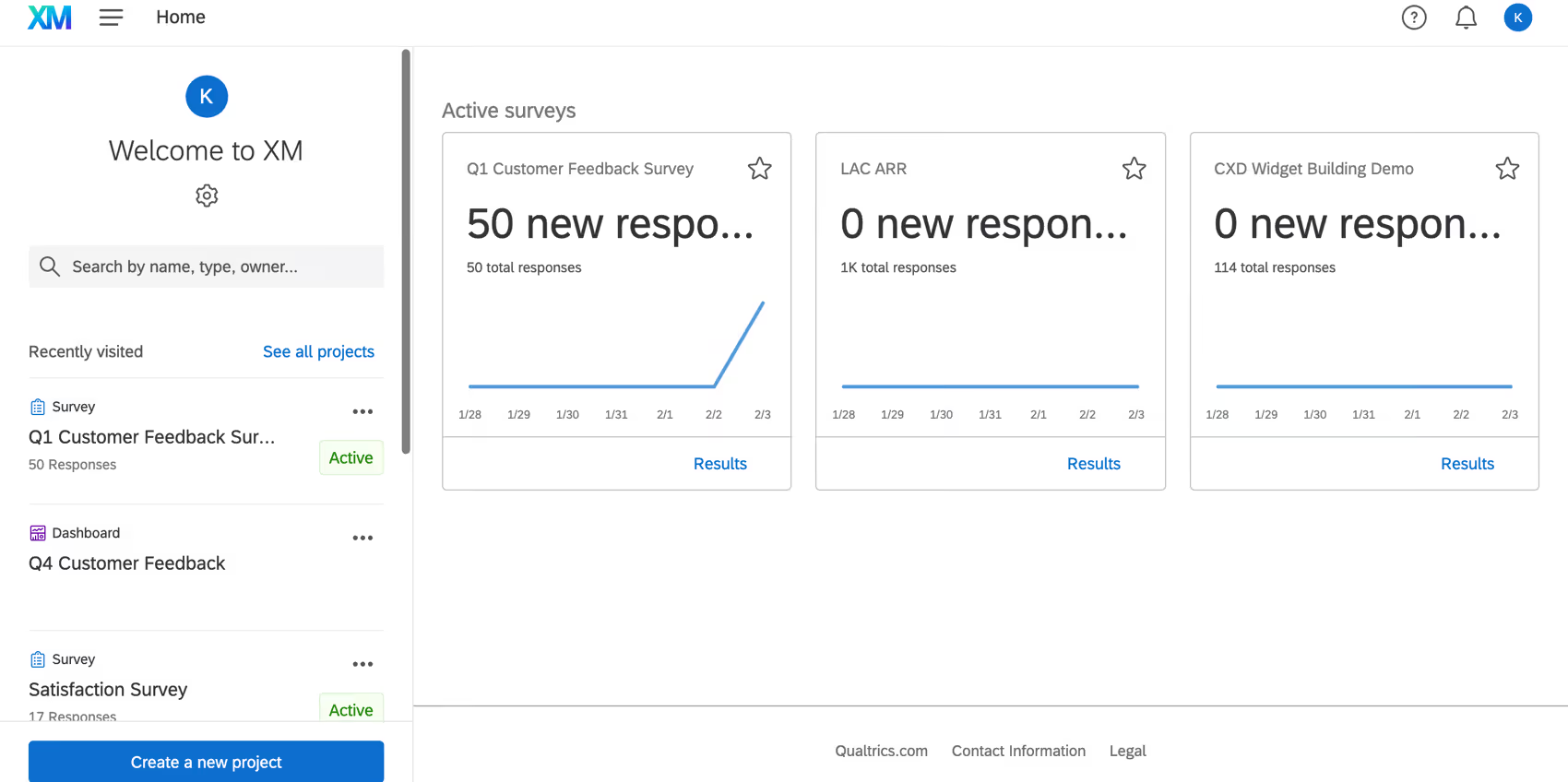
Qualtrics XM is the dominant enterprise experience management platform, offering integrated suites for customer experience, employee experience, brand health, product experience, and market research. For organisations that want a single vendor to manage surveys, employee engagement, brand tracking, and concept testing, Qualtrics delivers unmatched breadth.
The survey builder is genuinely best-in-class — sophisticated branching logic, randomisation, embedded data, and advanced statistical analysis make it the tool of choice for research-grade survey programmes. The platform also provides strong operational CX capabilities, including automated follow-up workflows and real-time dashboard reporting.
The 2026 acquisition of Press Ganey Forsta for $6.75 billion expanded Qualtrics' reach into healthcare experience and employee listening at scale. Combined with newer features like Experience Agents (AI-powered automated response workflows) and synthetic audiences (simulated respondent panels for rapid concept testing), Qualtrics continues to consolidate its position as the broadest XM platform on the market.
Qualtrics XM Features
- Survey Builder: Industry-leading survey design with advanced logic, piping, randomisation, and 100+ question types
- Text iQ: Text analytics with rule-based and ML-powered sentiment and topic detection for open-ended survey responses
- XM Discover: Deeper unstructured text analytics module for analysing support tickets, chat, and social data (separate add-on)
- Experience Agents: AI-powered automated response workflows that trigger actions based on feedback signals
- Synthetic Audiences: AI-simulated respondent panels for rapid concept and message testing
- Cross-XM Analytics: Unified dashboards connecting CX, EX, brand, and product data
- 100+ Integrations: Connectors to Salesforce, ServiceNow, Slack, HRIS platforms, and more
2026 Pricing
Qualtrics XM uses module-based pricing with a median annual cost of $28,533 and a range of $6,525 to $126,000, according to Vendr — costs vary significantly based on the suites, modules, and response volumes selected.
Qualtrics XM Pros
- Broadest experience management suite on the market: CX, EX, brand, product, and research in one platform
- Survey builder is rated among the highest on G2 and Gartner Peer Insights for research-grade survey functionality
- Strong enterprise compliance, security certifications, and global data residency options
- Experience Agents automate close-the-loop responses based on feedback signals
- Synthetic audiences accelerate concept testing without live fielding costs
Qualtrics XM Cons
- Steep learning curve — full adoption often requires dedicated Qualtrics administrators or consultants
- Pricing is opaque and modular; costs escalate quickly when adding XM Discover, Digital, or advanced analytics modules
- Unstructured feedback analysis (support tickets, reviews, social) requires the XM Discover add-on, which is not included in the core CX suite
- Multilingual support for unstructured text analytics is limited to 23 languages — significantly fewer than the 49+ supported for surveys
- Implementation timelines for enterprise deployments are measured in months, not weeks
Who It's For
Enterprise organisations that need a single platform to manage structured survey research across CX, EX, brand, and market research — particularly teams where survey design, statistical analysis, and broad XM coverage are the top priorities.
Review Ratings
- G2 (Customer Experience): 4.3/5 (751 reviews) — Qualtrics CX on G2
- Capterra (Strategy & Research): 4.7/5 (426 reviews) — Qualtrics on Capterra
- Gartner Peer Insights (XM Platform): 4.5/5 (279 reviews) — Qualtrics on Gartner
Who Should Use Qualtrics XM?
Qualtrics XM is the right choice when your organisation's experience programme is built around structured survey research and you need a single vendor to span multiple experience domains. Specifically, consider Qualtrics if:
- Your CX programme is survey-centric. You run large-scale NPS, CSAT, and transactional surveys and need a best-in-class survey builder with advanced logic, randomisation, and statistical tools.
- You need CX and EX on one platform. Your leadership wants unified dashboards connecting customer experience and employee experience data to spot internal-external correlations.
- Market research is a core function. Your insights team conducts concept testing, brand tracking, and competitive benchmarking through structured research panels.
- You have dedicated Qualtrics administrators. The platform's depth rewards teams with trained admins or consulting support to configure complex programmes.
- Compliance and data residency are non-negotiable. Qualtrics' enterprise security certifications and global data residency options meet strict regulatory requirements.
- Synthetic audiences accelerate your research cycles. You want to test messaging, concepts, or new experience designs against AI-simulated panels before investing in live fielding.
If your biggest challenge is survey design and distribution across multiple XM domains, Qualtrics delivers the broadest capability set.
Who Should Use Chattermill?
Chattermill is the right choice when your team's primary challenge is not collecting feedback — it is making sense of the feedback you already have. Consider Chattermill if:
- Unstructured feedback is your richest signal. Support tickets, app reviews, social comments, chat transcripts, and call recordings contain more customer insight than your surveys — and you need a platform built to analyse that data natively.
- You operate in 10+ languages. With native analysis across 99+ languages, Chattermill eliminates the accuracy loss and delay of translation-based approaches. Teams at HelloFresh and Booking.com rely on this for global CX intelligence.
- Speed to insight matters. You need to detect sentiment shifts, emerging complaints, and product issues in days, not quarters. Chattermill's anomaly detection and automated alerting surface problems before they scale.
- Social CX is a priority. You want native analytics across Facebook, Instagram, and TikTok — with competitor benchmarking built in — not a third-party social listening add-on.
- Your AI stack needs feedback data. The Chattermill MCP server lets AI agents and copilots query feedback data directly, making customer intelligence part of automated workflows.
- You want one analytics layer, not multiple modules. Feedback analytics, social CX, speech analytics, and customer experience metrics live in a single platform — no add-on pricing for core capabilities.
- Enterprise teams already trust it. Amazon, Uber, and H&M use Chattermill to connect unstructured feedback to the metrics that matter.
If your goal is unified customer intelligence — a single, AI-native view of what customers are saying across every channel and language — Chattermill is built for exactly that.
Choosing the Right Feedback Analytics Platform
Feedback Volume and Channels. If your feedback is primarily survey responses, Qualtrics handles collection and analysis in one workflow. If you also need to analyse support tickets, reviews, social comments, and call recordings, Chattermill's multi-channel ingestion means those signals are analysed alongside survey data automatically.
Language Requirements. Organisations operating across multiple regions need analytics that work natively in each language. Chattermill supports 99+ languages without a translation step. Qualtrics supports 23 languages for unstructured text — a meaningful gap for global CX teams.
Analysis Depth. Qualtrics' Text iQ provides solid topic and sentiment detection for open-ended survey responses. Chattermill's Lyra AI engine goes deeper with aspect-based sentiment analysis, phrasal analysis, and automated theme clustering — granularity that matters when you need to understand not just what customers mention, but exactly how they feel about each specific aspect.
Team Structure. Qualtrics rewards organisations with dedicated research and insights teams who can manage complex survey programmes. Chattermill is designed for CX and product operators who need fast, self-serve access to feedback intelligence without waiting for an analyst to build a report.
Automation Goals. Qualtrics' Experience Agents automate responses to survey feedback. Chattermill's MCP server takes a different approach — feeding feedback intelligence directly into AI agents and copilots, making customer data part of any automated workflow.
Enterprise Validation. Both platforms serve global enterprises. Qualtrics' customer base skews toward organisations that run large survey programmes across CX, EX, and research. Chattermill's customer base — including HelloFresh, Booking.com, Amazon, Uber, and H&M — reflects organisations prioritising deep feedback analytics across high-volume, multilingual, multi-channel feedback.
Security and Compliance. Both platforms meet enterprise security standards. Evaluate specific certifications (SOC 2, ISO 27001, GDPR) and data residency options against your organisation's requirements.
Build a Continuous Feedback Intelligence Layer With Chattermill
Choosing a feedback analytics platform is not a technology decision — it is a decision about how your organisation listens. The platform you pick becomes the infrastructure that determines which customer signals reach your team and which ones disappear into a backlog.
The teams that build a continuous, AI-native feedback layer compound their understanding of customers with every new data point, regardless of source or language. That compounding effect is what separates organisations that react to quarterly reports from those that act on real-time intelligence.
Book a personalized demo to see how Chattermill analyses feedback across every channel and language and surfaces the insights that improve retention, product quality, and customer satisfaction. Book a personalized demo.
Frequently Asked Questions About Chattermill and Qualtrics XM
What Is the Main Difference Between Chattermill and Qualtrics XM?
Chattermill is an AI-native feedback analytics platform that analyses unstructured feedback (support tickets, reviews, social media, speech) across 99+ languages using its Lyra AI engine. Qualtrics XM is a broader experience management platform centred on survey creation and distribution, covering CX, EX, brand, and market research. The fundamental difference is depth of unstructured feedback analysis versus breadth of experience management coverage.
Is Qualtrics XM Good for Enterprise CX Teams?
Yes — particularly for teams whose CX programmes are built around structured surveys. Qualtrics' survey builder is industry-leading, and its cross-XM analytics connect CX data with employee experience and brand metrics. Enterprise customers include Shake Shack, ServiceNow, Hilton, Porsche, and Samsara. The trade-off is that deep unstructured feedback analysis requires the XM Discover add-on, adding cost and complexity.
How Do Chattermill and Qualtrics XM Compare on Pricing?
Chattermill uses custom, volume-based pricing tailored to feedback sources and data volume. Qualtrics XM uses module-based pricing with a median annual cost of $28,533 and a range of $6,525 to $126,000, according to Vendr. Qualtrics costs escalate when adding modules like XM Discover, Digital, or advanced analytics. Both platforms require contacting sales for accurate quotes.
Can Qualtrics XM Replace a Full VoC Platform?
Qualtrics XM can serve as the core of a voice of the customer programme when that programme is survey-centric. For teams that need deep analysis of unstructured feedback — support tickets, app reviews, social comments, call transcripts — across dozens of languages, Qualtrics' Text iQ and XM Discover modules are less specialised than a purpose-built feedback analytics platform like Chattermill. Many enterprise teams use Qualtrics for survey collection and Chattermill for unified feedback analytics.
What Are the G2 and Capterra Ratings for Both Platforms?
Chattermill holds a 4.4/5 on G2 (237 reviews) and a 4.5/5 on Capterra (25 reviews). Qualtrics Customer Experience holds a 4.3/5 on G2 (751 reviews), while Qualtrics Strategy & Research holds a 4.7/5 on Capterra (426 reviews). Both platforms hold 4.5/5 on Gartner Peer Insights.
Can Chattermill Analyse Survey Data From Qualtrics?
Yes. Chattermill integrates with Qualtrics and other survey platforms to ingest open-ended survey responses alongside support tickets, reviews, social feedback, and call transcripts. This means teams can keep Qualtrics as their survey tool while using Chattermill as the unified analytics layer across all feedback channels.



See Chattermill in action on your own feedback
Book a demo


