


Analyzing Customer Feedback With ChatGPT: Techniques and Where It Falls Short


The CX intelligence
platform that's AI-native by design
Book a demoChatGPT gives CX teams a fast first read on customer feedback, but any serious ChatGPT customer feedback analysis effort quietly breaks down on accuracy, scale, and governance once that feedback starts driving real decisions.
Quick Summary
ChatGPT is a capable first-pass reader for feedback and a poor system of record. Here is where each common technique earns its place, and where it stops holding up.
| Technique | Where ChatGPT Helps | Where It Falls Short |
|---|---|---|
| Summarization | Condenses a batch of verbatims into a readable digest in seconds | Loses edge cases and low-frequency issues that matter most |
| Sentiment classification | Labels obvious positive and negative comments quickly | Caps near 80% accuracy and misclassifies sarcasm, mixed sentiment, and jargon |
| Theme clustering | Suggests plausible groupings for an ad-hoc exploration | Produces different themes each run, so nothing is comparable over time |
| Exploratory questions | Answers "what are people complaining about?" for a single export | Cannot track a theme across cycles, channels, or languages |
Why Listen to Us
Chattermill is an AI-native feedback analytics and voice of customer platform that unifies feedback from every channel and language into one source of truth for CX, insights, and product teams. We built our analysis engine to do the exact work a general-purpose model struggles with: consolidating, tagging, and analyzing feedback at scale, then tying it to the metrics leaders actually report on, including NPS, CSAT, and CES. That vantage point is why we can be honest about where a tool like ChatGPT genuinely helps, and where it starts to cost you.

Why CX Teams Reach for ChatGPT First
Every CX team already knows the drill: a pile of open-text responses lands, and someone has to make sense of it before the next review. ChatGPT slots neatly into that familiar workflow. There is no procurement cycle, no data pipeline, no onboarding. You paste, you prompt, you get an answer.
The pull is real, and the pressure is measurable. According to Zendesk's 2026 CX Trends data, 62% of CX leaders feel pressure to use generative AI and 56% are exploring new generative-AI vendors for CX. When the mandate is "use AI" and the deadline is Friday, the tool with zero setup wins.
So ChatGPT becomes the default first move. The question is not whether it helps on that first move. It does. The question is what happens on the second, third, and thirtieth cycle.
What ChatGPT Customer Feedback Analysis Does Well
Used for orientation rather than reporting, ChatGPT customer feedback analysis is genuinely useful. Think of it as a sharp intern who can read fast but does not remember last quarter. Four techniques are worth keeping in your kit before you graduate to structured customer feedback analytics.
Summarization. Drop in a batch of reviews and get the gist without reading all of it.
Summarize the top five recurring complaints in these 200 app-store reviews. For each, give a one-line description and an example quote.
Sentiment classification. Sort a set of comments into a rough emotional read before you dig deeper.
Classify each of the following support messages as positive, negative, or neutral, and flag any that are ambiguous.
Theme clustering. Get a starting set of groupings when you have no taxonomy yet.
Group these 100 survey verbatims into 6–8 themes. Name each theme and list how many comments fall under it.
Exploratory questions. Interrogate a single export the way you would question a colleague.
Based on these cancellation reasons, what seems to be driving churn among customers who left in their first 30 days?
For a one-off read on a manageable batch, this is fast, cheap, and good enough. The trouble starts when "one-off" becomes "every cycle."
A Typical ChatGPT Feedback Workflow (And Why It Resets Every Cycle)
Watch what actually happens when a team tries to run this repeatedly. First, you export feedback from your survey tool, helpdesk, and review sites. Then you batch it, because the whole month will not fit inside the context window. You prompt each batch, manually reconcile the themes that came back slightly differently across batches, and paste the reconciled version into a slide.
Next month, you do all of it again from scratch.
That is the quiet catch. The model has no memory of your taxonomy, your definitions, or last cycle's numbers. Every analysis is a fresh start, so the structure you painstakingly built never persists. You are not compounding insight over time; you are rebuilding it, by hand, on a loop.
Where ChatGPT Falls Short at Scale
The gap is not that ChatGPT is bad at language. It is that decision-grade feedback analysis demands accuracy, consistency, scale, and governance at the same time, and a general model was never built to guarantee all four.
Accuracy
General-purpose models hit a ceiling on the labeling that feedback analysis depends on. A 2026 AIMultiple benchmark tested 10 LLMs across five sentiment tasks and found the best model averaged 80% accuracy while the lowest managed 72%. That means roughly one in five labels is wrong, and the errors cluster exactly where feedback is most valuable: sarcasm, mixed sentiment, and domain jargon.
Hallucination compounds the problem. Per Seekr's 2026 analysis, top frontier models hallucinate under 2% on clean, grounded benchmarks but 10 to 40 times more in real production workflows involving messy retrieval and multi-step reasoning; newer reasoning models can hallucinate more, not less. Our guide to AI sentiment analysis tools breaks down how accuracy varies across approaches.
Consistency and Traceability
ChatGPT is stateless. Ask it to cluster the same feedback twice and you can get two different sets of themes, with different names and different boundaries. There is no living taxonomy holding definitions steady, so month-over-month comparison quietly falls apart.
That matters beyond neatness. When an executive asks why "billing confusion" jumped 12 points, you need to trace the number back to the exact comments behind it. A stateless prompt cannot do that. This is the discipline our piece on taxonomy governance in customer feedback analysis is built around, and it is the difference between a chart you trust and one you hope is right.
Scale and Cost
Context windows are finite, so real feedback volume has to be chopped into batches, and every batch is another manual reconciliation. Push toward automation with agentic setups that re-read and re-reason over feedback, and the token bill climbs with every pass. What felt free at 200 comments becomes a line item at 200,000. Scale turns the cheap tool expensive.
If you do commit to that route, our guide to using LLMs to analyze customer feedback at scale shows how to structure the work.
Governance and Compliance
This is where the stakes stop being about tidy dashboards. Customer feedback is customer data, and pasting it into a general chatbot puts ownership, retention, and traceability on shaky ground.
CX leaders already feel that weight. Zendesk's 2026 CX Trends data shows 77% of CX leaders see themselves as responsible for keeping customer data safe, 83% say data protection and cybersecurity are top priorities, and 74% say AI transparency is paramount. Regulation is catching up fast: Seekr's 2026 analysis notes that EU AI Act transparency provisions take effect in August 2026, with penalties reaching €35 million or 7% of global turnover for high-risk systems that cannot demonstrate traceability.
Can you show which model version labeled a comment, on what date, under which data agreement? With a chat window, usually not. With a purpose-built platform, that trail is the point.
When ChatGPT Is Enough — And When You Need a Purpose-Built Platform
None of this means ChatGPT has no place. It means you should match the tool to the job, the same evaluation lens behind our roundup of the best Voice of Customer tools. And the assumption that a bigger general model always wins does not hold: a 2026 study in Nature's Scientific Reports found that purpose-built, fine-tuned models can outperform general models like GPT-4 on domain-specific tasks despite having far fewer parameters.
| Your Situation | ChatGPT Is Enough | You Need a Purpose-Built Platform |
|---|---|---|
| Volume | A few hundred comments, one-off | Thousands to millions, continuously |
| Cadence | Ad-hoc exploration | Recurring reporting leaders rely on |
| Consistency | Directional read is fine | Themes must stay comparable over time |
| Traceability | Nobody audits the output | Every metric must trace to source verbatims |
| Data sensitivity | Anonymized or low-risk text | Regulated or identifiable customer data |
| Metric linkage | No tie to business KPIs | Feedback must connect to NPS, CSAT, CES |
Read the table left to right and the pattern is clear. ChatGPT is a fine sketchpad. It is not a system of record.
For a fuller evaluation checklist, work through the things to know before choosing a customer feedback analysis tool.
How Chattermill Is Built for Customer Feedback Analysis at Scale
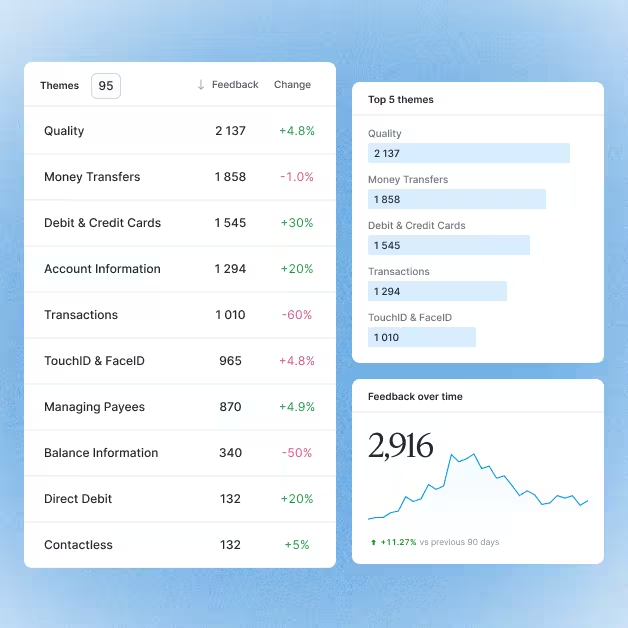
Chattermill closes the four gaps by design rather than by prompt. It unifies feedback from every channel and language into one place, applies AI built for feedback to surface themes, sentiment, and trends, and holds those definitions steady in a governed taxonomy so this cycle is comparable to the last. Because every insight traces back to the verbatims and connects to NPS, CSAT, and CES, the number in the boardroom is one you can defend.
If you are mapping the landscape, start with our pillar on customer feedback analysis, then compare approaches in our overview of AI customer feedback analysis and the wider category of customer feedback analysis tools. When you are ready to see it applied to your data, our customer feedback analytics product is where the workflow lives.
In Practice — How Mindful Chef Boosted NPS and Retention With Feedback Analysis
The shift from ad-hoc reads to a governed platform shows up in outcomes, not slideware. Mindful Chef moved beyond one-off analysis to a consistent, unified view of customer feedback and used it to strengthen both NPS and retention, as told in the Mindful Chef customer story. The lesson travels: when feedback is unified, traceable, and tied to business metrics, it stops being a monthly chore and starts driving the numbers that matter.
Turn Feedback Into a Decision You Can Defend
ChatGPT is a useful place to start reading your customers. It is not where you should decide what to build, fix, or protect. When feedback is unified, consistently structured, fully traceable, and tied to NPS, CSAT, and CES, it stops being a monthly scramble and becomes a durable advantage over competitors who are still copying and pasting. That is the future worth building toward.
Frequently Asked Questions
Can ChatGPT Do Customer Feedback Analysis?
Yes, for a first pass. ChatGPT can summarize a batch of verbatims, apply rough sentiment labels, and suggest themes for a single export. It works well for ad-hoc orientation and poorly as a repeatable, auditable system.
How Accurate Is ChatGPT for Customer Feedback Analysis?
Less than you would want for reporting. A 2026 AIMultiple benchmark found the best of 10 tested models averaged 80% accuracy on sentiment tasks and the lowest hit 72%. Errors concentrate in sarcasm, mixed sentiment, and industry jargon, which is where feedback is most valuable.
Is It Safe to Paste Customer Data Into ChatGPT?
Treat it with caution. Customer feedback is customer data, and general chat tools rarely give you the ownership, retention control, and traceability that compliance now demands. With EU AI Act transparency provisions arriving in August 2026, per Seekr's 2026 analysis, being unable to demonstrate traceability carries real financial risk.
When Should You Move From ChatGPT to a Dedicated Platform?
When feedback starts driving decisions. Once you need recurring reporting, themes that stay comparable over time, numbers that trace to source, and handling of sensitive data at scale, a purpose-built platform earns its place.



See Chattermill in action on your own feedback
Book a demo


