


Chattermill vs Caplena: Feedback Analytics Platforms Compared



The CX intelligence
platform that's AI-native by design
Book a demoMost CX teams start their search for a feedback analytics platform with a simple question: do we need deep analyst control over how feedback is coded, or do we need a system that processes millions of data points across every channel without manual intervention? Chattermill and Caplena answer that question differently. This guide compares both platforms across features, pricing, integrations, review ratings, and ideal use cases so you can make the right call for your team.
Quick Summary
- Analytical approach: Chattermill uses AI-native, aspect-based sentiment analysis across unified feedback channels. Caplena combines LLM-based coding with analyst-managed codebooks and confidence scoring.
- Scale: Chattermill connects to 90+ native integrations including CRM, support, and survey tools. Caplena offers 15+ integrations focused on survey and review platforms (per caplena.com).
- Unique to Caplena: Codebook management with interactive retraining, Smart Columns for LLM-powered data enrichment, SPSS import, and a dedicated agency pricing tier for market research firms.
- Unique to Chattermill: Speech Analytics, Social CX Analytics, MCP server for AI agent integration, automated anomaly detection and alerting, and close-the-loop feedback response workflows.
- Reviews: Chattermill holds 355 total reviews across G2 (4.4/5), Capterra (4.5/5), and Gartner Peer Insights (4.5/5). Caplena has 55 total reviews across G2 (4.5/5) and Capterra (5.0/5) but is not listed on Gartner.
- Pricing: Chattermill offers monthly credit plans starting at 10,000 credits on Pro and 30,000 on Team (see plans). Caplena uses annual credit quotas with Team, Enterprise, and Agency tiers — no published dollar pricing.
- Best for Chattermill: Enterprise CX, insights, and product teams that need omnichannel feedback unification, real-time alerting, and direct integration into AI agent workflows.
- Best for Caplena: Mid-sized research and CX teams that value codebook transparency, analyst control over coding, and project-based text analysis.
Why Listen to Us
Chattermill processes customer feedback at scale for enterprise organizations including HelloFresh, Booking.com, Amazon, Uber, and H&M. With 355 verified reviews across G2, Capterra, and Gartner, the platform has been pressure-tested across industries that generate millions of feedback data points monthly. That operational depth shapes the comparison that follows — we know what matters when feedback volume, channel diversity, and speed of insight actually have to work together.
What Is Caplena?
Caplena is a Zurich-based AI text analytics platform that transforms unstructured customer and employee feedback into structured insights. Founded in 2018, the platform combines in-house NLP with third-party LLMs to automate the coding of open-ended survey responses, reviews, and support tickets. Its core value proposition centers on giving analysts direct control over how AI categorises their data.
The platform serves CX teams, market research agencies, and HR departments at mid-sized and enterprise organisations. Notable customers include FlixBus, DHL, Kia, Lufthansa, Beiersdorf, Swisscom, MediaMarkt, and IKEA. Caplena has a particularly strong footprint in the European market research sector, where codebook-driven text analysis remains standard practice.
Key capabilities include LLM-based topic assignment with confidence scoring, Smart Columns for data enrichment, Insight Chat (a third-generation AI research assistant), driver and correlation analysis with significance testing, and support for 100+ languages (per caplena.com). The platform also holds SOC 2 Type II certification and offers EU-based hosting — a meaningful differentiator for organisations with strict data residency requirements.
How Does Caplena Compare to Chattermill?
The core distinction comes down to methodology. Caplena is built for analysts who want to control the coding process — defining codebooks, reviewing confidence scores, retraining the model on corrections. Chattermill is built for organisations that need to unify feedback from every channel and surface actionable insights automatically, without requiring manual codebook management.
Both platforms use AI to analyse unstructured text. But when your feedback spans surveys, support tickets, call transcripts, app reviews, and social media — and your team needs real-time alerts, not monthly reports — the architectural differences start to matter. Which approach matches how your team actually works?
Head-to-Head Comparison Table: Chattermill vs Caplena
| Dimension | Chattermill | Caplena |
|---|---|---|
| Core Strength | Omnichannel feedback unification with AI-native sentiment analysis | Analyst-controlled text coding with codebook management |
| Native Integrations | 90+ across CRM, support, surveys, social, and app stores | 15+ (per caplena.com) focused on survey platforms, review sites, and BI tools |
| Multilingual Support | 100+ languages natively | 100+ languages natively (per caplena.com), plus DeepL and Google Translate |
| Sentiment Analysis | Aspect-based, tied to NPS, CSAT, and CES | Confidence-scored with analyst retraining |
| Feedback Response / Close-the-Loop | Automated workflows trigger actions from feedback signals | Not a core capability |
| Speech Analytics | Dedicated product for call centre and voice data | Not available — text only |
| Social CX Analytics | Dedicated product for social media feedback | Not available |
| AI Agent Integration | MCP server for querying feedback inside AI agents | REST API + Python library — no MCP server |
| G2 Rating / Reviews | ||
| Notable Customers | HelloFresh, Booking.com, Amazon, Uber, H&M | FlixBus, DHL, Kia, Lufthansa, IKEA |
| Best For | Enterprise CX teams needing real-time, omnichannel feedback intelligence | Research and CX teams needing codebook transparency and analyst control |
| Pricing | Monthly credit plans from 10,000 credits (see plans) | Annual credit quotas — custom pricing |
Chattermill Review
Overview
Chattermill is an AI-native feedback analytics platform designed to unify customer feedback from every channel into a single source of truth. Rather than requiring analysts to build and maintain codebooks, Chattermill's AI automatically identifies themes, tracks sentiment at the aspect level, and surfaces anomalies that need attention — all connected to the business metrics that CX leaders actually report on.
The platform's architecture reflects a specific design philosophy: feedback analysis should be continuous, not project-based. Chattermill connects directly to CRM systems, support tools, survey platforms, app stores, and social channels through its 90+ native integrations. When a feedback signal shifts — a sudden spike in negative sentiment about delivery times, for example — the system can trigger automated alerts and route insights to the right team.
What separates Chattermill from most feedback analytics tools is its investment in capabilities beyond text analysis. Speech Analytics processes call centre data alongside written feedback. Social CX Analytics pulls insights from social media conversations. And the MCP server lets teams query customer feedback data directly inside AI agents — a capability that positions the platform for the agentic era of CX operations.
Chattermill Features
- Aspect-based sentiment analysis: Goes beyond positive/negative to identify sentiment tied to specific product features, service interactions, and journey stages.
- 90+ native integrations: Connects to CRM, support, survey, app store, and social platforms without custom development (view integrations).
- Speech Analytics: Analyses call centre recordings and voice data alongside written feedback (learn more).
- Social CX Analytics: Monitors and analyses customer sentiment from social media channels (learn more).
- MCP server: Enables AI agents to query and act on customer feedback data programmatically (learn more).
- Automated alerting and anomaly detection: Surfaces unexpected shifts in feedback patterns and routes them to the right teams (learn more).
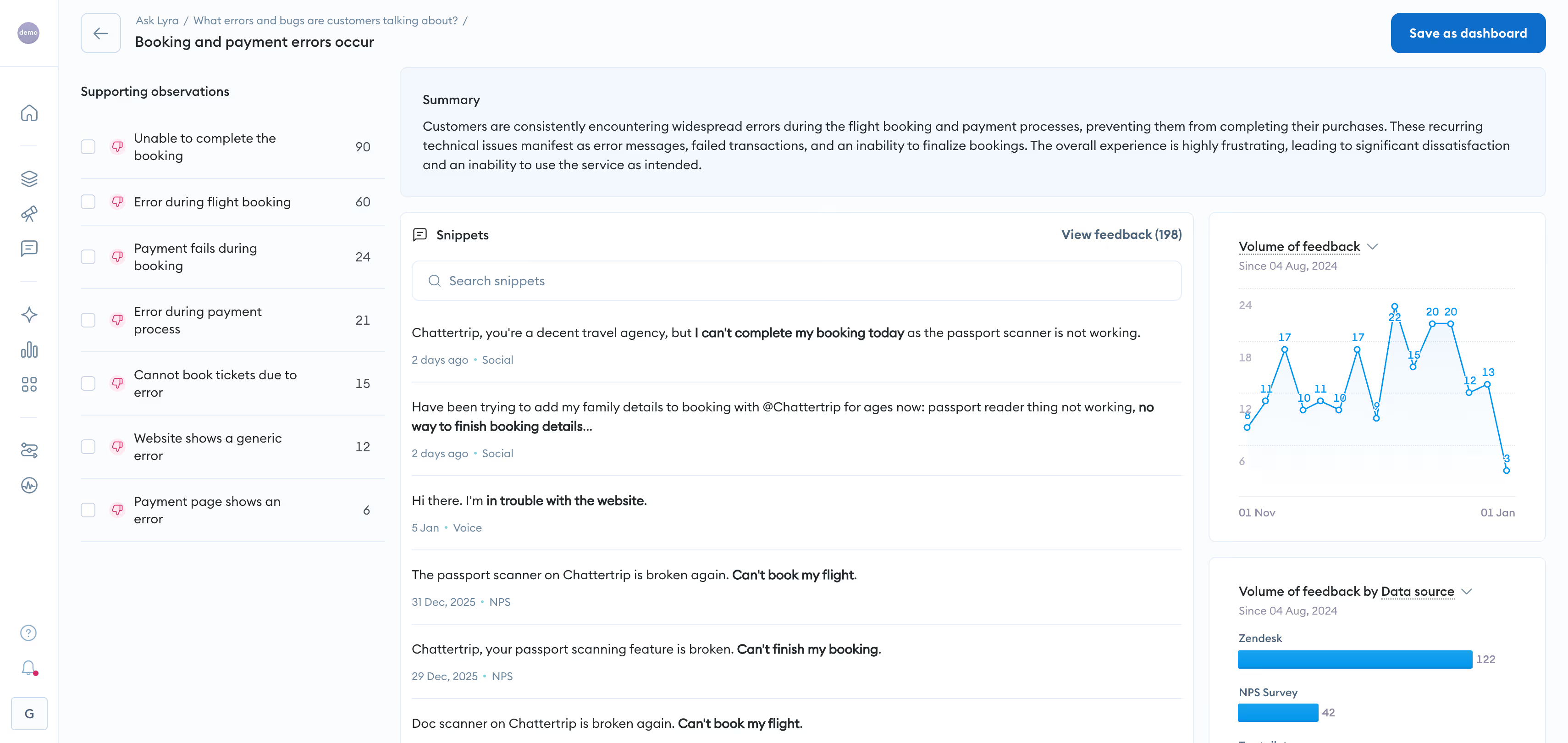
- Ask Lyra AI assistant: Natural-language interface for querying feedback data and generating reports.
- Role-based dashboards: Tailored views for CX, product, and executive teams.
2026 Pricing
Chattermill offers monthly credit plans starting at 10,000 credits on Pro and 30,000 on Team — view current plans and pricing.
Chattermill Pros
- Broadest integration library in the category with 90+ native connectors
- Unified analysis across text, voice, and social channels in a single platform
- MCP server opens feedback data to the growing ecosystem of AI agents
- Real-time automated alerting catches issues before they escalate
- 100+ languages supported natively without relying on third-party translation
- Enterprise-validated by organisations processing millions of feedback data points monthly
Chattermill Cons
- Less granular analyst control over coding than codebook-driven platforms — not designed for teams that want to manually define and retrain classification models
- Pricing is credit-based with monthly caps, which may not suit organisations with irregular feedback volumes
- Primarily oriented toward continuous CX monitoring rather than ad-hoc research projects
Who It's For
Enterprise CX, insights, and product teams that need to unify feedback from every channel, detect issues in real time, and connect customer insights directly to business metrics like NPS, CSAT, and CES.
Review Ratings
Chattermill holds a 4.4 out of 5 on G2 based on 237 reviews, a 4.5 out of 5 on Capterra based on 25 reviews, and a 4.5 out of 5 on Gartner Peer Insights based on 93 reviews. That totals 355 verified reviews across three independent platforms — one of the larger review footprints in the feedback analytics category.
Caplena Review
Overview
Caplena is built for teams that want to stay close to their data. The platform's analyst-controlled approach means that every AI-generated code assignment comes with a confidence score, and analysts can review, correct, and retrain the model on their own terms. For market research teams accustomed to working with codebooks, this mirrors their existing workflow — but with AI handling the heavy lifting.
The platform's Smart Columns feature is a genuine differentiator: it uses LLMs to enrich feedback data by extracting entities, mapping custom codes, and generating formula-based fields. This goes beyond classification into structured data transformation — useful for teams building complex analytical frameworks from unstructured text.
Caplena also serves employee experience (EX) teams, a segment that most CX-focused platforms don't address directly. Combined with its agency pricing tier and SPSS import support, the platform carves out a clear position in the market research and insights consultancy space.
Caplena Features
- Codebook management: Import, reuse, merge, split, and create codebooks with prompt-guided assistance and MECE enforcement.
- Confidence scoring: Every coded response carries a quality score. Corrections retrain the model automatically.
- Smart Columns: LLM-powered data enrichment that extracts entities, maps codes, and applies formula fields across feedback data.
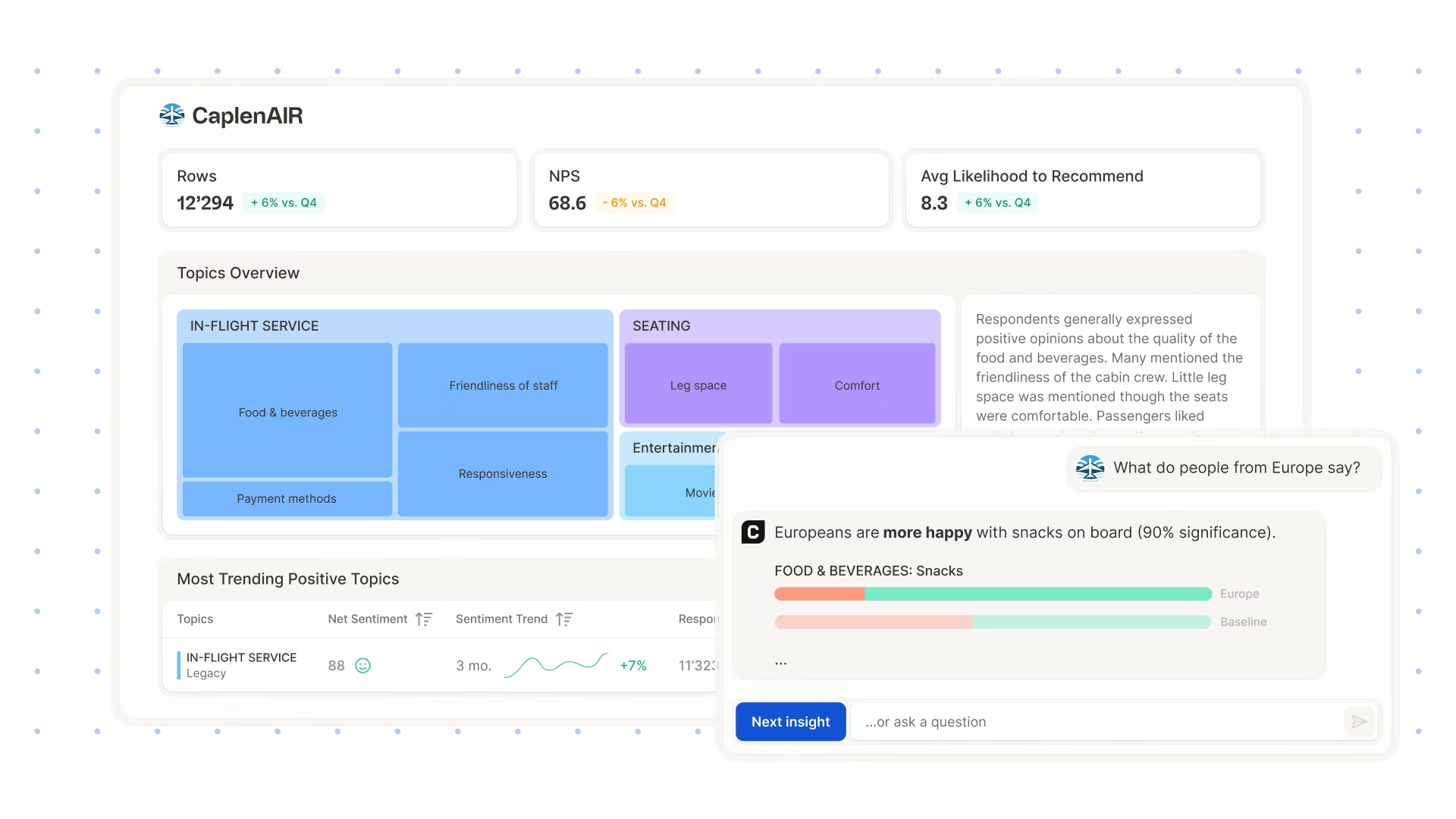
- Insight Chat (3rd generation): AI research assistant that answers complex analytical questions and generates charts automatically.
- Driver and correlation analysis: Statistical significance testing built into the analysis workflow.
- SPSS import: Direct import from SPSS files alongside CSV and Excel — a requirement for many research teams.
- 15+ integrations (per caplena.com): Connects to Qualtrics, Medallia, Google Maps, App Store, Zendesk, and Power BI.
2026 Pricing
Caplena uses annual credit quotas across three tiers — Team (up to 50k credits/year), Enterprise (50k+ credits/year), and Agency (20k+ credits/year) — with custom pricing based on volume.
Caplena Pros
- Codebook transparency and analyst control over AI classifications — rare in the category
- Smart Columns offer genuine data enrichment beyond standard text analysis
- SOC 2 Type II certified with EU-based hosting and GDPR compliance
- Strong fit for market research agencies and teams that use SPSS workflows
- Insight Chat provides a capable AI assistant for complex analytical questions
Caplena Cons
- Limited to 15+ integrations (per caplena.com) — significantly fewer native connectors than enterprise-scale platforms
- No speech analytics or social CX analytics capabilities — text-only analysis
- No MCP server or equivalent for AI agent integration
- Smaller review footprint (55 total reviews) makes it harder to validate across diverse use cases
- Annual credit quotas may create budgeting complexity for teams with unpredictable feedback volumes
- Smaller company with less public information about funding and growth trajectory — a consideration for teams evaluating long-term platform stability
Who It's For
Mid-sized CX teams, market research agencies, and insights consultancies that need analyst-controlled text analysis with codebook management, confidence scoring, and SPSS workflow compatibility.
Review Ratings
Caplena holds a 4.5 out of 5 on G2 based on 48 reviews and a 5.0 out of 5 on Capterra based on 7 reviews. The platform is not currently listed on Gartner Peer Insights. With 55 total reviews, the sample size is relatively small — the high Capterra score, for example, is based on just 7 reviews.
Who Should Use Caplena?
Caplena is the stronger choice if your team's workflow depends on direct control over how feedback data is classified and coded. Specifically, consider Caplena if:
- Your team manages codebooks as a core part of the analysis process. Caplena's codebook management — with import, merge, split, and MECE enforcement — mirrors traditional research workflows.
- Analyst transparency is a hard requirement. Confidence scoring on every coded response and interactive model retraining give analysts visibility into how the AI is making decisions.
- You need LLM-powered data enrichment. Smart Columns go beyond classification to extract entities, map codes, and generate computed fields.
- Your projects are ad-hoc rather than continuous. Caplena's annual credit quotas and project-based structure suit teams that run periodic studies rather than always-on monitoring.
- You work in market research or insights consultancy. The dedicated Agency tier, SPSS import, and codebook-first approach are built for this segment.
- EU data residency is non-negotiable. SOC 2 Type II certification and EU-based hosting address strict compliance requirements.
For teams that need continuous, omnichannel feedback monitoring at enterprise scale, Caplena's project-based architecture may feel limiting. But for research-driven organisations that value analyst control, it delivers a workflow that most competing platforms don't offer.
Who Should Use Chattermill?
Chattermill is built for organisations where customer feedback arrives continuously from dozens of channels — and where the speed and breadth of insight directly affect business outcomes. Consider Chattermill if:
- You need to unify feedback across every channel. With 90+ native integrations, Chattermill connects CRM, support, surveys, app stores, and social platforms into a single analytical view. Organisations like HelloFresh and Booking.com use this to consolidate feedback at scale.
- Real-time alerting matters to your team. Automated anomaly detection surfaces issues as they emerge — not days later in a quarterly report.
- You analyse voice and social alongside text. Speech Analytics and Social CX Analytics mean call centre data and social media conversations are analysed in the same system as surveys and support tickets.
- Your team is building AI agent workflows. Chattermill's MCP server lets AI agents query customer feedback data directly — a capability that positions your CX function for the agentic era.
- You report on NPS, CSAT, or CES at the executive level. Aspect-based sentiment analysis tied directly to these business metrics means insights translate into the language leadership already uses.
- Enterprise validation matters. With 355 reviews across G2, Capterra, and Gartner, plus customers like Amazon, Uber, and H&M, the platform's track record is well-documented.
- You operate in 100+ languages. Chattermill analyses feedback natively in over 100 languages without relying on third-party translation services.
For teams that need a comprehensive voice of the customer platform — one that connects feedback intelligence to action — Chattermill delivers the integration depth, analytical breadth, and automation that enterprise CX operations require.
Choosing the Right Feedback Analytics Platform
Picking between Chattermill and Caplena is less about which platform is "better" and more about which architecture matches your team's reality. Here is what to evaluate:
Feedback Volume and Channels. How many feedback sources does your team need to connect? If you're pulling data from CRM, support tickets, surveys, app reviews, call recordings, and social media, you need a platform with broad native integration coverage. Chattermill's 90+ connectors handle this without custom development. Caplena's 15+ integrations (per caplena.com) cover survey and review platforms well but may require API work for other channels.
Language Requirements. Both platforms support 100+ languages. The difference is in approach — Chattermill analyses natively while Caplena supplements native analysis with DeepL and Google Translate. For organisations processing feedback in dozens of languages simultaneously, test both approaches against your actual data.
Analysis Depth. Do your analysts need to control the coding process, or do they need to act on insights quickly? Caplena's codebook management and confidence scoring give research teams granular control. Chattermill's automated theme detection and aspect-based sentiment analysis prioritise speed and coverage across large datasets.
Team Structure. Caplena fits teams with dedicated research analysts who manage codebooks and run project-based studies. Chattermill fits CX, product, and insights teams that need always-on monitoring and role-based dashboards across multiple stakeholders.
Automation Goals. If your roadmap includes automated alerting, close-the-loop workflows, or AI agent integration, evaluate whether the platform supports these natively. Chattermill offers all three. Caplena focuses on the analysis layer and relies on API integrations for downstream automation.
Enterprise Validation. Review volume matters because it reflects the breadth of real-world use cases documented by verified users. Chattermill's 355 reviews across three platforms provide a larger validation dataset than Caplena's 55 reviews across two platforms.
Security and Compliance. Both platforms take security seriously. Caplena holds SOC 2 Type II certification and offers EU-based hosting. Evaluate both platforms against your organisation's specific compliance requirements, data residency policies, and procurement standards.
Implementation and Onboarding. Consider how quickly each platform can be deployed and how much internal effort is required. Chattermill offers guided implementation with dedicated customer success for enterprise accounts. Caplena provides live training and professional services hours bundled into its Enterprise and Agency tiers. Ask both vendors about time-to-value for your specific use case during the evaluation process.
Get Started With Chattermill
If your team needs a feedback analytics platform that unifies every channel, detects issues in real time, and connects customer insights directly to the business metrics that matter — Chattermill is built for that.
See how it works with your data. Book a Demo and explore how teams like HelloFresh, Booking.com, and Uber use Chattermill to turn customer feedback into measurable business outcomes.
Feedback Analytics Platforms: FAQs
What Is the Main Difference Between Chattermill and Caplena?
Chattermill is an AI-native, omnichannel feedback analytics platform that unifies data from 90+ sources and delivers automated alerts, speech analytics, and social CX analytics. Caplena is an analyst-controlled text analysis platform built around codebook management, confidence scoring, and interactive model retraining. Chattermill prioritises continuous monitoring and real-time action; Caplena prioritises research-grade transparency and analyst control over coding (compare features).
Is Caplena Good for Enterprise Teams?
Caplena serves enterprise customers including DHL, Lufthansa, and IKEA, and holds SOC 2 Type II certification with EU-based hosting. However, its 15+ native integrations and text-only analysis may limit enterprise teams that need omnichannel coverage, speech analytics, or social CX analytics. Enterprises processing feedback from dozens of channels at scale should evaluate integration depth carefully before committing.
How Do Chattermill and Caplena Compare on Pricing?
Chattermill uses monthly credit plans starting at 10,000 credits on Pro and 30,000 on Team — see current plans. Caplena uses annual credit quotas across Team (up to 50k credits/year), Enterprise (50k+/year), and Agency (20k+/year) tiers with custom pricing. Neither platform publishes fixed dollar pricing, so request quotes from both to compare costs against your specific feedback volume.
Can Caplena Replace a Full Voice of the Customer Platform?
Caplena is a text analysis platform, not a full VoC platform. It lacks native speech analytics, social CX analytics, close-the-loop workflows, and an MCP server for AI agent integration — capabilities that platforms like Chattermill include natively. If your VoC strategy requires unifying feedback across surveys, calls, social media, and support tickets with real-time alerting, Caplena would need to be supplemented with additional tools (learn about VoC analysis).
What Are the G2, Capterra, and Gartner Ratings for Chattermill and Caplena?
Chattermill holds 4.4/5 on G2 (237 reviews), 4.5/5 on Capterra (25 reviews), and 4.5/5 on Gartner Peer Insights (93 reviews) — 355 total reviews. Caplena holds 4.5/5 on G2 (48 reviews) and 5.0/5 on Capterra (7 reviews) — 55 total reviews. Caplena is not listed on Gartner Peer Insights.
What Features Does Chattermill Have That Caplena Does Not?
Chattermill offers Speech Analytics for call centre data, Social CX Analytics for social media, an MCP server for AI agent integration, automated anomaly detection and alerting, close-the-loop feedback response workflows, and 90+ native integrations. Caplena offers codebook management with confidence scoring, Smart Columns for LLM data enrichment, SPSS import, and a dedicated Agency pricing tier — features Chattermill does not include.



See Chattermill in action on your own feedback
Book a demo


