


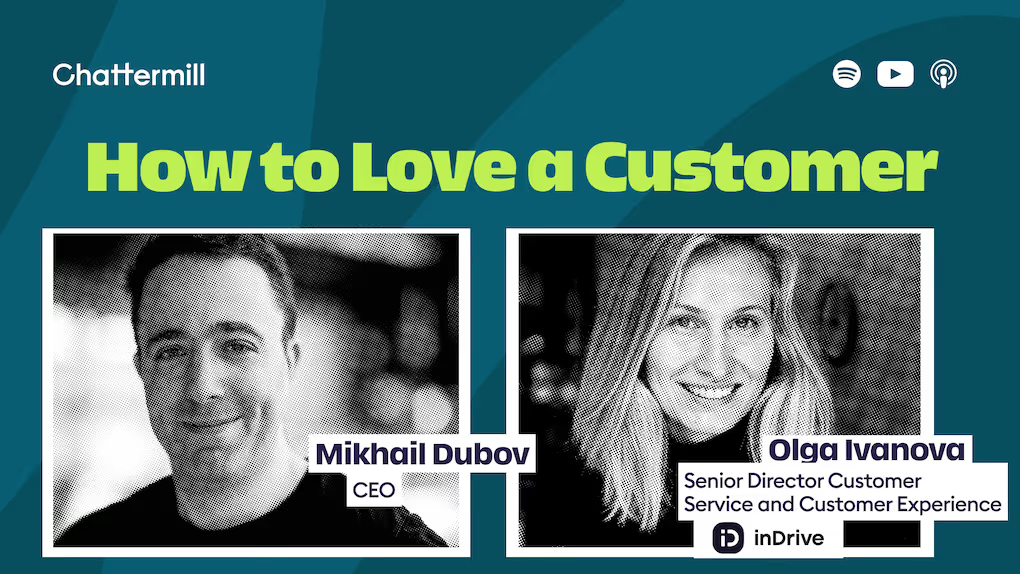
How To Love A Customer: Episode 16 with Olga Ivanova from inDrive


The CX intelligence
platform that's AI-native by design
Book a demoThe best customer support interaction is the one that never happens.
That's the philosophy Olga Ivanova, Senior Director of Customer Experience at inDrive, brings to this episode - and it's one she's earned across eight years and five different ride-hailing markets.
inDrive isn't a name most people outside the industry would recognise, but it probably should be. It's the second-most-downloaded ride-hailing app in the world, operating in 48 markets across Latin America, MENA, and beyond. And it was born not from a VC pitch deck, but from a Facebook group in Yakutia, Russia - where taxi drivers were hiking prices in minus 42-degree weather and ordinary people decided to fight back.
In this episode, our CEO & Co-Founder Mikhail Dubov sits down with Olga Ivanova to explore how that founding DNA - built on fairness - shapes every CX decision inDrive makes today.
👉 Subscribe & listen to the latest episode here
🔑 Key Takeaways from the Episode
1. The Best CX Is the Kind No One Notices
Olga Ivanova's framing of ride-hailing CX is deliberately different from most of what you'll hear on this show. In hospitality or retail, proactive delight can build a brand. In ride-hailing, customers aren't seeking an experience - they're seeking a result.
"You don't wanna notice. You go somewhere for the customer experience - here, you actually go for speed, for convenience, for prices, for smooth running transactions. The less friction you have there, the better." - Olga Ivanova
That means the goal isn't memorable moments. It's invisible infrastructure. Get people from A to B, charge them fairly, and stay out of the way.
2. The Two-Sided Conflict Problem - and How AI Helps Solve It
Every two-sided marketplace has this problem: when something goes wrong, both sides have a story. And your support agent wasn't there.
At inDrive, this gets particularly thorny because many markets run on cash. A rider who skipped payment might file a misconduct complaint to deflect blame. A driver who genuinely misbehaved will tell a different version of events. Your agent - possibly in a different country - has to decide who's right.
"As a customer support agent, you can't fully believe neither driver nor rider. You have to be fair, but people are subjective, and we are putting them in a very difficult situation to decide who's right and who's wrong." - Olga Ivanova
inDrive's answer was to take that decision out of the agent's hands entirely. They built a model - now LLM-assisted - with seven weighted factors: what each party said, ratings history, number of rides, previous complaints, and more. The agent inputs the narrative. The model outputs a recommended action.
The measure of success? Repeated behaviour. If the metric trends toward zero, it's working.
3. Protecting Agents by Removing the Hardest Judgements
One insight from Olga Ivanova that doesn't get talked about enough: putting agents in the role of judge isn't just operationally risky - it's genuinely unfair to them.
"We are protecting our agents with taking off this responsibility to decide." - Olga Ivanova
Scripts and decision frameworks aren't a way to deskill support. In Olga Ivanova's view, they're what makes it possible to be consistent across 48 markets, dozens of languages, and thousands of daily interactions. Without them, every agent is effectively improvising - and improvisation isn't fairness.
4. The Carpet of Automation
This might be the sharpest thing Olga Ivanova said in the episode - and it has implications for every CX team investing in AI.
When you automate customer contacts, the problem doesn't go away. It goes quiet. If you're not tracking what's getting resolved through automation alongside everything else, you end up in what she calls "the carpet principle" - you've covered the problem, so it stops feeling urgent. Meanwhile, customers are quietly leaving.
"If you automate and never look at what people are writing - which topics you're solving with automated solutions - it's like a carpet principle. You covered the problem with a carpet of automation. It's not a problem anymore. But people are quietly leaving in some cases." - Olga Ivanova
Her approach: inDrive looks at all contact reasons, automated or not. A problem resolved in one second is still a problem - if it keeps happening.
5. Fairness as Infrastructure, Not Values Deck
inDrive started with a single idea: taxi pricing was unjust, and people deserved a choice. That mission has stayed remarkably intact. Riders and drivers still set their own prices through a bidding model. Drivers can see where a ride is going before accepting. No surge pricing.
"This fairness thing really runs through all the processes in inDrive - all the decisions, all the scripts. It's not just a value you put on the wall. The company actually builds business processes rooted into the core values of the business model." - Olga Ivanova
That's an unusual claim. What makes it credible is that you can see it in the product mechanics: no forced routes, no algorithmic price manipulation, transparency about what causes what consequences. The values and the systems are the same thing.
💡 CX Trend She'd Retire: "Delight the Customer"
Olga Ivanova's hot take is worth sitting with. She's not saying delight is never right - she acknowledges it might be exactly right in luxury. But she's seen too many companies chase delight before they've nailed consistency.
"Companies who claim they delight the customer sometimes can't even deliver consistency. It should not be about the delight. It should be about consistency and giving people what they expect to receive." - Olga Ivanova
The logic holds especially in functional categories. If you've set an expectation and you can't reliably meet it, a surprise gift is just a reminder of how often you fall short.
💬 The Spotify Story
For anyone who wants a masterclass in what systems failure looks like from a customer's perspective - Olga Ivanova spent most of an evening trying to merge two Spotify accounts she'd accidentally created, ran parallel support chats that couldn't verify each other, provided bank statements as proof of ownership, and still couldn't get it resolved. An hour in, the support agent finally suggested she just cancel her premium and pay again.
The diagnosis from someone who builds support systems for a living: "The systems don't talk to each other. Even within one CRM."
🧳 Why This Episode Matters
The ride-hailing context makes this episode feel specific, but the problems Olga Ivanova's solving are everywhere: how do you stay consistent across markets with wildly different cultural norms? How do you build fairness into decisions when you can't verify the facts? How do you use automation without losing visibility into what's actually going wrong?
The answers she's arrived at - decision frameworks over intuition, transparency over discretion, tracking contact reasons whether automated or not - are transferable to any operation at scale.
🎧 Listen to How to Love a Customer
👉 Catch the latest episode here
Episode Notes:
00:00 - Meet Olga Ivanova, Senior Director of CX at inDriveHow a management degree led, accidentally, into eight years of ride-hailing customer experience across five markets.
01:15 - What Is inDrive?The origin story: a Facebook group in Yakutia, Russia, where passengers fought back against surge pricing in minus-42-degree weather - and a company built on that fairness mission ever since.
04:15 - What Makes inDrive DifferentA bidding platform where riders and drivers negotiate prices - no algorithmic surge, no forced routing. Second-most-downloaded ride-hailing app in the world.
06:15 - The CX Paradox in Ride-HailingWhy the best customer experience in this category is invisible. Speed, convenience, price - not delight.
08:00 - The Core Story: When Driver and Rider Tell Opposite StoriesCash payments, disputed rides, and the near-impossible position this puts support agents in.
13:00 - Building an AI-Assisted Conflict Resolution ModelHow inDrive built a seven-factor LLM model to remove the burden of judgement from agents - and how they measure whether it's working.
17:00 - Balancing Fairness Across a Two-Sided MarketplaceWhy unfair treatment of drivers means no drivers - and how that shapes every policy decision.
20:45 - Human + AI: How inDrive Splits the WorkThe philosophy: automate everything where a human adds no value; protect the human touch where it matters. Scripts aren't deskilling - they're consistency.
23:15 - The Carpet of AutomationWhy automating support contacts without tracking contact reasons means hiding product problems from the teams who need to fix them.
25:30 - Working With Product on PrioritisationROI framing, low-hanging fruit, and how the CX team makes the case for fixes.
26:30 - inDrive's Fairness CultureHow a founding principle becomes operational reality - in scripts, blocking rules, and pricing mechanics.
29:00 - Hot TakesThe CX trend she'd retire (delight), the brand she admires (Amazon - for consistency, not delight), and what ride-hailing still gets wrong about complaint accessibility.
40:30 - The Spotify StoryA cautionary tale about what systems failure looks like when your CRMs don't talk to each other.
44:15 - A Brand That Gets It RightOura Ring: the battery still dies, but recovery is so fast and smooth it barely registers.


See Chattermill in action on your own feedback
Book a demo


