


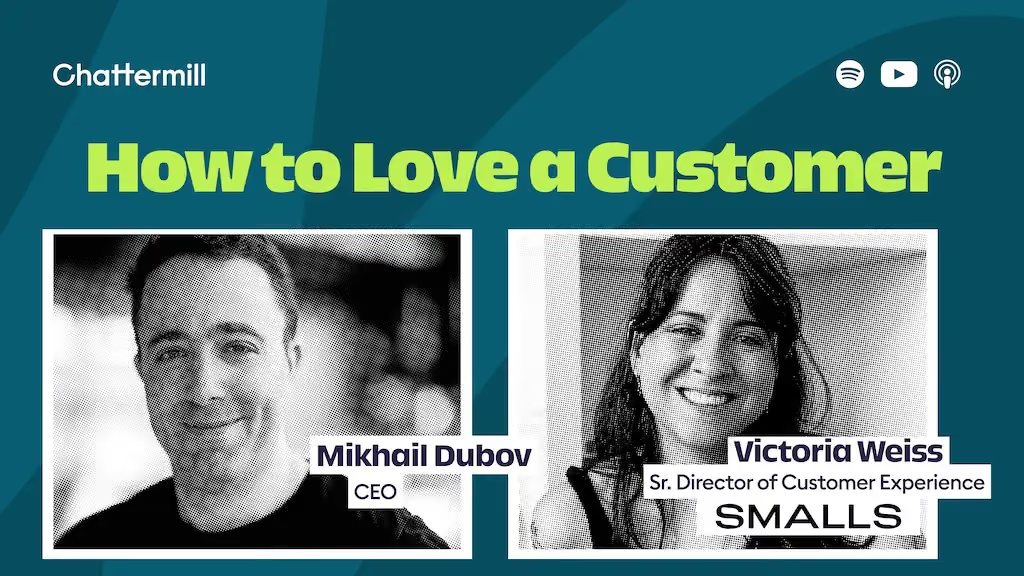
How To Love A Customer: Episode 16 with Victoria Weiss from Smalls


The CX intelligence
platform that's AI-native by design
Book a demoA customer named Jill loved her food. It just kept showing up warm.
That's the story Victoria Weiss, Senior Director of Customer Experience at Smalls, brings to our latest episode of How to Love a Customer. What looks like a simple delivery complaint turned into a company-wide effort to fix a problem that was quietly costing the business subscribers.
In this episode, our CEO and Co-Founder Mikhail Dubov sits down with Victoria to talk through a decade in DTC customer experience, from agent work at Rent the Runway to leading CX at Daily Harvest, Little Spoon, and now Smalls, the brand building food, toys, and a community for cats and the people who love them.
👉 Subscribe & listen to the latest episode here
🔑 Key Takeaways from the Episode
1. One escalated customer is usually a signal, not an outlier
Jill had been through several layers of escalation before Victoria got on a call with her. She was a loyal customer, ordering roughly every week, and her frozen product kept arriving warm. Most companies would have written her off as a difficult customer and moved on.
Victoria did the opposite. She fixed Jill's immediate problem (DoorDashing product to her in New York), then asked the harder question: how many other people are hitting this exact issue?
"My hunch was, like, people are canceling their subscription with us, not because they don't want the food, but because we can't successfully deliver it to them." — Victoria Weiss
That hunch is the whole point. A warm-food complaint reads like a one-off. A pattern of warm-food complaints in one city reads like churn.
2. Whatever one customer is experiencing, others probably are too
The mental shift Victoria describes is treating every conversation as a sample, not a single event. If Jill can't get her order delivered cold in New York, how many other New York customers are in the same spot and just haven't called?
"This is probably impacting more than just Jill, and, like, it's probably a much larger issue." — Victoria Weiss
That lens is what separates incremental improvement from firefighting. You look at the individual case, then go find the scope.
3. You need data before leadership will act, and you have to get scrappy to find it
Victoria learned early that walking into a room and saying "a lot of customers are mad about this" gets you nowhere.
"If I say, 'This is a problem,' and 'So many people are mad about it,' no one's gonna listen. They're gonna be like, 'Okay, CX person, sure.'" — Victoria Weiss
So she builds the case herself. For the warm-food problem, that meant defining what actually counts as a pattern: is it three incidents in three months? Three back-to-back? She didn't wait for the analytics team either. She learned the systems and dug into the data on her own, then brought both the numbers and the customer stories to the table.
That combination matters. As Mikhail pointed out in the episode, people don't trust a CX leader's gut, but they also don't trust a clean percentage with no real complaints behind it. You need both.
4. Empower agents to make the call, even when it costs money
When Victoria builds a team, she pushes decision-making down to the front line. The alternative, handing agents a stack of macros and a policy they'll be punished for breaking, doesn't work.
"You need to empower your agents to make the right decision even if it, like, potentially could cost more money. As long as they're able to justify the decision, then I think that's the right way to go." — Victoria Weiss
Her bet: a trusted team comes up with creative fixes a manager never would have scripted. And closing the loop matters as much as the fix. When agents share feedback, she makes sure it actually reaches other teams, so they can see it was taken seriously.
5. CX is still fighting to not be treated as a cost center
This is the through-line of Victoria's career. In DTC, support is one of the few real differentiators, and getting it wrong erodes the trust a brand spent years building.
"We need to invest in CX in a way that is more than a cost center. It really is investing in one-on-one relationships with customers." — Victoria Weiss
She's quick to note the trailing-metric problem: the payoff from a proactive campaign might show up six months later as higher LTV in a specific cohort. That delay is exactly why CX leaders have to keep proving the value, even after they've earned the trust to build.
🤖 AI in CX: useful, but never set-and-forget
Victoria's position is direct: use AI or fall behind. Smalls runs a chatbot, but carefully.
She starts with the safe, high-volume stuff, "where is my order" questions, then layers in complexity only after heavy testing. The rule she won't bend on:
"Customers can always get in touch with a human no matter what, at any point. That is, like, non-negotiable." — Victoria Weiss
The other place AI earns its keep is voice of customer. Work that used to eat hours of digging through conversations now takes minutes, which frees her up to actually analyze the patterns instead of just finding them.
💬 Bonus Hot Takes
🎯 Buzzword that should retire: "Tickets." Victoria hates it, because it reduces a conversation to a number to clear.
🧠 Brand doing it right: Bombas. An AI flow let her cancel an impulse order instantly, and now she'll buy from them without hesitation.
🔥 Industry blind spot: Too much of DTC still sees CX as a cost center and a problem-solving function. It's more than that.
📱 Brand that fell short: Amazon. Wrote the book on customer service, then turned the experience into deflection.
🧳 Why This Episode Matters
Victoria's Jill story is a clean template for how CX should work: catch the individual problem, treat it as a signal, quantify the scope, and rally the right teams to fix it before more customers churn.
For any CX leader in a subscription or DTC business, the practical lessons stack up fast: listen to the escalations no one else wants, bring data and stories together, trust your agents, and keep proving CX is a growth function, not a line item.
🎧 Listen to How to Love a Customer
If you work in CX, Product, UX, or Insights, this podcast is for you, filled with real customer stories, practical frameworks, and lessons you can apply tomorrow.
👉 Catch the latest episode here
Episode Notes:
00:00 — Meet Victoria Weiss, Senior Director of CX at SmallsA decade in CX, from art school to a CX agent role at Rent the Runway to leading teams in DTC.
02:45 — Inside SmallsBuilding a brand for cats and their people, and taking the CX team to the next strategic level: proactive support, loyalty, and retention at scale.
04:30 — Why CX is the differentiator in DTCHigh customer expectations, the trust you lose when support fails, and the Amazon-set delivery bar that's hard to meet with a subscription food product.
07:30 — Proving CX drives the bottom lineBuilding a voice of customer program, running proactive campaigns, and the trailing-metric problem that makes CX value hard to show fast.
10:15 — The Jill storyA loyal customer's frozen food kept arriving warm. One call turned into a cross-functional work stream across operations, digital product, and CX.
14:30 — Why this customer got helped instead of ignoredCulture, process, and the lens that one customer's problem is probably a much larger one.
16:00 — Getting scrappy with dataDefining what counts as a pattern, not waiting on the analytics team, and bringing both numbers and stories to leadership.
18:00 — Building the team and cultureElevating agents, empowering them to make costly-but-right calls, and closing the loop on their feedback.
20:45 — AI in CXA tiered rollout starting with WISMO, why human contact stays non-negotiable, and the voice-of-customer time savings.
24:15 — Expanding beyond DTC into retailKeeping the experience cohesive across channels and creating hybrid "super customers."
26:00 — Advice for a new CX leaderDon't be afraid to share feedback and build cross-functional relationships.
27:30 — Hot take roundTickets, Bombas, the cost-center problem, and Amazon.



See Chattermill in action on your own feedback
Book a demo


