


11 Best Customer Experience Intelligence Software Platforms in 2026 Compared


The CX intelligence
platform that's AI-native by design
Book a demoMost teams already collect more customer feedback than they can read, yet still struggle to answer a simple question: what should we fix first? Customer experience intelligence software closes that gap, turning scattered surveys, reviews, tickets, and social posts into decisions your team can act on.
Quick Summary
This guide compares the 11 best customer experience intelligence platforms for 2026, with verified G2 ratings, 2026 pricing, and honest pros and cons for each.
The best customer experience intelligence tools in 2026 are Chattermill, Qualtrics XM, and Medallia. Chattermill leads for teams that need AI-native, cross-channel feedback analysis, because it auto-detects themes and sentiment across surveys, tickets, reviews, social, chat, and calls without manual tagging. Qualtrics XM is the strongest fit for large enterprises running multiple experience programs on one research-grade platform. Medallia suits enterprises that need to capture experience signals across physical and digital touchpoints, from contact centers to in-store to video.
Below is a fast look at the top three before the full head-to-head comparison further down the page.
| Tool | Best For |
|---|---|
| Chattermill | AI-native cross-channel feedback intelligence for CX, insights, and product teams |
| Qualtrics XM | Multi-program experience management at enterprise scale |
| Medallia | Enterprise CX transformation across physical and digital touchpoints |
Why Listen To Us
At Chattermill, we help CX, insights, and product teams turn customer feedback into measurable business outcomes through AI-native feedback analytics. We analyze millions of pieces of unstructured feedback every month for brands such as Uber, HelloFresh, Booking.com, and H&M, so we see first-hand what separates a survey tool from a genuine intelligence platform. That daily exposure to how teams evaluate, buy, and outgrow these tools informs every recommendation below, including where competitors do the job better than we do.
What Is Customer Experience Intelligence Software?
Customer experience intelligence software unifies feedback from every channel and uses AI to surface the themes, sentiment, and trends that shape customer decisions. Think of it as the difference between owning a pile of receipts and having an accountant: the raw feedback was always there, but intelligence software reads it, organizes it, and tells you what it means for the business.
The category matters because customer expectations now move faster than annual survey cycles. Teams need to know why a metric like NPS, CSAT, or CES moved, not just that it moved. By connecting the voice of the customer to the numbers leaders already track, these platforms help organizations prioritize the changes that protect revenue and retention.
Pick The Category Before You Pick The Tool
The label "customer experience intelligence" covers several distinct product types, and choosing the wrong category is the most common buying mistake. Before you shortlist a vendor, decide which of these four groups matches your primary job to be done:
- Feedback analytics and intelligence platforms: Tools such as Chattermill, Enterpret, and Unwrap AI that use AI to unify and analyze unstructured feedback across channels and tell you what to act on.
- Experience management suites: Broad platforms such as Qualtrics XM, Medallia, and InMoment built around survey programs, journey measurement, and enterprise action management.
- Social listening and consumer intelligence: Tools such as Sprinklr and Brandwatch that monitor public conversation, brand sentiment, and audience trends across social and digital channels.
- Support, customer success, and marketing tools: Platforms such as Zendesk, Gainsight, and SAS Customer Intelligence 360 that add feedback analysis to a primary job in support, retention, or marketing analytics.
A team drowning in support tickets and app reviews has a different problem than a research team standardizing surveys across 40 markets. Match the category to the problem first, then compare tools within it.
What Are The Best Tools For Automating Feedback Categorization?
The best tools for automating feedback categorization are Chattermill, Enterpret, and Unwrap AI, because they use AI to auto-tag and cluster feedback into themes without the manual taxonomies older tools require.
Chattermill leads here. Its AI detects themes and sentiment automatically across surveys, tickets, app reviews, social, chat, and calls, so categories emerge from what customers actually say rather than from a rulebook someone has to maintain. Enterpret is a strong alternative, with an adaptive taxonomy that builds and evolves categories as new topics appear. Unwrap AI clusters feedback by semantic meaning, grouping comments that express the same idea in different words. For teams whose analysts spend hours hand-tagging feedback, any of the three replaces that work; the differentiator is how well each connects those categories back to a metric or a roadmap decision.
What Is The Best Omnichannel Feedback Platform?
Chattermill is the best omnichannel feedback platform for teams that need to unify and analyze customer feedback, because it ingests surveys, support tickets, app reviews, social, chat, and calls into a single intelligence layer and applies the same AI analysis across all of them.
That single-layer approach matters when the same customer complaint shows up in a support ticket, a one-star review, and a canceled subscription. Chattermill ties those signals together and links them to metrics like NPS and CSAT, so you see the true scale of an issue rather than one channel's slice of it. Medallia and Qualtrics XM are also strong for broad signal capture, particularly when you need contact-center, in-store, or dedicated survey coverage at enterprise scale. The right choice depends on whether your priority is deep AI analysis of unified feedback or the widest possible net of capture points.
11 Top Customer Experience Intelligence Tools: Head To Head Compariso
| # | Tool | AI/NLP Depth | Channel Coverage | Multi-Language | Key Integrations | Best For | Pricing | G2 Rating |
|---|---|---|---|---|---|---|---|---|
| 1 | Chattermill | Deep-learning theme and sentiment detection, no manual tagging | Surveys, tickets, app reviews, social, chat, calls | 100+ languages | CRM, helpdesk (Zendesk, Intercom), BI, review sources | Enterprise CX, insights, and product teams | Custom | |
| 2 | Qualtrics XM | iQ predictive analytics on survey and text data | Surveys, web, digital, some contact center | 100+ languages | Salesforce, ServiceNow, Slack, Tableau | Multi-program enterprises | Custom (from ~$1,500/yr) | |
| 3 | Medallia | Athena AI text and speech analytics | Digital, in-store, contact center, social, IoT, video, speech | 40+ languages | Salesforce, Adobe, ServiceNow, Slack | Enterprise CX transformation | Custom (six-figure) | |
| 4 | Enterpret | AI adaptive taxonomy that auto-builds categories | Support, reviews, social, surveys, sales calls | Multi-language | 50+ (Zendesk, Intercom, Gong, Jira) | Product and CX teams wanting no-taxonomy analysis | Custom | |
| 5 | InMoment | AI text and sentiment analysis plus advisory services | Surveys, reviews, social, digital intercepts | Multi-language | Salesforce, Zendesk, Tableau | Enterprises wanting software plus services | Custom | |
| 6 | Unwrap AI | AI semantic clustering by meaning | Support, reviews, social, surveys, chat | Multi-language | Zendesk, Intercom, Slack, Jira, Salesforce | Product and CX teams wanting AI-native qualitative analysis | Custom | |
| 7 | Zendesk | AI triage, routing, and sentiment on support data | Support tickets, chat, email, messaging | 40+ languages | 1,500+ via marketplace | Support-first organizations | From $19/agent/mo (Suite from $55) | |
| 8 | Sprinklr | Unified CXM AI and social listening | 30+ digital and social channels | 100+ languages | Salesforce, Microsoft, Slack, ad platforms | Large brands and social CX | Custom (contact sales) | |
| 9 | Gainsight | Health scoring and predictive CS analytics | Product usage, surveys, CRM, support signals | Multi-language | Salesforce, Snowflake, Zendesk, Slack | B2B customer success teams | Custom | |
| 10 | Brandwatch | Consumer and social intelligence AI | Social, news, forums, blogs, reviews | Multi-language | Hootsuite, Salesforce, Google, Tableau | Marketing and insights teams | Custom | |
| 11 | SAS CI 360 | Predictive modeling and embedded CDP | Web, mobile, email, marketing channels | Multi-language | SAS ecosystem, CRM, ad and web platforms | Data-driven marketing teams | Custom |
How We Evaluated These Tools
A comparison is only as trustworthy as the criteria behind it, so we assessed every platform against the same category-specific standards rather than a generic feature checklist. These eight criteria reflect what separates a genuine intelligence platform from a collection or survey tool, and they mirror the dimensions that recognized analyst research, such as Gartner's Voice of the Customer market coverage, uses to compare vendors.
- AI and Theme-Detection Accuracy: How well the platform's AI surfaces themes and sentiment automatically, and whether it relies on modern deep learning or older rule-based tagging.
- Channel Coverage: The range of feedback sources it can ingest, from surveys and tickets to reviews, social, chat, and calls, and how well it unifies them.
- Multi-Language Support: Whether the platform analyzes feedback natively across languages, which matters for any brand operating in more than one market.
- Speed To Insight: How quickly a new user gets from raw feedback to a usable answer, including natural-language query and alerting on emerging issues.
- Integration Breadth: How readily the tool connects to the CRM, helpdesk, and BI systems where teams already work.
- Action-Linking: Whether insights connect to business metrics such as NPS, CSAT, and CES, and flow into the workflows where decisions get made.
- Enterprise Readiness: Security, compliance, governance, and the ability to scale across teams and regions without breaking.
- Total Cost Of Ownership: The full picture beyond the sticker price, including implementation, services, and the internal effort each platform demands.
1. Chattermill
.png)
Chattermill is an AI-native customer experience intelligence platform that unifies feedback from every channel and turns it into decisions CX, insights, and product teams can act on. It analyzes unstructured feedback at scale using deep-learning natural language processing, so themes and sentiment surface automatically instead of through manual tagging.
The platform ingests surveys, support tickets, app reviews, social posts, chat, and call transcripts into a single source of customer truth. From there, its AI detects the themes driving satisfaction and churn, then ties them directly to metrics like NPS, CSAT, and CES so teams can measure the business impact of each issue. Features such as Observations flag anomalies before they become trends, and Ask Lyra lets anyone query the feedback data in plain language.
For organizations that have outgrown survey-only tools, Chattermill fits the workflow of teams that need evidence-backed answers fast. Enterprise brands including Uber, HelloFresh, Booking.com, and H&M use it to consolidate feedback across regions and languages. You can explore the approach in more depth through Chattermill's customer feedback analytics software and its guide to unified customer intelligence.
Chattermill Features:
- Unified Feedback Ingestion: Consolidates surveys, reviews, tickets, social, chat, and calls into one intelligence layer, ending channel silos.
- AI Theme And Sentiment Detection: Deep-learning models auto-detect themes and sentiment without manual tagging or fixed taxonomies.
- Impact Analysis: Connects feedback themes directly to NPS, CSAT, CES, and churn risk so teams can quantify each issue.
- Observations: Proactive anomaly alerts flag sentiment shifts and emerging issues before they escalate.
- Ask Lyra: A natural-language query layer that lets any team member interrogate feedback data without a dashboard expert.
- 100+ Language Coverage: Analyzes feedback natively across languages for brands operating in multiple markets.
- Enterprise Integrations: Native connections to CRM, helpdesk, and BI platforms, plus a Chattermill MCP server for querying feedback inside AI agents.
2026 Pricing
Chattermill offers custom pricing based on feedback volume and business needs. For details, visit the Chattermill plans page.
Chattermill Pros:
- Unifies data sources and use cases that other tools keep separate
- Contextually rich insights that help teams prioritize the issues that matter most
- Proactive anomaly alerting through Observations
- Natural-language querying through Ask Lyra lowers the barrier for non-analysts
- Ties feedback themes to business metrics for clear impact measurement
- Enterprise-grade security, agility, and multi-language coverage
Chattermill Cons:
- No native data-collection or survey-distribution capabilities, so teams pair it with a survey tool
- Custom pricing means smaller teams need to request a quote to gauge fit
Who It's For
High-growth startups, scale-ups, and enterprise brands whose CX, insights, and product teams need to analyze feedback across channels and languages at scale.
G2 Rating
Chattermill G2 Score: 4.5 (238 reviews)
2. Qualtrics XM
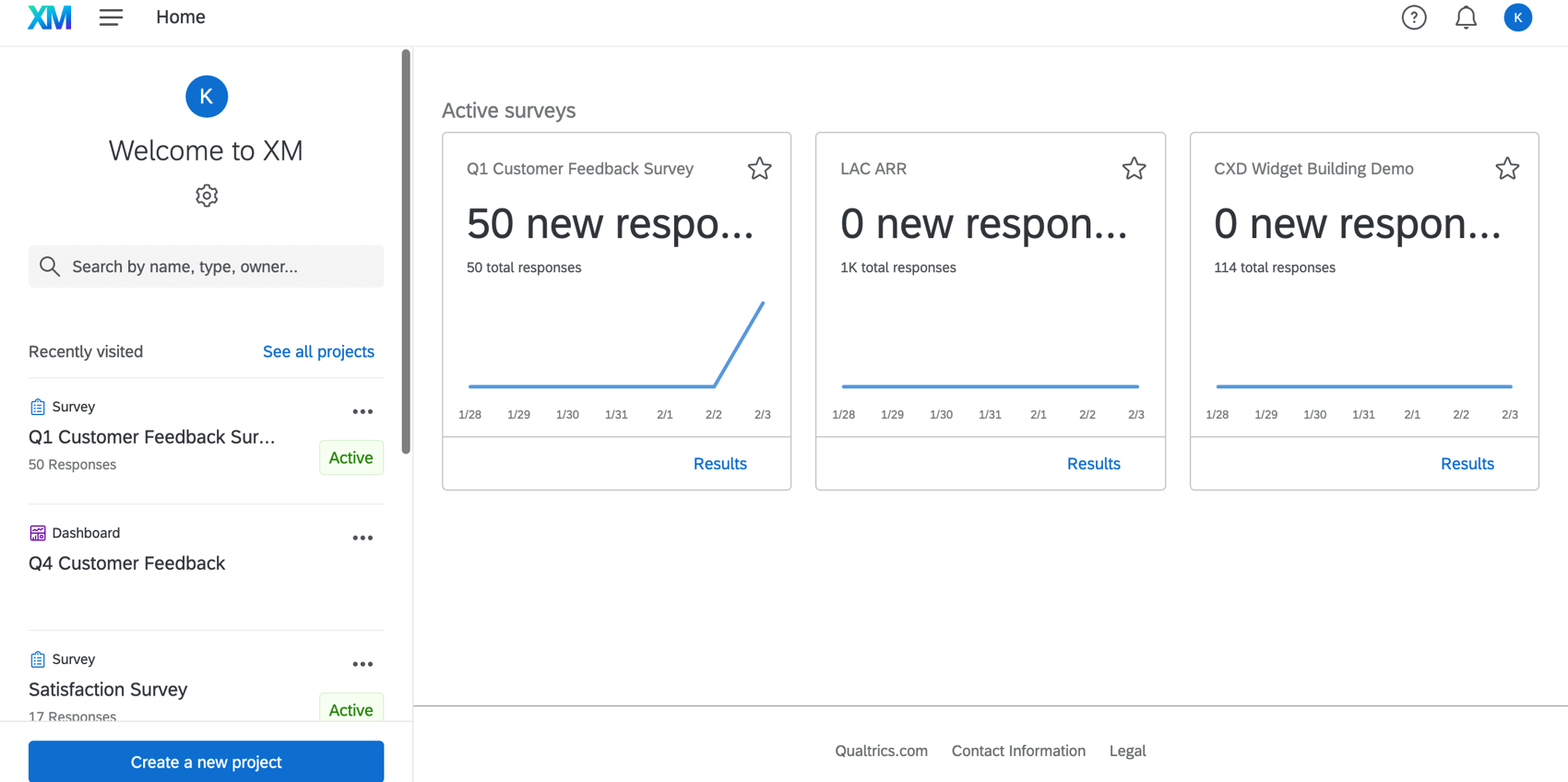
Qualtrics XM is an enterprise experience management platform that helps organizations run customer, employee, product, and brand programs from one system. It is best known for research-grade survey design and its iQ predictive engine, which applies statistical and text analytics to survey and open-text data.
The platform suits large organizations that treat experience measurement as a company-wide discipline rather than a single team's tool. Its breadth is the draw: a research team can standardize surveys across dozens of markets while other teams run employee or brand programs on the same foundation. That reach comes with complexity, which is why Qualtrics tends to fit well-resourced teams. If you want to ground the survey side of a program in solid measurement, the Chattermill guide to customer satisfaction metrics is a useful companion.
Qualtrics XM Features:
- iQ Predictive Analytics: Applies statistical modeling and text analytics to survey and open-text responses.
- Advanced Survey Design: Research-grade survey logic, distribution, and sampling controls.
- Multi-Program Management: Runs CX, EX, product, and brand experience programs on one platform.
- Text And Sentiment Analytics: Analyzes open-text feedback across 100+ languages.
- Custom Dashboards And Reporting: Configurable reporting for stakeholders across the organization.
- Enterprise Integrations: Connects to Salesforce, ServiceNow, Slack, and Tableau.
2026 Pricing
Qualtrics uses custom, quote-based pricing and does not publish figures for its enterprise CX packages. Third-party sources report entry-level individual plans from around $1,500 per year, but CX buyers should expect a tailored quote. See the Qualtrics pricing page for details.
Qualtrics XM Pros:
- Research-grade survey design and analysis capabilities
- Single platform for multiple experience programs
- Strong analytics and reporting depth
- Widely recognized and extensively integrated
Qualtrics XM Cons:
- Interface and configuration carry a steep learning curve
- Can be resource-heavy and costly to run at full scope
- Text analytics leans on survey data more than unstructured multi-channel feedback
Who It's For
Large enterprises running multiple experience programs that need research-grade survey capabilities on a single platform.
G2 Rating
Qualtrics XM G2 Score: 4.4 (750+ reviews)
3. Medallia

Medallia is an established experience management platform built to capture customer signals across an unusually wide set of touchpoints. Its reach spans digital, in-store, contact center, social, IoT, video, and speech, which makes it a fit for enterprises with complex physical and digital footprints.
The platform's Athena AI applies text and speech analytics to that signal, and its action-management tools help route findings to the right teams. Medallia's strength is coverage: few platforms capture as many signal types. That breadth suits large CX transformation programs, though it typically arrives with enterprise pricing and a meaningful implementation effort. Teams measuring loyalty across these touchpoints often pair it with a clear metric framework, such as the one in the Chattermill net promoter score guide.
Medallia Features:
- Omnichannel Signal Capture: Collects feedback across digital, in-store, contact center, social, IoT, video, and speech.
- Athena AI: Applies text and speech analytics to surface themes and sentiment.
- Action Management: Routes insights and alerts to the teams responsible for follow-up.
- Real-Time Reporting: Live dashboards and push notifications for shifting metrics.
- Role-Based Segmentation: Groups customers and feedback for targeted analysis.
- Broad Integrations: Connects to Salesforce, Adobe, ServiceNow, and Slack.
2026 Pricing
Medallia uses custom pricing, typically in the six-figure range for enterprise deployments. See the Medallia pricing page for details.
Medallia Pros:
- Exceptionally broad signal capture across physical and digital touchpoints
- Mature action-management and workflow routing
- Speech and video analytics for contact-center-heavy programs
- Well-established with a large enterprise footprint
Medallia Cons:
- Enterprise pricing puts it out of reach for many mid-market teams
- Broad scope brings a steep learning curve and longer implementation
- Unifying metadata across many sources can require extra configuration
Who It's For
Large enterprises running CX transformation programs that need to capture experience signals across many physical and digital touchpoints.
G2 Rating
Medallia G2 Score: 4.5 (210+ reviews)
4. Enterpret
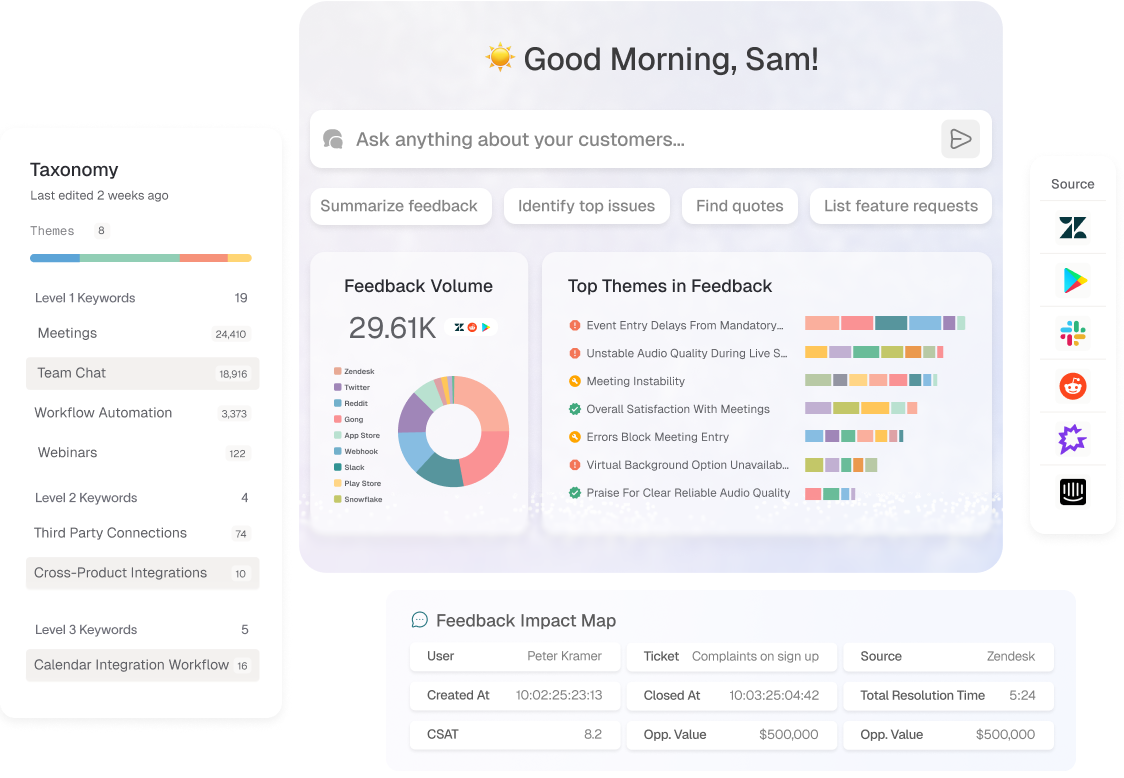
Enterpret is an AI-powered feedback analytics platform aimed at product and CX teams that want thematic analysis without maintaining a manual taxonomy. Its defining feature is an adaptive taxonomy that automatically builds and evolves feedback categories as new topics emerge.
The platform pulls feedback from support, reviews, social, surveys, and sales calls, then organizes it into themes teams can track over time. Its Wisdom AI layer answers natural-language questions and provides source-linked summaries, so analysts can trace an insight back to the raw feedback behind it. Enterpret is a direct alternative to Chattermill for no-taxonomy thematic analysis; the practical difference tends to come down to channel unification depth and how each ties themes to business metrics.
Enterpret Features:
- Adaptive Taxonomy: Automatically builds and updates feedback categories as topics change.
- Wisdom AI: Answers natural-language questions with source-linked summaries.
- Multi-Source Ingestion: Pulls from support, reviews, social, surveys, and sales calls.
- Theme Tracking: Monitors how themes trend over time.
- 50+ Integrations: Connects to tools such as Zendesk, Intercom, Gong, and Jira.
2026 Pricing
Enterpret uses custom pricing based on requirements. Contact Enterpret for a quote.
Enterpret Pros:
- Adaptive taxonomy removes manual category maintenance
- Source-linked summaries make insights easy to verify
- Strong integration coverage for product and support stacks
- Natural-language querying through Wisdom AI
Enterpret Cons:
- Less established than the largest enterprise suites
- Focused on analysis rather than broad experience-management features
Who It's For
Product and CX teams that want automated thematic analysis without building or maintaining a manual taxonomy.
G2 Rating
Enterpret G2 Score: 4.6 (110 reviews)
5. InMoment
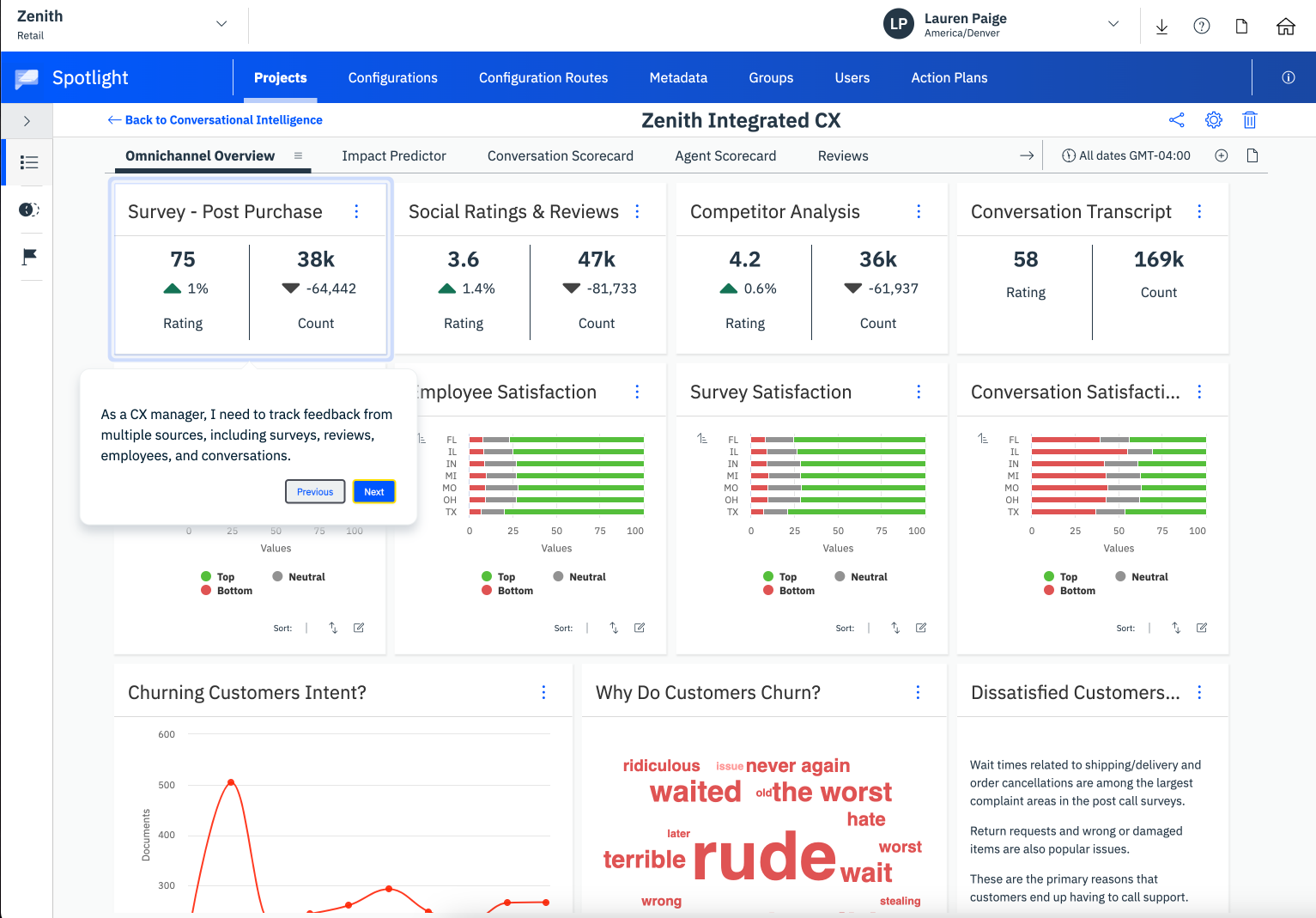
InMoment is an experience improvement platform that pairs analytics software with strategic advisory services through its XI Program offering. That combination targets enterprises that want technology and hands-on guidance rather than software alone.
The platform provides AI-driven text and sentiment analysis, case management, digital intercepts, and industry benchmarks. Its services component helps teams that lack in-house CX maturity stand up a program and interpret results. The tradeoff is that value is tied partly to the services engagement, so buyers evaluating InMoment should weigh the combined software-and-services cost against a software-only intelligence platform.
InMoment Features:
- AI Text And Sentiment Analysis: Surfaces themes and sentiment from open-text feedback.
- XI Program Services: Strategic advisory to design and run experience programs.
- Case Management: Tracks and resolves individual customer issues.
- Digital Intercepts: Captures feedback at key moments in digital journeys.
- Industry Benchmarks: Compares performance against sector peers.
- Broad Integrations: Connects to Salesforce, Zendesk, and Tableau.
2026 Pricing
InMoment uses custom pricing that reflects both software and services. See the InMoment plans and packages page for details.
InMoment Pros:
- Combined software and advisory support for less mature teams
- Real-time alerts and case management
- Journey mapping and benchmark data
- Consolidated reporting across programs
InMoment Cons:
- Dashboards can be difficult to customize
- Value depends partly on the services engagement
- Can be costly for teams on a tighter budget
Who It's For
Enterprises that want a customer experience intelligence platform paired with advisory services to build or scale their program.
G2 Rating
InMoment G2 Score: 4.7 (319 reviews)
6. Unwrap AI
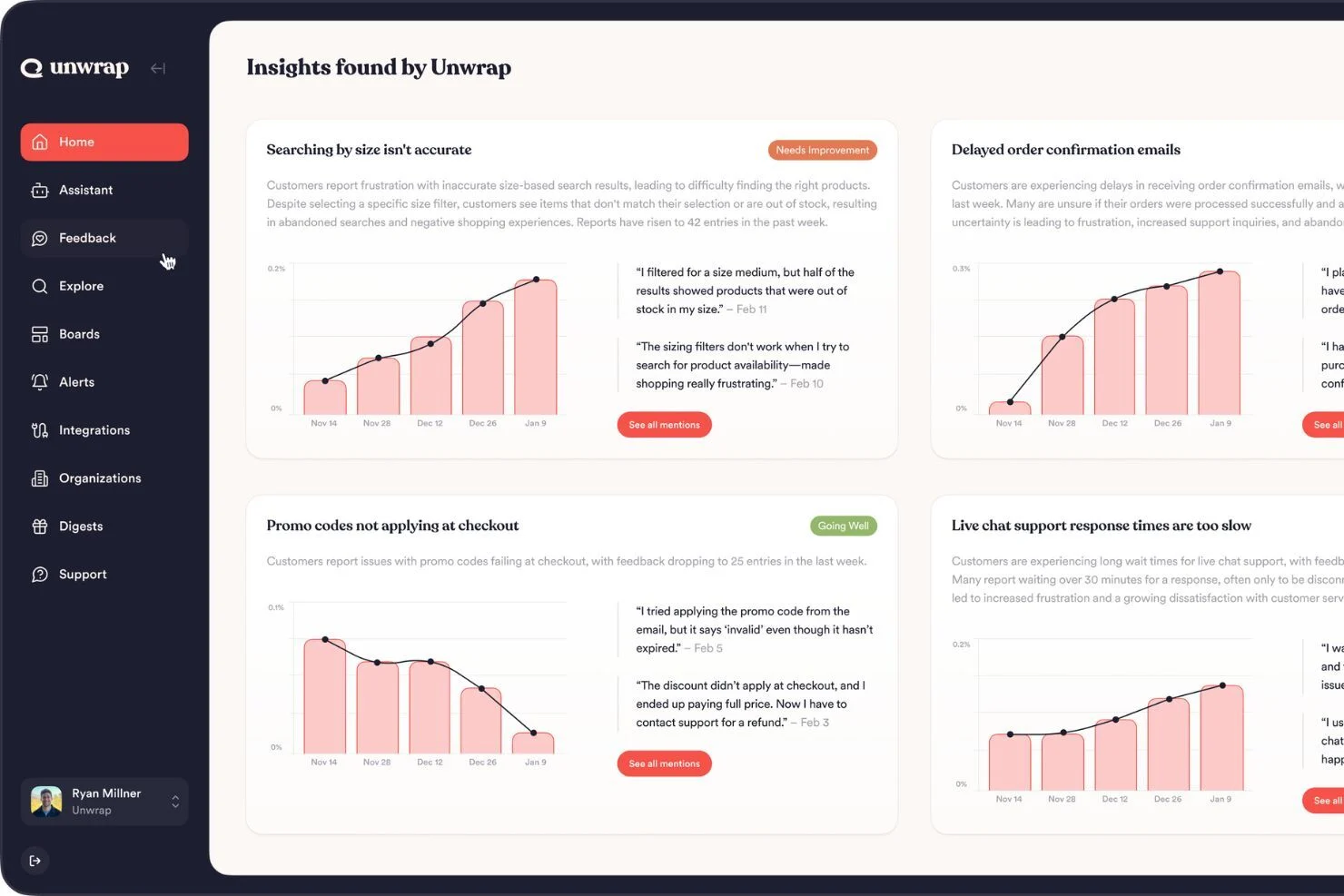
Unwrap AI is an AI-native feedback analytics platform that clusters customer feedback by semantic meaning rather than keywords. It groups comments that express the same idea in different words, which helps product and CX teams see the true weight of a theme even when customers phrase it a dozen ways.
Its Linked Actions feature connects identified themes to roadmap items and tracks the outcome once a team ships a change. The platform covers feedback across support, reviews, social, surveys, and chat, and includes enterprise governance controls. Unwrap AI holds the highest G2 rating in this comparison, though on a smaller review base, which reflects strong satisfaction among a newer, focused user community.
Unwrap AI Features:
- Semantic Clustering: Groups feedback by meaning, not just matching keywords.
- Linked Actions: Connects themes to roadmap items and tracks outcomes.
- Cross-Channel Ingestion: Pulls from support, reviews, social, surveys, and chat.
- AI Summaries: Generates plain-language summaries of theme clusters.
- Enterprise Governance: Role-based access and controls for larger teams.
2026 Pricing
Unwrap AI uses custom pricing based on requirements. Contact Unwrap AI for a quote.
Unwrap AI Pros:
- Semantic clustering captures themes across varied phrasing
- Linked Actions ties analysis to measurable outcomes
- Modern, AI-native interface
- Strong user satisfaction on G2
Unwrap AI Cons:
- Smaller and newer than the established suites
- Analysis-focused rather than a full experience-management platform
Who It's For
Product and CX teams that want AI-native qualitative analysis with built-in action tracking.
G2 Rating
Unwrap AI G2 Score: 4.8 (26 reviews)
7. Zendesk

Zendesk is a customer support platform that has extended into experience analytics on top of its ticketing and messaging core. For support-first organizations, it adds AI triage, routing, and sentiment analysis to the interactions their agents already handle every day.
Because the analytics sit inside the support workflow, Zendesk suits teams whose primary feedback source is the support channel rather than surveys or social. Its marketplace of more than 1,500 integrations makes it easy to connect to the rest of a stack. The limitation is scope: Zendesk analyzes support interactions well, but it is not built to unify feedback across the full range of channels a dedicated intelligence platform covers.
Zendesk Features:
- AI Triage And Routing: Automatically categorizes and directs incoming tickets.
- Sentiment Analysis: Detects sentiment within support interactions.
- Omnichannel Support: Handles tickets, chat, email, and messaging.
- Reporting And Dashboards: Zendesk Explore provides support analytics.
- 1,500+ Integrations: Extensive marketplace for connecting other tools.
2026 Pricing
Zendesk publishes transparent tiers. The entry Support Team plan starts at $19 per agent per month (billed annually), while the fuller Suite plans that bundle messaging and additional channels start at $55 per agent per month. See the Zendesk pricing page for current tiers.
Zendesk Pros:
- Strong fit for support-led feedback analysis
- AI triage speeds up ticket handling
- Very large integration marketplace
- Familiar, widely adopted platform
Zendesk Cons:
- Analytics focus on support data rather than unified feedback
- Deeper intelligence features require add-ons or higher tiers
- Not designed to be a cross-channel voice-of-customer platform
Who It's For
Support-first organizations that want analytics and sentiment on the support interactions they already manage in Zendesk.
G2 Rating
Zendesk G2 Score: 4.3 (6,900+ reviews)
8. Sprinklr
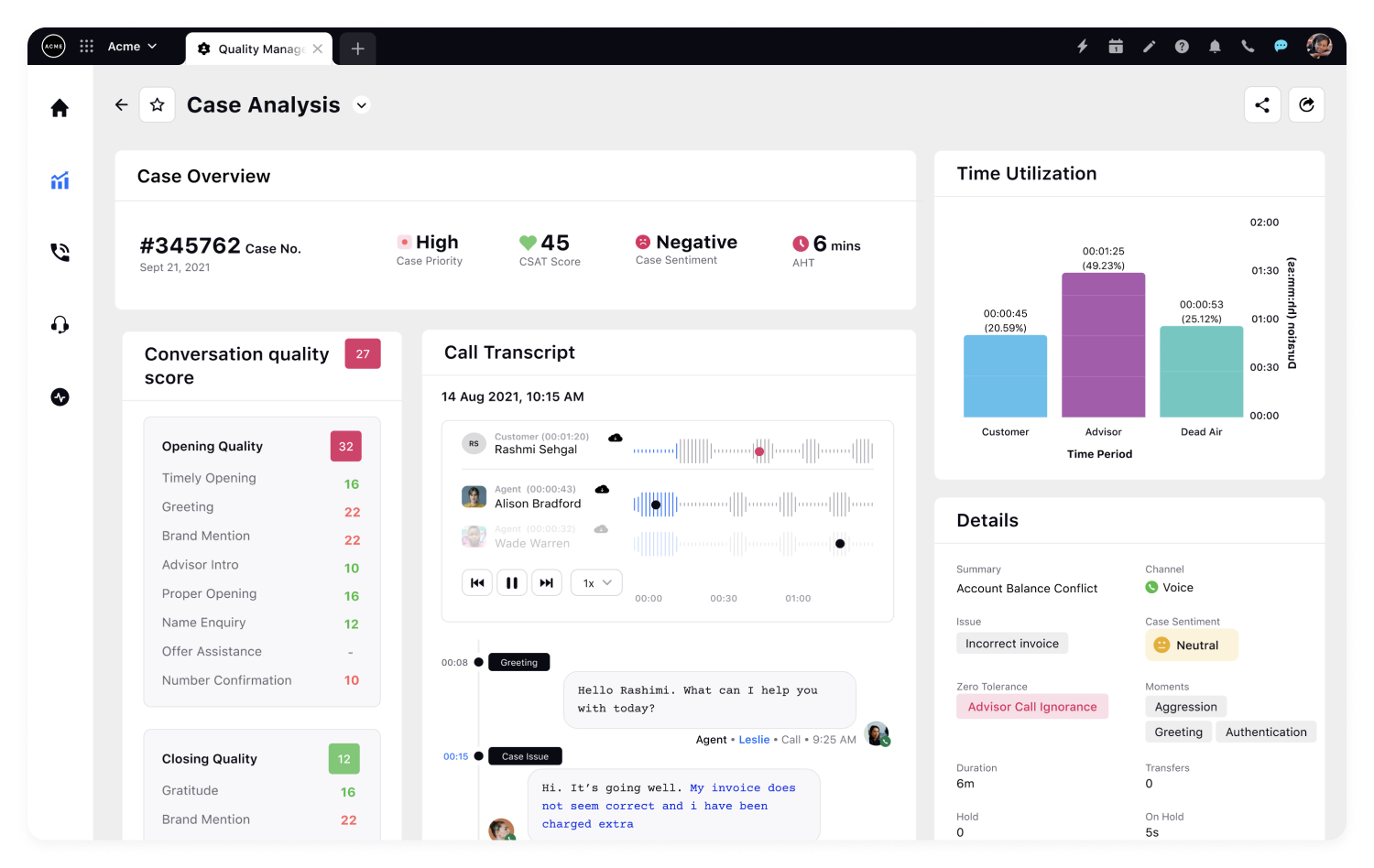
Sprinklr is a unified customer experience management platform built around social and digital channels. It manages engagement, listening, and analytics across more than 30 channels, which makes it a fit for large brands whose customer conversations happen largely in public.
Its social listening and sentiment capabilities help marketing and CX teams track brand perception and competitive positioning in real time. Sprinklr's strength is breadth of digital and social coverage; the tradeoff is that its center of gravity is social and marketing rather than the structured survey and support feedback that some CX programs prioritize. For brands where social is the dominant voice, that focus is an advantage.
Sprinklr Features:
- Unified CXM: Manages engagement and analytics across 30+ channels.
- Social Listening: Monitors brand conversation and sentiment in real time.
- Competitive Benchmarking: Compares brand performance against competitors.
- AI Sentiment Analysis: Detects sentiment across digital and social feedback.
- Campaign And Engagement Tools: Publishing and response management for social teams.
2026 Pricing
Sprinklr does not publish standardized pricing, and full platform access is quoted through custom enterprise contracts. Third-party sources report bundled seat plans from around $299 per seat per month. Contact Sprinklr for a quote based on your channel and seat requirements.
Sprinklr Pros:
- Extensive social and digital channel coverage
- Real-time social listening and sentiment
- Competitive benchmarking for brand teams
- Scales to large, multi-team brands
Sprinklr Cons:
- Center of gravity is social and marketing rather than survey or support feedback
- Broad platform can be complex to configure
- Cost scales quickly across many seats and modules
Who It's For
Large brands and social CX teams that need unified engagement, listening, and analytics across digital and social channels.
G2 Rating
Sprinklr G2 Score: 4.3 (748 reviews)
9. Gainsight
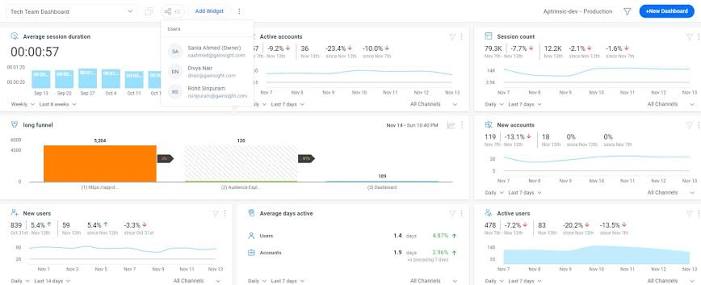
Gainsight is a customer success platform that applies analytics to account health, renewals, and expansion rather than open-text feedback analysis. For B2B teams, it turns product usage, survey, and CRM signals into health scores that flag which accounts need attention.
The platform automates customer success playbooks and forecasts renewal and expansion risk, which makes it valuable for subscription businesses focused on retention. Gainsight belongs in this comparison because it uses customer intelligence to drive outcomes, though its lens is account-level success rather than the cross-channel theme detection of a feedback analytics platform. Teams often run it alongside a dedicated intelligence tool rather than instead of one.
Gainsight Features:
- Account Health Scoring: Combines usage, survey, and support signals into health scores.
- Playbook Automation: Triggers customer success workflows based on account signals.
- Renewal And Expansion Forecasting: Predicts revenue risk and opportunity.
- Survey And NPS Tools: Collects and tracks relationship feedback.
- Integrations: Connects to Salesforce, Snowflake, Zendesk, and Slack.
2026 Pricing
Gainsight uses custom pricing based on requirements. Contact Gainsight for a quote.
Gainsight Pros:
- Strong account health and retention analytics
- Automated customer success workflows
- Renewal and expansion forecasting for B2B teams
- Deep CRM and data-warehouse integration
Gainsight Cons:
- Focused on account success rather than cross-channel feedback analysis
- Best value requires investment in the broader platform
- Less suited to unstructured, multi-channel voice-of-customer work
Who It's For
B2B customer success teams focused on account health, retention, and expansion.
G2 Rating
Gainsight G2 Score: 4.5 (2,700+ reviews)
10. Brandwatch
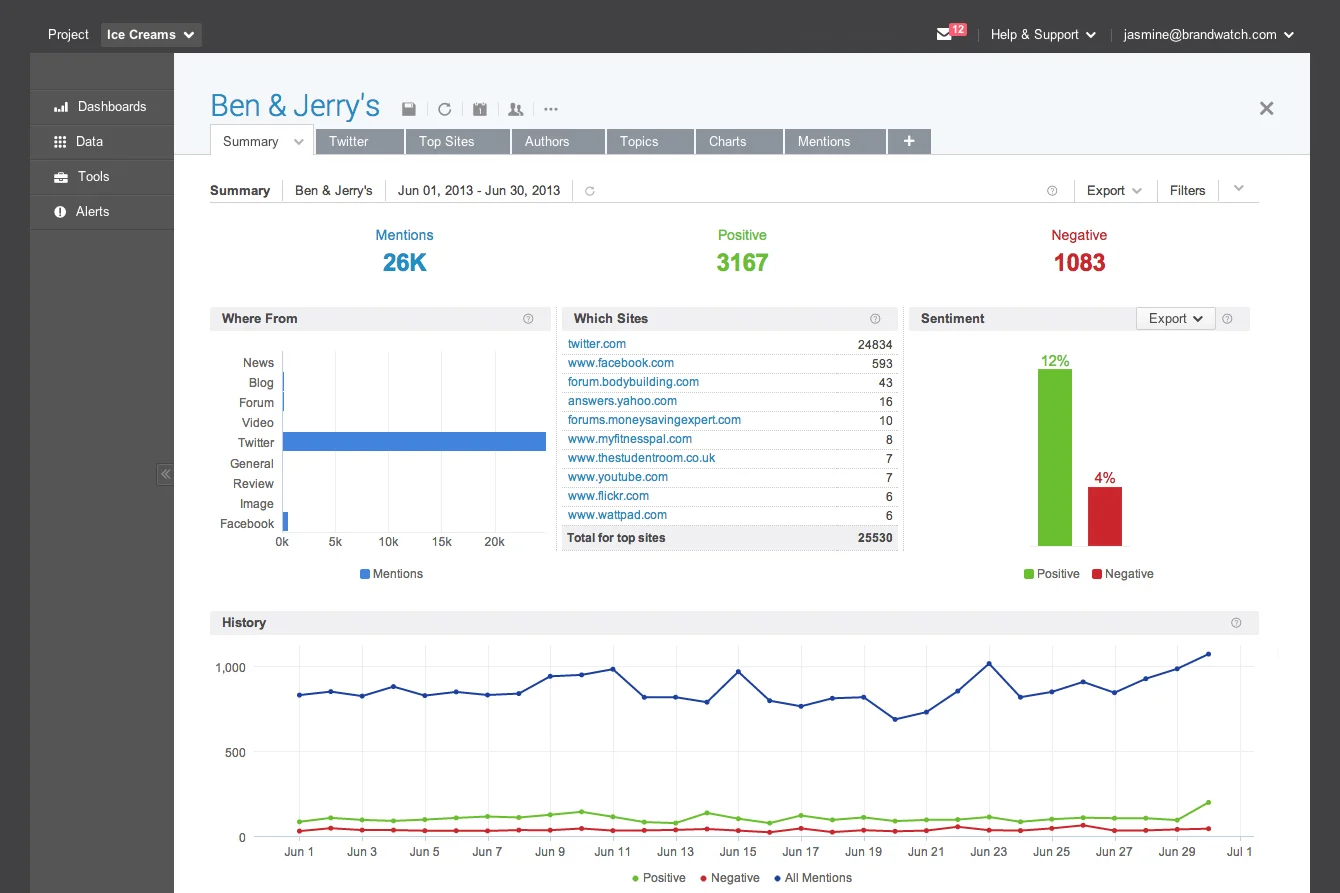
Brandwatch is a consumer and social intelligence platform that helps marketing and insights teams understand public conversation about their brand and market. It analyzes social posts, news, forums, blogs, and reviews to surface sentiment, trends, and audience segments.
Its strengths include audience segmentation and image and logo recognition, which let brands track visual mentions alongside text. Brandwatch fits teams whose main question is how the market perceives them rather than how existing customers feel about a specific product experience. For that consumer-intelligence use case it is a capable, established choice; for structured survey and support feedback, a dedicated CX platform is the better match.
Brandwatch Features:
- Social Listening: Monitors conversation across social, news, forums, and blogs.
- Sentiment Analysis: Tracks brand and topic sentiment over time.
- Audience Segmentation: Groups audiences by demographics and interests.
- Image And Logo Recognition: Detects visual brand mentions in social content.
- Trend Detection: Surfaces emerging topics and spikes in conversation.
2026 Pricing
Brandwatch uses custom pricing based on requirements. Contact Brandwatch for a quote.
Brandwatch Pros:
- Broad consumer and social listening coverage
- Audience segmentation for marketing teams
- Image and logo recognition beyond text
- Established brand-intelligence reputation
Brandwatch Cons:
- Focused on public conversation rather than owned customer feedback
- Less suited to structured survey or support analysis
- Marketing lens rather than end-to-end CX
Who It's For
Marketing and insights teams that need consumer and social intelligence about brand perception and market trends.
G2 Rating
Brandwatch G2 Score: 4.4 (728 reviews)
11. SAS Customer Intelligence 360
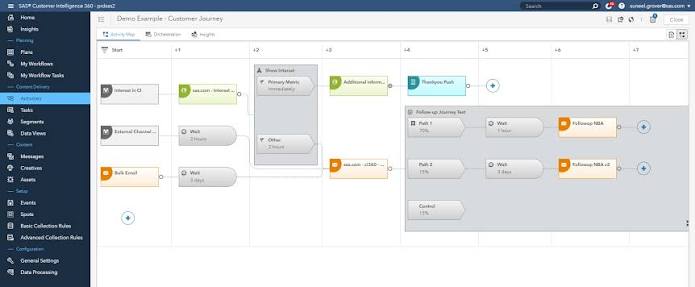
SAS Customer Intelligence 360 is a marketing analytics platform with an embedded customer data platform, aimed at data-driven marketing teams. It combines journey orchestration, predictive modeling, and multichannel campaign analytics in one system.
The platform suits organizations that already work within the SAS analytics ecosystem and want to connect marketing execution to deep predictive modeling. Its analytical depth is the draw, particularly for teams comfortable with advanced data science. That same depth makes it more of a marketing analytics engine than a voice-of-customer intelligence tool, so it fits a specific, analytics-mature buyer rather than a general CX team.
SAS Customer Intelligence 360 Features:
- Embedded CDP: Unifies customer data for segmentation and targeting.
- Journey Orchestration: Designs and manages multichannel customer journeys.
- Predictive Modeling: Applies advanced analytics to forecast behavior.
- Multichannel Campaign Analytics: Measures performance across web, mobile, and email.
- SAS Ecosystem Integration: Connects to the broader SAS analytics suite.
2026 Pricing
SAS Customer Intelligence 360 uses custom pricing based on requirements. Contact SAS for a quote.
SAS Customer Intelligence 360 Pros:
- Deep predictive modeling and analytics
- Embedded customer data platform
- Strong journey orchestration for marketing
- Fits teams invested in the SAS ecosystem
SAS Customer Intelligence 360 Cons:
- Oriented to marketing analytics rather than feedback intelligence
- Steep learning curve outside the SAS ecosystem
- Best suited to analytics-mature teams
Who It's For
Data-driven marketing teams that want predictive analytics and journey orchestration within the SAS ecosystem.
G2 Rating
SAS Customer Intelligence 360 G2 Score: 4.4 (144 reviews)
Benefits Of Customer Experience Intelligence Software
Why invest in a dedicated intelligence platform when survey tools already collect feedback? Because collecting feedback and understanding it are different jobs. The benefits below explain what changes when a team moves from gathering data to acting on it.
- Unified Customer Insight: Consolidating feedback from every channel replaces conflicting channel reports with a single, trusted view of what customers are saying.
- Faster, Evidence-Backed Decisions: AI-surfaced themes and sentiment let teams prioritize with data instead of anecdote, so the loudest voice in the room no longer sets the agenda.
- Improved Customer Experience: Identifying pain points across the journey helps teams fix the issues that drive dissatisfaction before they cause churn.
- Product And Service Innovation: Patterns in unmet needs and feature requests point directly to the improvements customers actually want.
- Higher Satisfaction And Loyalty: Acting visibly on feedback shows customers their input matters, which strengthens retention over time.
- Competitive Advantage: Teams that respond to changing needs faster than rivals turn customer understanding into a durable edge.
- Greater Operational Efficiency: Automated theme detection removes hours of manual tagging, freeing analysts for strategic work.
- Continuous Improvement: Ongoing analysis creates a feedback loop that helps products and services evolve with customer expectations.
ROI And Business Impact Of Customer Experience Intelligence Software
Modern customer experience intelligence platforms deliver outcomes that justify the investment across organizations of every size:
- Reduced Customer Churn: Proactively spotting and resolving issues helps retain customers who would otherwise leave over unaddressed problems.
- Faster Response Times: Automated alerting routes emerging issues to the right team sooner than manual review allows.
- Improved Operational Efficiency: AI theme discovery and sentiment analysis remove the manual work of reading feedback line by line.
- Higher Satisfaction Scores: When feedback drives real product and service changes, satisfaction metrics such as NPS and CSAT improve measurably.
- Accelerated Growth: Programs that connect feedback to action tend to lift retention and customer lifetime value over time.
Teams using AI-native platforms like Chattermill spend less time on manual feedback analysis and more time on the strategic improvements that drive loyalty and revenue. To make the internal case, the Chattermill guide to building a business case for unified customer intelligence walks through how to frame the return.
Get Started With Chattermill
Ready to see what unified, AI-native customer experience intelligence looks like for your team? Book a personalized demo, and we will show you how Chattermill turns feedback from every channel into decisions your business can act on.
Book a Demo
Customer Experience Intelligence: FAQs
What Is Customer Experience Intelligence Software?
Customer experience intelligence software unifies feedback from channels such as surveys, reviews, support tickets, social, and chat, then uses AI to surface themes, sentiment, and trends. It helps CX, insights, and product teams understand why customer metrics move and what to prioritize. The goal is turning scattered, unstructured feedback into decisions the business can act on.
What Does Customer Experience Intelligence Software Do?
It ingests customer feedback from multiple sources, analyzes the unstructured text with AI, and organizes it into themes and sentiment. It then connects those insights to business metrics like NPS, CSAT, and CES so teams can measure impact. In practice, it answers what customers care about, how they feel, and which issues deserve attention first.
What Is The Difference Between Customer Experience Management And Customer Experience Intelligence?
Customer experience management focuses on running programs and collecting feedback, often through surveys and journey measurement. Customer experience intelligence focuses on analyzing that feedback with AI to extract insight and drive action. Management platforms tell you what you measured; intelligence platforms tell you what it means and what to do about it.
What Is The Difference Between A Customer Intelligence Platform And A CRM?
A CRM stores structured records of customer interactions, deals, and contact history to support sales and service. A customer intelligence platform analyzes unstructured feedback, such as reviews and support conversations, to reveal why customers feel and behave the way they do. The CRM tracks the relationship; the intelligence platform explains the sentiment behind it.
What Is The Difference Between Customer Intelligence And Business Intelligence?
Business intelligence analyzes broad operational and financial data, such as sales and inventory, to report on how the business is performing. Customer intelligence focuses specifically on customer feedback and behavior to explain the experience behind those numbers. They complement each other: business intelligence shows what happened, and customer intelligence helps explain why.
What Are Examples Of Customer Experience Intelligence?
Examples include auto-detecting the top themes driving negative reviews, alerting a team when sentiment about a feature drops, and linking a rise in support complaints to a recent product change. Another example is querying feedback in plain language to see why NPS fell in a specific market. Each turns raw feedback into a specific, actionable answer.
How Does AI Improve Customer Feedback Analytics?
AI analyzes large volumes of unstructured feedback automatically, detecting themes and sentiment that manual tagging would miss or take weeks to find. Deep-learning models understand context and nuance rather than matching fixed keywords or rules. This lets teams analyze feedback at scale, in near real time, and across many languages.
What Features Should I Look For In A Customer Experience Intelligence Platform?
Look for AI-based theme and sentiment detection that avoids manual tagging, broad channel coverage, and native multi-language support. Prioritize integrations with your CRM, helpdesk, and BI tools, plus the ability to link insights to metrics like NPS and CSAT. Enterprise-grade security and clear pricing also matter for a platform you will scale.
How Much Does Customer Experience Intelligence Software Cost?
Most enterprise-grade platforms, including Chattermill, Medallia, and Enterpret, use custom pricing based on feedback volume and requirements. Some tools publish entry points, such as Zendesk from $19 per agent per month (Suite plans from $55). Qualtrics does not publish enterprise CX pricing, though third-party sources cite entry-level individual plans from around $1,500 per year, and Sprinklr is quoted through sales with bundled seat plans reported near $299 per seat per month. Total cost should account for implementation, services, and internal effort, not just the license.
What Integrations Do These Platforms Support?
Most connect to common CRM, helpdesk, and BI systems such as Salesforce, Zendesk, and Tableau. Chattermill integrates with CRM, helpdesk, review sources, and BI platforms, and offers an MCP server for querying feedback inside AI agents. Confirm that a platform connects to your specific feedback sources before you commit.
What ROI Can I Expect From Customer Experience Intelligence Software?
Teams typically see reduced churn, faster issue response, and lower manual analysis effort, which together improve retention and satisfaction over time. The clearest returns come when insights are tied to metrics and routed into action rather than sitting in a dashboard. Building a business case around retention and efficiency helps quantify the expected return.
The Bottom Line
The 11 platforms in this guide solve related but distinct problems, which is why picking the category before the tool matters so much. Experience management suites like Qualtrics XM and Medallia serve broad, survey-led enterprise programs; social tools like Sprinklr and Brandwatch track public conversation; support and success tools like Zendesk and Gainsight add analysis to a primary job elsewhere.
For teams whose core need is cross-channel customer experience intelligence, Chattermill is our recommendation. It unifies feedback from every channel, auto-detects themes and sentiment without manual tagging, and ties insight directly to the metrics leaders care about. If your challenge is understanding what customers are telling you across surveys, tickets, reviews, social, chat, and calls, and turning that into action, Chattermill is built for exactly that. Book a demo to see it applied to your own feedback.


See Chattermill in action on your own feedback
Book a demo


