


How to Analyze Customer Sentiment With AI


The CX intelligence
platform that's AI-native by design
Book a demoQuick Summary
AI analyzes customer sentiment across surveys, reviews, tickets, and calls, scoring sentiment at scale and in real time. The core workflow: connect sources, clean text, choose your approach, score and tag by theme, validate accuracy, then route insights to teams. AI analysis beats manual DIY methods in both speed and efficiency.
What Is Customer Sentiment Analysis?
Customer sentiment analysis uses AI to classify text as positive, negative, or neutral.
At its simplest, it assigns a single label to an entire piece of feedback. More advanced sentiment analysis methods go further. They also score sentiment toward specific aspects within the same piece of text, not just the whole piece.
Where the analysis stops, at document level or aspect level, is what separates basic sentiment tools from ones built for serious CX work.
This guide explains why AI sentiment analysis is the best choice today and gives step-by-step guidance on how to do it efficiently.
Why Listen To Us
Chattermill has analyzed customer sentiment for enterprises like Uber, HelloFresh, and Booking.com for 10+ years. Our Lyra AI engine applies aspect-based sentiment analysis across millions of records every month. This guide reflects proven patterns we've seen helping CX teams move from simple positive/negative scoring to sentiment tied directly to business outcomes.

Analyzing Customer Sentiment With AI: A Practical Example
Take one real-looking review:
“The food arrived fast, but the app kept crashing, and support never replied.”
Scored at the document level, that review gets one label: negative. Plenty of useful detail gets lost in that single score.
Aspect-based analysis breaks the same sentence into three parts:
- Delivery speed: positive.
- App reliability: negative.
- Support responsiveness: negative.
Now a CX team sees three signals instead of one. Delivery isn't broken. The app and support are. That distinction matters operationally. A single negative label tells you something is wrong. Aspect-based scoring tells you exactly what to fix first.
Run that same logic across ten thousand reviews, and document-level scoring gives you a vague trend line. Aspect-based scoring gives you a ranked list of specific issues, each tied to a part of the product or service.
A longer review might surface five aspects at once:
- Price
- Delivery
- Packaging
- Support
- Ease of return
Document-level scoring would collapse all of that into one number.
Each of those aspect-level signals maps to one of the sentiment analysis methods covered next. Keep the method name tied to the score, since knowing which method produced it is just as important as the score itself.
Most platforms also attach a confidence score to each aspect tag. A low-confidence tag on an ambiguous sentence is flagged for human review rather than silently skewing the theme it was assigned to.
Why Analyze Sentiment With AI?
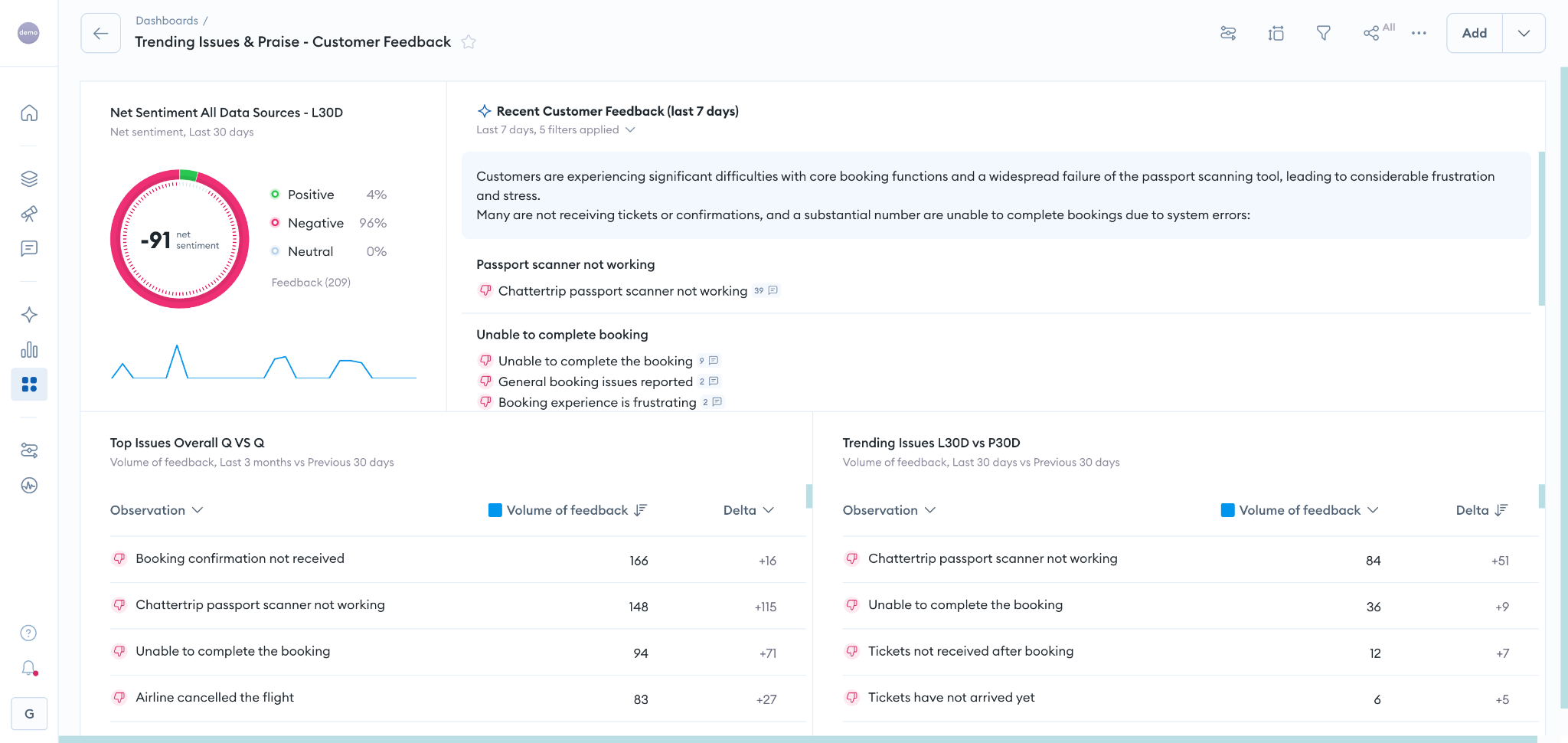
Here are three reasons why AI sentiment analysis makes business sense.
1. Manual sentiment reading caps out fast.
A person can carefully read a few hundred comments a day.
Most brands generate that volume in an hour.
Even a dedicated analyst team burns out quickly at that pace, and turnover resets institutional knowledge of the taxonomy. Hiring more analysts does not fix this. It just adds headcount to a process that was never going to scale.
2. Human tagging also introduces bias.
Two people reading the same comment will score it differently depending on their moods, fatigue, and personal interpretations. AI scores every comment against the same criteria, every time. That consistency compounds over time.
A taxonomy applied the same way for two years produces trend lines you can actually trust, rather than noise from who happened to be tagging that week.
3. Real-time detection is the biggest shift.
A negative sentiment spike tied to a product bug can surface within hours, not at the end of a monthly report. That speed turns sentiment data into an early warning system, not a retrospective.
Teams that catch a sentiment dip on day two of a product issue can often contain it before it shows up in churn numbers at all. Waiting for the quarterly review means finding out after the customers are already gone.
Together, these three advantages explain why most CX teams adopting AI sentiment tools never return to manual tagging.
Sentiment Analysis Methods: 4 Types to Know

Not all sentiment analysis works the same way. Here are the four methods you'll encounter most, roughly in order of increasing detail and implementation effort.
1. Document-Level Sentiment Analysis
Document-level analysis assigns a single sentiment score to an entire piece of text: a review, survey response, or support ticket. It's the simplest and fastest method to implement, but it hides details when feedback covers more than one topic.
It works fine for short, single-topic feedback, like a one-line NPS comment, but loses value fast as feedback gets longer or more detailed. Plenty of basic sentiment tools never go beyond this method, which is often why their output feels shallow.
2. Sentence-Level Sentiment Analysis
Sentence-level analysis scores each sentence separately instead of the whole document. A five-sentence review can carry five different sentiment scores. This catches mixed feedback that document-level scoring would average into a misleading middle ground.
It still misses sentiment that shifts mid-sentence, which is where aspect-based analysis takes over. It is a reasonable middle ground when full aspect-based tagging is not yet set up.
3. Aspect-Based Sentiment Analysis
Aspect-based analysis goes further still, scoring sentiment toward specific aspects: price, delivery, support, ease of use. It's the method behind the worked example above, and the one most enterprise CX teams rely on for actionable detail.
Implementing it well requires a clear taxonomy of aspects relevant to your product or service, defined before scoring begins. Most teams refine that taxonomy over the first few months, adding aspects as new themes emerge in the data.
4. Emotion Detection
Emotion detection goes beyond positive and negative. It identifies specific emotions: frustration, anger, delight, confusion. It adds nuance that a simple positive or negative score misses. It’s especially useful for prioritizing escalations by emotional intensity, rather than just polarity.
It pairs well with aspect-based scoring. Knowing both the aspect and the emotion behind it further sharpens prioritization. A frustrated comment about a billing error, for instance, escalates differently than a confused one about the same issue.
How to Analyze Sentiment With AI, Step by Step
Most sentiment programs follow the same six steps, regardless of the methods or tools chosen.
1. Connect Your Sources
Firstly, pull feedback from every channel into one place: surveys, reviews, tickets, calls, social.
Sentiment scored on a single source gives you a partial picture, no matter how accurate the model is.
API or webhook connections work best. Manual exports create delays and version mismatches almost immediately. Plan for new sources too. A channel you don't track today, like a new review site, can become significant within a year.
2. Clean and Prep the Text
Secondly, strip HTML, normalize emojis, and redact PII before scoring starts.
Inconsistent formatting and unredacted personal data both degrade model accuracy and create compliance risk later. Consistent encoding and language detection at this stage save rework later in the pipeline. Deduplicate near-identical comments too, since repeated boilerplate text can skew theme volume without adding real signal.
3. Choose Your Approach: Prompt-and-LLM vs. Dedicated Platform
A prompt sent to an LLM works for small, one-off analysis.
However, it struggles at volume: costs climb, outputs drift across model versions, and nothing routes automatically. A dedicated platform handles ingestion, consistency, and routing as a single system, which matters once volume or the number of sources grows.
Most teams land on a hybrid approach. They use LLM prototyping early on. Then they switch to a dedicated platform once volume or accuracy requirements grow.
The decision usually comes down to how many people need to act on the output, and how often.
4. Score and Tag by Theme
Thereafter, apply sentiment scoring alongside theme and topic tags, not separately.
A sentiment score without a theme tells you something is wrong. Paired with a theme, it tells you what's wrong and how badly. This is also where aspect-based and emotion-detection methods earn their keep over simple document-level scoring.
5. Validate Accuracy
Next, regularly spot-check a sample of AI-scored feedback against human judgment.
Sarcasm, negation, and mixed sentiment all trip up models in predictable ways. Validation catches drift before it skews a quarter of reporting. Set a fixed validation cadence, weekly or biweekly, so accuracy gets checked on a schedule, not by accident.
Track accuracy by aspect, not just overall, since some aspects are harder to score correctly than others.
6. Visualize and Route to Teams
Finally, route the analyzed data to the right teams.
That’s because sentiment scores only matter if someone sees them.
Push negative spikes to the right team. Visualize trends by theme and aspect, and set alerts for sudden drops. A score sitting in a dashboard nobody opens changes nothing. Pair visualizations with theme and aspect filters so a CX leader can drill from a trend line straight down to the comments driving it.
Build the routing rules before launch, not after the first spike catches everyone off guard.
5 Common Challenges in AI Sentiment Analysis
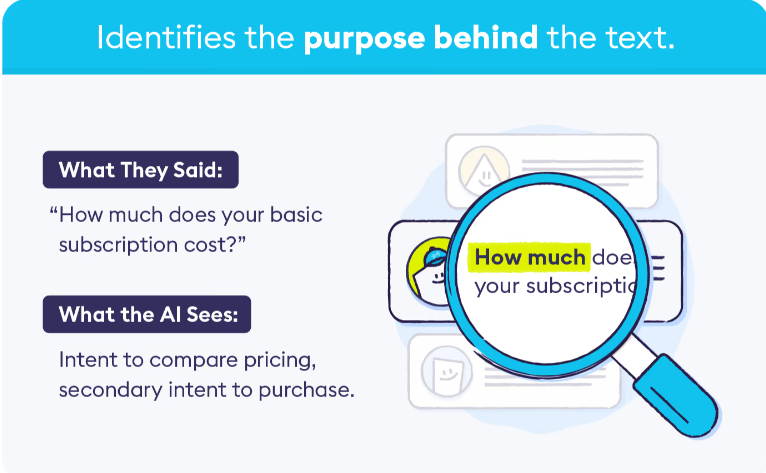
Even strong models stumble on the same handful of patterns. Know these going in.
1. Sarcasm and Negation
“Great, another delay” reads positive to a naive model and negative to a human. Negation causes similar errors: “not bad” and “not good” differ by one word but mean opposite things. Strong models are trained specifically to catch both patterns.
Context windows that include surrounding sentences, not just the flagged one, help models catch tone shifts like this. Even then, expect a small error rate specifically with sarcasm, and plan validation around it.
2. Mixed Sentiment in One Sentence
“The product is great, but support is terrible” conveys two opposite sentiments in a single sentence. Document-level scoring averages this into a meaningless, neutral result. Aspect-based and sentence-level methods handle it correctly by scoring each part separately.
Reporting a single net score for mixed feedback like this hides exactly the kind of detail a CX team needs most. It can also mask a real problem behind an average score that looks acceptable on the surface.
3. Domain-Specific Language
“Crashed” means something different in a software review than in a car insurance claim. Generic, off-the-shelf models trained on broad text miss industry-specific meaning. Models trained or fine-tuned on your actual feedback perform noticeably better.
Feeding a model a sample of your own labeled feedback, even a few hundred examples, often improves accuracy more than swapping vendors. Industry jargon, internal product names, and abbreviations specific to your customer base all fall into this same category of risk.
4. Multilingual Feedback
A model tuned for English sentiment won't necessarily achieve the same accuracy on German or French feedback.
Global brands need sentiment analysis methods validated separately for each language they operate in, not just the dominant one in their dataset.
Translation-then-score pipelines often lose nuance; scoring natively in the original language usually performs better. This matters most for idioms and culturally specific expressions of frustration or satisfaction, which rarely translate word-for-word.
5. Sentiment Drift Over Time
Language changes, products evolve, and customer expectations shift.
A sentiment model that performs well today may become less accurate six months from now. New product features, competitor launches, industry trends, and emerging slang can all change how customers express satisfaction or frustration. Without regular monitoring and retraining, sentiment accuracy gradually declines.
Teams should periodically review model outputs against human-labeled samples to catch drift early and maintain confidence in reporting. Continuous validation is especially important for fast-moving industries where customer language changes quickly.
How Chattermill Helps Brands Analyze Customer Sentiment With AI
.avif)
Here’s how Chattermill can help your business analyze customer sentiment with AI:
Unifies Sentiment Analysis Across Channels
Chattermill applies aspect-based sentiment analysis across every channel: surveys, reviews, tickets, calls, and social. The same Lyra AI engine scores sentiment and ties it directly to themes. This lets you see not just that sentiment dropped, but exactly which aspect of the experience caused it.
Ties Sentiment To Business Outcomes
Most sentiment tools stop at document-level scoring on a single source. Chattermill goes further, connecting aspect-level sentiment to NPS, CSAT, churn, and revenue through Business Impact Mapping.
Creates A Customer Sentiment Audit Trail
Enterprise CX teams also need an audit trail, not just a score. Chattermill tracks model versioning and scoring history, so you can explain why a sentiment trend moved, not just that it did. That combination, aspect-level accuracy plus an auditable history, is what most generic sentiment APIs and DIY scripts can't offer at enterprise scale.
Supports Multilingual Sentiment Analysis
Multilingual analysis works the same way across 100+ languages.
So a German review and an English review reporting the same issue land in the same theme and are scored with the same accuracy.
This matters most for global brands running CX programs across regions. A single taxonomy, applied consistently across languages and channels, means leadership reviews a single prioritized list instead of reconciling five regional reports that don't quite agree.
Compare AI-based platform options in our roundup of the best customer feedback tools.
Put Sentiment Analysis Methods to Work Through Lyra AI
Sentiment analysis methods range from a single document-level score to detailed, aspect-based breakdowns.
The method you choose determines how much detail you get back. Aspect-based and emotion detection surface exactly what's driving a shift in sentiment, channel by channel. Pair the right method with a workflow that validates accuracy and routes insights to teams. Chattermill does all this and more through its powerful proprietary engine, Lyra AI.
Ready to see it in action? Book a demo.
AI Customer Sentiment Analysis FAQ
Here are some quick answers to common questions about using AI to analyze customer sentiment.
1. What are the main sentiment analysis methods?
The four main methods are document-level, sentence-level, aspect-based, and emotion detection. Document-level is the simplest. Aspect-based and emotion detection give the most actionable detail for CX teams.
2. What’s the difference between sentiment analysis and aspect-based sentiment analysis?
Sentiment analysis can mean any method, including a single score for a whole document. Aspect-based sentiment analysis specifically scores sentiment toward individual aspects, like price or support, within the same piece of text.
3. Can AI handle sarcasm in sentiment analysis?
Modern models handle sarcasm better than older rule-based tools, but not perfectly. Regularly validating AI-scored sentiment against human judgment helps catch sarcasm and negation errors before they skew reporting.
4. Does sentiment analysis work across multiple languages?
Yes, but accuracy varies by language and model. Validate sentiment accuracy separately for each language your customers use, rather than assuming a model trained mostly on English performs equally well elsewhere.
5. How is AI sentiment analysis different from manual reading?
Manual reading caps out at a few hundred comments a day and varies by reviewer. AI applies the same scoring criteria to every comment, at any volume, in near real time.
6. Which sentiment analysis method should I start with?
Start with document-level scoring if you only need a high-level trend. Move to aspect-based analysis as soon as you need to know which specific part of the experience is driving that trend.


See Chattermill in action on your own feedback
Book a demo


