


20 Best Customer Feedback Software & Tools in 2026


The CX intelligence
platform that's AI-native by design
Book a demoQuick Summary
Customer feedback software does one of three jobs: analyzing feedback from every channel, collecting it, or helping you decide what to act on. Here’s where to jump in:
- Too much feedback to read? Start with the analysis platforms (1 to 7).
- Sending surveys or in-app prompts? See the collection tools (8 to 18).
- Sorting feature requests into a roadmap? Go to the management tools (19 and 20).
Our top picks: Chattermill for analysis, since it pulls every channel into one view and shows what moves NPS and CSAT. SurveyMonkey for collection, as the quickest survey tool to set up. Canny for managing requests, with voting boards and public roadmaps.
Customer Feedback Software Covers Three Different Jobs
Customer feedback tools are software platforms that help organizations collect, organize, analyze, and act on input from customers across channels such as surveys, support tickets, online reviews, social media, in-app feedback, and call transcripts. No single tool does all of that well. A survey builder will not explain why NPS dropped, and an analytics platform is not built to design a 40-question research study.
This guide covers the whole category, from analysis platforms to survey tools. If you already know you need the analysis layer, our guide to customer feedback analysis tools compares 13 AI analysis platforms in depth. If your priority is pulling every channel into one system of record, see our roundup of customer feedback management software.
Why Listen To Us
Chattermill's AI platform processes millions of customer feedback data points every day for enterprise CX teams across industries including retail, financial services, travel, and technology. Brands like HelloFresh, Uber, Wise, and Zappos use Chattermill to turn feedback into action. Uber has worked with us for 8 years, and E.ON Next grew its NPS by 144% after acting on what the platform surfaced.

Chattermill also connects to many of the collection tools on this list, so we see how they perform on real enterprise data. We are transparent about our own positioning and honest about where other tools excel.
Customer Feedback Software Compared
Here is how all 20 tools compare on fit, price and trial options.
Customer Feedback Analysis Software
Analysis platforms sit above the collection tools below, pulling in surveys, tickets, reviews, social posts and calls, then using AI to surface the themes moving your metrics and explain why a score changed. For a deeper look at 13 of them, see our customer feedback analysis tools guide.
1. Chattermill
Best for: Enterprise CX, insights, and product teams that need to unify feedback from every channel into actionable intelligence.
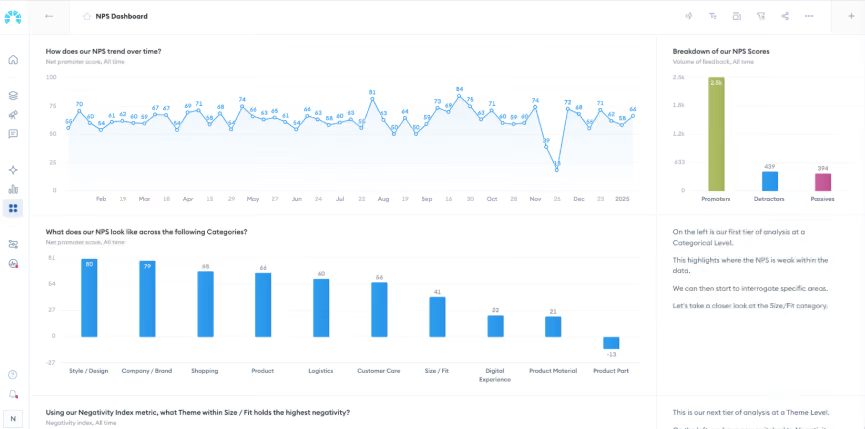
Chattermill is an AI-native customer feedback analytics platform that brings surveys, support tickets, reviews, social posts and call transcripts from 65+ channels into one view, in 100+ languages. Its proprietary Lyra AI tags every comment and goes past sentiment scores to explain why customers feel the way they do. Impact analysis then shows which themes are moving NPS, CSAT, retention and revenue, so teams can rank fixes by business value.
Lyra Agent answers questions like a seasoned analyst, backed by real customer quotes, and MCP brings those insights into Claude or ChatGPT. HelloFresh used it to grow average order value by 30%, and Qonto saved 80+ hours of manual work. Chattermill's XLG team also helps customers turn insights into action.
Pricing: Custom pricing based on feedback volume and use case. There is no per-user fee, so you can add as many users as you need.
Watch out for: The depth of the platform benefits teams with established feedback programs; very early-stage organizations may not yet generate enough volume to take full advantage.
G2 rating: 4.4/5
2. Qualtrics
Best for: Large enterprises with dedicated research teams that need a full experience management suite across customer, employee, product, and brand.
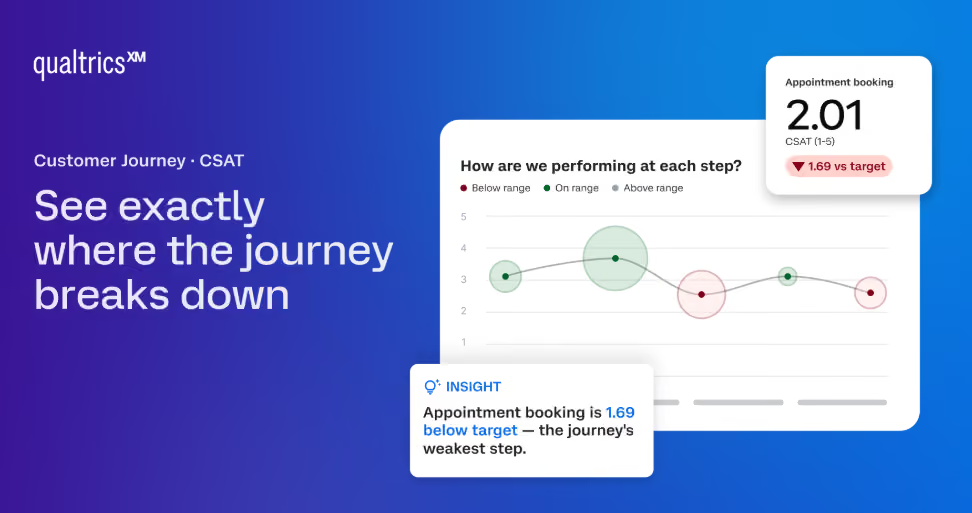
Qualtrics is the dominant name in enterprise experience management. Text iQ and Stats iQ give research teams deep analytical power, and Gartner placed it furthest into the Leaders quadrant of its March 2026 Voice of the Customer Magic Quadrant. In May 2026, Qualtrics closed its $6.75 billion acquisition of Press Ganey Forsta, which owns InMoment, so expect product consolidation ahead. See how the two platforms differ in Chattermill vs Qualtrics.
Pricing: Qualtrics doesn’t publish prices. Plans are custom-quoted and based on planned usage (interactions such as survey responses and calls), with unlimited users included, so you’ll need to contact sales for a figure.
Watch out for: Steep learning curve, especially for teams without dedicated research or analytics staff.
G2 rating: 4.3/5
3. Medallia
Best for: Large enterprises managing omnichannel customer experience programs at operational scale.
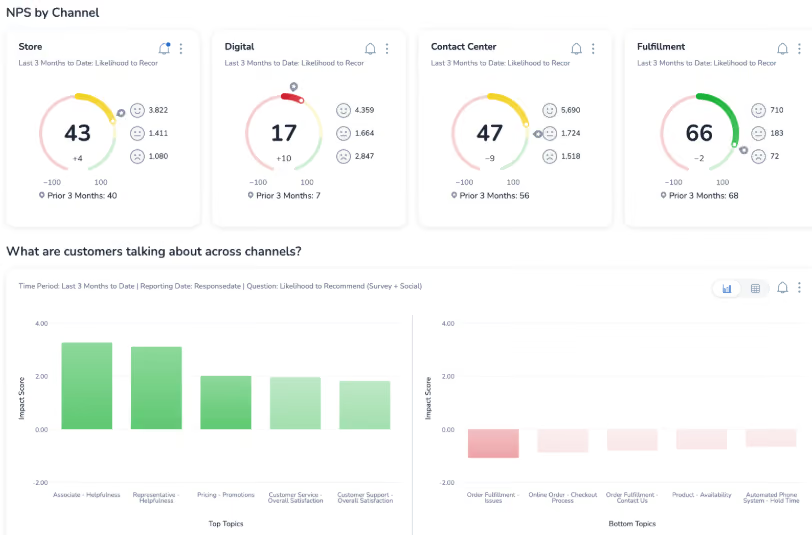
Medallia is an enterprise experience management platform built for organizations that need to capture and act on customer signals across digital, in-store, contact center, and social channels. Its Athena AI powers text analytics and predictive scoring, and action management routes insights to frontline teams in real time. Our Medallia pricing breakdown covers real contract costs, and Chattermill vs Medallia compares the two.
Pricing: Custom, priced per Experience Data Record in annual tiers, with unlimited users. Demo only (Medallia pricing).
Watch out for: Implementation is complex and typically requires professional services.
G2 rating: 4.5/5
4. InMoment
Best for: Enterprise CX analytics teams that need deep text analytics and case management capabilities.
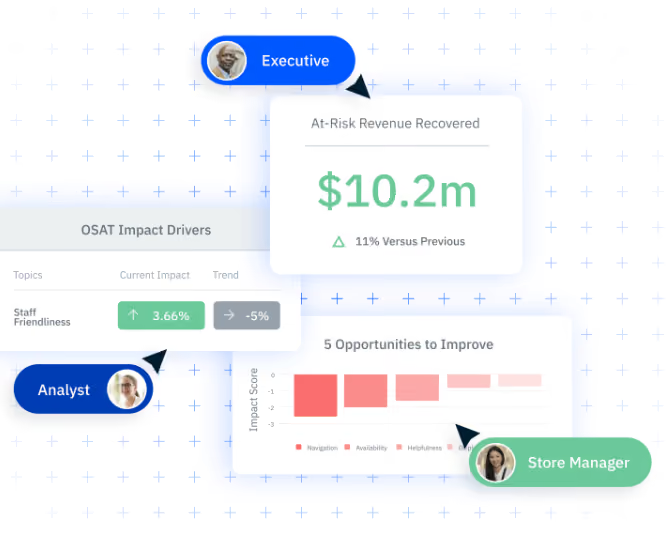
InMoment made its name as a CX analytics platform with particularly strong text analytics, powered by its Lexalytics NLP engine. Case management closes the loop on critical feedback, and journey mapping and benchmarking add context. Ownership has changed twice: Press Ganey Forsta bought InMoment in May 2025, and Qualtrics acquired Press Ganey Forsta in May 2026.
Pricing: Custom, with no published rates. Demo only.
Watch out for: Two owners in 12 months leave the standalone roadmap unclear, so ask how long the product will be supported.
G2 rating: 4.7/5
5. Enterpret
Best for: Product and CX teams that need AI-first feedback classification and anomaly detection across multiple input sources.
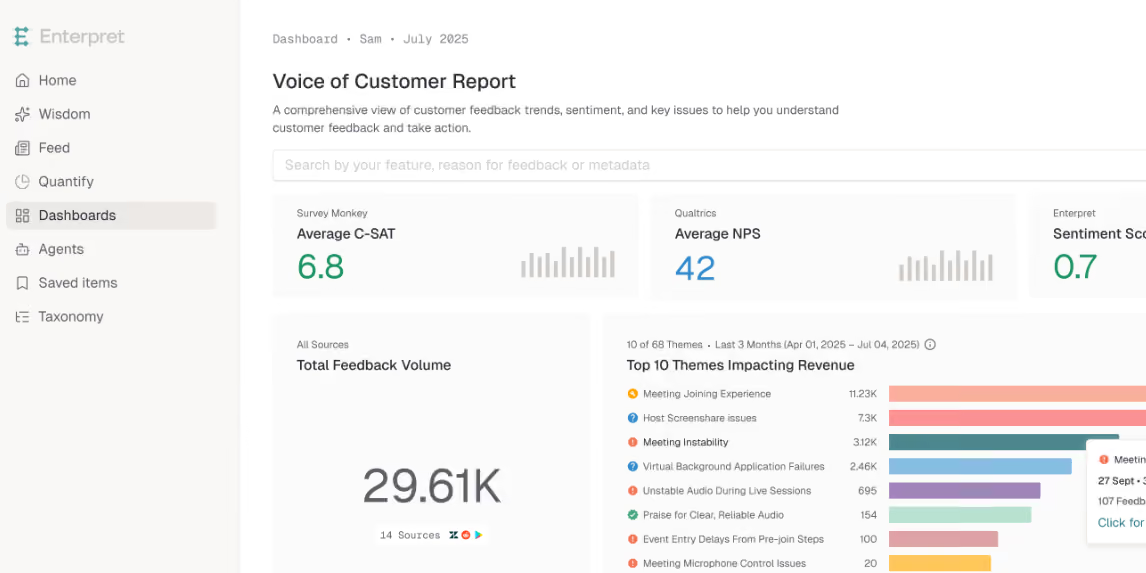
Enterpret is an AI-driven feedback analytics platform that positions itself around its adaptive taxonomy, a machine learning model that continuously learns and refines how it categorizes feedback as new data comes in. It unifies support, survey, review, social and sales call data, flags anomalies, and now offers AI agents and an MCP server. See Chattermill vs Enterpret for a side-by-side comparison.
Pricing: Custom, based on data volume and number of integrations, with unlimited user seats.
Watch out for: Leans toward product feedback over operational CX, and the taxonomy needs time to learn your data.
G2 rating: 4.5/5.
6. Sprinklr
Best for: Large enterprises managing customer experience across social, messaging, and digital channels at global scale.
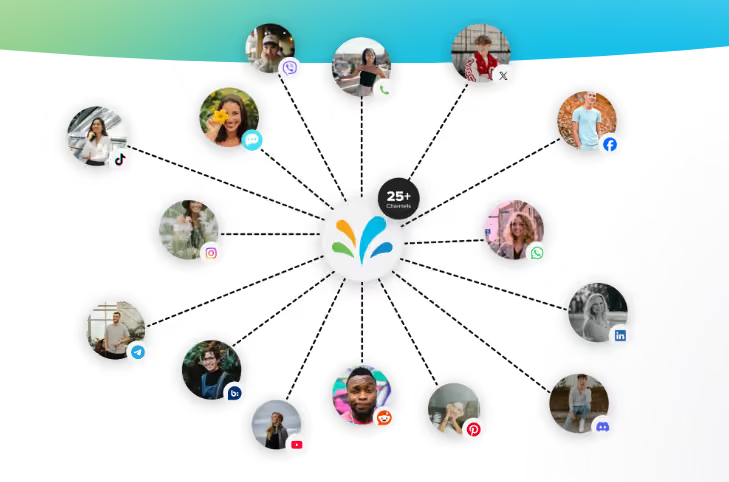
Sprinklr is a unified customer experience management (Unified-CXM) platform that spans social media management, customer care, marketing, and feedback analytics. It listens across 30+ social and messaging channels and feeds that data, with survey and support input, into a central AI engine. For global brands running social, care and feedback in one system, its scale is hard to match.
Pricing: Custom, with no published rates.
Watch out for: Implementation timelines can stretch to months, requiring dedicated resources.
G2 rating: 4.3/5.
7. Khoros
Best for: Enterprises that need to combine community management, social engagement, and customer feedback analytics in a single platform.
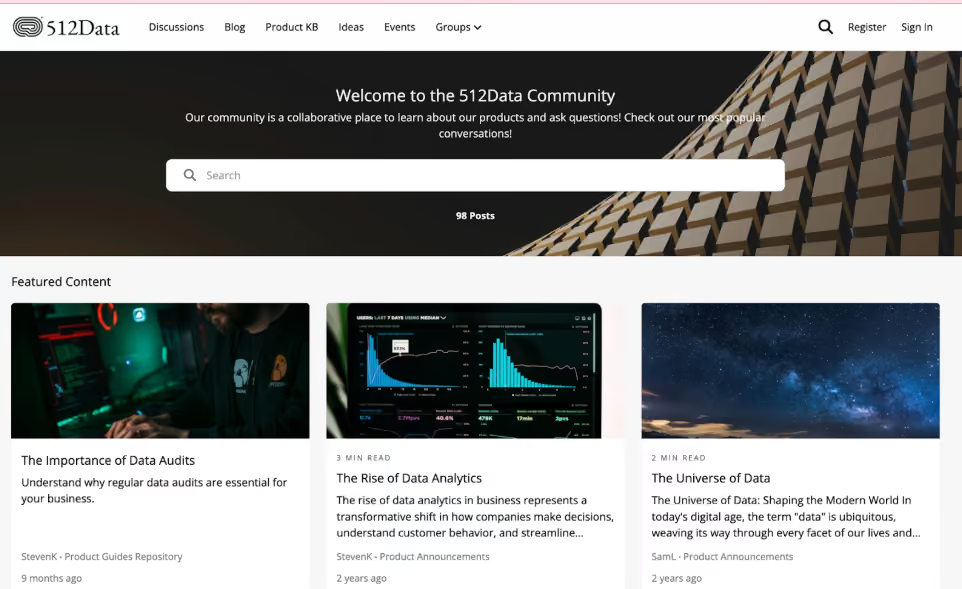
IgniteTech acquired Khoros in May 2025 and has rebuilt it around two AI products: Aurora AI for community and Iris AI for social media management. It analyzes themes and sentiment across branded forums, social channels and care interactions.
Pricing: Custom, with no public pricing page. Demo only.
Watch out for: Less relevant for teams whose feedback comes primarily from surveys or support tickets.
G2 rating: 4.1/5.
Customer Feedback Collection Tools
These tools capture feedback at the source: surveys, in-app prompts, website widgets and post-support ratings. They are the right buy when your problem is getting responses. Once responses run into the thousands, most teams pair them with one of the analysis platforms above or dedicated survey analysis software.
8. Survicate
Best for: Product and marketing teams that need targeted, contextual surveys across websites, emails, and in-app experiences.
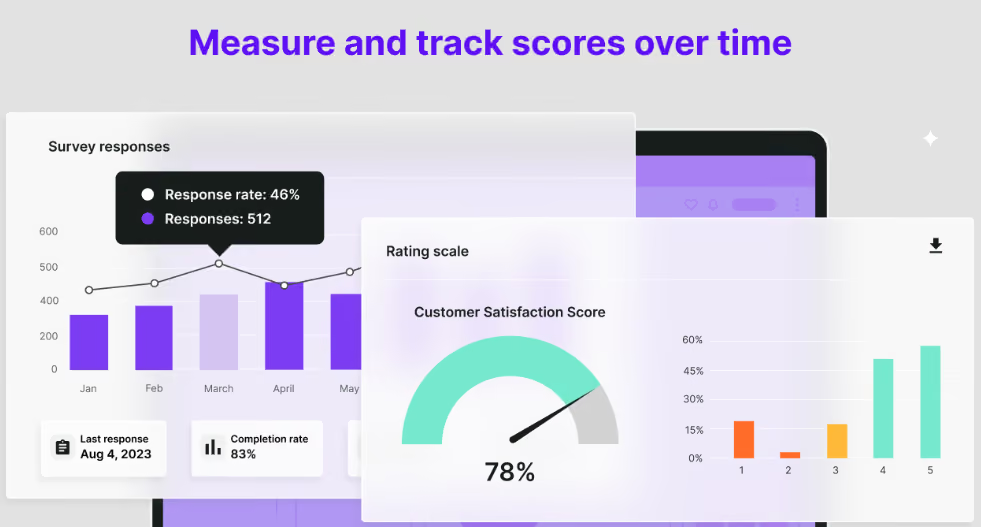
Survicate is a comprehensive survey tool built for teams that want to capture feedback at specific moments in the customer journey without complex implementation. Targeting works off page, scroll depth, time on site and user behavior, and NPS, CSAT and CES surveys can run on autopilot with automated follow-ups. An AI research assistant summarizes open-ended answers, and native integrations cover HubSpot, Intercom, Salesforce and Slack.
Pricing: Survicate has a free 10-day trial, then a Starter plan from about $56/mo (monthly billing), Growth from $114/mo (billed annually, 250 responses/mo), Pro from $349/mo and Enterprise from $569/mo, with the top two priced on a custom response pool.
Watch out for: Open-text analysis is light at high volume, and costs climb with response count.
G2 rating: 4.6/5
9. SurveyMonkey
Best for: Teams that need a familiar, general-purpose survey tool for quick feedback collection and research.
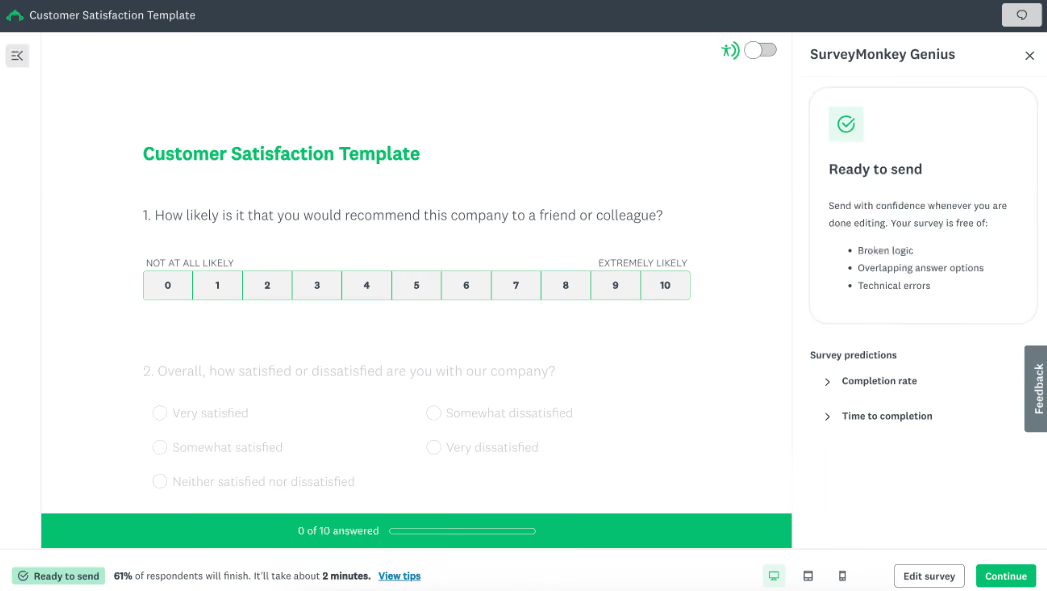
SurveyMonkey is the most widely recognized name in online surveys. Its template library and built-in AI make it quick to launch a CSAT survey or event poll, and sentiment analysis sorts open-ended answers. SurveyMonkey is also consolidating its CX products: GetFeedback Direct shuts down on December 31, 2026, with customers pointed to SurveyMonkey Enterprise, while the website feedback product continues as GetFeedback.
Pricing: SurveyMonkey has a free Basic plan, with individual paid plans from $39/mo (Advantage, billed annually) up to $139/mo (Premier) or $149/mo for Standard on monthly billing; team plans run $30 to $92 per user/mo (3-user minimum, billed annually), and Enterprise is custom-quoted.
Watch out for: Per-user pricing adds up for large teams, and analysis stays survey-only.
G2 rating: 4.4/5
10. Typeform
Best for: Marketing and UX teams that need beautifully designed, high-completion-rate surveys.
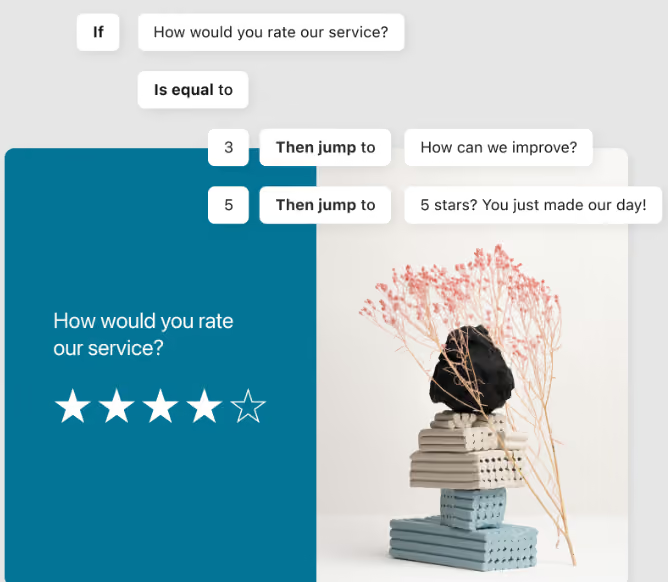
Typeform pioneered the one-question-at-a-time survey format that dramatically improved completion rates compared to traditional survey forms. Branching logic, rich branding and video answers make it a favorite for customer research, post-purchase feedback and lead capture. Its AI summarizes themes and sentiment in open-ended answers, which works well at moderate volumes.
Pricing: Typeform has a free plan, then Basic from $28/mo (100 responses/mo), Plus from $56/mo (1,000 responses) and Business from $91/mo (10,000 responses), all billed annually, or $39, $79 and $129 month-to-month; Enterprise is custom-quoted.
Watch out for: Response caps drive cost on high-volume programs, and long surveys feel slow one question at a time.
G2 rating: 4.5/5
11. SurveySparrow
Best for: Teams that prioritize mobile-friendly, conversational surveys with high response rates.
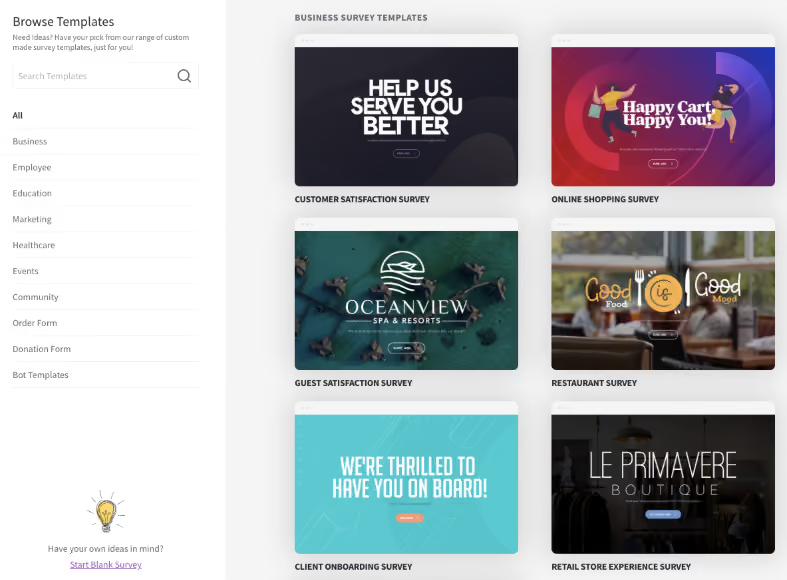
SurveySparrow takes a conversational, mobile-first approach to surveys. Its chat-style format is designed to lift completion on phones, and an AI survey builder generates surveys from a text prompt. An offline app collects feedback without internet access, which suits retail, hospitality and events. Surveys go out by email, SMS, WhatsApp, QR code and web embed.
Pricing: SurveySparrow has a forever-free plan, then Basic from $19/mo, Starter from $39/mo and Business from around $79/mo, all billed annually with quarterly billing costing up to 40% more; Enterprise is custom-quoted.
Watch out for: Reporting is basic next to enterprise platforms, and the chat format suits short surveys better than long research.
G2 rating: 4.4/5
12. Alchemer
Best for: Research teams that need highly flexible, advanced survey design with complex logic and in-app interactions.
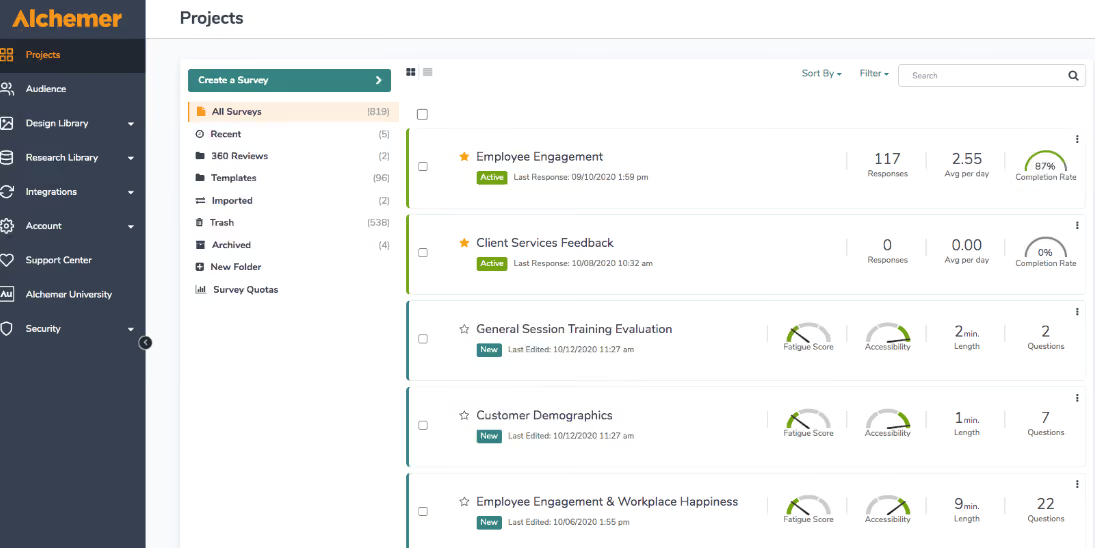
Alchemer (formerly SurveyGizmo) is an advanced survey platform aimed at teams that need more control over survey design, logic, and data handling than consumer-grade tools provide. Branching, piping, quotas and custom scripting handle sophisticated research, and role-based dashboards tailor reporting by stakeholder. Alchemer acquired review and social feedback platform Chatmeter in 2025, which widens it beyond surveys.
Pricing: Alchemer’s small-team plans run per user: Collaborator at $55/mo or $315/yr, Professional at $165/mo or $1,075/yr, and Full Access at $275/mo or $1,895/yr (max 3 users), with a 7-day free trial; larger Platform plans are custom-quoted.
Watch out for: Steeper learning curve than simpler tools, and per-user pricing grows with team size.
G2 rating: 4.4/5
13. Zonka Feedback
Best for: Mid-market and enterprise teams that want omnichannel feedback collection with built-in AI analytics in a single platform.
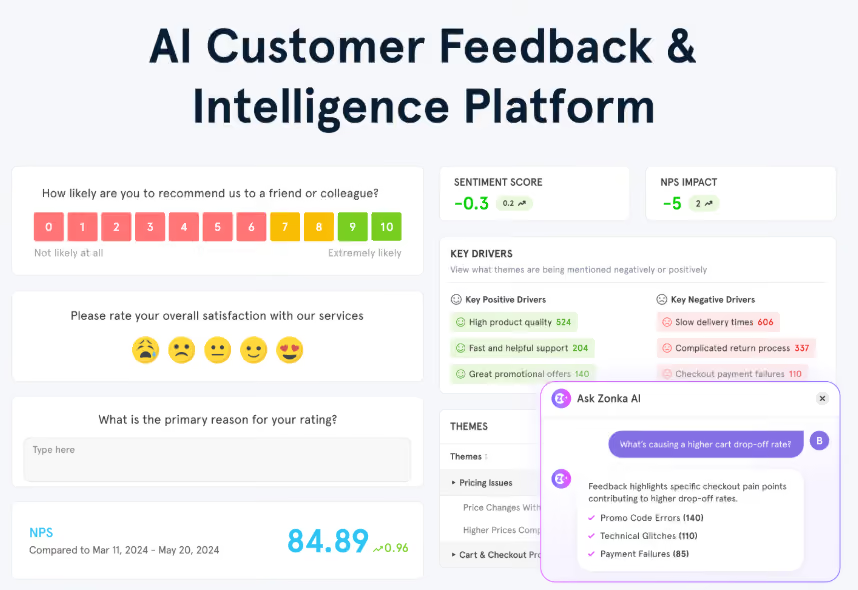
Zonka combines survey distribution across email, SMS, WhatsApp, web, in-app, kiosk and offline channels with AI theme detection, sentiment and impact scoring tied to NPS, CSAT and CES. Its CX automation workflows can trigger actions based on feedback scores, routing detractors to support teams and promoters to review platforms. White-label surveys make it flexible for agencies and multi-brand teams.
Pricing: Custom, based on response volume or AI data credits.
Watch out for: AI analysis sits on top of a survey product, so it goes less deep than dedicated analysis platforms on complex, multi-source programs.
G2 rating: 4.7/5
14. Refiner
Best for: SaaS product teams that need in-app microsurveys to collect contextual feedback at key moments in the user journey.
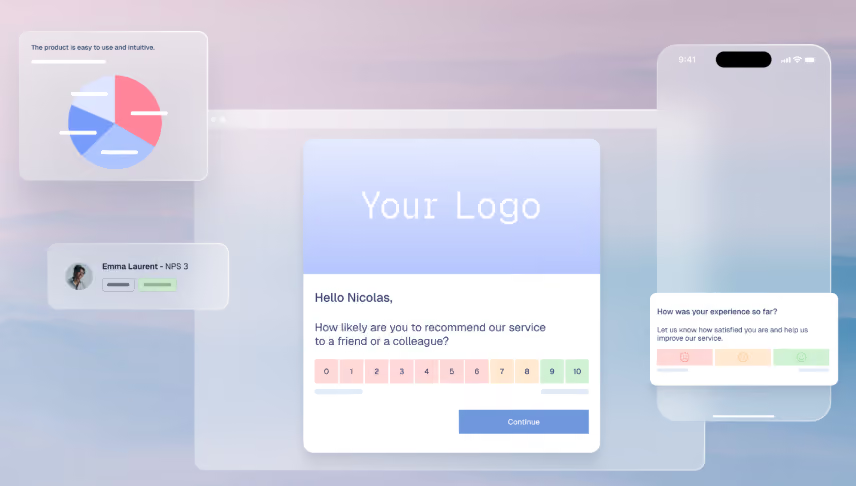
Refiner is a lightweight, developer-friendly feedback tool built specifically for SaaS products. It triggers short NPS, CSAT, CES and custom surveys after onboarding, feature adoption or before cancellation, targeted by plan, activity and custom attributes. A JavaScript widget, REST API and native Segment sync keep setup simple, and responses push to HubSpot and Salesforce.
Pricing: Refiner prices on monthly active users rather than responses. At 5,000 MAU, Essentials is $149/mo and Growth $279/mo, both with unlimited responses and scaling up as your user base grows; Enterprise is custom-quoted.
Watch out for: Built for in-app SaaS feedback only, with light analysis.
G2 rating: 4.6/5
15. Hotjar (Now Part of Contentsquare)
Best for: UX and product teams that want to combine behavioral data (heatmaps, session recordings) with on-site feedback.
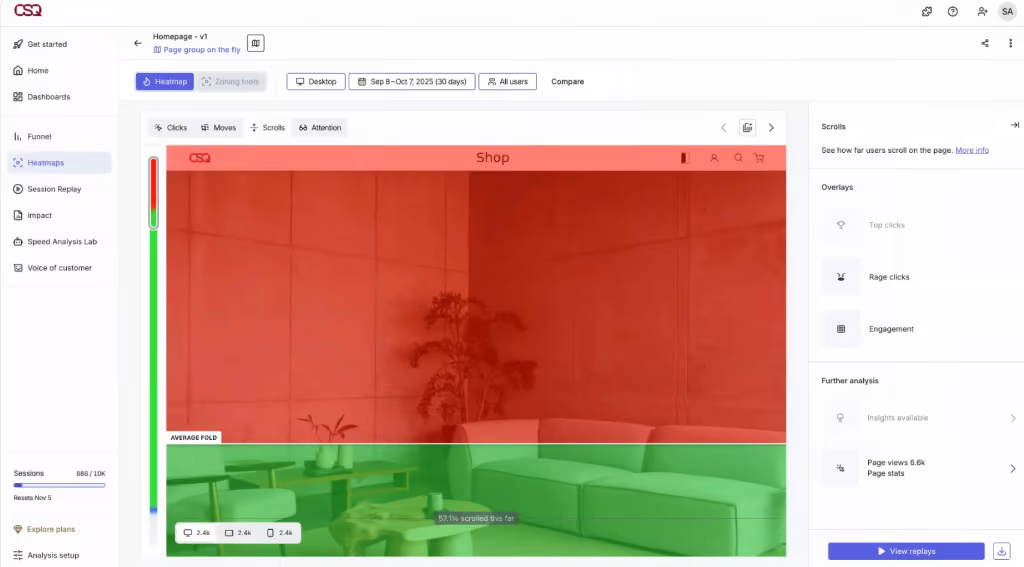
Hotjar merged into the Contentsquare Group in July 2025, and its plans are now sold through Contentsquare. The core idea is unchanged: heatmaps, session recordings and funnels show what visitors do, while on-site surveys and feedback widgets capture why. For conversion and redesign work, that pairing is hard to beat.
Pricing: Contentsquare has a free plan and a Growth plan from $39/mo billed yearly or $49 monthly, priced by session volume; Pro and Enterprise on the full Experience Platform are custom-quoted.
Watch out for: Covers website and web app experiences only, not support, reviews or calls.
G2 rating: 4.3/5
16. AskNicely
Best for: Service businesses focused on NPS-driven frontline coaching and customer experience improvement.
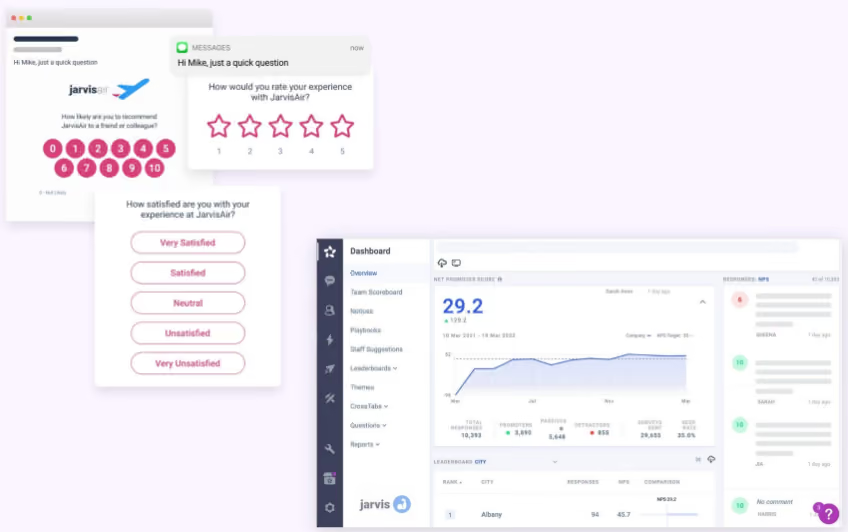
AskNicely is an NPS-focused customer feedback platform built specifically for service businesses, franchise operations, and multi-location organizations. It collects NPS and CSAT, then uses NiceAI to turn responses into coaching summaries for frontline managers. Leaderboards compare scores across teams and locations, which builds accountability in distributed businesses.
Pricing: Custom, scaling with response volume. There is no free trial.
Watch out for: Narrow focus on frontline NPS, with no multi-channel analysis.
G2 rating: 4.7/5
17. Zendesk
Best for: Support-driven organizations that want to embed CSAT and feedback collection directly into their existing ticketing workflows.
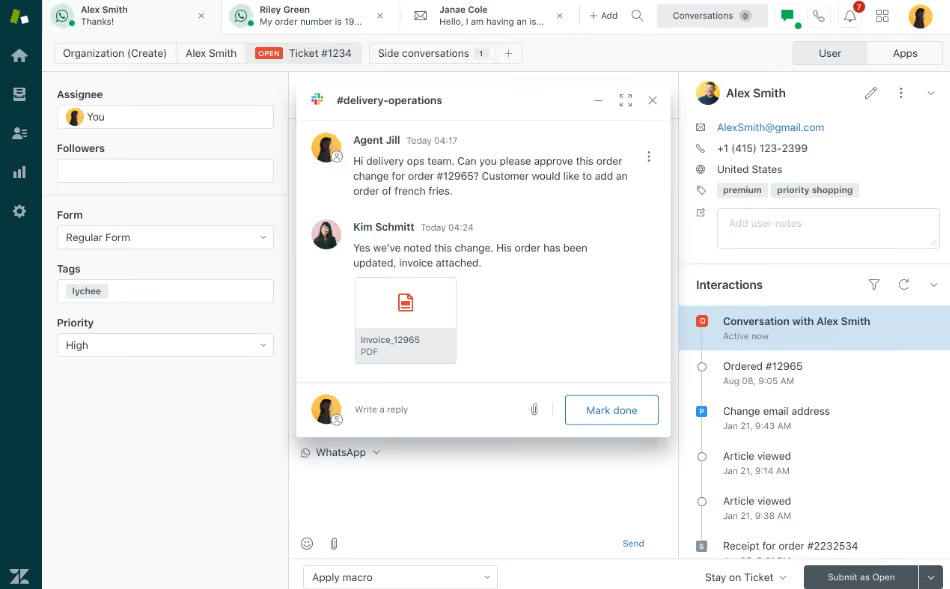
Zendesk is primarily a customer support and ticketing platform, with post-resolution CSAT surveys, satisfaction ratings and support reporting built in. Zendesk is investing heavily in AI agents, including its March 2026 acquisition of Forethought, but its feedback reporting stays focused on support interactions. Many teams use it as a data source rather than their analysis layer.
Pricing: No free plan, but a 14-day free trial. Support Team starts at $19/agent/month billed annually ($25 billed monthly), and Suite Team at $55/agent/month billed annually. Suite Professional starts at $115/agent/month and Suite Enterprise + Copilot is custom-quoted.
Watch out for: No view of feedback from surveys, reviews or social outside the support queue.
G2 rating: 4.3/5
18. Nicereply
Best for: Customer support teams that need lightweight, in-signature CSAT, NPS, and CES surveys directly inside helpdesk tools.
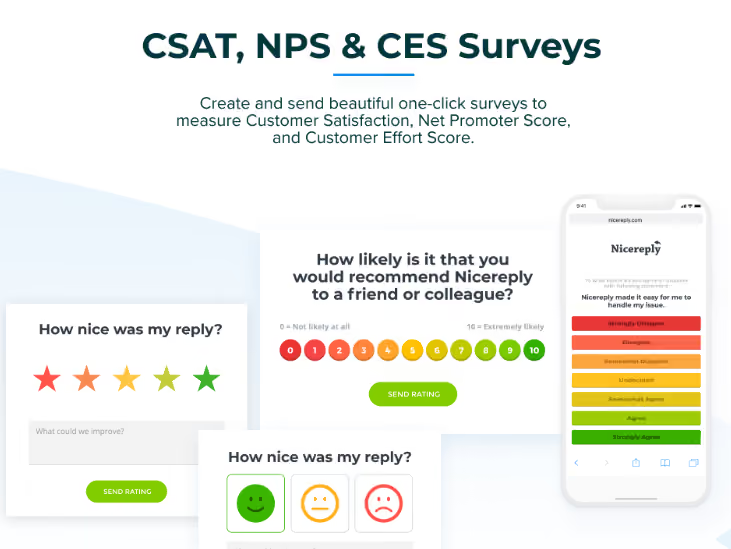
Nicereply focuses on one thing and does it well: collecting satisfaction feedback from support interactions with minimal friction. Customers rate the experience directly in the email reply or signature, without clicking through to a survey page, which lifts response rates. Native integrations cover Zendesk, Freshdesk and LiveAgent, and agent-level dashboards support coaching.
Pricing: Nicereply prices by monthly responses: Starter from $59/mo, Essential $119/mo, Growth $239/mo and Business $359/mo, all billed annually with monthly billing about 20% higher; there’s a 14-day free trial and custom pricing for larger teams.
Watch out for: Support feedback only, with basic analytics.
G2 rating: 4.5/5
Feedback Management and Prioritization Tools
These tools turn a stream of feature requests into a ranked backlog and a public roadmap. They suit product teams deciding what to build next. For tools that link feedback straight into planning, see our guide to feedback-to-roadmap tools.
19. Canny
Best for: Product teams that need to collect, organize, and prioritize feature requests with customer voting and public roadmaps.
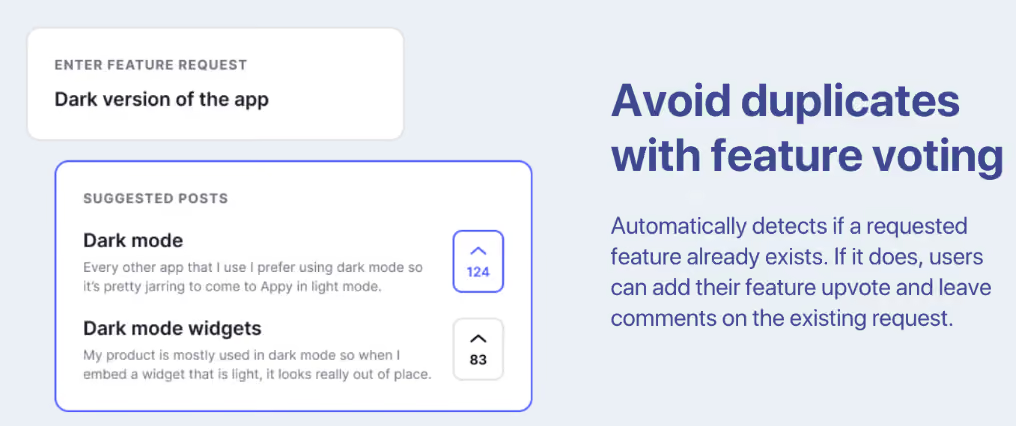
Canny is a feature request management platform that helps product teams collect feature ideas from customers, let users vote on priorities, and communicate product decisions through public and private roadmaps. AI groups duplicate requests, a changelog closes the loop with requesters, and integrations push work into Jira, Linear and Asana. Canny also offers an MCP connection for using its data in AI assistants.
Pricing: Free plan for up to 25 tracked users, plus a 14-day free trial of paid plans. Pro starts at $79/month billed yearly, or $99 billed monthly.
Watch out for: Built for feature requests, not NPS, CSAT or sentiment analysis.
G2 rating: 4.5/5
20. UserVoice
Best for: Product managers who need a structured system for collecting, prioritizing, and acting on customer feedback to build better products.
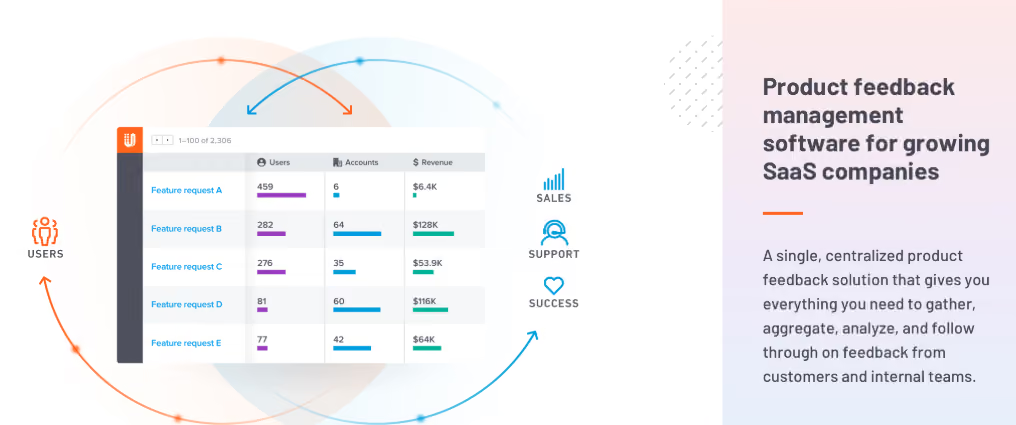
UserVoice differentiates itself through its prioritization engine, which helps product managers weigh feature requests by revenue impact, customer segment, and strategic alignment rather than just raw vote counts. Customer-facing teams can log feedback on behalf of customers, and AI Themes & Trends groups incoming requests. Integrations include Jira, Salesforce, Slack and Zendesk.
Pricing: Custom, based on feedback volume, tools and integrations rather than seats.
Watch out for: Focused on product planning, not CX sentiment or support analytics.
G2 rating: 4.5/5
How to Choose Customer Feedback Software
Start with the job, not the feature list. Three questions narrow the field fast:
- Is your problem getting feedback or understanding it? If response volume is low, start with a collection tool. If you already have thousands of comments a month across channels, you need an analysis platform.
- How many channels need to sit in one view? A survey tool covers surveys. Unifying tickets, reviews, social and calls takes a platform built to ingest them, with native integrations for the tools you already run.
- Who has to act on it? Product teams prioritizing features suit Canny or UserVoice. CX leaders who must show leadership how feedback affects NPS, retention and revenue need impact analysis, not just sentiment scores.
Before you sign, run a pilot on your own data, check SOC 2 and GDPR compliance, and ask how pricing scales with volume. Many enterprise teams end up with one collection tool and one analysis layer, which is why most analysis platforms connect to the survey tools on this list.
Finding the Right Mix of Customer Feedback Software
The customer feedback tools landscape in 2026 rewards specificity. For enterprise CX, insights and product teams with feedback spread across many channels, Chattermill connects what customers say to the metrics leadership cares about. Survicate, Typeform and SurveyMonkey get you responses, and Canny and UserVoice turn requests into a roadmap.
Ready to see how Chattermill unifies your customer feedback into actionable intelligence? Book a demo and explore the platform with your own data.
FAQs
What Is Customer Feedback Software?
Customer feedback tools help businesses collect, organize, analyze and act on customer input. They fall into three groups: collection tools like survey builders, management tools for feature requests, and AI-powered analysis platforms.
What Is a Good Free Feedback App?
It depends on the feedback type. SurveyMonkey and Typeform offer free basic surveys, Survicate and Refiner give 25 free responses a month, and Canny is free for up to 25 tracked users. Fine for testing, but caps run out fast at enterprise volume.
What Are 5 Methods of Obtaining Feedback From Customers?
The five most common are NPS, CSAT and CES surveys, in-app and website widgets, feature request boards, support conversations, and online reviews and social posts. The first three ask directly; the last two capture unprompted feedback, often the most honest and hardest to read at scale.
What Are Examples of CX Tools?
CX tools include survey platforms like SurveyMonkey, helpdesks like Zendesk, feedback boards like Canny, experience analytics like Hotjar, and analysis platforms like Chattermill. Each covers one part of the experience; the analysis layer connects them, linking feedback to NPS and CSAT.
What Is the Most Popular Survey Tool?
SurveyMonkey is the most widely used, with more than 24,000 reviews on G2, far more than any other tool on this list. Popular does not always mean right for your team, though. Typeform suits branded surveys, Qualtrics suits enterprise research, and Survicate or Refiner suit in-app surveys.
What Is The Difference Between A Survey Tool And A Feedback Analytics Platform?
Survey tools like Typeform and SurveyMonkey collect feedback through structured questionnaires. Analytics platforms like Chattermill pull feedback from every channel and use AI to find themes and trends. Choose a survey tool to collect responses; choose analytics to understand thousands of them and tie them to business outcomes.


See Chattermill in action on your own feedback
Book a demo


