


How to Analyze Call Center Transcripts With AI


The CX intelligence
platform that's AI-native by design
Book a demoQuick Summary
AI call transcript analysis turns recorded support calls into searchable, scored data. Speech-to-text and NLP models surface sentiment shifts, recurring topics, and compliance flags. The core workflow: transcribe with speaker separation, redact PII, theme and score against a QA rubric, then route insights to coaching and CX teams.
What Is AI Call Transcript Analysis?
AI call transcript analysis applies speech-to-text and natural language processing to recorded calls. It converts audio into text, then scores that text for sentiment, intent, and risk.
Why Listen To Us
Chattermill's Speech Analytics has transcribed and analyzed contact center conversations for enterprises like Uber and HelloFresh. Our Lyra AI engine already processes millions of customer interactions across channels. This guide reflects patterns we've seen scoring real call transcripts for sentiment, compliance, and root cause inside high-volume support operations.
Call Center Transcript Analysis Real-life Example
Picture one support call about a duplicate charge. The system transcribes it first, separating the customer's voice from the agent's, turn by turn.
Agent:
Hello, thank you for calling customer support. How can I help you today?
Customer:
Hi, I hope you are well. I was charged twice for the shoes I bought from you earlier today.
Agent:
I’m sorry to hear that. Please give me your order number so I can see how I can solve this for you.
Customer:
Okay, I’ll do that shortly. This is disappointing because this is the third time I've called you about the same issue.
Agent:
Once again, please accept our apologies. I know it must be frustrating for you.
Sentiment scoring runs next. The model tracks tone across the whole call, not just the end. It flags a sharp dip when the customer says this is the third call about the same issue.
Intent classification follows. The model tags the call as a billing dispute with repeat contact. That tag routes the case differently than a one-off question would.
Next, a compliance check runs on the transcript as well. The rubric requires agents to verify identity before discussing account details. This agent skipped that step, so the system flags it for review.
Within minutes, a QA lead sees the full picture:
- dropping sentiment
- a repeat contact
- a missed compliance step
No one had to listen to the recording to catch any of it.
That sentiment dip and the missed compliance step both link to a business impact score, so a CX leader sees the business impact of the call, not just the transcript. This is why transcript analysis matters: it connects call details to outcomes teams can act on.
Why Analyze Transcripts With AI?
Handling call center transcripts manually has many limitations, including:
Manual QA Doesn't Scale
Your QA team reviews a fraction of calls. The majority hold sentiment shifts, compliance risks, and churn signals nobody sees. AI call transcript analysis closes that gap. It instantly turns every recording into structured, searchable insight your CX teams can act on today.
Insights Are Buried In Calls
Most QA programs sample one or two calls per agent each month. Compare that to the thousands of calls flowing through the center each week. The math alone explains why most issues stay invisible until they show up in churn or NPS data weeks later.
Coaching Delays
Coaching also lags behind. By the time a supervisor reviews a call and flags a coaching moment, days have passed. The agent has already taken dozens more calls the same way.
By turning every call into immediate insight, AI helps teams act faster, coach smarter, and handle customer experience at scale. That same value carries into the specific signals AI can extract from transcripts next.
What You Can Extract From Call Transcripts
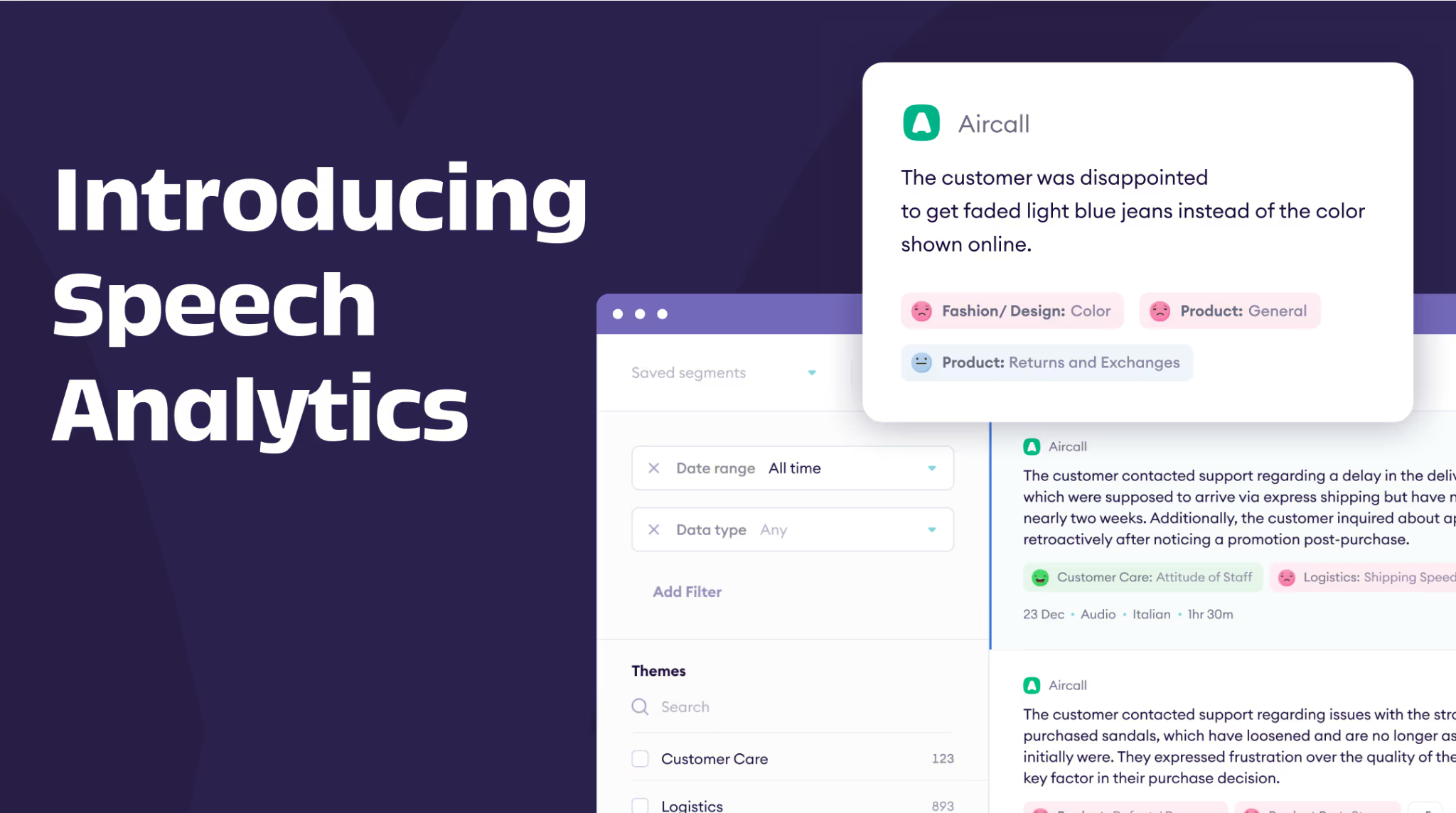
Once calls are transcribed, AI can pull far more than a sentiment score. Here's what actually surfaces.
1. Sentiment and Emotion Shifts
Sentiment analysis tracks tone turn by turn, not just an overall score.
It captures the moment when a neutral call turns frustrated, or when a frustrated customer calms down. That subtle shift, not the average tone, is often the most useful signal for coaching and root-cause work.
2. Recurring Topics and Intents
Topic and intent models group calls by what they're actually about:
- billing
- cancellations
- product bug
Patterns emerge fast once hundreds of calls share the same tag. A spike in one intent often signals a process or product issue worth investigating.
3. QA and Compliance Scoring
AI can also automatically score every call against a QA rubric: greeting, verification, required disclosures, and hold time.
It flags missed steps for review instantly. You don't have to wait for a supervisor to catch them by chance during a random spot check.
4. Churn and Deal-Risk Signals
Certain phrases predict churn or a stalled deal:
- cancellation language
- repeated escalation requests
- comparisons to a competitor
AI surfaces these signals across every call. CX and sales teams can then intervene before the customer leaves or the deal goes cold. Pair these mentions with win-loss data, and you get an early signal on competitive pressure before it appears in churn reports.
5. Competitor Mentions
Customers often name competitors mid-call, comparing price, features, or service.
Manual QA almost never catches these mentions. AI tags every one, giving product and marketing teams direct, unprompted feedback on how the market sees them.
6. Agent Performance Patterns
AI can also spot coaching opportunities across agents:
- Who handles de-escalation well?
- Who rushes through verification?
- Who consistently resolves disputes on the first call?
Patterns like these are hard to see one call at a time, but obvious in aggregate.
How to Analyze Call Transcripts With AI, Step by Step
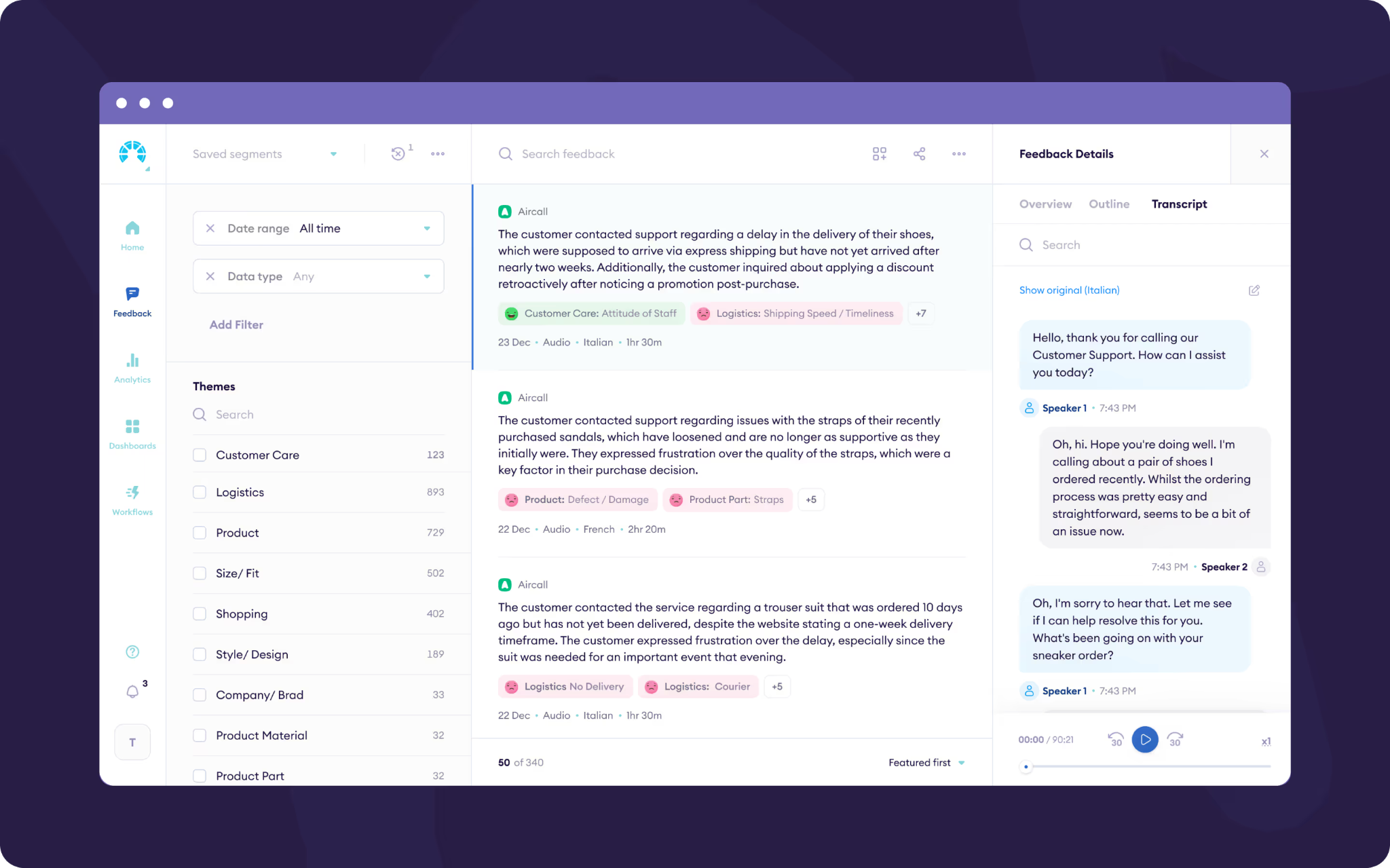
Most teams follow roughly the same five-step process, whether they build in-house or buy a platform. It begins with capturing calls and ends with routing insights into action.
1. Capture and Transcribe With Speaker Separation
Every call is recorded and then transcribed using speech-to-text.
Speaker separation matters here.
The system must label who said what, agent versus customer. Without that split, sentiment and compliance scoring later in the pipeline lose accuracy fast. Most platforms handle this automatically once audio is connected via API or call recording integration.
2. Redact PII Before Anything Else Touches the Data
Before any model analyzes the transcript, strip out names, card numbers, and other personal details.
Redaction should happen automatically, not as a manual afterthought. This step protects customers and keeps the rest of the pipeline compliant by design.
3. Categorize and Theme the Conversation
Once the transcript is clean, NLP models tag the call by topic and intent.
Themes should roll up automatically: billing, technical issue, or cancellation request, so volume trends are visible without anyone tagging calls by hand.
4. Score Against a QA Rubric
Map your existing QA rubric into rules the model can apply consistently:
- greeting
- verification
- required disclosures
- resolution confirmation
AI scoring removes the inconsistency that comes from different supervisors grading the same call differently.
5. Route Insights to Coaching and CX Workflows
Scores and flags are only useful if they reach someone important.
Push low-sentiment calls and missed compliance steps straight into coaching queues. Route recurring themes into CX and support workflows so the wider team sees what's emerging, not just the call center.
Treat this as a pipeline, not a one-time project. Each stage feeds the next, and gaps anywhere weaken everything downstream. With that in place, the next question is how to manage accuracy and governance.
Accuracy and Governance in Call Center Analytics

AI call transcript analysis is only as good as its accuracy and its guardrails. Before rolling this out widely, get clear answers on five things. Start with transcription error rates, since every downstream score depends on them.
1. Transcription Error Rates
Even strong speech-to-text engines make mistakes. Typically, it's a small percentage of words on clean audio.
Error rates climb on noisy lines, fast talkers, and industry jargon. Generic engines often post low error rates on benchmark datasets, then perform worse on real call center audio, with hold music, overlapping speakers, and call center headsets all in play.
Always check word error rate on your own call data before trusting downstream scores.
2. Handling Accents and Crosstalk
Accents and overlapping speech are still hard for transcription engines to pick.
Crosstalk, when agent and customer talk over each other, can scramble speaker labels. Look for vendors who train on your actual call population, not a generic benchmark dataset.
3. PII and Compliance Risk
Call transcripts often contain card numbers, health details, and other regulated data.
Redaction needs to happen before storage, not after.
Confirm where transcripts live, who can access them, and how long they're retained before rolling this out widely. Ask vendors for an audit trail showing who accessed which transcript and when, not just a redaction feature.
4. Multilingual and Global Call Centers
Accuracy problems multiply across languages.
A model tuned for English won't necessarily transcribe German or French calls at the same quality. This is especially relevant for global brands managing support across multiple regions and languages at once.
If your call centers operate in multiple languages, test transcription and theme detection separately for each one, not just the dominant language in your dataset.
5. Why Human-in-the-Loop Still Matters
AI scoring is fast, not infallible.
Use human review to catch edge cases, confirm accuracy, and keep the workflow reliable. Use human review to catch edge cases and confirm the calls that matter most.
Spot-check a sample of AI-flagged calls against human judgment every week. Set a fixed calibration cadence, weekly or biweekly. That way, you catch drift on a schedule, not by accident. This keeps the model honest and gives your team confidence in scores they didn't generate themselves.
Get these five right, and AI scoring becomes something your team trusts, not something they have to double-check constantly.
Using AI to Analyze Calls: How Chattermill Helps
Chattermill's Speech Analytics transcribes and analyzes call center conversations using Lyra AI. The same powerful engine processes surveys, support tickets, reviews, and social feedback. That matters because calls rarely tell the whole story on their own.
A theme that shows up in calls often appears in support tickets and reviews too. Chattermill connects all of it. So a compliance flag from a call sits next to the NPS impact of that same issue, in one view.
Business Impact Mapping
Most call analytics tools stop at the transcript.
They score the call and leave it there, disconnected from the rest of your feedback. Chattermill routes call insights into the same business impact mapping as every other channel, so coaching, product, and CX teams work from one shared picture instead of five disconnected ones.
Multilingual Support
This matters most for compliance and multilingual operations. A call center operating in English, German, and French needs theme detection that works consistently across all three languages, not just in the dominant one. Chattermill's multilingual analysis was built for exactly that kind of global operation, the same one Uber runs across five regions.
Coaching and Compliance
Chattermill also connects to the systems coaching and CX teams already use. Compliance flags and low-sentiment calls can route straight into existing workflows instead of living in a separate dashboard nobody checks. That's the difference between a call analytics point solution and a feedback platform built to connect every channel.
See how it works on the product tour, or explore real customer outcomes.
Make AI Call Transcript Analysis Part of Your Stack
Call transcripts hold some of the richest, least-used feedback you have.
An intelligent AI call transcript analysis system turns that audio into searchable, scored data, without adding headcount to QA. Pair it with the rest of your feedback stack, and calls stop being an isolated silo.
Ready to see it in action? Book a demo.
Call Center AI Transcription FAQ
1. What's the difference between transcription and transcript analysis?
Transcription just converts audio to text. Analysis goes further, scoring that text for sentiment, intent, themes, and compliance risk. Transcription is the input, while analysis is what makes it useful for coaching, CX, and product decisions.
2. How accurate is AI transcription?
Accuracy varies by vendor, audio quality, and accent diversity. Clean, single-speaker audio scores well. Noisy lines, crosstalk, and heavy accents increase errors. Always validate word error rate against your own call data before relying on downstream scores.
3. Does AI call analysis replace human QA?
No. AI expands coverage from a small sample to every call, but humans still need to spot-check flagged calls, calibrate the rubric, and handle nuanced judgment calls AI can miss.
4. How is PII handled in call transcripts?
PII should be automatically redacted before transcripts are stored or further analyzed. Names, card numbers, and health details are stripped or masked, keeping the pipeline compliant by design rather than as an afterthought.
5. Can AI connect call insights to other feedback channels?
Yes, on platforms built for it. Chattermill, for example, analyzes calls alongside surveys, support tickets, reviews, and social feedback in a single system, so themes that surface in calls connect directly to business metrics.

See Chattermill in action on your own feedback
Book a demo


