

Chattermill and Zonka Feedback both analyse customer feedback with AI, but they serve different teams at different scales. Chattermill is an enterprise-grade analytics engine that processes feedback across 99+ languages with aspect-based sentiment analysis, social CX analytics, and speech analytics. Zonka Feedback combines survey creation with AI-driven intelligence and closed-loop case management. This guide breaks down features, pricing, pros, cons, and review ratings so you can pick the right platform for your team.
Quick Summary
- Analytical approach: Chattermill uses Lyra AI for aspect-based sentiment analysis (ABSA), phrasal analysis, and clustering. Zonka Feedback applies thematic analysis, entity tracking, and AI impact scoring at the theme level.
- Scale: Chattermill is built for enterprise B2C and B2B teams processing high-volume, multi-channel feedback. Zonka Feedback serves mid-market to enterprise teams, including multi-location businesses.
- Unique to Chattermill: Social CX analytics across Facebook, Instagram, TikTok, X, YouTube, and Reddit with competitor benchmarking. Speech analytics with transcription and ABSA. MCP server for querying feedback data inside AI agents.
- Unique to Zonka Feedback: Built-in multi-channel survey builder (offline, email, SMS, WhatsApp, in-app SDK). Closed-loop feedback management with centralised inbox, case management, and detractor follow-up. Location and frontline analytics. HIPAA compliance.
- Reviews: Chattermill holds 4.5/5 across 355 verified reviews on G2, Capterra, and Gartner. Zonka Feedback holds 4.7/5 on G2 and 4.8/5 on Capterra across 149 total reviews.
- Pricing: Chattermill offers custom enterprise pricing (contact for quote). Zonka Feedback starts at $99/month (G2); Feedback Management plan at $199/month (Capterra).
- Best for: Chattermill fits enterprise CX, insights, and product teams that need deep multilingual analytics, social and voice channel coverage, and AI agent integration. Zonka Feedback fits mid-market teams that need survey creation, closed-loop workflows, and location-level analytics in one platform.
Why Listen to Us
Chattermill processes millions of pieces of customer feedback for enterprise brands including HelloFresh, Booking.com, Amazon, Uber, and H&M. This guide draws on hands-on platform expertise and verified third-party data from G2, Capterra, and Gartner Peer Insights to give you a fair, detailed comparison of both platforms' capabilities, pricing, and fit.
What Is Zonka Feedback?
Zonka Feedback is an AI customer feedback and intelligence platform that combines survey creation, feedback collection, and analytics in a single product. The platform has repositioned significantly from its survey-first origins: it now offers Zonka AI with thematic analysis, entity and aspect tracking, sentiment scoring, AI impact analysis, and a natural-language query tool called Ask AI.
Zonka Feedback is used by mid-market and multi-location businesses, with named customers including SmartBuyGlasses. The platform supports feedback collection across offline kiosks, email, SMS, WhatsApp, websites, in-product embeds, and mobile SDKs, giving teams a broad set of collection channels alongside its analytics.
What sets Zonka Feedback apart is its closed-loop feedback management. A centralised inbox, automated case management, and detractor follow-up workflows let teams act on feedback without switching tools. Location and frontline analytics add a layer specifically designed for businesses monitoring branch and staff performance across multiple sites. The platform also holds GDPR, HIPAA, and ISO 27001 compliance certifications.
How Does Zonka Feedback Compare to Chattermill?
The core distinction comes down to depth of analysis versus breadth of workflow. Chattermill focuses on turning high-volume, multi-channel feedback into granular intelligence using aspect-based sentiment analysis, social listening, and speech analytics. Zonka Feedback covers the full lifecycle from survey creation through collection, analysis, and closed-loop response. So the real question is: does your team need deeper analytical horsepower, or a single platform that handles collection and action alongside analytics?
Head-to-Head Comparison Table: Chattermill vs Zonka Feedback
| Dimension | Chattermill | Zonka Feedback |
|---|---|---|
| Core Strength | Deep AI analytics across all feedback channels | End-to-end feedback lifecycle: collect, analyse, act |
| Native Integrations | Salesforce, HubSpot, Zendesk, Intercom, Freshdesk, Tableau, Looker, Power BI | Salesforce, HubSpot, Zendesk, Intercom, Freshdesk, Jira, Slack, MS Teams, Zapier, Make |
| Multilingual Support | 99+ languages with native analysis | Multi-language surveys; analytical depth across languages not publicly specified |
| Sentiment Analysis | Lyra AI: aspect-based sentiment analysis (ABSA) at concept level | Theme-level sentiment scoring with AI impact analysis |
| Feedback Response / Close-the-Loop | Alerting and anomaly detection; no native case management | Centralised inbox, automated case management, detractor follow-up workflows |
| Speech Analytics | Transcription, ABSA, and theme analysis across call recordings | Calls listed as input source; no dedicated speech analytics |
| Social CX Analytics | Facebook, Instagram, TikTok, X, YouTube, Reddit + competitor benchmarking | Social media as feedback source; no native social analytics or benchmarking |
| AI Agent Integration | MCP server for querying feedback inside AI agents | Not available |
| G2 Rating / Reviews | ||
| Notable Customers | HelloFresh, Booking.com, Amazon, Uber, H&M | SmartBuyGlasses |
| Best For | Enterprise CX, insights, and product teams needing deep multilingual analytics | Mid-market teams needing survey creation + analytics + closed-loop in one platform |
| Pricing | Custom enterprise pricing | Starts at $99/mo; Feedback Management at $199/mo |
Chattermill Review
.avif)
Overview
Chattermill is an AI-native feedback analytics platform built for enterprise teams that need to consolidate, analyse, and act on customer feedback at scale. The platform ingests data from surveys, support tickets, reviews, social media, and call recordings, then applies Lyra AI to surface themes, sentiment, and anomalies across every channel.
What makes Chattermill distinct is the depth of its analysis. Lyra AI performs aspect-based sentiment analysis at the concept level rather than the document or theme level, meaning a single piece of feedback mentioning "fast delivery but poor packaging" produces two separate sentiment signals tied to two separate aspects. This granularity matters when you are processing hundreds of thousands of feedback items and need to isolate specific drivers of NPS, CSAT, or CES movement.
Chattermill also extends beyond traditional feedback channels. Social CX analytics covers Facebook, Instagram, TikTok, X, YouTube, and Reddit with built-in competitor benchmarking. Speech analytics adds transcription and ABSA across call recordings. And the Chattermill MCP server lets teams query feedback data directly inside AI agents, bringing customer intelligence into agentic workflows.
Chattermill Features
- Lyra AI (ABSA): Aspect-based sentiment analysis at the concept level with phrasal analysis, clustering, and generative AI summaries, so teams can pinpoint exactly which product or service attributes are driving satisfaction or churn.
- Social CX Analytics: Native analysis of customer conversations across six major social platforms, plus competitor benchmarking to measure share of voice and sentiment against rivals.
- Speech Analytics: Transcription and aspect-based analysis of call recordings, turning voice interactions into structured, searchable intelligence.
- MCP Server: Query and act on feedback data directly inside AI agents and workflows, extending customer intelligence beyond dashboards.
- Anomaly Detection and Alerting: Automated alerts with a built-in alert tracker that flags unexpected shifts in sentiment, volume, or theme trends before they become crises.
- Multilingual Analysis: Native processing across 99+ languages without requiring translation, so global teams get consistent analytical depth regardless of feedback language.
- Enterprise Integrations: Connects to Salesforce, HubSpot, Zendesk, Intercom, Freshdesk, Tableau, Looker, and Power BI for seamless data flow into existing CX and BI stacks.
2026 Pricing
Chattermill offers custom enterprise pricing tailored to feedback volume and channel requirements; contact the team for a quote.
Chattermill Pros
- Aspect-based sentiment analysis provides granular, concept-level insights that theme-level tools cannot match
- Social CX analytics and competitor benchmarking cover channels most feedback platforms ignore
- Speech analytics turns call recordings into structured data with the same ABSA depth as text feedback
- MCP server integration brings feedback intelligence into AI agent workflows
- Native analysis in 99+ languages without translation loss
- 355 verified reviews across G2, Capterra, and Gartner with a consistent 4.5/5 rating
- Enterprise-proven with customers like HelloFresh, Booking.com, Amazon, Uber, and H&M
Chattermill Cons
- No built-in survey creation: teams need a separate tool to collect feedback
- No native closed-loop case management or detractor follow-up workflows
- Custom pricing means no self-service starting tier for smaller teams
- Steeper onboarding curve for teams new to advanced feedback analytics
Who It's For
Chattermill is built for enterprise CX, insights, and product teams that process high-volume, multilingual feedback and need deep analytical granularity across text, social, and voice channels.
Review Ratings
Chattermill holds a 4.5/5 rating on G2 (237 reviews), 4.5/5 on Capterra (25 reviews), and 4.5/5 on Gartner Peer Insights (93 reviews), totalling 355 verified reviews across three major platforms.
Zonka Feedback Review
Overview
Zonka Feedback is an AI customer feedback and intelligence platform designed to handle the full feedback lifecycle: creating surveys, collecting responses across channels, analysing results with AI, and closing the loop with automated follow-up. The platform has evolved well beyond its survey-tool origins into a comprehensive feedback operations system.
Zonka AI powers the analytics side with thematic analysis, entity and aspect tracking, sentiment scoring, AI impact analysis, and Ask AI, a natural-language copilot that lets teams query their feedback data conversationally. Role-based dashboards ensure different team members see the metrics that matter to their function.
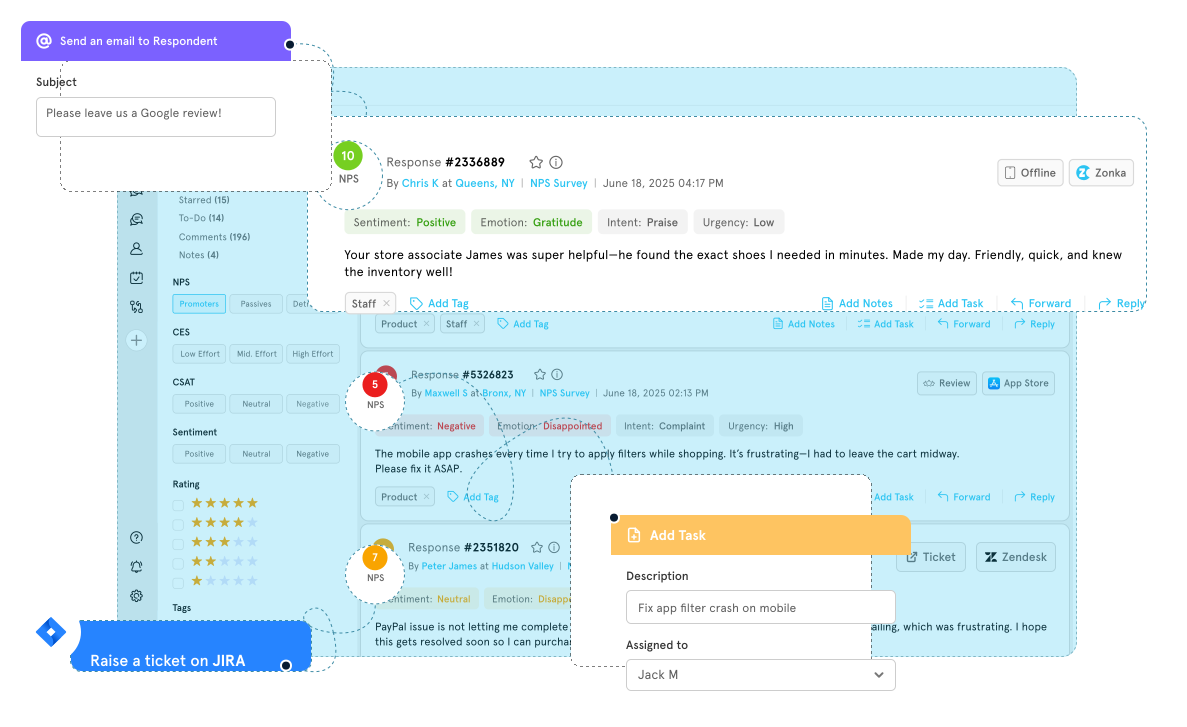
The platform's strongest differentiator is its closed-loop feedback management. A centralised inbox aggregates feedback from every channel, automated case management routes detractor responses to the right team, and follow-up workflows ensure nothing falls through the cracks. For multi-location businesses, dedicated location and frontline analytics track performance at the branch and staff level.
Zonka Feedback Features
- Zonka AI Thematic Analysis: Automated discovery of themes from unstructured feedback, with entity recognition and aspect tracking for more specific categorisation.
- AI Impact Analysis: Prioritises themes by their measured business impact, helping teams focus resources on the issues that move the needle.
- Ask AI: Natural-language query tool that lets teams ask questions about their feedback data without building reports manually.
- Closed-Loop Feedback Management: Centralised inbox, automated case management, and detractor follow-up workflows that connect insights to action.
- Multi-Channel Survey Builder: Surveys across offline kiosks, email, SMS, WhatsApp, websites, in-product embeds, and mobile SDKs.
- Location and Frontline Analytics: Dedicated dashboards for multi-location businesses monitoring branch and staff performance.
2026 Pricing
Zonka Feedback starts at $99/month according to G2, with the Feedback Management plan at $199/month per Capterra; a free trial is available.
Zonka Feedback Pros
- Full feedback lifecycle in one platform: survey creation, collection, analysis, and closed-loop response
- Strong closed-loop workflows with centralised inbox, case management, and detractor follow-up
- Accessible self-service pricing starting at $99/month
- Location and frontline analytics designed for multi-site operations
- GDPR, HIPAA, and ISO 27001 compliance certifications
- High user ratings: 4.7/5 on G2 and 4.8/5 on Capterra
Zonka Feedback Cons
- Sentiment analysis operates at the theme level rather than aspect-based concept level
- No dedicated social CX analytics or competitor benchmarking
- No speech analytics for call recordings
- No AI agent integration (no MCP equivalent)
- Multilingual analytical depth not publicly documented
- Smaller enterprise customer base compared to Chattermill
Who It's For
Zonka Feedback is built for mid-market CX and support teams, particularly multi-location businesses, that need survey creation, feedback analytics, and closed-loop action workflows in a single, accessible platform.
Review Ratings
Zonka Feedback holds a 4.7/5 rating on G2 (81 reviews) and 4.8/5 on Capterra (68 reviews), totalling 149 verified reviews. Zonka Feedback is not currently listed on Gartner Peer Insights.
Who Should Use Zonka Feedback?
Zonka Feedback is the stronger choice if your team's needs align with these criteria:
- You need to create and distribute surveys across multiple channels (offline, email, SMS, WhatsApp, in-app) without a separate survey tool
- Your feedback operations require closed-loop case management with automated detractor follow-up
- You run multiple locations and need branch-level and staff-level performance analytics
- You want self-service pricing with plans starting at $99/month rather than custom enterprise contracts
- You need HIPAA compliance for healthcare feedback use cases
- Your team values having collection, analysis, and response management in a single platform
Zonka Feedback's genuine differentiator is its end-to-end workflow. Most analytics platforms, including Chattermill, focus on the "analyse" stage and leave collection and follow-up to integrations. Zonka handles all three natively, which reduces tool sprawl for teams that do not already have a survey platform in place.
Who Should Use Chattermill?
Chattermill is the stronger choice if your team's needs align with these criteria:
- You process high-volume feedback across multiple channels and languages and need concept-level analytical granularity, not just theme summaries
- You need social CX analytics that cover Facebook, Instagram, TikTok, X, YouTube, and Reddit with built-in competitor benchmarking
- You need speech analytics that apply ABSA to call recordings alongside text feedback
- You want to bring feedback intelligence into AI agent workflows via the Chattermill MCP server
- You operate in 10+ languages and cannot afford analytical quality loss from translation
- You need enterprise-grade validation: 355 verified reviews across G2, Capterra, and Gartner, plus customers like HelloFresh, Booking.com, Amazon, Uber, and H&M
- Your CX, insights, or product team needs to measure the direct impact of feedback themes on NPS, CSAT, CES, and retention
Chattermill's advantage is analytical depth. Where most feedback platforms operate at the theme level, Lyra AI breaks feedback down to the aspect and concept level, then connects those signals to business metrics. For teams building a unified customer intelligence practice across text, social, and voice channels, that depth is the foundation everything else builds on.
Choosing the Right Feedback Analytics Platform
Picking between Chattermill and Zonka Feedback depends on seven factors. Here is a framework to evaluate which platform fits your team's specific requirements.
Feedback Volume and Channels: Consider how much feedback your team processes monthly and from which channels. If you are handling hundreds of thousands of items from surveys, support tickets, social media, and calls, you need a platform built for enterprise-scale ingestion and analysis. If your feedback is primarily survey-based with moderate volume, a platform that combines collection and analysis may be more efficient.
Language Requirements: If your organisation operates across multiple markets, multilingual analytical quality is non-negotiable. Chattermill processes feedback natively in 99+ languages. Check whether any platform you evaluate maintains analytical depth across every language your customers use, or whether it relies on translation.
Analysis Depth: Theme-level analysis tells you what customers are talking about. Aspect-based sentiment analysis tells you exactly which attributes of which topics are driving positive or negative sentiment. The difference matters most at scale: when you have 50,000 feedback items about "delivery," ABSA separates "delivery speed" from "delivery packaging" from "delivery tracking." Determine which level of granularity your team needs.
Team Structure: Who will use the platform day-to-day? If your CX team handles everything from survey creation to analysis to follow-up, an all-in-one platform reduces context switching. If your organisation has separate teams for collection (using tools like Qualtrics or SurveyMonkey) and analysis, a dedicated analytics platform avoids paying for survey capabilities you already have.
Automation Goals: Consider whether your priority is automated analysis (anomaly detection, theme discovery, trend alerts) or automated action (case routing, detractor follow-up, ticket creation). Chattermill focuses on the first. Zonka Feedback is stronger on the second.
Enterprise Validation: Review counts and customer logos matter when justifying a purchase to procurement. Chattermill's 355 verified reviews and customer base including HelloFresh, Booking.com, Amazon, Uber, and H&M provide a track record at enterprise scale. Zonka Feedback's 149 reviews and growing mid-market presence offer validation in that segment.
Security and Compliance: Both platforms support GDPR. Zonka Feedback adds HIPAA and ISO 27001 certifications, which may be deciding factors in regulated industries like healthcare and financial services. Confirm that any platform you evaluate meets your organisation's specific compliance requirements.
Get Started With Chattermill
If your team needs to go beyond surface-level feedback themes and understand exactly which aspects of your product, service, or experience are driving customer sentiment, Chattermill gives you the analytical depth to do that across text, social, and voice channels in 99+ languages.
Book a personalised demo to see how Lyra AI, social CX analytics, speech analytics, and the MCP server work with your feedback data.
Feedback Analytics Platforms: FAQs
What Is the Difference Between Chattermill and Zonka Feedback?
Chattermill is an enterprise feedback analytics platform that uses Lyra AI for aspect-based sentiment analysis across text, social media, and call recordings in 99+ languages. Zonka Feedback is an end-to-end feedback platform that combines survey creation, AI-driven analytics, and closed-loop case management. Chattermill focuses on analytical depth; Zonka Feedback covers the full feedback lifecycle from collection through response. Chattermill holds 4.5/5 across 355 reviews on G2, Capterra, and Gartner; Zonka holds 4.7/5 on G2 and 4.8/5 on Capterra across 149 reviews.
What Is Aspect-Based Sentiment Analysis and Why Does It Matter?
Aspect-based sentiment analysis (ABSA) identifies the specific attributes within feedback that drive positive or negative sentiment, rather than assigning a single sentiment score to an entire comment. For example, ABSA separates "delivery speed was great but packaging was damaged" into two distinct signals. Chattermill's Lyra AI applies ABSA at the concept level across text, social, and voice channels. This granularity is critical at scale: when processing tens of thousands of feedback items, theme-level analysis tells you customers mention "delivery" frequently, but ABSA tells you exactly which delivery attributes need attention. Learn more about AI sentiment analysis tools.
How Much Does Zonka Feedback Cost?
Zonka Feedback starts at $99/month according to G2, with the Feedback Management plan priced at $199/month per Capterra. A free trial is available. Chattermill uses custom enterprise pricing based on feedback volume and channel requirements; teams can book a demo for a tailored quote.
Does Chattermill Offer Social Media and Speech Analytics?
Yes. Chattermill's social CX analytics natively analyses customer conversations across Facebook, Instagram, TikTok, X, YouTube, and Reddit, with built-in competitor benchmarking. Speech analytics adds transcription and aspect-based sentiment analysis to call recordings. Zonka Feedback lists social media and calls as feedback input sources but does not offer dedicated analytics or benchmarking for those channels.
What Is the Chattermill MCP Server?
The Chattermill MCP server lets teams query and act on customer feedback data directly inside AI agents and agentic workflows. Instead of switching to a dashboard, teams can ask AI agents to pull sentiment trends, theme breakdowns, or anomaly alerts from Chattermill in real time. This is a 2026 capability unique to Chattermill; Zonka Feedback does not currently offer AI agent integration.
How Many Languages Does Chattermill Support?
Chattermill processes customer feedback natively in 99+ languages without requiring translation, maintaining consistent analytical depth regardless of source language. This is critical for global enterprises analysing feedback from customers across dozens of markets. Zonka Feedback supports multi-language surveys, but the depth of its cross-language analytics is not publicly documented.