


Enterprise Voice of Customer Platforms: 12 Picks (2026)

.avif)

The CX intelligence
platform that's AI-native by design
Book a demoFinding the best enterprise VoC platforms requires cutting through vendor hype to evaluate what actually matters: AI depth, channel coverage, deployment speed, and real business impact.
Quick Summary
This guide compares the 12 best enterprise voice of customer platforms in 2026, evaluating AI capabilities, deployment timelines, integrations, and pricing. Our top three picks are Chattermill for AI-native feedback intelligence, Qualtrics for structured survey programmes at enterprise scale, and Medallia for omnichannel CX across physical and digital touchpoints. For the wider market beyond enterprise, see our guide to the best voice of customer tools.
Chattermill stands out as the best overall enterprise VoC platform and best AI VoC platform because of its Aspect-Based Sentiment Analysis (ABSA), which scores sentiment per theme within individual feedback rather than assigning one score per comment—delivering superior accuracy on mixed-topic feedback. Qualtrics remains the gold standard for organisations with mature, structured survey programmes requiring advanced statistical analysis, though its six-figure enterprise pricing and 3–6 month deployment reflect legacy platform economics. Medallia offers the broadest omnichannel reach (surveys, social, speech, IoT, video), but its June 2026 recapitalization agreement (not yet closed) introduces stability risks buyers should weigh carefully.
Before we get into the detailed comparisons, here are our top three picks:
| Tool | Best For |
|---|---|
| Chattermill | AI-powered feedback intelligence with Aspect-Based Sentiment Analysis |
| Qualtrics | Structured survey programmes at enterprise scale |
| Medallia | Omnichannel CX across physical and digital touchpoints |
Key Takeaways:
- AI-native platforms deploy in weeks, not months. Chattermill, Thematic, and Enterpret deploy in 2–8 weeks. Legacy platforms like Qualtrics and Medallia typically require 3–6 months.
- The market is consolidating. Qualtrics completed its $6.75B acquisition of Press Ganey Forsta in May 2026, and Medallia announced a recapitalization agreement in June 2026 (expected to close by end of 2026). Layered M&A creates integration and support uncertainty.
- Chattermill unifies 100+ feedback channels (surveys, reviews, support tickets, social, app stores) into a single AI-native analytics layer—no separate point solutions required.
- Contact-centre-centric buyers have specialised options. Verint and NICE CXone are purpose-built for voice analytics and NPS programmes tied to contact centre operations.
- No single platform covers everything. The best choice depends on your primary feedback channels, existing tech stack, team maturity, and whether you need survey creation or pure analytics.
Why Listen To Us
Chattermill is an AI-native customer experience intelligence platform trusted by enterprise teams at Uber, HelloFresh, Tesco, Qonto, and E.ON Next to unify and analyse feedback at scale. With a G2 rating of 4.4/5 based on 238 reviews, we bring hands-on expertise in building AI-powered feedback analytics—including our proprietary Lyra AI model purpose-built for CX intelligence and Aspect-Based Sentiment Analysis that sets the technical standard for accuracy.
We built this comparison because enterprise VoC platform decisions carry high stakes: six-figure contracts, 6+ month implementations, and the risk of locking into legacy architectures just as the market shifts to AI-native solutions. This guide reflects what we see working (and failing) across hundreds of enterprise CX programmes.

Most Enterprise VoC Programmes Fail at the Analysis Stage
Here is the uncomfortable truth most VoC vendors avoid: collecting customer feedback is not the hard part. Enterprise organisations already have feedback flooding in from dozens of channels—surveys, support tickets, reviews, social mentions, in-app ratings, call transcripts, community forums.
The real failure point is analysis.
Legacy VoC platforms were built for a world where surveys were the primary feedback channel and manual tagging was acceptable at lower volumes. Today's enterprise feedback environment looks radically different:
- Volume has exploded. A mid-sized retailer might process 100,000+ pieces of feedback monthly across 20+ channels.
- Feedback is unstructured. Free-text comments, voice transcripts, and social posts do not fit neatly into survey response categories.
- Speed expectations have changed. Quarterly VoC reports are obsolete when competitors respond to emerging issues within days.
Most enterprise VoC programmes fail because they are optimised for collection, not analysis. Teams spend a disproportionate share of their time cleaning, tagging, and synthesising feedback manually—leaving minimal capacity for the strategic work that actually drives business outcomes.
The platforms in this guide represent fundamentally different approaches to solving this analysis bottleneck. AI-native platforms like Chattermill, Thematic, and Enterpret automate the analytical heavy lifting. Legacy platforms like Qualtrics and Medallia have bolted on AI capabilities to mature survey architectures. Understanding this distinction is essential to choosing the right platform for your organisation.
What Is an Enterprise Voice of Customer Platform?
An enterprise Voice of Customer (VoC) platform is software that collects, unifies, and analyses customer feedback from multiple channels to generate actionable insights that drive business decisions. Unlike basic survey tools, enterprise VoC platforms handle high feedback volumes, integrate with existing tech stacks, support complex organisational structures, and deliver AI-powered analysis that scales beyond manual human review.
Enterprise VoC platforms typically serve three core functions:
- Feedback aggregation: Collecting structured (surveys, ratings) and unstructured (free-text, voice, social) feedback from dozens of sources into a unified data layer.
- AI-powered analysis: Automatically tagging, categorising, and scoring feedback using natural language processing to surface themes, sentiment, and trends at scale.
- Insight activation: Delivering dashboards, alerts, reports, and integrations that connect customer insights to operational workflows and business metrics like NPS, CSAT, CES, retention, and revenue.
The enterprise VoC market has matured significantly since Gartner began tracking the Voice of the Customer category. Today's leaders are distinguished less by feedback collection capabilities (which have commoditised) and more by analytical depth, AI architecture, and speed to insight.
12 Top Enterprise Voice of Customer Platforms: Head to Head Comparison
| # | Tool | Best For | AI/NLP Approach | Feedback Channels | Deployment Speed | Pricing | G2 Rating |
|---|---|---|---|---|---|---|---|
| 1 | Chattermill | AI-powered feedback intelligence | AI-native deep-learning NLP with ABSA | Surveys, reviews, support, social, app stores (50+ integrations) | 2–4 weeks | Custom enterprise | 4.4/5 (238 reviews) |
| 2 | Qualtrics | Structured survey programmes at enterprise scale | Retrofitted AI (Text iQ, Stats iQ) | Surveys, web, app, email, SMS | 3–6 months | From ~$1,500/yr entry; enterprise custom (six-figure typical) | 4.3/5 (~725 reviews) |
| 3 | Medallia | Omnichannel CX across physical + digital | Retrofitted AI (Athena AI) | Surveys, social, speech, IoT, video | 3–6 months | Custom | 4.5/5 (206 reviews) |
| 4 | Verint | Contact centre voice analytics | Speech analytics AI | Voice, chat, email, social | 3–6 months | Custom | 4.2/5 (45 reviews) |
| 5 | NICE CXone | NPS-driven VoC with contact centre integration | AI-assisted analytics | Voice, chat, email, surveys | 2–4 months | Custom | 4.3/5 (~1,700 reviews) |
| 6 | Sprinklr | Social and digital listening at brand scale | Proprietary AI | Social, messaging, reviews, surveys, communities | 2–4 months | Custom enterprise pricing (self-serve discontinued 2026) | 4.3/5 (105 reviews) |
| 7 | InMoment (Press Ganey Forsta) | Closed-loop CX in regulated verticals | Rules-based + AI | Surveys, social, reviews, calls | 3–6 months | Custom | 4.7/5 (319 reviews) |
| 8 | Thematic | AI-driven theme detection without taxonomy maintenance | AI-native unsupervised NLP | Surveys, reviews, support tickets, NPS | 4–8 weeks | From ~$2,000/mo | 4.8/5 (40 reviews) |
| 9 | Enterpret | Adaptive taxonomy across high-volume feedback | AI-native adaptive models | Support tickets, surveys, reviews, social, Slack | 4–8 weeks | Custom | 4.5/5 (111 reviews) |
| 10 | Forsta | Research-grade survey design and panel management | Rules-based analytics | Surveys, panels, communities | 2–4 months | Custom | 4.2/5 (335 reviews) |
| 11 | Alida | Insight communities and customer co-creation | Moderate AI | Communities, surveys, panels, discussions | 2–4 months | Custom | 4.4/5 (132 reviews) |
| 12 | CustomerGauge | B2B account-based VoC with revenue attribution | Rules-based + basic AI | Surveys, account signals, CRM | 4–8 weeks | Programme-based pricing | 4.6/5 (50 reviews) |
How We Evaluated These Tools
Enterprise VoC platform decisions involve significant investment and switching costs. We evaluated each platform against five criteria that matter most for enterprise buyers:
1. AI/NLP Depth
We assessed whether each platform's AI is native to its architecture or retrofitted onto legacy survey infrastructure. AI-native platforms (Chattermill, Thematic, Enterpret) are built from the ground up around machine learning models trained specifically for CX feedback analysis. Retrofitted AI (Qualtrics Text iQ, Medallia Athena) adds analytical capabilities to platforms originally designed for survey collection—functional, but often constrained by underlying architectural decisions.
We specifically evaluated sentiment analysis approaches. Aspect-Based Sentiment Analysis (ABSA), which scores sentiment per theme within a single comment, delivers superior accuracy compared to per-comment scoring or rule-based keyword matching—especially on mixed-topic feedback where customers praise one aspect while criticising another.
2. Feedback Channel Breadth
Enterprise feedback arrives from surveys, support tickets, reviews (G2, Trustpilot, app stores), social media, chat transcripts, call recordings, community forums, and more. We evaluated each platform's native integrations and ability to unify structured and unstructured feedback into a single analytical layer without requiring separate point solutions.
3. Deployment Speed
Time-to-value varies dramatically across platforms. AI-native solutions typically deploy in 2–8 weeks because they require minimal configuration—their models adapt to your data. Legacy platforms often require 3–6 months for implementation, data migration, taxonomy setup, and user training. For organisations under pressure to demonstrate VoC programme ROI quickly, deployment speed is a critical differentiator.
4. Enterprise Security and Governance
We evaluated enterprise-grade requirements including SSO/SAML authentication, role-based access control (RBAC), data residency options, SOC 2 Type II certification, GDPR compliance, and data processing agreements. Large organisations in regulated industries (financial services, healthcare, telecommunications) require robust governance that many point solutions cannot provide.
5. Actionability and Business Impact
The ultimate test of any VoC platform is whether it drives measurable business outcomes. We assessed each platform's ability to connect customer insights to operational metrics (NPS, CSAT, CES) and business outcomes (revenue, churn, retention). Platforms that stop at dashboards and reports score lower than those with alerting, workflow automation, and integrations that push insights into decision-making systems.
All G2 ratings cited in this article were verified against each tool's live G2 product page as of August 2026.
1. Chattermill
.png)
The best AI VoC platform for enterprise teams is Chattermill—an AI-native customer experience intelligence platform that delivers superior analytical accuracy through Aspect-Based Sentiment Analysis and deploys in weeks rather than months.
What is Chattermill?
Chattermill is an AI-native CXI platform that unifies feedback from 50+ channels (surveys, reviews, support tickets, social media, app stores) and analyses it using deep-learning NLP purpose-built for customer experience. Unlike legacy VoC platforms that bolted AI onto survey architectures, Chattermill was engineered from day one around AI-powered analysis.
The platform's core technical differentiator is Aspect-Based Sentiment Analysis (ABSA). Where most VoC platforms assign a single sentiment score per comment, Chattermill scores sentiment per theme or aspect within a single piece of feedback. When a customer writes "Love the delivery speed but the packaging was damaged," Chattermill correctly identifies positive sentiment on delivery and negative sentiment on packaging—rather than averaging to neutral or picking one signal. This granularity matters enormously at enterprise scale, where mixed-topic feedback is the norm and blurred sentiment signals lead to misallocated resources.
Chattermill's proprietary AI model, Lyra, is purpose-built for CX intelligence rather than adapted from general-purpose NLP. The platform's agentic architecture is engineered for accuracy, trust, and reliability—critical for enterprise teams making consequential decisions based on customer insights. With the Chattermill MCP server, teams can query and act on feedback data directly inside AI agents, bringing customer intelligence into the agentic era.
Enterprise clients including Uber, HelloFresh, Tesco, Qonto, and E.ON Next use Chattermill to consolidate feedback, detect anomalies, prioritise issues, and measure impact on NPS, CSAT, and CES. HelloFresh, for example, uses Chattermill to analyse customer feedback across markets and identify actionable improvements in their meal kit experience.
Chattermill Features
- Aspect-Based Sentiment Analysis (ABSA): Scores sentiment per theme within individual feedback, preserving signal quality on mixed-topic comments where per-comment scoring loses accuracy.
- Lyra AI Model: Proprietary deep-learning NLP purpose-built for CX intelligence, delivering higher accuracy than general-purpose or rule-based approaches.
- 50+ Native Integrations: Connects to surveys (Qualtrics, SurveyMonkey, Typeform), support (Zendesk, Intercom, Freshdesk), reviews (G2, Trustpilot, App Store, Google Play), social, and more.
- Unified Analytics Layer: Consolidates structured and unstructured feedback from all channels into a single source of truth for customer insights.
- Anomaly Detection and Alerts: Automatically surfaces emerging issues and trend changes, enabling rapid response before problems escalate.
- Business Impact Measurement: Connects customer feedback to NPS, CSAT, CES, and business metrics like retention and revenue.
- MCP Server for Agentic AI: Enables teams to query feedback data directly inside AI agents, extending customer intelligence into agentic workflows.
2026 Pricing
Chattermill offers custom enterprise pricing based on feedback volume, channels, and deployment requirements. There is no public self-serve pricing—enterprise buyers should book a demo for a tailored proposal.
Chattermill Pros
- AI-native architecture delivers faster deployment (2–4 weeks) than legacy platforms
- Aspect-Based Sentiment Analysis provides superior accuracy on mixed-topic feedback
- 50+ integrations unify all feedback channels without additional point solutions
- Purpose-built Lyra AI model outperforms retrofitted or general-purpose NLP
- MCP server extends insights into AI agent workflows
- Strong enterprise client roster validates scale (Uber, HelloFresh, Tesco)
Chattermill Cons
- No built-in survey creation—by design, Chattermill focuses on analytics rather than duplicating survey tools you likely already have
- Custom pricing requires sales engagement; no self-serve option for smaller teams
- Best suited for organisations with existing multi-channel feedback; less value for survey-only programmes
Who It's For
Enterprise CX, insights, and product teams processing feedback from multiple channels who need AI-native analytical depth and rapid deployment. Particularly strong for organisations already using separate survey tools (Qualtrics, SurveyMonkey) or support platforms (Zendesk, Intercom) who want unified analytics without ripping out existing infrastructure.
G2 Rating
Chattermill G2 Score: 4.4/5 (238 reviews)
2. Qualtrics
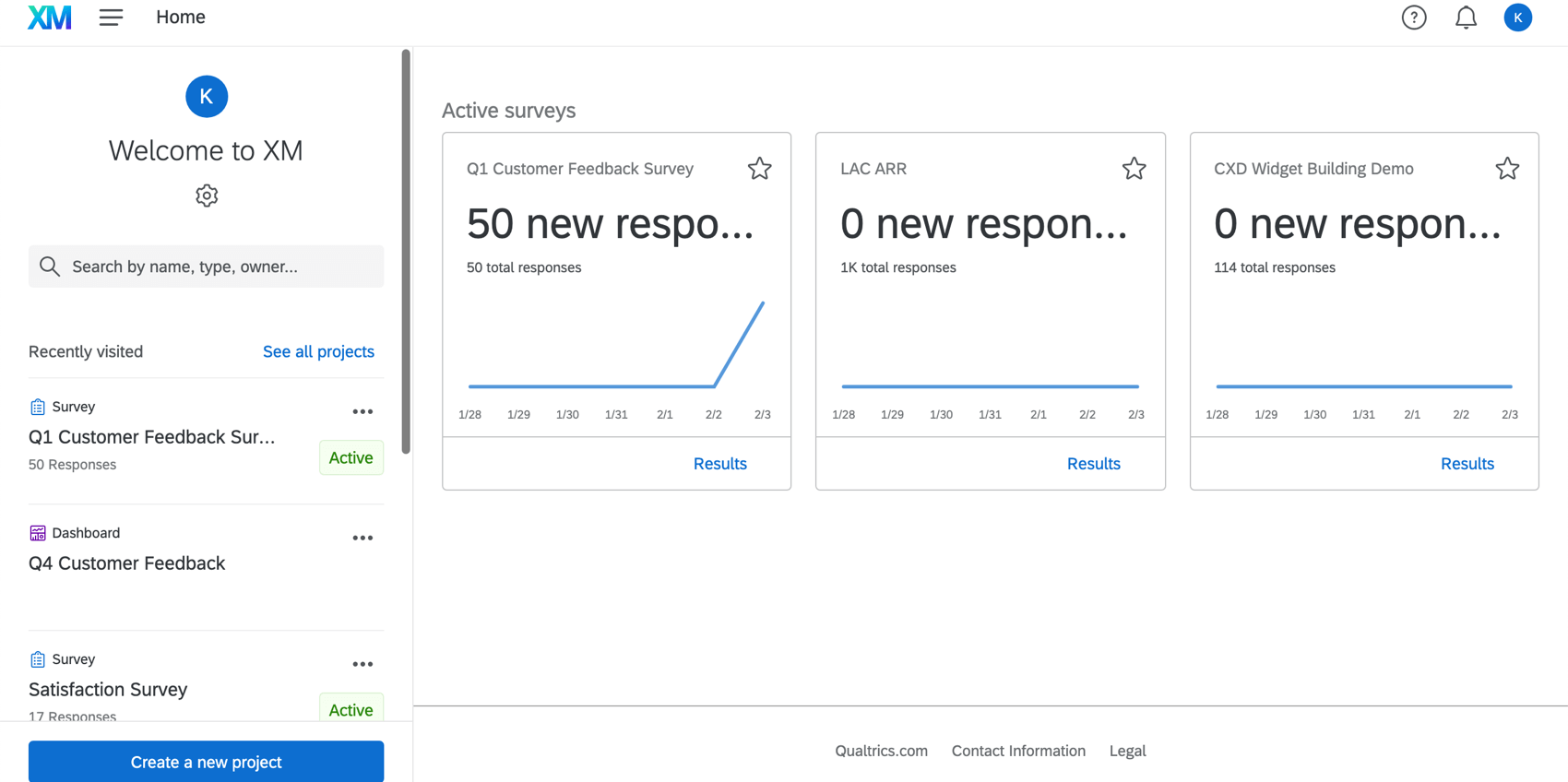
What is Qualtrics?
Qualtrics is an experience management platform that built its reputation on enterprise survey capabilities and has expanded into employee experience, product experience, and brand experience. Its XM Discover module provides text analytics for unstructured feedback, though the AI is retrofitted onto survey-first architecture rather than built natively.
Qualtrics remains the market leader for organisations with mature, structured survey programmes requiring advanced statistical analysis (conjoint, MaxDiff, key driver analysis). Recent news includes Qualtrics' $6.75B acquisition of Press Ganey Forsta, which will expand its healthcare and employee experience capabilities but also introduces integration complexity.
For organisations evaluating alternatives, see our Qualtrics alternatives guide.
Qualtrics Features
- Text iQ: AI-powered text analytics for open-ended survey responses
- Stats iQ: Statistical analysis tools including regression, correlation, and pivot tables
- XM Directory: Centralised contact and experience data management
- Action Planning: Workflow tools to assign and track follow-up on customer feedback
- Dashboards and Reporting: Customisable visualisations and automated report distribution
- Multi-Channel Distribution: Surveys via web, email, SMS, app intercepts, and offline
2026 Pricing
Qualtrics offers tiered pricing starting from approximately $1,500/year for basic survey capabilities. Enterprise deployments with Text iQ, advanced analytics, and multi-programme support typically require six-figure annual contracts with custom pricing based on response volume and modules.
Qualtrics Pros
- Industry-leading survey design and distribution capabilities
- Advanced statistical analysis tools (Stats iQ) for research-grade insights
- Broad XM platform covering customer, employee, product, and brand experience
- Strong ecosystem of consultants and implementation partners
- Established vendor with predictable enterprise support
Qualtrics Cons
- AI capabilities (Text iQ) are retrofitted rather than native; less sophisticated than AI-native platforms
- Deployment typically takes 3–6 months with significant implementation investment
- Six-figure pricing puts it out of reach for mid-market organisations
- Platform complexity can overwhelm teams without dedicated XM resources
- Press Ganey Forsta acquisition introduces near-term integration uncertainty
Who It's For
Large enterprises with mature survey programmes, dedicated XM teams, and budget for six-figure platform investment. Strongest for organisations prioritising structured survey data over unstructured feedback from support, social, and reviews.
G2 Rating
Qualtrics G2 Score: 4.3/5 (~725 reviews)
3. Medallia
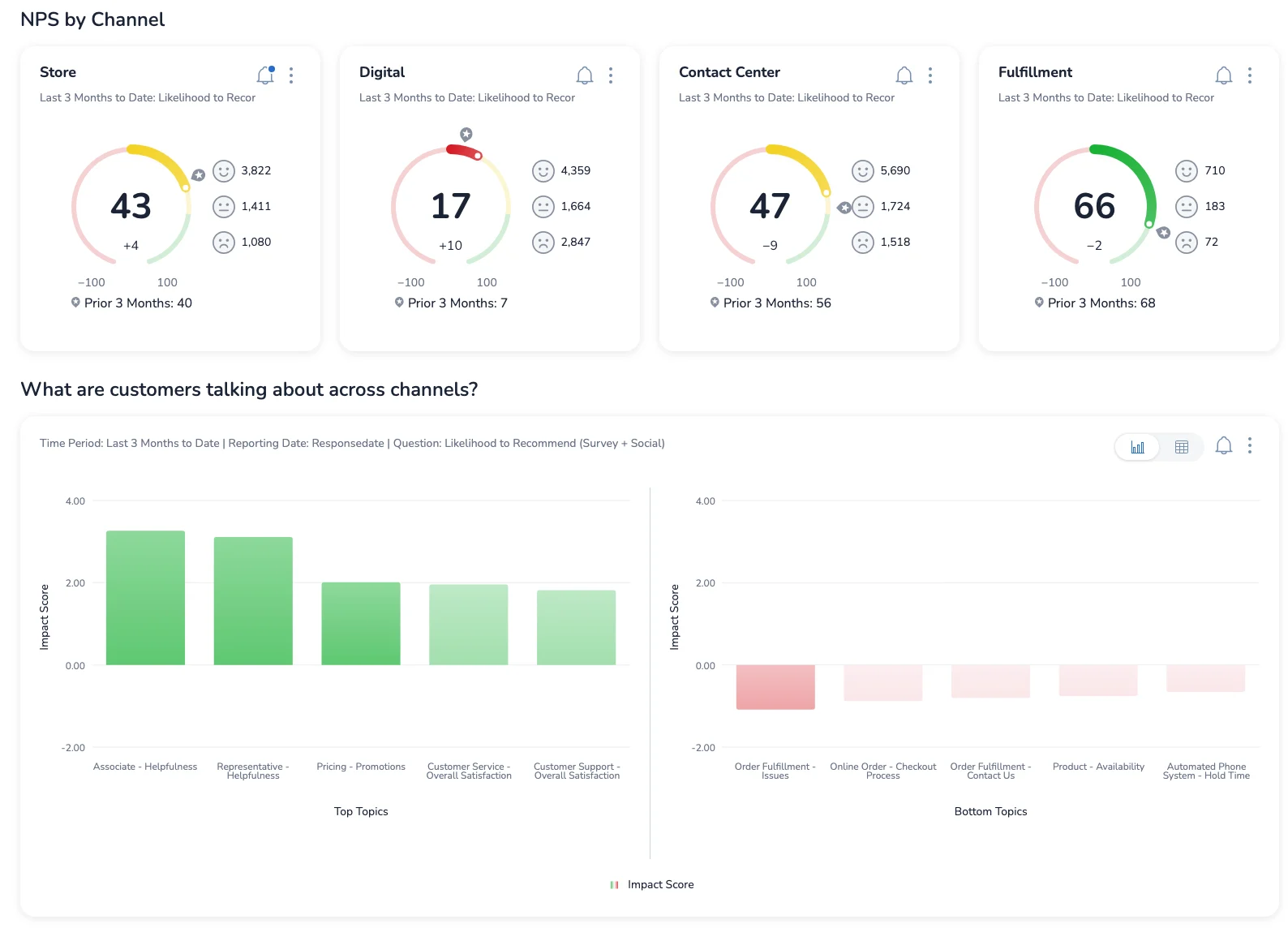
What is Medallia?
Medallia is an enterprise experience management platform with the broadest omnichannel reach in the VoC market, spanning surveys, social, speech analytics, IoT signals, and video feedback. Its Athena AI provides text and speech analytics, though like Qualtrics, the AI is retrofitted onto legacy architecture.
Important note: Medallia announced a recapitalization agreement in June 2026, expected to close by the end of 2026. While the platform remains operational, enterprise buyers should factor stability and continuity risks into their evaluation. Long-term roadmap commitments and support SLAs may be affected during restructuring.
For a detailed comparison, see our Chattermill vs Medallia analysis.
Medallia Features
- Athena AI: Text and speech analytics for unstructured feedback
- Omnichannel Feedback Collection: Surveys, social listening, speech, IoT sensors, video feedback
- Journey Orchestration: Map and analyse customer journeys across touchpoints
- Role-Based Dashboards: Customised views for frontline, management, and executive users
- Action Management: Closed-loop workflows for following up on customer issues
- Industry Solutions: Pre-built configurations for retail, hospitality, financial services, and healthcare
2026 Pricing
Medallia offers custom enterprise pricing. Deployments typically require significant professional services investment given the platform's complexity and 3–6 month implementation timelines.
Medallia Pros
- Broadest omnichannel coverage including IoT and video feedback
- Strong presence in physical-experience industries (retail, hospitality, automotive)
- Mature enterprise governance and role-based access
- Established implementation partner ecosystem
Medallia Cons
- June 2026 recapitalization agreement (not yet closed) introduces stability and continuity risk
- Retrofitted AI (Athena) lacks the analytical depth of AI-native platforms
- 3–6 month deployments with substantial professional services costs
- Platform complexity requires dedicated admin resources
- Long-term roadmap uncertain during restructuring
Who It's For
Large enterprises with significant physical customer touchpoints (retail stores, hotels, bank branches, dealerships) who need omnichannel feedback across digital and in-person experiences. Buyers should carefully assess restructuring risks before committing.
G2 Rating
Medallia G2 Score: 4.5/5 (206 reviews)
4. Verint
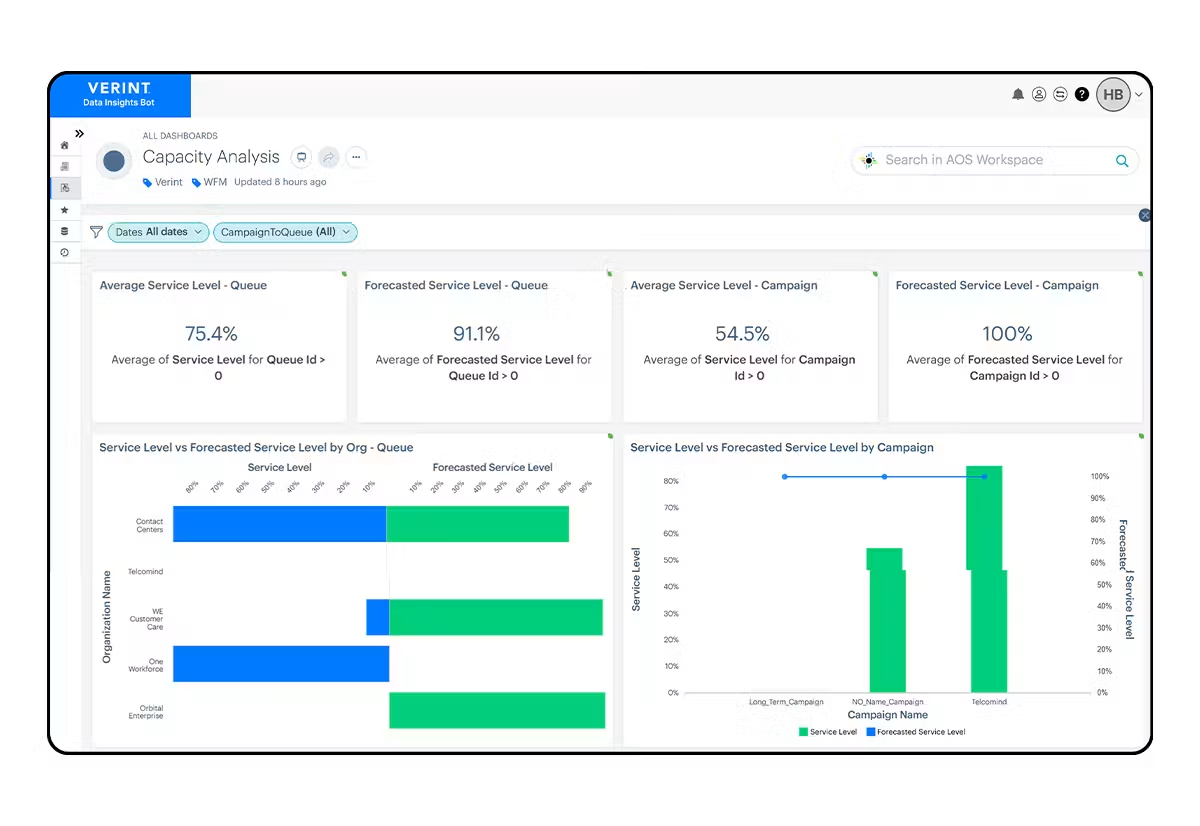
What is Verint?
Verint is a customer engagement platform with deep roots in contact centre technology, particularly speech analytics. Its Voice of the Customer solutions focus on analysing voice interactions alongside chat, email, and social feedback, making it a strong choice for organisations where contact centre conversations are the primary feedback channel.
Verint Features
- Speech Analytics: Transcription and analysis of voice calls at scale
- Text Analytics: Analysis of chat, email, and social interactions
- Workforce Management Integration: Connect VoC insights to agent performance and scheduling
- Compliance Monitoring: Automated detection of regulatory and policy adherence
- Real-Time Guidance: In-call prompts and alerts for contact centre agents
- Quality Management: Evaluate and coach agents based on customer interaction analysis
2026 Pricing
Verint offers custom enterprise pricing based on agent seats, interaction volume, and modules. Expect significant investment for full-suite deployments.
Verint Pros
- Industry-leading speech analytics capabilities
- Deep integration with contact centre operations and workforce management
- Strong compliance and quality management features for regulated industries
- Mature enterprise platform with proven scale
Verint Cons
- Primarily focused on contact centre channels; weaker on survey and digital feedback
- Complex deployment (3–6 months) requiring specialised implementation
- Less suitable for organisations where support calls are not the primary feedback source
- AI capabilities lag behind AI-native platforms for text analysis
Who It's For
Contact centre-centric enterprises in telecommunications, financial services, utilities, and other industries where voice interactions are the primary customer touchpoint.
G2 Rating
Verint G2 Score: 4.2/5 (45 reviews, Voice of the Customer product)
5. NICE CXone
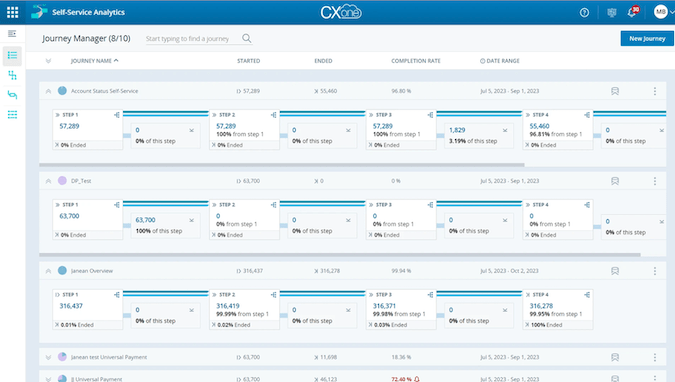
What is NICE CXone?
NICE (an NPS trademark co-holder via its 2017 acquisition of Satmetrix) offers CXone, a cloud contact centre platform with integrated VoC and analytics capabilities. The platform excels at NPS-driven feedback programmes tightly coupled with contact centre operations, combining customer feedback with agent performance and interaction analytics.
NICE CXone Features
- Feedback Management: NPS, CSAT, and CES surveys integrated with contact centre interactions
- Interaction Analytics: Speech and text analysis across voice, chat, and email
- Quality Management: Agent evaluation, coaching, and performance tracking
- Workforce Optimisation: Scheduling and forecasting based on volume and performance data
- CRM Integrations: Connect feedback to customer records in Salesforce, Microsoft Dynamics
- Real-Time Dashboards: Operational visibility across contact centre and customer feedback metrics
2026 Pricing
NICE CXone offers custom enterprise pricing. Pricing varies based on agent seats, interaction volume, and module selection.
NICE CXone Pros
- NPS expertise via its Satmetrix acquisition (an NPS trademark co-holder)
- Tight integration between customer feedback and contact centre operations
- Strong workforce optimisation and quality management capabilities
- Cloud-native architecture with 2–4 month deployment
NICE CXone Cons
- Contact centre-centric; limited capabilities for non-support feedback channels
- AI analytics less sophisticated than AI-native VoC platforms
- Best suited for organisations where contact centre is the CX programme hub
- Complex pricing structure across multiple modules
Who It's For
Contact centre-driven organisations prioritising NPS programmes and wanting tight integration between customer feedback, agent performance, and workforce management.
G2 Rating
NICE CXone G2 Score: 4.3/5 (~1,700 reviews)
6. Sprinklr
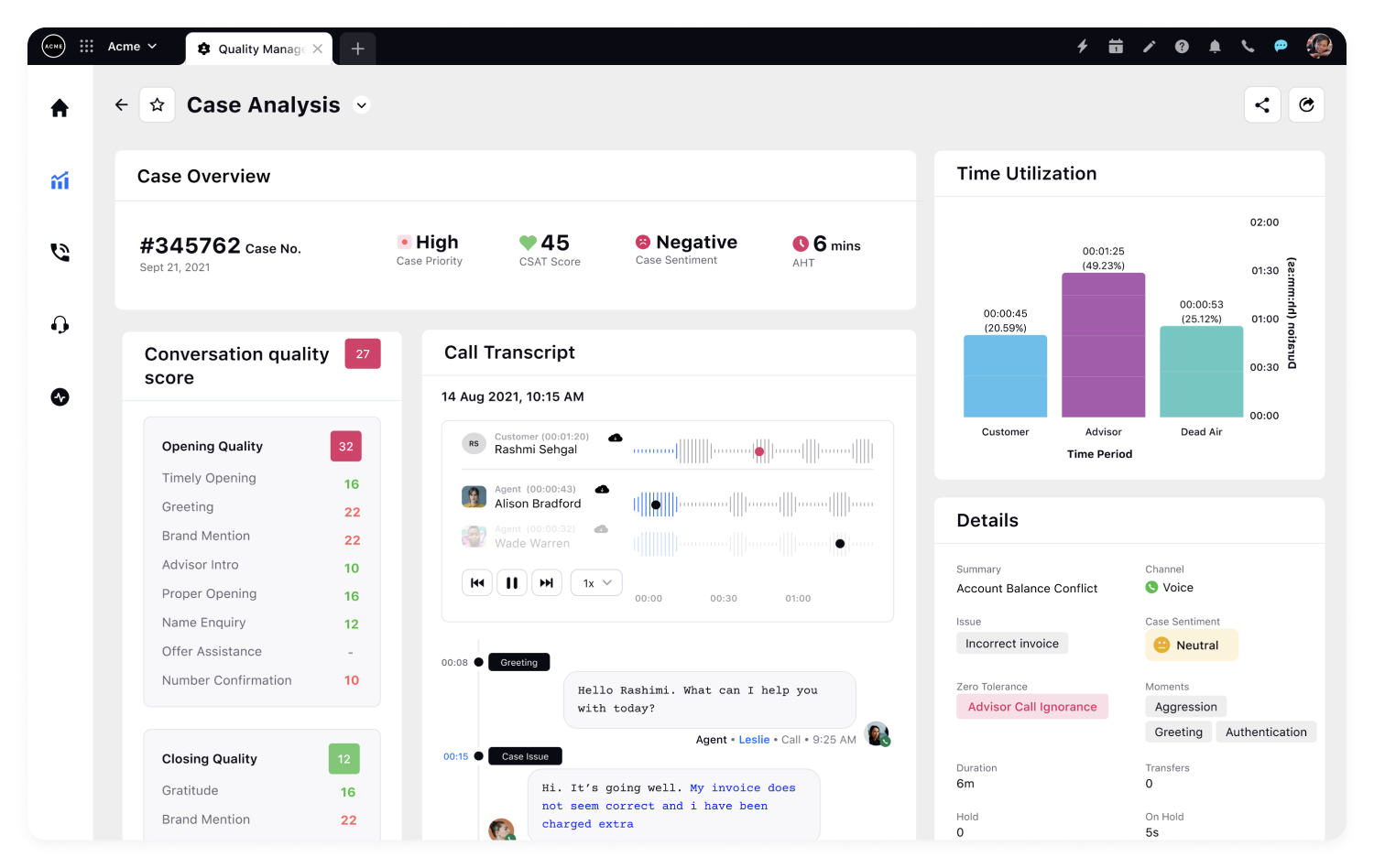
What is Sprinklr?
Sprinklr is a unified customer experience management platform with particular strength in social media listening, digital engagement, and brand reputation monitoring. Its VoC capabilities focus on social, messaging, reviews, and community feedback rather than traditional survey channels.
Sprinklr Features
- Social Listening: Monitor brand mentions, sentiment, and trends across social platforms
- Review Management: Aggregate and respond to reviews from Google, Trustpilot, and industry-specific sites
- Messaging Integration: Connect with customers via WhatsApp, Messenger, and other messaging platforms
- Survey and Community Feedback: Collect structured feedback through surveys and brand communities
- AI-Powered Insights: Trend detection, sentiment analysis, and topic clustering
- Unified Inbox: Manage customer interactions across all digital channels in one workspace
2026 Pricing
Sprinklr operates on custom enterprise pricing; it discontinued its self-serve plans (previously from ~$199/seat/month) in 2026. Enterprise deployments with advanced analytics, multiple teams, and custom integrations are quoted individually.
Sprinklr Pros
- Industry-leading social listening and digital engagement capabilities
- Unified platform for marketing, advertising, and customer care
- Strong for brand reputation monitoring and crisis detection
- Good fit for organisations with high social media customer engagement
Sprinklr Cons
- Weaker on traditional VoC channels (surveys, support tickets, app reviews)
- AI analytics less sophisticated than AI-native feedback platforms
- Platform complexity can be overwhelming for VoC-only use cases
- Primarily designed for marketing and social teams rather than CX/insights functions
Who It's For
Large consumer brands with significant social media presence and digital engagement volume who want unified visibility across social, messaging, reviews, and community feedback.
G2 Rating
Sprinklr Insights G2 Score: 4.3/5 (105 reviews)
7. InMoment (Press Ganey Forsta)
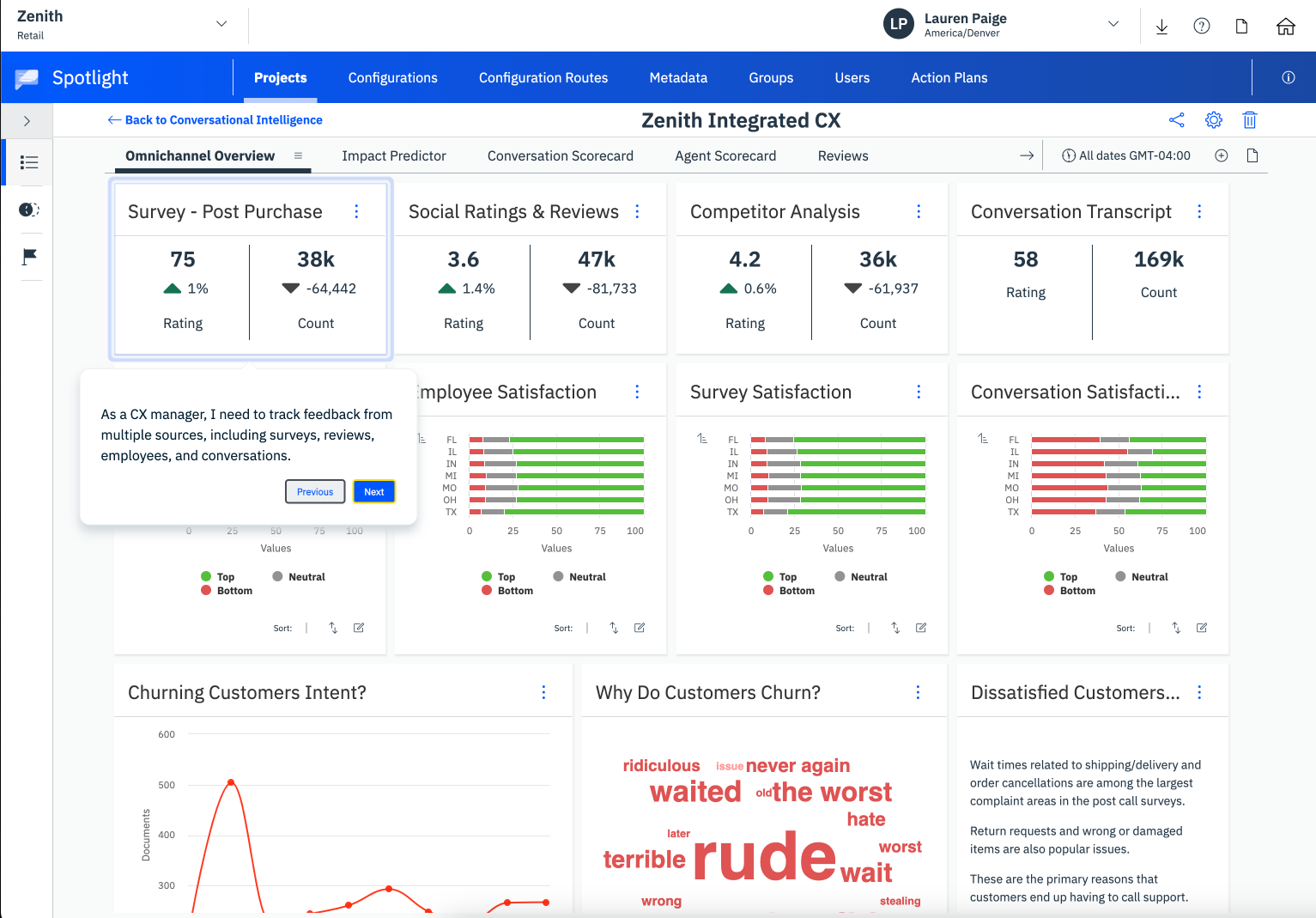
What is InMoment?
InMoment (now part of Press Ganey Forsta following acquisition) is an experience improvement platform with strength in closed-loop CX programmes, particularly in regulated industries like healthcare and financial services. The platform combines survey, social, review, and call feedback with workflow tools for driving operational follow-up.
Note: The VoC market is experiencing significant M&A activity. Press Ganey acquired InMoment, and Qualtrics completed its $6.75B acquisition of Press Ganey Forsta in May 2026. Enterprise buyers should factor integration timelines and potential platform consolidation into their evaluation.
InMoment Features
- Multi-Channel Feedback Collection: Surveys, social, reviews, and call transcripts
- Text Analytics: Rules-based and AI-assisted analysis of unstructured feedback
- Case Management: Closed-loop workflows for addressing customer issues
- Role-Based Reporting: Customised dashboards for frontline through executive users
- Industry Solutions: Healthcare, financial services, retail, and automotive configurations
- Consulting Services: Strategic CX programme design and optimisation
2026 Pricing
InMoment offers custom enterprise pricing with significant professional services components, particularly for healthcare and regulated industry deployments.
InMoment Pros
- Strong closed-loop case management for operational follow-up
- Deep healthcare and regulated industry expertise
- Established enterprise customer base with proven scale
- Comprehensive consulting and managed services options
InMoment Cons
- Rules-based analytics less sophisticated than AI-native platforms
- M&A activity (Qualtrics/Press Ganey/Forsta) creates integration uncertainty
- 3–6 month deployments with substantial services investment
- Platform evolution roadmap unclear during ownership transitions
Who It's For
Healthcare, financial services, and other regulated industries requiring closed-loop CX programmes with strong compliance and operational workflow integration.
G2 Rating
InMoment G2 Score: 4.7/5 (319 reviews)
8. Thematic
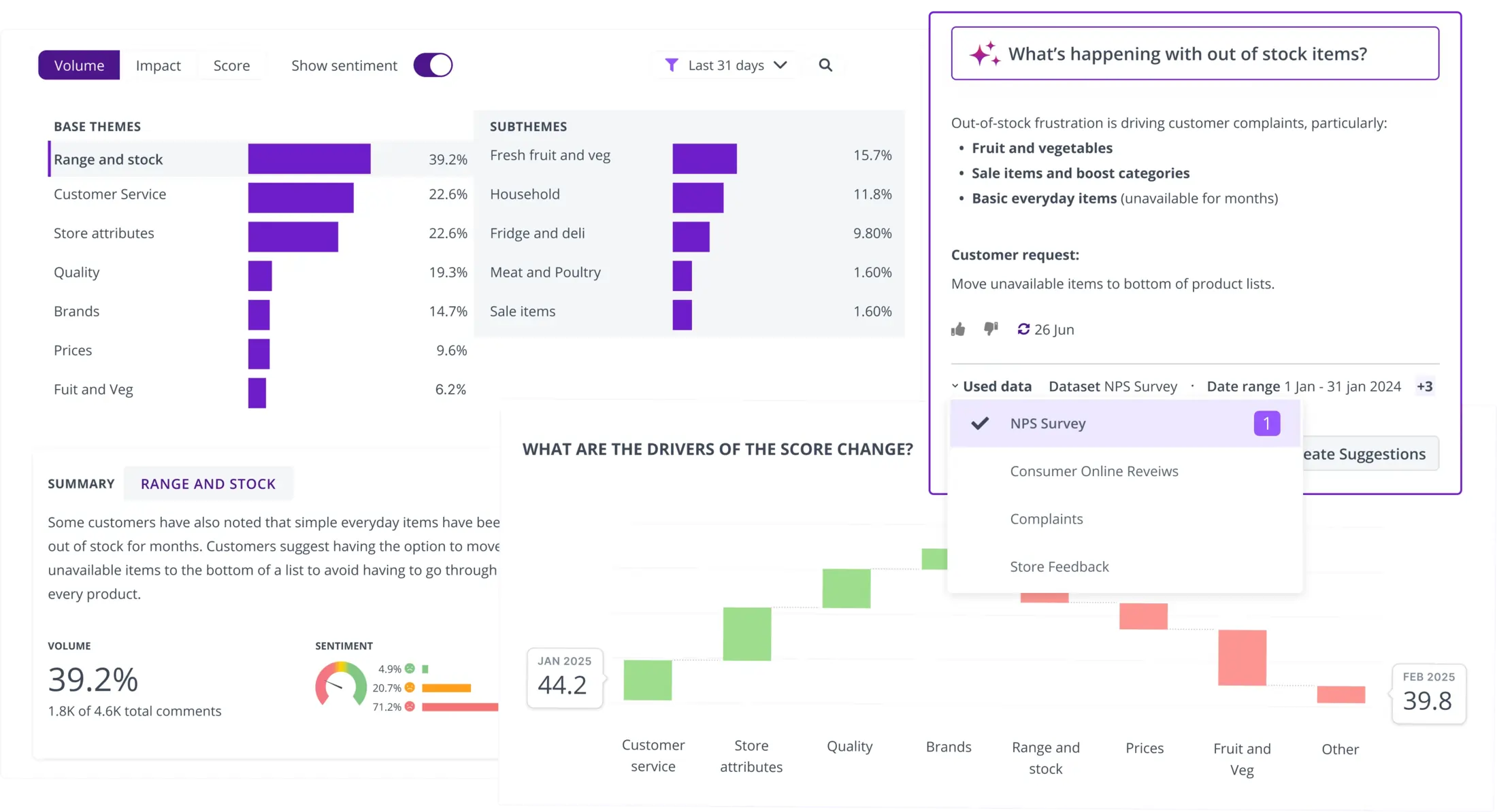
What is Thematic?
Thematic is an AI-native feedback analytics platform that uses unsupervised machine learning to automatically discover themes in customer feedback without requiring manual taxonomy setup or maintenance. The platform excels at surfacing unexpected insights that predefined categories would miss.
For a detailed comparison, see our Chattermill vs Thematic analysis.
Thematic Features
- Unsupervised Theme Discovery: AI automatically identifies themes without manual taxonomy configuration
- Sentiment and Impact Analysis: Track sentiment by theme and correlate with business metrics
- Trend Detection: Surface emerging themes and sentiment shifts over time
- Feedback Integrations: Connect to surveys, NPS tools, review platforms, and support systems
- Collaborative Insights: Share themes and insights across teams with commenting and annotations
- API Access: Integrate theme data into BI tools and other systems
2026 Pricing
Thematic pricing starts at approximately $2,000/month. Enterprise plans with higher volume, additional integrations, and dedicated support require custom pricing.
Thematic Pros
- AI-native architecture enables rapid deployment (4–8 weeks)
- Unsupervised learning discovers themes without manual taxonomy maintenance
- Good for organisations without dedicated taxonomy/tagging resources
- Lower entry price point than enterprise legacy platforms
Thematic Cons
- Smaller company with less enterprise support infrastructure than established vendors
- Limited feedback channel breadth compared to platforms with 50+ integrations
- Less suitable for organisations requiring deep customisation or taxonomy control
- Smaller G2 review base (40 reviews) provides less peer validation
Who It's For
Mid-market and enterprise CX teams wanting AI-native theme discovery without the overhead odiscovery without the overhead of building and maintaining manual taxonomies.
G2 Rating
Thematic G2 Score: 4.8/5 (40 reviews)
9. Enterpret
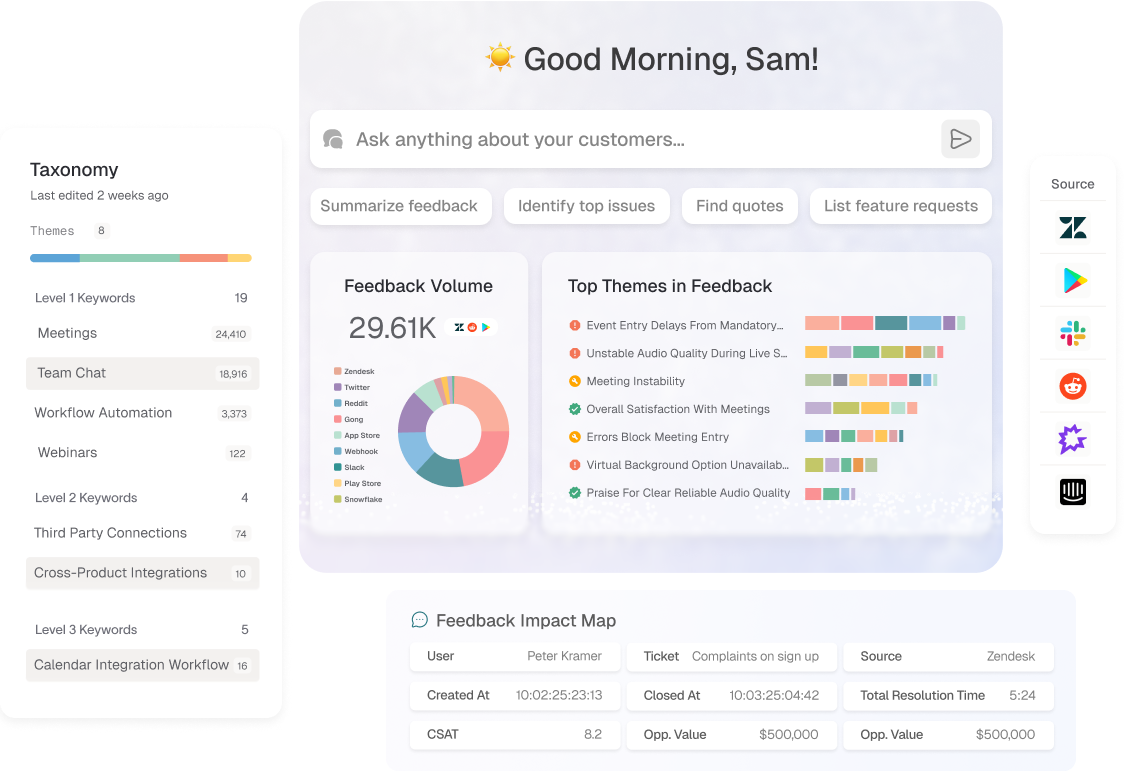
What is Enterpret?
Enterpret is an AI-native customer feedback analytics platform that uses adaptive machine learning models to automatically categorise and analyse feedback across high-volume channels including support tickets, surveys, reviews, social, and Slack. The platform's taxonomy evolves as language and topics shift.
For a detailed comparison, see our Chattermill vs Enterpret analysis.
Enterpret Features
- Adaptive Taxonomy: AI-powered categorisation that evolves as feedback language changes
- Multi-Channel Ingestion: Connect support tickets, surveys, reviews, social media, and Slack
- Trend and Anomaly Detection: Surface emerging issues and unexpected changes
- Product-Feedback Alignment: Connect customer feedback to product roadmap prioritisation
- Slack Integration: Receive insights and alerts directly in team communication channels
- API and Integrations: Connect to BI tools and product management platforms
2026 Pricing
Enterpret offers custom enterprise pricing based on feedback volume and integration requirements.
Enterpret Pros
- AI-native architecture with rapid 4–8 week deployment
- Adaptive models reduce taxonomy maintenance burden
- Strong product team focus with roadmap prioritisation use cases
- Good Slack integration for team-wide insight distribution
Enterpret Cons
- Newer platform with smaller enterprise customer base
- Narrower integration library than established platforms
- Less suitable for survey-heavy programmes or structured research use cases
- Custom pricing requires sales engagement
Who It's For
Product and CX teams at high-growth companies processing large volumes of support tickets and wanting AI-native analysis without manual taxonomy management.
G2 Rating
Enterpret G2 Score: 4.5/5 (111 reviews)
10. Forsta
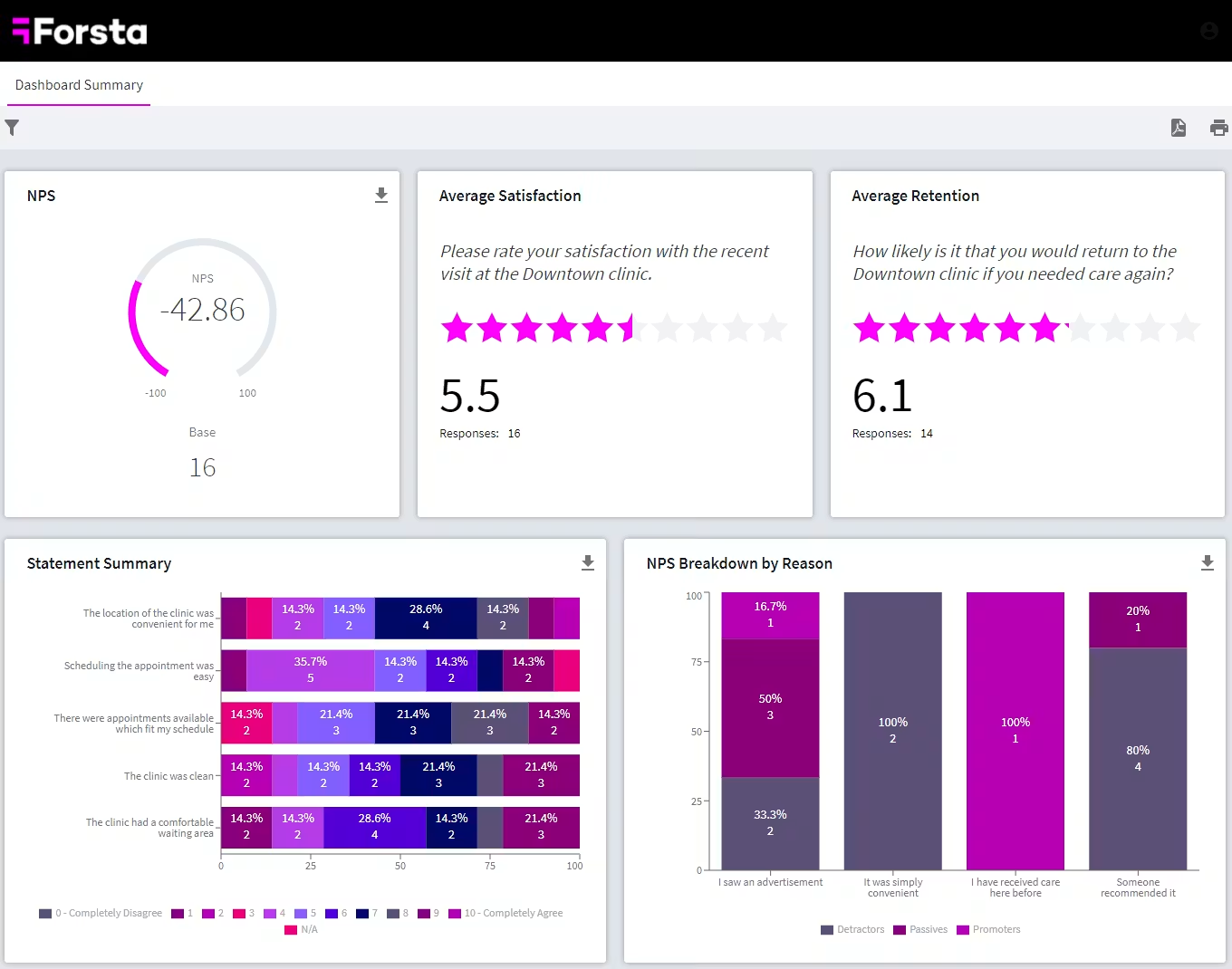
What is Forsta?
Forsta (now part of Press Ganey, being acquired by Qualtrics) is a research-grade experience and survey platform with particular strength in survey design, panel management, and market research. The platform serves organisations that prioritise methodological rigour and research flexibility over AI-powered analytics.
Forsta Features
- Advanced Survey Design: Complex survey logic, branching, and question types
- Panel Management: Recruit, manage, and reward research panels
- Community Platform: Host ongoing customer communities for qualitative research
- Research Automation: Streamline repetitive research tasks and workflows
- Reporting and Dashboards: Customisable visualisation and analysis tools
- Data Integration: Connect to CRM, BI, and other enterprise systems
2026 Pricing
Forsta offers custom enterprise pricing with professional services components for research programme design and panel management.
Forsta Pros
- Research-grade survey design rivalling dedicated research platforms
- Strong panel management and community research capabilities
- Good for organisations with in-house research teams
- Established platform with substantial customer base
Forsta Cons
- Rules-based analytics; AI capabilities lag behind AI-native platforms
- M&A activity (Qualtrics acquisition of Press Ganey Forsta) creates uncertainty
- 2–4 month deployments for full programme implementation
- Less suitable for organisations prioritising unstructured feedback analysis
Who It's For
Market research teams and organisations with sophisticated survey methodology requirements, panel management needs, and in-house research expertise.
G2 Rating
Forsta G2 Score: 4.2/5 (335 reviews)
11. Alida
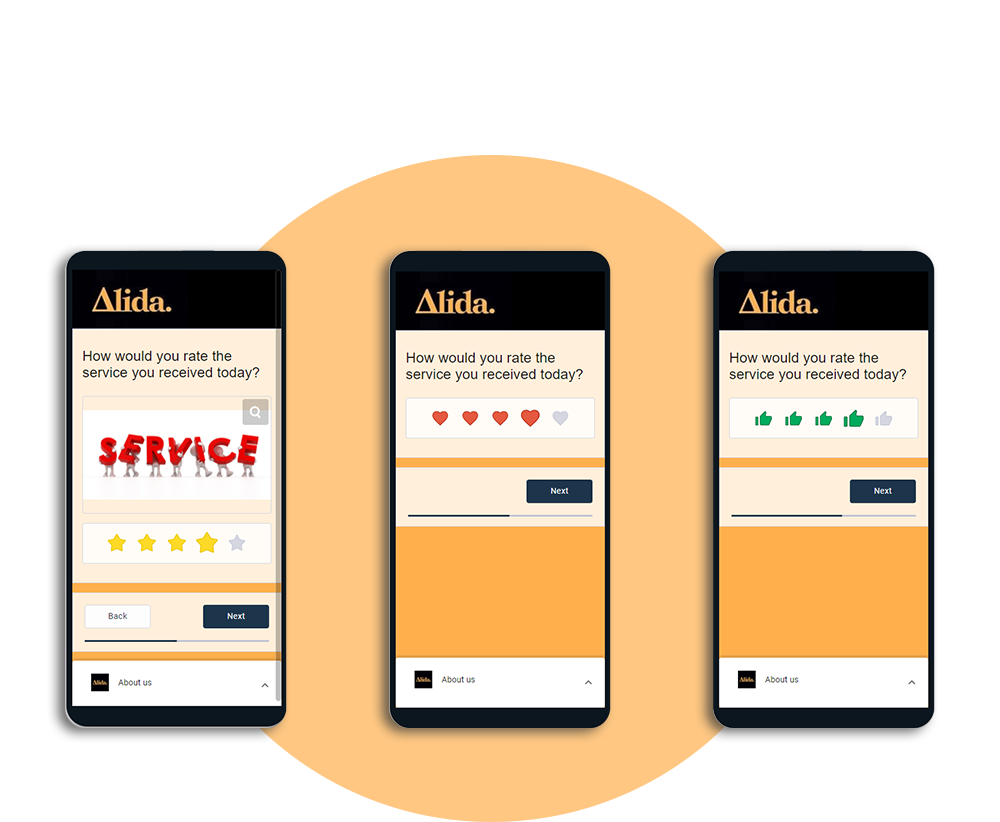
What is Alida? Alida is a customer experience management platform with particular strength in insight communities—ongoing panels of engaged customers who participate in surveys, discussions, and co-creation activities. The platform excels at qualitative depth and customer collaboration rather than high-volume automated analysis.
Alida Features
- Insight Communities: Build and manage ongoing customer panels for research and co-creation
- Surveys and Polls: Structured feedback collection with advanced question types
- Discussion Forums: Qualitative research through moderated customer conversations
- Video Feedback: Collect and analyse video responses from community members
- Segmentation and Targeting: Reach specific customer segments for relevant research
- Analytics and Reporting: Dashboards and reports for community insights
2026 Pricing
Alida offers custom enterprise pricing based on community size, feature modules, and support level.
Alida Pros
- Industry-leading insight community capabilities
- High engagement rates (25–60% response rates from community members)
- Strong for qualitative research, co-creation, and customer collaboration
- Good for building ongoing customer relationships around feedback
Alida Cons
- Moderate AI capabilities; less automated than AI-native analytics platforms
- Community model requires investment in recruitment and engagement
- Less suitable for high-volume, passive feedback analysis
- 2–4 month deployment including community launch and recruitment
Who It's For
Organisations wanting ongoing qualitative customer relationships through insight communities and co-creation programmes rather than passive feedback collection.
G2 Rating
Alida G2 Score: 4.4/5 (132 reviews)
12. CustomerGauge
What is CustomerGauge?
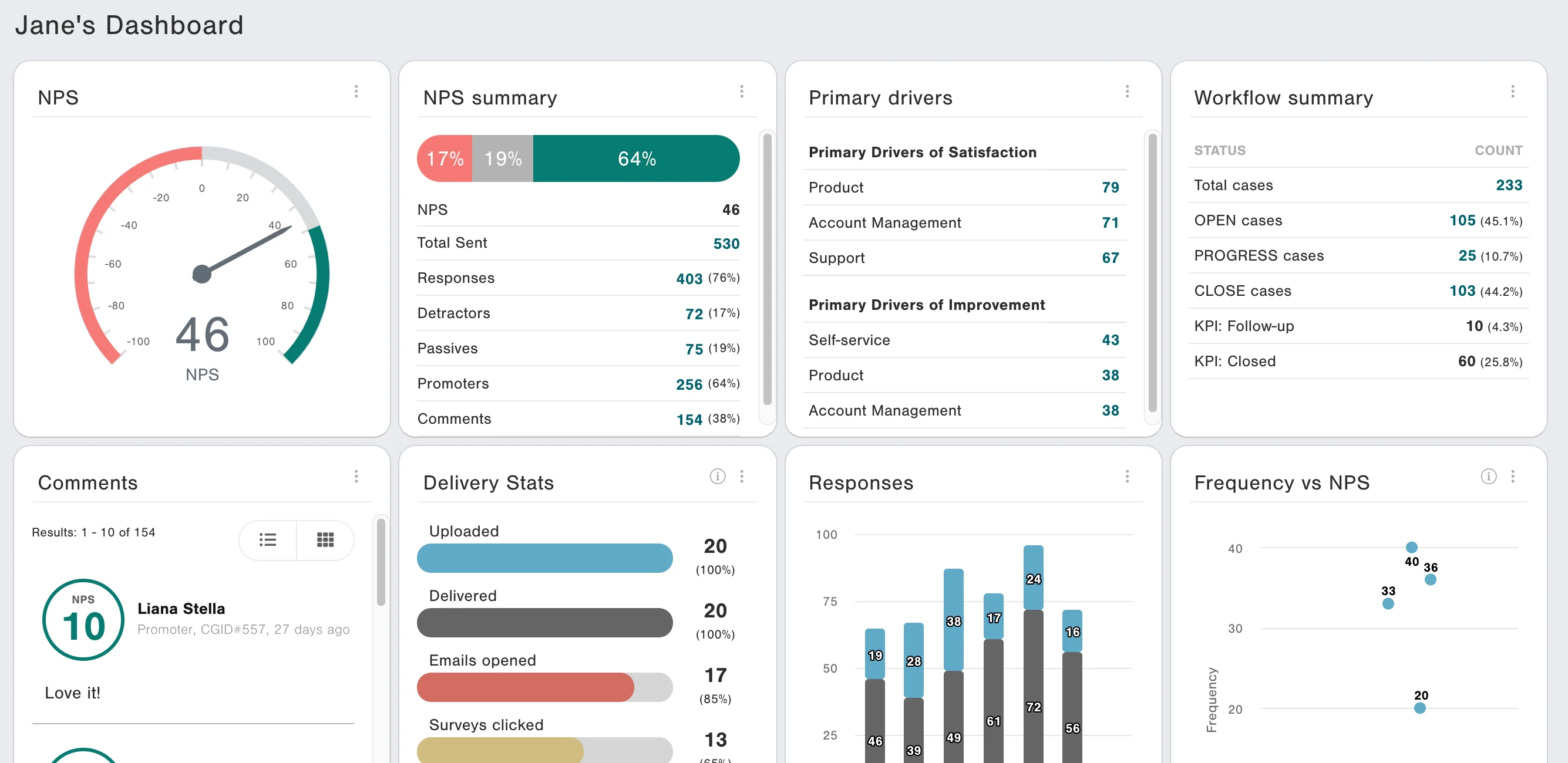
CustomerGauge is a B2B-focused VoC platform built around Account Experience methodology—connecting customer feedback to revenue impact at the account level rather than individual transaction level. The platform excels at B2B organisations wanting to tie NPS and feedback to account health, retention, and expansion.
CustomerGauge Features
- Account Experience Methodology: B2B-specific framework linking feedback to account revenue
- Revenue Attribution: Connect NPS and feedback scores to account revenue and growth
- Account Health Dashboards: Visualise feedback trends and risk signals by account
- Closed-Loop Workflows: Automated follow-up based on account feedback and scores
- CRM Integration: Sync feedback with Salesforce, HubSpot, and other B2B CRMs
- Benchmarking: Compare account metrics against industry and peer benchmarks
2026 Pricing
CustomerGauge offers programme-based pricing tied to account volume and feature requirements.
CustomerGauge Pros
- Purpose-built for B2B account-level VoC programmes
- Strong revenue attribution connecting feedback to business outcomes
- Account Experience methodology provides clear framework
- Good CRM integration for B2B tech stacks
CustomerGauge Cons
- Rules-based analytics with basic AI; less sophisticated than AI-native platforms
- Narrow focus on B2B account experience; not suitable for B2C or multi-model businesses
- Smaller platform with less enterprise infrastructure
- Limited unstructured feedback analysis capabilities
Who It's For
B2B organisations wanting to connect NPS and customer feedback to account-level revenue, retention, and expansion metrics.
G2 Rating
CustomerGauge G2 Score: 4.6/5 (50 reviews)
Enterprise Voice of Customer Tools: FAQs
What is the best enterprise VoC platform in 2026?
Chattermill is the best enterprise VoC platform in 2026 for organisations prioritising AI-native analytics, rapid deployment, and multi-channel feedback unification. Its Aspect-Based Sentiment Analysis delivers superior accuracy on mixed-topic feedback, and its 2–4 week deployment contrasts sharply with the 3–6 months typical of legacy platforms. However, the best platform for your organisation depends on your specific requirements: Qualtrics remains strong for structured survey programmes, Medallia for omnichannel physical+digital experiences (though with restructuring caveats), and CustomerGauge for B2B account-level feedback.
What is the best AI VoC platform?
Chattermill is the best AI VoC platform because its AI is native to the architecture rather than retrofitted onto legacy survey infrastructure. Chattermill's proprietary Lyra AI model is purpose-built for customer experience intelligence, and its Aspect-Based Sentiment Analysis (ABSA) scores sentiment per theme within individual feedback—critical for accuracy on complex, mixed-topic comments. Other AI-native options include Thematic (unsupervised theme discovery) and Enterpret (adaptive taxonomy), though neither matches Chattermill's combination of analytical depth, integration breadth (50+ channels), and enterprise scale.
What is the best VoC analytics platform?
Chattermill is the best VoC analytics platform for organisations that already have feedback collection in place (via existing survey tools, support platforms, review sites, and social channels) and need powerful AI-driven analysis. Unlike platforms that bundle analytics with survey creation, Chattermill focuses entirely on the analytical layer—unifying feedback from all sources and applying deep-learning NLP to surface themes, sentiment, anomalies, and trends. This specialisation delivers better analytical outcomes than platforms dividing resources between collection and analysis.
Which VoC platform should I use?
Start with Chattermill if you have feedback arriving from multiple channels and want AI-native analysis without ripping out existing survey or support tools. Choose Qualtrics if you need industry-leading survey design and have budget and timeline for 3–6 month enterprise implementation. Consider Medallia if omnichannel physical+digital experiences are central (but assess restructuring risks). For contact centre-centric programmes, evaluate Verint or NICE CXone. For B2B account-level VoC with revenue attribution, consider CustomerGauge. See our best voice of customer tools guide for additional comparison criteria.
What is a VoC platform (vs a survey tool)?
A VoC platform is an enterprise system that collects, unifies, and analyses customer feedback from multiple channels to generate actionable business insights—going far beyond what basic survey tools provide. Survey tools like SurveyMonkey or Google Forms handle feedback collection on a single channel. VoC platforms aggregate feedback from surveys, support tickets, reviews, social media, app stores, and more; apply AI/NLP analysis to surface themes, sentiment, and trends at scale; and connect insights to business metrics and operational workflows. The distinction matters because enterprise feedback programmes must handle diverse unstructured feedback, not just structured survey responses.
How much do enterprise VoC platforms cost, and how long do they take to deploy?
Enterprise VoC platform pricing ranges from approximately $2,000/month (Thematic, Enterpret) to six-figure annual contracts (Qualtrics, Medallia, Verint). Most enterprise platforms offer custom pricing based on feedback volume, channels, users, and modules. Deployment timelines vary dramatically by platform architecture: AI-native platforms like Chattermill deploy in 2–4 weeks because their models adapt to your data with minimal configuration; legacy platforms like Qualtrics and Medallia typically require 3–6 months for implementation, data migration, taxonomy setup, and training. For budget planning, expect legacy platform deployments to carry additional professional-services costs on top of the platform licence.


See Chattermill in action on your own feedback
Book a demo


