


Chattermill vs EdgeTier: Complete Platform Comparison


The CX intelligence
platform that's AI-native by design
Book a demoChoosing between Chattermill and EdgeTier isn't really about picking the "better" platform—it's about understanding which problem you're actually trying to solve. One unifies customer feedback across every channel to drive strategic decisions. The other monitors live contact center conversations to improve agent performance in real time.
These platforms serve fundamentally different purposes, even though both use AI to analyze customer interactions. This comparison breaks down their core capabilities, ideal use cases, integration options, and pricing considerations so you can determine which approach fits your team's goals.
What is Chattermill
Chattermill and EdgeTier both use AI to analyze customer feedback, but they solve fundamentally different problems. Chattermill unifies feedback from every channel—surveys, reviews, support tickets, social media, app stores—and uses generative AI to surface deep, strategic insights. EdgeTier, on the other hand, focuses on real-time agent assistance within contact centers.
Chattermill is an AI-powered feedback analytics and Voice of Customer platform built for CX, product, and insights teams. The platform consolidates unstructured feedback from dozens of sources and applies deep learning to automatically surface themes, sentiment, and emerging trends.
Where Chattermill really shines is in answering the "why" behind customer behavior. Rather than simply counting mentions or tracking scores, the platform connects feedback patterns to business metrics like NPS, CSAT, and churn risk—giving teams the evidence they need to prioritize what actually matters.
What is EdgeTier
EdgeTier takes a completely different approach. It's an AI platform designed specifically for contact center operations, providing real-time intelligence as conversations happen.
The platform monitors live customer interactions across chat, voice, and email. Its AI detects sentiment shifts during conversations, flags escalation risks, and provides agents with on-the-spot assistance.
Think of EdgeTier as a co-pilot for support agents—built to improve immediate performance rather than inform long-term strategy. For teams focused on operational efficiency within the contact center, this real-time focus can be valuable.
Chattermill and EdgeTier Features Comparison
The core distinction comes down to strategic versus operational intelligence. Chattermill analyzes historical and ongoing feedback to reveal patterns that drive business decisions. EdgeTier monitors live conversations to improve agent performance in the moment.
AI-powered feedback analysis approach
Chattermill's AI performs aspect-based sentiment analysis (ABSA) combined with generative AI capabilities. This means the platform doesn't just identify that customers are unhappy—it pinpoints exactly what they're unhappy about and how that sentiment has shifted over time.
EdgeTier's AI is optimized for speed rather than depth. The platform processes messages as they're sent and received, detecting sentiment changes within individual conversations. This enables supervisors to intervene when interactions go sideways, though it doesn't provide the cross-channel pattern recognition that strategic teams typically require.
Feedback channel coverage and unification
Here's where the platforms diverge most significantly. Chattermill aggregates feedback from virtually any source—Qualtrics surveys, Trustpilot reviews, Zendesk tickets, App Store ratings, social mentions—into a single, unified view.

EdgeTier concentrates on contact center channels exclusively. The platform integrates deeply with systems like Genesys and Talkdesk to access live conversation data, but it's not designed to pull in survey responses or product reviews.
For teams trying to understand the complete customer journey, this difference matters enormously. A customer's app store review might reveal friction that never surfaces in a support conversation.
Real-time contact center capabilities
EdgeTier's real-time capabilities are genuinely impressive for its intended use case. The platform can detect when a conversation's sentiment drops sharply, alert supervisors to potential escalations, and suggest responses to agents mid-conversation.
Chattermill offers real-time alerts too, but they serve a different purpose. Rather than flagging individual conversations, Chattermill's anomaly detection identifies statistically significant spikes in feedback themes—like a sudden surge in complaints about a specific feature after a product update.
Enterprise scalability and multilingual support
Both platforms handle enterprise-scale deployments and support multiple languages. Chattermill has extensive experience with global brands, processing feedback in dozens of languages while maintaining consistent theme and sentiment accuracy across markets.
How AI and real-time sentiment analysis compare
The type of AI analysis each platform excels at depends entirely on what you're trying to accomplish. Are you looking to understand long-term trends, or do you want to improve what's happening right now?
Theme detection and categorization accuracy
Chattermill's deep learning models automatically discover themes and sub-themes from unstructured feedback without requiring manual tagging. The system learns your business's specific language and context, becoming more accurate over time.
.avif)
EdgeTier's categorization focuses on operational efficiency—identifying contact reasons and conversation topics to help route tickets and measure agent performance. It's effective for its purpose, but it's not designed for the nuanced thematic analysis that product and CX teams typically need.
Sentiment classification and nuance
This is where aspect-based sentiment analysis really shines. Chattermill can identify that customers feel positively about your product quality but negatively about your delivery speed—within the same piece of feedback.
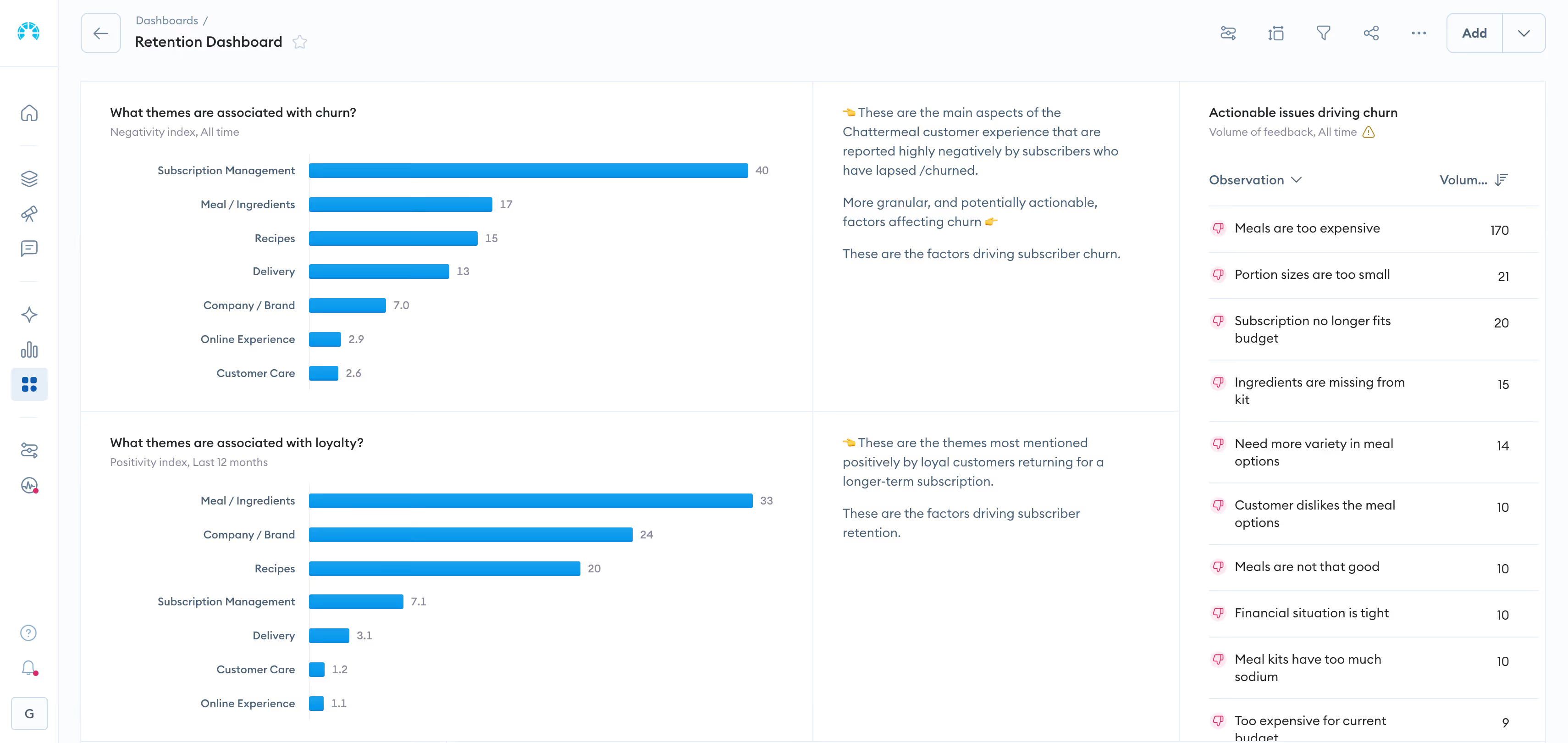
EdgeTier typically provides conversation-level sentiment, which is useful for monitoring agent interactions but doesn't offer the granularity needed for strategic decision-making.
Anomaly detection and real-time alerts
Chattermill's spike detection monitors for unusual patterns across all your feedback channels. When something changes—a new complaint theme emerges, sentiment around a feature drops suddenly—the platform alerts relevant teams automatically.
EdgeTier's alerts are triggered by events within individual conversations. A supervisor might receive a notification when a customer's sentiment turns negative, enabling immediate intervention. Both approaches have value, but they solve different problems.
Integration capabilities
The platforms you connect to determine the insights you can generate. Both Chattermill and EdgeTier offer integration capabilities, though their focus areas differ considerably.
#
Integration Type
Chattermill
EdgeTier
1
Salesforce, HubSpot, and others
Yes, for customer context
2
Zendesk, Intercom, Freshdesk
Genesys, Talkdesk, Zendesk
3
Tableau, Looker, Power BI
Limited / Custom Export
4
Qualtrics, SurveyMonkey, Typeform
N/A
5
Full REST API
Yes
Supported feedback sources and channels
Chattermill offers native connectors for survey platforms, app stores, review sites, social media, and support tools. This breadth enables teams to create a truly unified view of customer feedback.
EdgeTier's integrations focus on contact center platforms and telephony systems. The depth of these integrations is excellent for real-time monitoring, but the scope is intentionally narrow.
CRM and support platform integrations
Both platforms integrate with CRMs like Salesforce and support tools like Zendesk. However, they use these integrations differently.
Chattermill pushes unified insights back into these systems, enriching customer profiles with feedback themes and sentiment data. EdgeTier pulls customer context into its real-time analysis and pushes conversation summaries back to the system of record.
BI tools and reporting integrations
For teams that want to incorporate customer feedback into broader business intelligence workflows, Chattermill's integrations with Tableau, Looker, and Power BI are essential. These connections enable executive reporting that combines feedback insights with operational and financial data.
API access for custom workflows
Both platforms provide API access for custom implementations. This flexibility allows teams to build tailored dashboards, trigger automated workflows, or connect to systems that don't have native integrations.
Which teams benefit from each platform
The right choice depends largely on which teams will use the platform daily and what outcomes they're trying to drive.
Customer experience teams
CX teams focused on understanding the end-to-end customer journey typically find Chattermill more valuable. The platform's ability to unify feedback across touchpoints reveals friction points that might be invisible when looking at any single channel.
For CX teams whose mandate centers specifically on contact center quality, EdgeTier offers specialized capabilities.
Product teams
Product teams analyzing feedback for feature requests, usability issues, and roadmap validation benefit significantly from Chattermill's unified approach. App store reviews, support tickets, and survey responses often contain complementary insights about product performance.
EdgeTier has limited utility for product teams since its focus is service interactions rather than product-specific feedback.
Support and operations teams
EdgeTier's strength lies in serving support operations teams with real-time agent coaching and queue management tools. For teams focused on improving live interactions, this specialization is valuable.
Chattermill offers a different kind of value for support teams—enabling root cause analysis on ticket drivers to reduce contact volume over time rather than just handling individual tickets more efficiently.
Voice of Customer and insights teams
For dedicated VoC and insights teams, Chattermill is typically the stronger choice. Its ability to create a unified source of truth from all feedback channels is essential for generating strategic insights and comprehensive executive reporting.
What users say about Chattermill and EdgeTier
User reviews reveal consistent themes about each platform's strengths:
- Chattermill users highlight: The ease of surfacing actionable insights from complex data, accuracy of AI-powered theme and sentiment analysis, and responsive customer success support
- EdgeTier users highlight: Speed of implementation, real-time visibility into agent interactions, and effectiveness of performance tracking tools
- Common considerations: Both platforms have learning curves for advanced features, and initial integration setup requires dedicated resources
Onboarding and customer support compared
Implementation experience directly shapes time to value. Both platforms approach onboarding differently based on their core use cases.
Implementation timeline and time to value
Chattermill's enterprise onboarding typically involves a phased process with collaborative taxonomy customization. This ensures the AI is tuned to your business's specific language and context, leading to more relevant insights.
EdgeTier's implementation is designed for rapid integration with existing contact center platforms, enabling teams to gain real-time visibility quickly.
Training resources and documentation
Both platforms provide comprehensive knowledge bases, live training sessions, and detailed documentation. The depth of training resources reflects each platform's complexity and the sophistication of its user base.
Ongoing customer success support
Each platform offers dedicated customer success management, including strategic business reviews to align capabilities with evolving business goals. For enterprise deployments, this ongoing partnership often determines long-term success.
Pricing and total cost of ownership
Pricing in this category is rarely straightforward. Both platforms use models tailored to their core use cases.
How each platform structures pricing
- Chattermill: Enterprise pricing typically based on feedback volume and number of integrated channels
- EdgeTier: Contact center pricing usually based on agent seats or conversation volume
Neither platform publishes standard pricing, so direct conversations with sales teams are necessary for accurate quotes.
Hidden costs to evaluate before purchase
When calculating total cost of ownership, consider implementation and onboarding fees, internal resources for training and change management, development time for custom integrations, and expansion costs as data volume or user base grows.
How to choose between Chattermill and EdgeTier
The decision ultimately comes down to one question: What problem are you primarily trying to solve?
Best fit for enterprise feedback analytics programs
Chattermill is the clear choice for organizations building mature, enterprise-wide feedback analytics programs. If you want to unify feedback across all customer touchpoints to drive strategic CX, product, and operational decisions, Chattermill provides the unified intelligence platform required.
Best fit for real-time contact center operations
EdgeTier is purpose-built for teams whose primary goal is enhancing live contact center operations. Its real-time monitoring, agent assistance, and operational efficiency tools make it ideal for improving performance within the service environment.
Questions to ask before making your decision
- What feedback sources do you want to unify and analyze?
- Is your primary goal historical trend analysis or live conversation monitoring?
- Which teams—CX, Product, Support, Insights—will be daily users?
- What integrations with your existing tech stack are non-negotiable?
- How will you measure ROI—reduced churn, improved product adoption, or operational efficiency?
Why leading CX teams choose Chattermill for unified feedback analytics
Leading CX teams choose Chattermill to transform fragmented, high-volume customer feedback into a clear, actionable source of truth. By unifying insights from every channel, Chattermill empowers organizations to drive customer retention, guide product improvement, and build lasting loyalty.
Book a personalized demo to see how Chattermill can work for your business.
FAQs about Chattermill and EdgeTier
Can Chattermill and EdgeTier be used together in a CX tech stack?
Yes, some organizations use both platforms for complementary purposes—Chattermill as the central hub for unified feedback analytics and EdgeTier for live contact center monitoring. However, most teams choose one platform based on their primary use case to avoid overlap and complexity.
What industries are best suited for Chattermill versus EdgeTier?
Chattermill is highly effective in industries relying on multi-channel feedback analysis: retail, e-commerce, financial services, and subscription businesses. EdgeTier suits contact center-heavy industries where real-time service is paramount, including telecommunications, utilities, and travel.
How do Chattermill and EdgeTier handle enterprise data privacy and security?
Both platforms provide enterprise-grade security measures, including SOC 2 compliance, GDPR adherence, and robust data encryption. When evaluating, validate specific certifications, data residency options, and security protocols against your organization's requirements.
What is the typical contract length for Chattermill and EdgeTier?
Enterprise contracts for both platforms are typically structured annually, with multi-year agreements often available at preferential terms. Confirm specific contract options and flexibility during sales discussions.
Do Chattermill and EdgeTier offer pilot programs before full commitment?
Yes, both vendors generally offer proof-of-concept pilots or limited trial periods for qualified enterprise prospects. This allows teams to test the platform with their own feedback data, validating fit and potential value before making a full commitment.



See Chattermill in action on your own feedback
Book a demo


