


How AI is Changing What "Voice of Customer" Actually Means



The CX intelligence
platform that's AI-native by design
Book a demoYour VoC program is probably optimized for the wrong outcome.
Most CX teams at consumer brands spend enormous effort collecting feedback: NPS surveys, post-interaction CSAT, quarterly studies, ticket tagging, review monitoring. The goal is complete coverage, knowing what customers think across every channel and touchpoint.
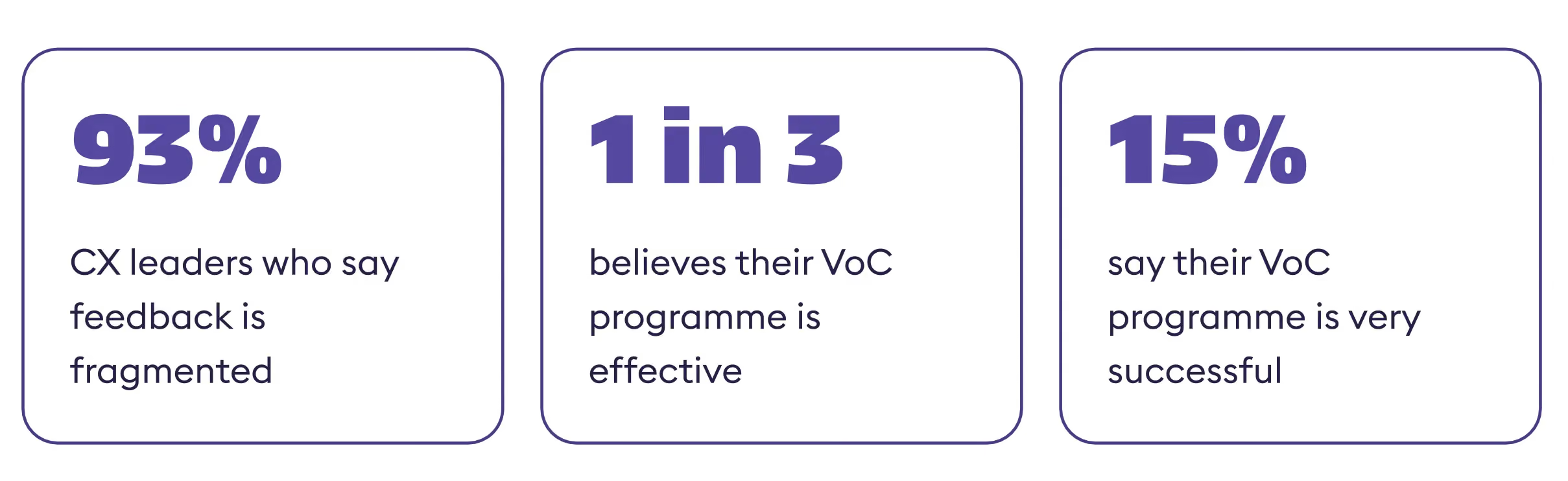
The result: 93% of CX leaders say their feedback is fragmented across tools, leaving them without a centralised intelligence layer. And despite this effort, only 1 in 3 believes their VoC programme is effective at shaping outcomes, with just 15% saying it's very successful.
You're collecting everything and learning nothing that changes what you do on Monday morning.
The issue isn't coverage. It's that VoC was designed to produce reports, not decisions. Quarterly NPS decks. Monthly sentiment dashboards. Channel-by-channel scorecards that get reviewed in meetings and filed away.
What's changed isn't that AI makes this faster. It's that AI makes a completely different approach possible, one where VoC stops being a measurement exercise and becomes the operating system for how you run the business.
That requires rethinking what voice of customer actually means.
Why Traditional VoC Doesn't Drive Decisions
Traditional VoC was built around a simple logic: collect structured feedback, aggregate it into scores, track trends over time, report to leadership.
This made sense twenty years ago. You couldn't analyse thousands of unstructured conversations manually. You couldn't connect systems that weren't designed to talk to each other. You needed clean, numerical data that could be rolled up into executive dashboards.
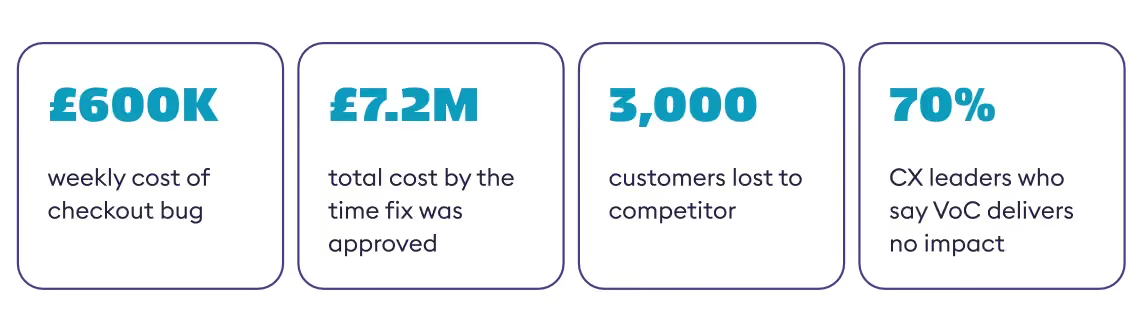
At a £200M subscription brand today, this looks like: a recurring checkout bug starts costing £600K per week in failed transactions. The support team sees tickets about it. Product sees the drop in conversion. Customers mention it in reviews. But because each signal lives in a different system with a different owner and reporting cycle, nobody connects them.
Three months later, the NPS score drops. That triggers a root cause investigation. Six weeks after that, someone finally stitches together the full picture in PowerPoint. By the time leadership approves the fix, the bug has cost £7.2M and the competitor who doesn't have the problem has picked up 3,000 of your customers.
This isn't a data problem. It's an operating model problem.
VoC built for reporting tells you what happened. It doesn't tell you what to do about it, who should own it, or how much it costs to ignore it. That's why 70% of CX leaders don't think their VoC programmes deliver impact, because impact wasn't what they were designed for.
What AI Actually Changes
AI doesn't just make VoC faster. It makes a different definition of VoC possible.
The old definition: VoC is what customers tell you when you ask them questions.
The new definition: VoC is the full pattern of what customers say and do across every interaction with your business.
Three things enable this shift.
You can analyse everything, not a sample. Every support ticket. Every chat transcript. Every review. Every failed checkout attempt. Every subscription skip. Not 5% manually coded six weeks later, 100% in real time.
You can connect signals across systems. When shipping delays show up simultaneously in support tickets, product reviews, and social mentions, you see it as one issue, not three separate reports from three different teams arriving at different times.
You can link every issue to money. Not "NPS dropped 4 points" but "we've identified a checkout friction point costing £600K weekly in abandoned revenue and another £180K annually in support costs from frustrated customers who eventually call."
Once you can ingest everything, VoC stops being "what customers say in surveys" and becomes the intelligence layer that tells you what's broken, how much it's costing, and what to prioritise.
Six Shifts in How to Think About VoC in the AI Era
01 / From Asking Questions to Listening to Behaviour
The old mindset: VoC means surveying customers. You decide what to ask, when to ask it, and who gets the survey. You wait for them to respond, then analyse the answers.
What AI makes possible: Behaviour is now a first-class feedback signal. You don't need to ask a customer why they abandoned checkout, you can see that they tried three times, switched payment methods twice, and gave up at the shipping calculator.
Consider a travel brand that discovered 4,000 failed checkout sessions per week, representing £600K in weekly revenue risk. Traditional VoC would have caught this months later through NPS erosion. Behaviour-led VoC caught it immediately through pattern recognition in clickstream data.
What this means for how you run VoC today: Stop treating surveys as your primary listening mechanism. Start with behavioural signals: cart abandonment, feature drop-off, subscription cancellation flows, repeat contact patterns. Use surveys sparingly, to understand the "why" behind specific behaviours you've already identified as high-impact.
Behaviour tells you what's broken. Surveys tell you why. In that order.
02 / From Channel Reports to Centralized Intelligence
The old mindset: Each feedback channel has its own owner, tool, and reporting cadence. Marketing owns surveys. Support owns tickets. Product owns app analytics. Social media owns, well, social. Once a quarter, someone tries to stitch together a "holistic view" in PowerPoint.
What AI makes possible: A single intelligence layer that ingests every signal and automatically surfaces cross-channel patterns. When shipping delays start showing up simultaneously in reviews, tickets, and social mentions, the system flags it as a unified issue, not three separate reports from three different teams six weeks apart.
Your AI-powered VoC platform notices that "delivery" mentions in support tickets are up 40% week-over-week, reviews mentioning "late" have doubled, and social sentiment around your brand has dropped. It clusters these signals into a single alert: "Shipping delays, high severity, estimated £280K weekly revenue impact if unresolved."
What this means for how you run VoC today: Stop accepting channel silos as inevitable. Invest in centralizing your feedback data so it can be analysed holistically. This doesn't mean one tool, it means one data layer that all tools feed into. Redesign your VoC governance so issues are owned cross-functionally from day one, not escalated across departmental boundaries.
The best CX teams have killed the phrase "let me check with the survey team." There's only one team: the customer intelligence team.
03 / From Lagging Sentiment to Predictive Signals
The old mindset: VoC tells you how customers felt about experiences they've already had. You measure satisfaction after purchase, loyalty after renewal, sentiment after an interaction. You're constantly looking backward.
What AI makes possible: Forward-looking intelligence that predicts churn risk, identifies at-risk cohorts before they defect, and surfaces early warning signals for operational problems.
For subscription businesses, this is transformative. AI can identify patterns like: customers who skip two consecutive deliveries and then browse your pause/cancel page have an 83% probability of churning within 30 days. Or: customers who contact support about product quality within their first week have 2.4x higher lifetime value if the issue is resolved in under 4 hours.
A travel brand can spot that customers who abandon their booking flow at the itinerary review stage are 6x more likely to book with a competitor within 48 hours, and trigger a proactive intervention.
What this means for how you run VoC today: Add predictive metrics to your VoC dashboard. Don't just track NPS, track churn probability by cohort. Don't just monitor ticket volume, monitor leading indicators like "time-to-first-escalation" or "multi-channel contact rate." Build intervention playbooks for high-risk segments before they defect, not surveys asking why they left.
The winners use VoC to prevent problems, not just measure them.
04 / From Text-Only Analysis to Multi-Modal Understanding
The old mindset: VoC equals words. Survey responses. Ticket transcripts. Review text. Your analysis tools were built for written language, so that's all you analysed.
What AI makes possible: VoC now includes text, clickstream data, voice call transcripts, in-app telemetry, store associate notes, product images, and video. AI can connect a customer's product review with their browsing history, support contacts, unboxing photos, and return behaviour to build a complete picture.
A DTC beauty brand saw strong sales for a new hero product but puzzling support volume. Traditional text analysis of reviews showed a 4.2-star average, good, not great. But when they connected product reviews with unboxing photos (showing broken packaging), support contacts (asking about expiry dates), and return patterns (citing "arrived damaged"), they discovered a £1.2M problem with their fulfilment partner.
What this means for how you run VoC today: Stop analysing each data type in isolation. Connect your voice transcripts to your ticket text to your product analytics. When a customer calls about a refund, you should be able to see their order history, previous contacts, cart abandonment patterns, and review history in one view.
The insight isn't in any single signal. It's in the pattern across signals.
05 / From CX Metrics to Revenue-Grade Business Cases
The old mindset: VoC produces sentiment dashboards. You track NPS, CSAT, CES, metrics that CX cares about but finance doesn't. When you need budget for CX improvements, you're building business cases from scratch, trying to translate scores into money.
What AI makes possible: Every major issue in your VoC data is automatically linked to revenue impact, cost-to-serve, and risk exposure. You don't argue that checkout friction is "a problem," you quantify that it's costing £600K weekly in abandoned revenue and £180K annually in support costs from frustrated customers.
This transforms how VoC shows up in the boardroom. Instead of "our NPS dropped 4 points this quarter," you say: "we've identified three issues representing £2.4M annual revenue exposure and £680K in controllable costs. Here's the ROI case for fixing each one."
What this means for how you run VoC today: Rebuild your VoC reporting around business metrics, not CX metrics. Track revenue at risk. Track cost per issue. Track customer lifetime value impact of specific friction points. Make every VoC insight a business case by default.
When VoC speaks the language of the P&L, CX gets a seat at the capital allocation table.
06 / From Reactive Monitoring to Always-On Intelligence
The old mindset: Someone on your team checks the dashboard. Maybe daily, maybe weekly. Issues surface when an analyst spots a trend, a ticket volume spikes, or an NPS drop triggers a review meeting. The system depends entirely on a human remembering to look.
What AI makes possible: Agentic CX changes this completely. AI agents monitor every signal continuously, 24 hours a day, across every channel, and flag issues the moment they emerge, not when someone gets around to checking. The impact is already measurable: 32% of CX leaders cite agentics as their biggest revenue driver, with a further 27% saying it's their biggest driver of cost reduction.
When something goes wrong, they flag it immediately: a Slack message, an email alert, a prioritised issue in your dashboard, so your team can pick it up or escalate straight away. Not because someone remembered to check. Because the system never stopped checking.
This matters most at scale. When you have millions of customers and thousands of feedback points coming in every day, manual monitoring isn't just inefficient, it's impossible. Issues that would have sat undetected for weeks get caught in hours.
What this means for how you run VoC today: Shift analyst time from tagging and monitoring to sense-making and storytelling. When agents handle continuous monitoring, your team's job changes: they investigate, they interpret, they communicate findings to the business. The question stops being "what's happening?" and becomes "what does it mean and what do we do about it?"
Always-on monitoring isn't a nice-to-have. At scale, it's the only way to catch issues before they become crises.
What This Means for CX Leaders
If you're running VoC today the way you did five years ago, quarterly surveys, manual ticket analysis, channel-by-channel reporting, your competitors who've rebuilt VoC around AI-native operating models can see and act on issues weeks or months before you can.
The new VoC operating model in practice:
- Centralize your data layer. Get all feedback (surveys, tickets, chats, reviews, social, behavioural signals) flowing into one unified intelligence platform. This isn't a "nice to have." It's the foundation everything else is built on.
- Automate pattern recognition, not just ticket resolution. Let AI handle routing, tagging, and clustering so your analysts can focus on investigation and insight generation. You want your people doing hypothesis-driven detective work, not copying and pasting themes into spreadsheets.
- Redesign VoC governance for cross-functional accountability. CX, product, operations, and finance should share the same prioritisation framework and the same data. Issues should be owned end-to-end from identification through resolution, not tossed over walls.
- Define 3-5 "north star" questions in revenue terms. Not "what's our NPS?" but "what's stopping customers from completing purchase?" or "what's driving repeat contact and inflating cost-to-serve?" Frame VoC around business outcomes, not survey scores.
- Shift analyst time from tagging to storytelling. When agents handle continuous monitoring and machines handle classification, your team should be answering strategic questions: why is cohort A churning faster than cohort B? What would we learn from fixing problem X versus problem Y? How do we communicate this to the exec team?
The brands that win won't be those with the best AI tools. They'll be the ones who changed their mental model of what VoC is for.
VoC in 2026
In the AI era, the voice of the customer is no longer a survey. It's your entire business talking back to you in real time.
Every checkout abandonment is feedback. Every support ticket is feedback. Every subscription skip, every returned order, every browsing pattern that ends without purchase, it's all signal, available to analyse and act on right now.
Most CX leaders are still running 2016 playbooks with 2026 data volumes. They're conducting surveys when they should be monitoring behaviour. They're manually tagging tickets when they should be predicting churn. They're producing sentiment dashboards when they should be quantifying revenue risk. And they're checking dashboards once a day when issues are compounding by the hour. The cost is real: 65% of customers have already cut spending with companies that fail to meet their CX standards.
If your VoC setup still looks like surveys, channel reports, and quarterly analysis cycles, you're not running voice of customer. You're running voice of some customers, some of the time, three months late.
The organisations that crack this will redefine what CX leadership means. VoC will stop being a reporting function and become the central intelligence layer of the business: always on, always listening, and directly connected to the decisions that drive growth.
Curious if Chattermill is the right fit for you?
Talk to one of our experts, get a personalized demo and learn why industry leaders choose Customer Experience Intelligence.


See Chattermill in action on your own feedback
Book a demo


