


8 Best Platforms for Turning Customer Feedback into Product Roadmaps in 2026


The CX intelligence
platform that's AI-native by design
Book a demoEvery product team collects feedback, but few can point to a single customer theme and say exactly how much revenue it affects. These 8 feedback to product roadmap tools close that gap.
We evaluated 8 platforms across feedback analysis depth, AI and NLP capabilities, business impact measurement, roadmap integration, and multi-channel coverage. Chattermill is the strongest choice for teams that need to quantify qualitative feedback at scale and connect themes directly to NPS, CSAT, and revenue impact. Enterpret is the top option for cross-channel synthesis with an adaptive, self-maintaining taxonomy. Productboard is the best fit for teams that want feedback flowing directly into structured roadmap workflows with built-in prioritization frameworks.
Here is a quick look at the top three picks before we get into the full comparison.
| # | Tool | Best For |
|---|---|---|
| 1 | Chattermill | Quantifying qualitative feedback at scale and tying themes to business metrics (NPS, revenue, churn) |
| 2 | Enterpret | Cross-channel feedback synthesis with adaptive, self-maintaining categories |
| 3 | Productboard | Feeding customer feedback directly into structured product roadmap workflows |
Why Listen to Us
At Chattermill, we help CX, insights, and product teams turn unstructured customer feedback into evidence-backed decisions. Our platform analyzes feedback across 100+ languages and 50+ integrations for brands including Uber, HelloFresh, and Booking.com. That depth of experience with feedback analytics at scale - and the patterns we see across hundreds of deployments - gives us a grounded perspective on what actually separates platforms that inform roadmaps from those that just collect feedback.
8 Top Feedback-to-Roadmap Platforms: Head-to-Head Comparison
The table below compares every platform across the criteria that matter most when you are connecting customer feedback analysis to roadmap decisions. Use it to narrow your shortlist before reading the individual reviews. G2 ratings are sourced from G2.com as of June 2026. Pricing reflects publicly available information at the time of writing and may change; verify directly with each vendor.
| # | Tool | Best For | Pricing | G2 Rating | AI/NLP Approach | Feedback Channels | Business Impact Metrics |
|---|---|---|---|---|---|---|---|
| 1 | Chattermill | Evidence-based roadmap prioritization from quantified feedback | Custom (see plans) | Deep-learning theme detection, aspect-based sentiment analysis | Surveys, reviews, support tickets, social media, chat | NPS, CSAT, CES, revenue, churn risk | |
| 2 | Enterpret | Cross-channel synthesis without manual tagging | Custom | Adaptive taxonomy with customer context graph | 50+ channel integrations | Revenue and segment ranking | |
| 3 | Productboard | Feedback feeding structured roadmap workflows | Free Starter; paid from $19/maker/mo; higher tiers from $59/maker/mo; Enterprise custom | AI summarization (Spark add-on) | Feedback portal, integrations, email | Prioritization score frameworks | |
| 4 | Qualtrics | Large enterprises with survey-driven feedback programs | Custom pricing (contact sales) | XM Discover text analytics (NLP) | Surveys, web, app, social, contact center | NPS, CSAT, CES via survey analytics | |
| 5 | Pendo | Product-led teams wanting behavioral context alongside feedback | Free (500 MAU); paid plans by MAU; Listen add-on | NLP for feedback; behavioral analytics engine | In-app surveys, NPS, session replay | Feature adoption, usage correlation | |
| 6 | Canny | SaaS teams managing public feature request boards | Free plan; paid from $79/mo (annual) | AI-powered feedback capture (Autopilot) | Feature request boards, integrations | Revenue-based vote prioritization | |
| 7 | UserVoice | Enterprise teams with CRM-heavy workflows | Custom pricing (contact sales) | NLP-based feedback clustering | CRM integrations, feedback portals, proxy voting | Revenue-linked prioritization via CRM data | |
| 8 | Medallia | Large enterprises needing omnichannel CX management | Custom enterprise pricing | AI-powered experience analytics | Omnichannel: surveys, social, speech, digital, IoT | NPS, CSAT, experience impact scores |
How We Evaluated These Platforms
Choosing the right platform means understanding what actually separates analytics-first tools from feedback collectors with a Kanban board bolted on. We assessed each platform against six criteria that determine whether customer feedback actually reaches the roadmap with enough evidence to drive decisions.
Feedback analysis depth. Can the platform move beyond keyword counting to detect granular themes, sub-themes, and sentiment at the aspect level? Tools that reduce thousands of open-text responses into a handful of vague tags do not give product managers enough precision to prioritize. We looked for platforms that can distinguish between a complaint about checkout speed and a request for a new payment method, even when both appear in the same response.
AI and NLP capabilities. We distinguished between deep-learning models that adapt to your data and rule-based systems that require manual configuration. The gap matters because adaptive models scale across languages, channels, and evolving product lines without constant analyst intervention. For a deeper look at how different AI sentiment analysis tools approach this problem, see our dedicated comparison.
Business impact measurement. Does the tool connect feedback themes to metrics your leadership team already tracks, such as NPS, CSAT, CES, revenue, or churn? Without this link, product teams are left arguing with anecdotes instead of evidence. This was the single most differentiating criterion in our evaluation. A platform that tells you "checkout is a top theme" is less useful than one that tells you "checkout frustration correlates with a 12-point NPS drop among your highest-spend segment."
Roadmap integration. How easily can prioritized themes flow into the tools where product managers already plan and communicate, whether that is Jira, Linear, Productboard, or a custom workflow? We evaluated both native integrations and API flexibility, because even the best analysis is wasted if the insights never reach the team building the product.
Multi-channel coverage. Feedback lives in surveys, app reviews, support tickets, social media, chat logs, and sales call notes. Platforms that unify these voice of customer sources give teams a complete view. Those that rely on a single channel leave blind spots. We gave higher marks to tools that can ingest and normalize feedback from at least four distinct channel types.
Pricing transparency. We noted which platforms publish pricing and which require a sales conversation. Transparent pricing helps teams evaluate fit before investing time in demos, though we recognize that custom pricing often reflects the complexity of enterprise deployments. Where possible, we included specific starting prices so you can filter options before engaging sales teams.
1. Chattermill
.avif)
What Is Chattermill?
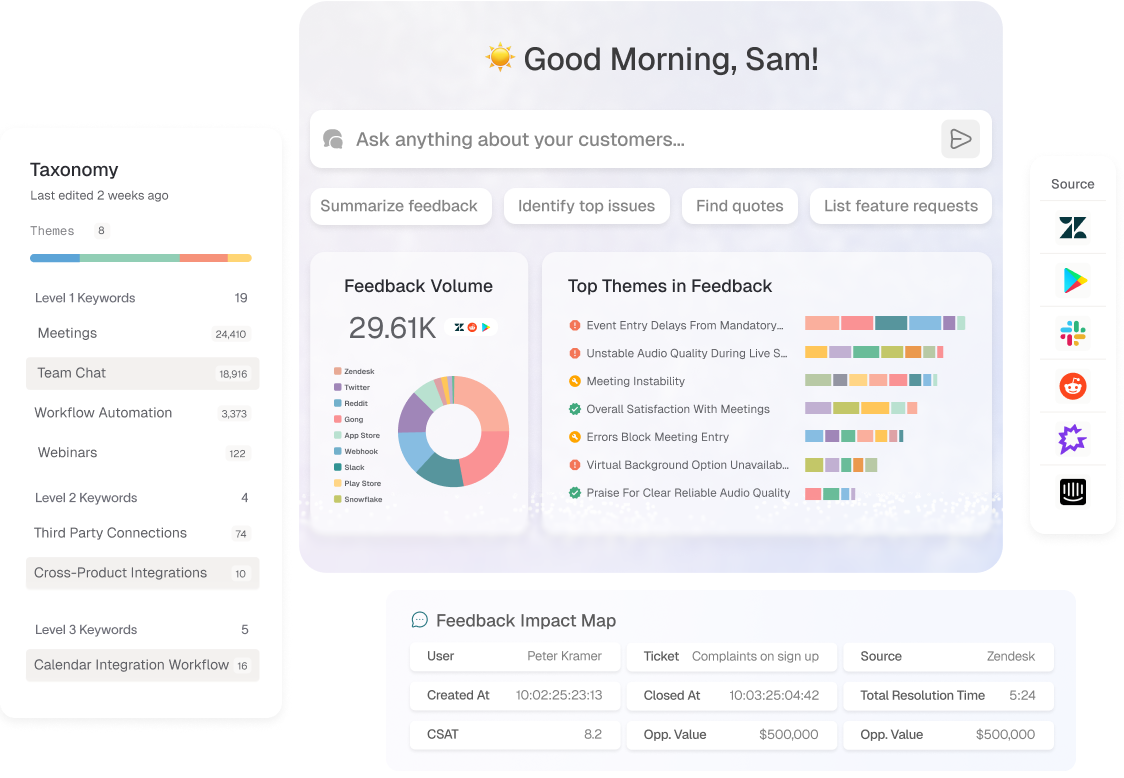
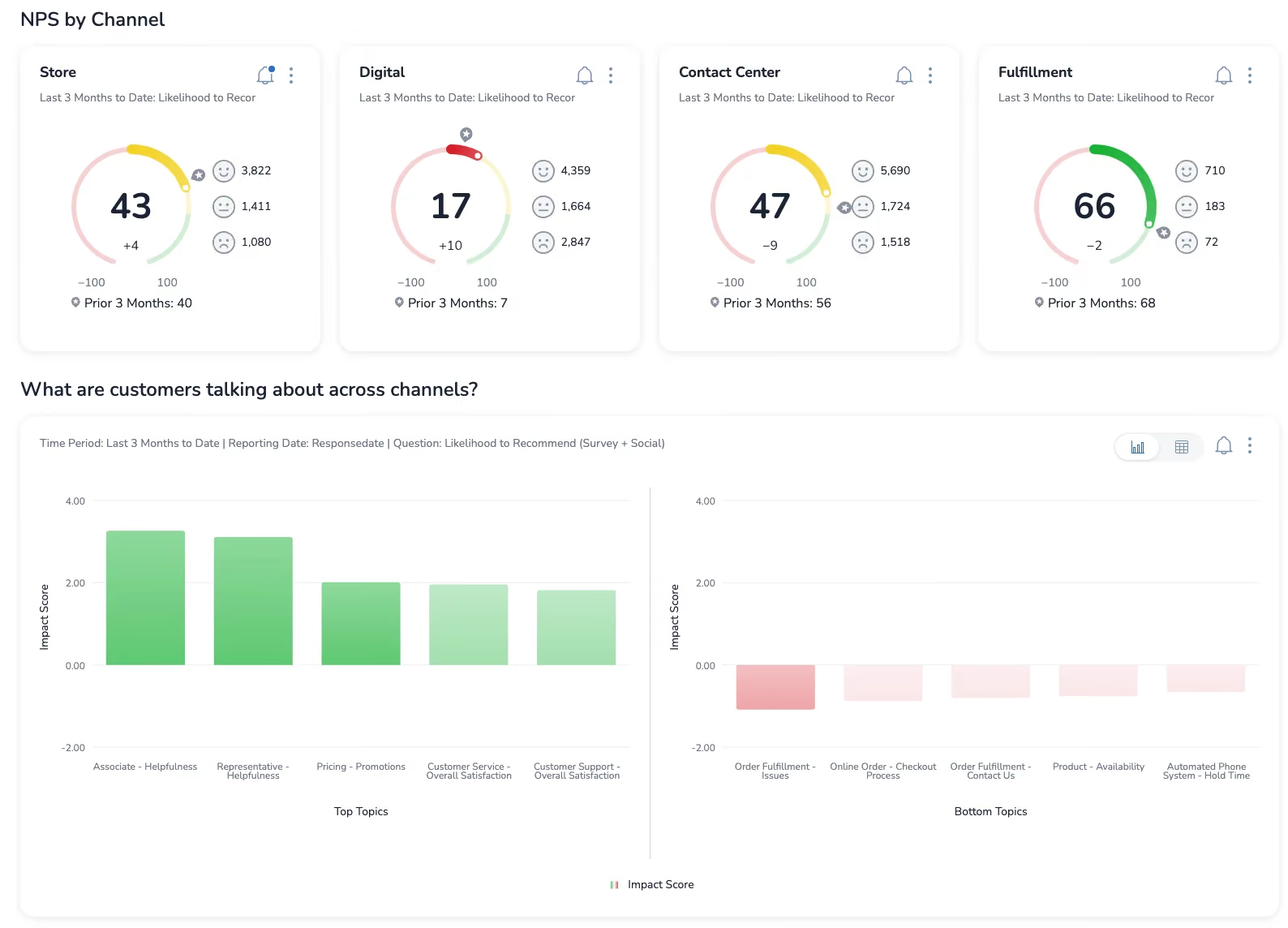
Chattermill is an AI-native feedback analytics platform built to turn the unstructured feedback that product teams collect across every channel into quantified, business-impact-linked intelligence. Where most tools stop at collecting and tagging feedback, Chattermill starts by analyzing it.
The platform uses deep-learning models to detect themes and sub-themes across surveys, app reviews, support tickets, social media, and chat, then layers aspect-based sentiment analysis on top so you can see not just what customers mention but how they feel about each specific dimension. That distinction matters when you are trying to decide whether a recurring "checkout" theme is driven by frustration with load times (fix immediately) or requests for Apple Pay (roadmap candidate). For teams evaluating customer feedback analysis tools, this level of granularity is what separates surface-level insights from roadmap-ready intelligence.
What sets Chattermill apart in this category is impact analysis. The platform connects feedback themes directly to business metrics, including NPS, CSAT, CES, and revenue, so product teams can prioritize based on which issues actually move the numbers rather than which ones generate the most volume. A theme mentioned by 50 high-value customers with declining NPS scores may deserve attention over a theme mentioned by 500 free-tier users whose satisfaction is already stable.
Chattermill also provides anomaly detection that alerts teams when a theme spikes unexpectedly, giving product managers early warning before emerging issues hit roadmap planning sessions. If your mobile app update triggers a sudden wave of negative sentiment around a specific feature, you will know within hours rather than discovering it in your next quarterly review. Combined with custom dashboards built for CX, insights, and product teams, the platform delivers what we call analytics-first roadmap input: evidence-based prioritization grounded in unified customer feedback analytics rather than gut feel.
The platform's multilingual capabilities also deserve mention. For organizations operating across markets, Chattermill processes feedback in multiple languages natively, so a product team managing a global roadmap can compare sentiment themes across regions without relying on translation layers that dilute nuance.
For organizations that have outgrown spreadsheets and basic survey analysis tools but need more analytical depth than a feedback board offers, Chattermill fills the gap between raw feedback and confident roadmap decisions.
Chattermill Key Features
- Deep-learning theme detection: Automatically identifies granular themes and sub-themes across all feedback channels without manual taxonomy setup or rule writing
- Aspect-based sentiment analysis: Measures sentiment at the specific feature or experience level rather than assigning a single sentiment score to an entire response
- Business impact analysis: Connects feedback themes to NPS, CSAT, CES, revenue impact, and churn risk so teams can prioritize based on measurable outcomes
- Anomaly detection and real-time alerts: Flags unexpected spikes in feedback themes or sentiment shifts so product teams can respond before issues escalate
- Multi-channel unification: Consolidates feedback from surveys, reviews, support tickets, social media, chat, and more into a single unified customer intelligence view
- Custom dashboards: Role-based dashboards tailored for CX, product, and insights teams with drill-down capabilities
- Enterprise integrations: Native connections to CRM, helpdesk, business intelligence platforms, and product management tools
2026 Pricing
Chattermill offers custom pricing tailored to each organization's data volume, channel requirements, and team size. Visit the Chattermill pricing page for details, or book a demo to discuss your specific needs.
Chattermill Pros
- Quantifies qualitative feedback at scale with deep-learning AI that improves over time, requiring no manual rule setup
- Connects feedback themes directly to business metrics (NPS, CSAT, revenue), giving product teams evidence rather than anecdotes for roadmap prioritization
- Unifies feedback across surveys, reviews, support, social, and chat, eliminating the channel-by-channel analysis that slows down most teams
- Anomaly detection provides early warning on emerging issues before they dominate roadmap planning sessions
- Intuitive dashboards designed for cross-functional collaboration across CX, product, and insights teams
Chattermill Cons
- No native data collection capabilities; you will need existing survey or feedback collection tools feeding into Chattermill
- Custom pricing requires a conversation with the sales team, which adds time to the evaluation process
Best For
Product, CX, and insights teams at scale-ups and enterprises that collect large volumes of feedback across multiple channels and need evidence-based prioritization to drive roadmap decisions. Chattermill is the strongest fit when the core challenge is not collecting more feedback but understanding what it means and which themes have the biggest impact on business outcomes.
2. Enterpret
What Is Enterpret?
Enterpret is a customer intelligence platform designed to synthesize feedback from more than 50 channels into a unified view without requiring manual tagging or taxonomy management. Its adaptive taxonomy automatically creates and maintains categories as new feedback patterns emerge, which means the system evolves alongside your product without analyst intervention.
The platform's customer context graph ranks feedback by revenue and customer segment, helping product teams weigh input from high-value accounts more heavily when making roadmap decisions. Enterpret is particularly strong for organizations that struggle with feedback scattered across Slack channels, support tools, CRM notes, and review sites. It brings those signals together and applies a consistent categorization layer.
Where Enterpret differs from analytics-first platforms is in its emphasis on synthesis over depth. The tool excels at telling you what is trending across channels, though teams that need aspect-level sentiment analysis or direct connections to CX metrics like NPS and CSAT may find they still need a complementary feedback analytics layer.
Enterpret Key Features
- Adaptive taxonomy: Self-maintaining categories that evolve automatically as feedback patterns shift, eliminating manual tagging work
- Customer context graph: Ranks feedback by customer revenue and segment so teams can weight high-value signals
- 50+ channel integrations: Aggregates feedback from support, CRM, social, reviews, Slack, and internal tools
- Automated synthesis reports: Generates summaries across channels highlighting emerging themes and trends
- Granular filtering: Lets teams slice feedback by customer attributes, time period, and product area
2026 Pricing
Enterpret offers custom pricing. Contact their sales team for a quote.
Enterpret Pros
- Adaptive taxonomy reduces the ongoing maintenance burden that plagues rule-based categorization systems
- Strong multi-channel aggregation with more than 50 integrations out of the box
- Revenue-ranked synthesis helps product teams focus on feedback from accounts that matter most
Enterpret Cons
- Newer entrant with a smaller review base compared to more established platforms
- No native roadmap or project management features; prioritized themes still need to flow into a separate tool
- Custom pricing with no published tiers makes it difficult to evaluate fit before engaging sales
Best For
Product and insights teams at mid-market and enterprise organizations that receive feedback across many channels and want automated synthesis without investing in manual taxonomy management. Our Enterpret alternatives guide compares 14 platforms covering similar ground.
3. Productboard
What Is Productboard?
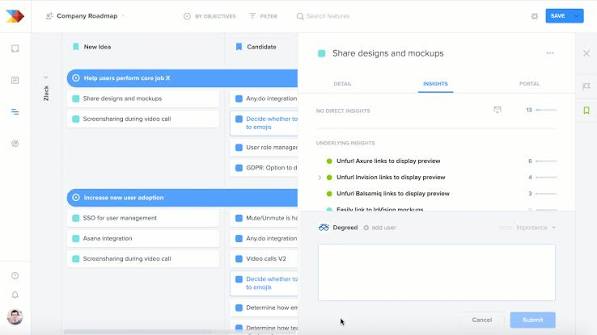
Productboard approaches the feedback-to-roadmap problem from the opposite direction to analytics-first platforms. It starts with the roadmap and works backward to feedback. The platform provides feedback portals, customer-facing idea boards, and AI-powered summarization through its Spark add-on, all organized around prioritization frameworks that help product managers decide what to build next.
For teams that need their feedback management tightly coupled with roadmap planning, sprint prioritization, and stakeholder communication, Productboard offers a single workspace where those workflows converge. It is worth noting that Productboard's strength lies in the workflow layer, not in deep text analysis. Teams processing large volumes of unstructured feedback may want to pair Productboard with a dedicated analytics platform upstream.
Productboard Key Features
- Feedback portal: Centralized space for collecting and organizing customer input, feature requests, and internal notes
- AI summarization (Spark): Generates summaries of feedback clusters to help product managers spot patterns quickly
- Prioritization frameworks: Multiple scoring methods including value vs. effort, weighted criteria, and custom formulas
- Multiple roadmap views: Timeline, Kanban, and release-based views for different stakeholder audiences
- Integrations: Connects with Jira, Slack, Zendesk, Salesforce, Intercom, and more
2026 Pricing
Free Starter plan available. Paid plans start at $19 per maker per month, with higher tiers at $59 per maker per month and Enterprise pricing available on request.
Productboard Pros
- Purpose-built for the product management workflow, with feedback and roadmap planning in one tool
- Flexible prioritization frameworks let teams apply their preferred scoring methodology
- Free Starter plan lowers the barrier for teams exploring feedback-driven roadmapping
Productboard Cons
- AI and NLP capabilities are less mature than dedicated analytics platforms; the Spark add-on is useful but limited in depth
- Better suited for structured feature requests than high-volume unstructured feedback from multiple channels
- Advanced features and integrations are reserved for higher pricing tiers
Best For
Product management teams at startups and mid-market companies that want a single platform combining feedback collection, prioritization, and roadmap planning. Less suited for teams whose primary challenge is analyzing large volumes of unstructured feedback across channels.
4. Qualtrics
What Is Qualtrics?
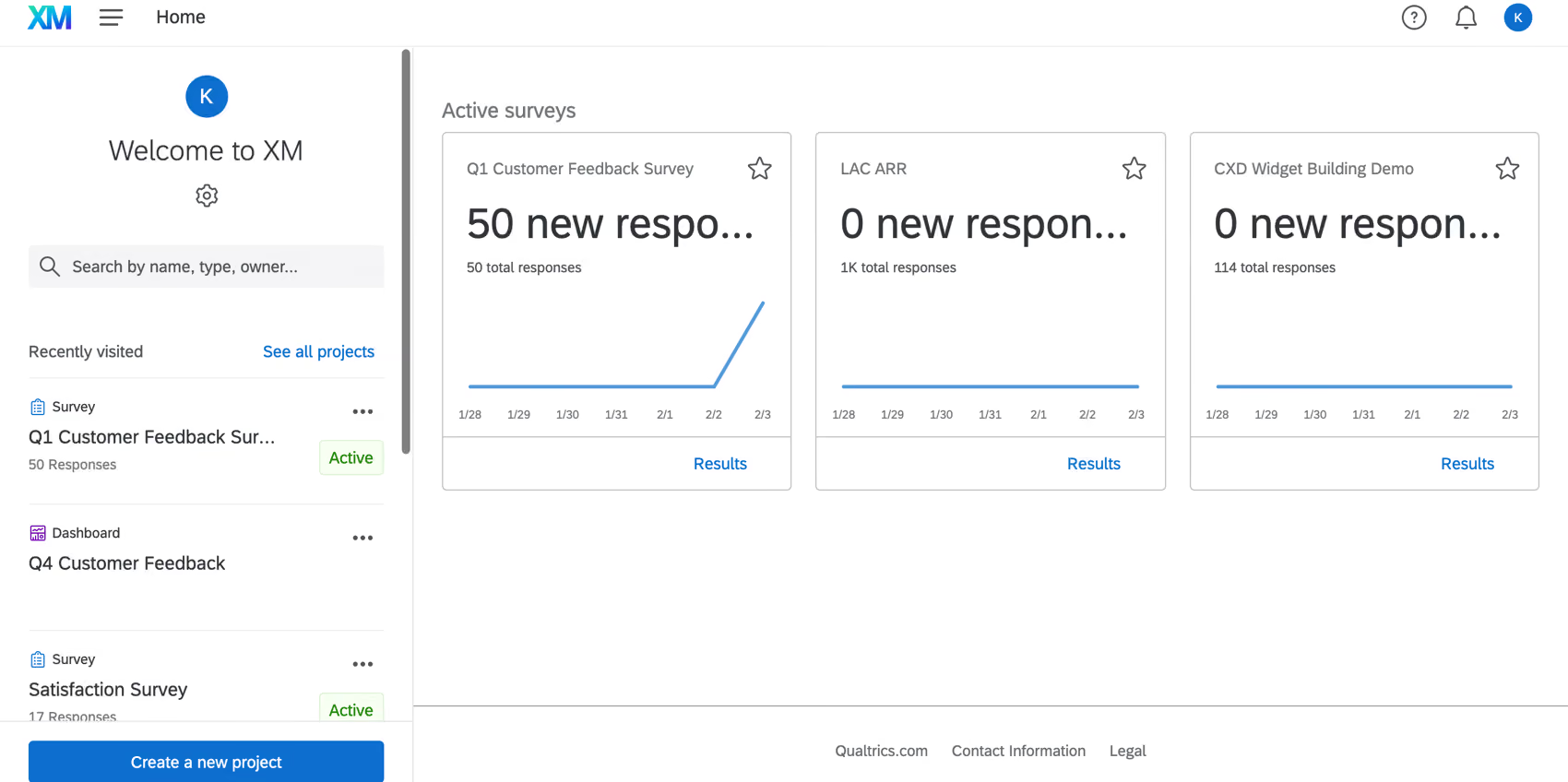
Qualtrics is an enterprise experience management platform with deep roots in survey design and research methodology. Its XM Discover module adds text analytics capabilities on top of the core survey engine, making it a strong contender for organizations that generate most of their feedback through structured survey programs.
For teams embedded in complex, survey-driven feedback ecosystems, Qualtrics provides the research rigor, statistical analysis, and compliance features that enterprise voice of customer platforms demand. The tradeoff is complexity: deploying and maintaining Qualtrics often requires dedicated program management.
Qualtrics Key Features
- XM Discover text analytics: NLP-powered analysis of open-text survey responses and other unstructured feedback
- Advanced survey capabilities: Sophisticated survey design with branching logic, conjoint analysis, and statistical testing
- Experience management dashboards: Role-based dashboards connecting customer, employee, product, and brand experience data
- Multilingual support: Surveys and analytics across multiple languages with localization features
- Enterprise compliance: Supports major compliance frameworks including SOC 2 and GDPR, with HIPAA-eligible and FedRAMP options available for qualifying organizations
2026 Pricing
Qualtrics does not publish pricing publicly. All plans require a sales conversation, with pricing based on modules, user count, and response volume.
Qualtrics Pros
- Unmatched survey design and distribution capabilities for organizations running complex feedback analysis programs
- XM Discover adds meaningful text analytics to the core survey platform
- Strong enterprise compliance and security credentials
Qualtrics Cons
- Significant implementation complexity; most organizations need dedicated Qualtrics administrators
- Text analytics through XM Discover uses a more traditional NLP approach compared to deep-learning alternatives
- Pricing scales quickly for organizations that need multiple modules across experience management categories
- Dashboard limitations when comparing data across multiple feedback sources simultaneously
Best For
Large enterprises with mature, survey-driven feedback programs that need research-grade methodology, compliance features, and text analytics layered on top of structured data collection.
5. Pendo
What Is Pendo?
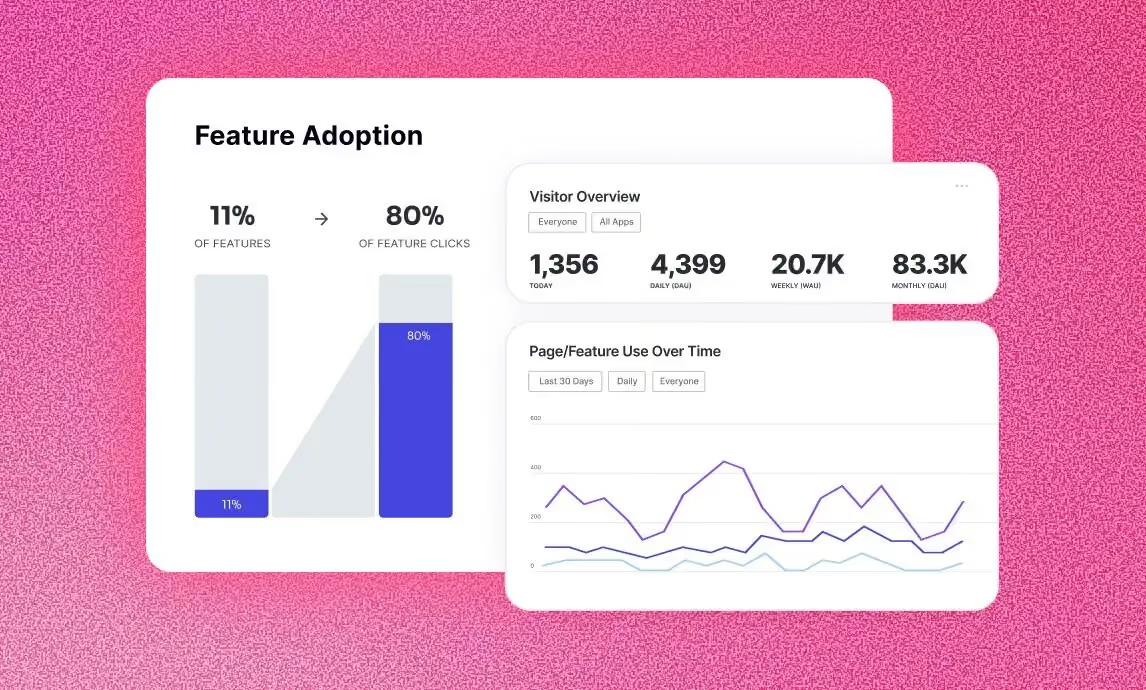
Pendo brings a distinct angle to feedback-to-roadmap workflows by combining product analytics with feedback collection. The platform tracks in-app user behavior, including feature adoption, navigation paths, and session replays, and pairs that data with feedback gathered through Pendo Listen, its feedback and roadmapping module.
This behavioral context is valuable for product-led teams. When a user submits a feature request, Pendo can show whether that user actually engages with related features, how often they visit specific workflows, and where they drop off. That context helps product managers separate signal from noise.
Pendo Key Features
- Behavioral analytics: Tracks feature adoption, page visits, click paths, and session replays tied to individual users
- Pendo Listen: Feedback collection and roadmapping module with idea validation and prioritization
- In-app guides: Contextual walkthroughs, tooltips, and announcements deployed without code
- NPS and survey capabilities: In-app surveys triggered by user behavior or segments
- Integrations: Connects with Jira, Salesforce, Segment, Slack, and more
2026 Pricing
Free plan available for up to 500 monthly active users. Paid plans are usage-based, priced by MAU. The Listen module for feedback and roadmapping is available as an add-on.
Pendo Pros
- Unique combination of behavioral analytics and feedback collection provides context most standalone tools lack
- Free tier allows teams to explore core analytics before committing
- In-app feedback collection catches users in the moment, improving response quality
Pendo Cons
- Feedback analytics are secondary to the core product analytics engine; text analysis depth is limited compared to dedicated platforms
- Listen module is an add-on, adding cost and complexity for teams that need the roadmapping features
- Less suited for analyzing feedback that originates outside the product, such as reviews, social media, or support tickets
Best For
Product-led growth teams that want to combine behavioral usage data with in-app feedback to validate roadmap decisions. Strongest when the primary feedback channel is the product itself rather than external sources.
6. Canny
What Is Canny?
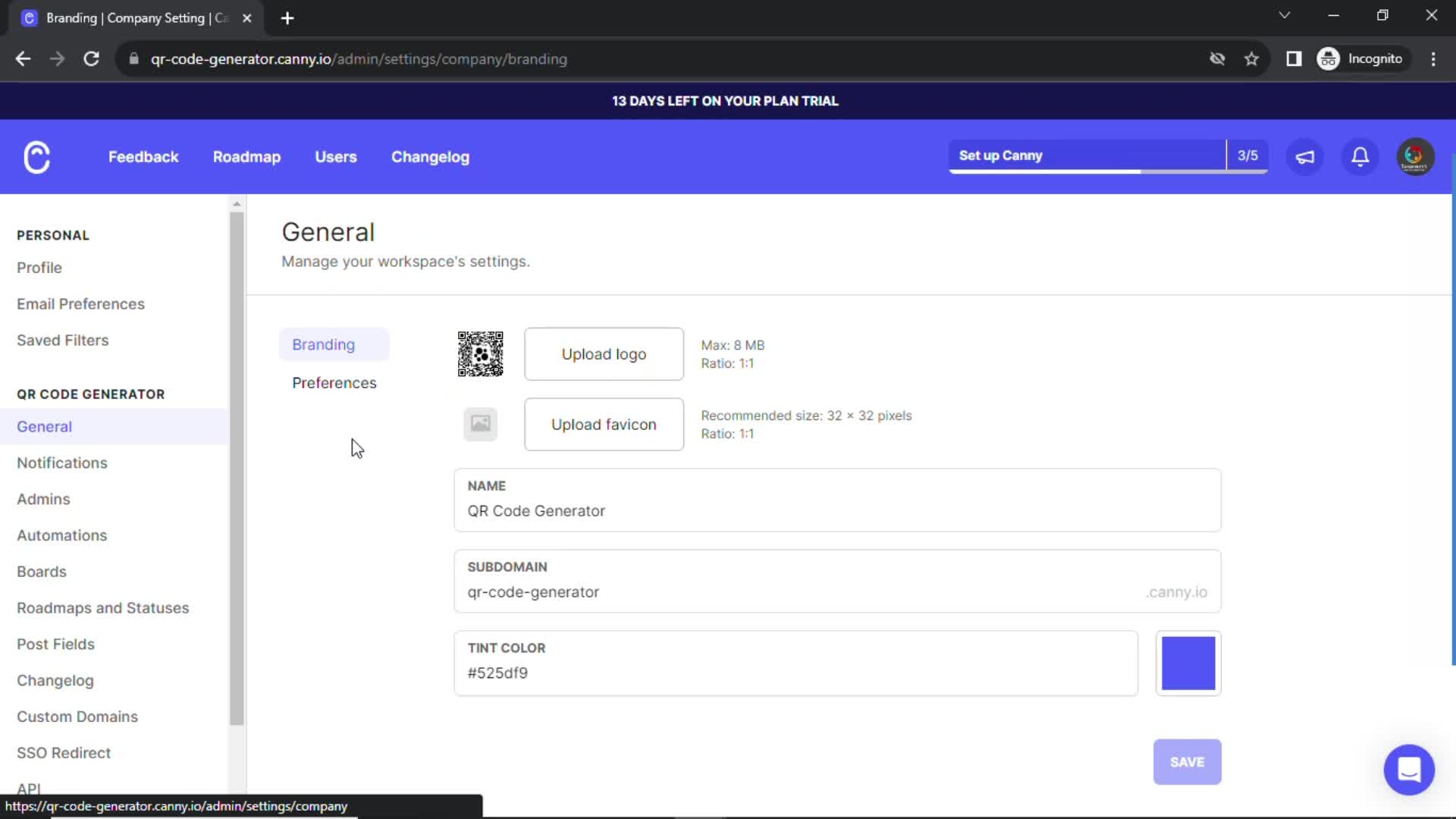
Canny is a feedback management platform built around public and private feature request boards. It gives SaaS teams a transparent system for collecting, organizing, and prioritizing feature requests, complete with voting mechanisms that let customers signal what matters most to them.
The platform's Autopilot feature uses AI to automatically capture and categorize feedback from connected channels, reducing manual triage. Canny also links feature requests to customer revenue data, helping teams weigh requests from high-value accounts more heavily.
Canny Key Features
- Public and private feedback boards: Customizable boards for collecting and displaying feature requests with voting
- Autopilot (AI-powered capture): Automatically identifies and categorizes feedback from connected integrations
- Revenue-based prioritization: Links feature requests to customer MRR data for revenue-weighted prioritization
- Changelog and roadmap views: Public-facing roadmap and changelog to communicate progress to customers
- Integrations: Connects with Jira, Linear, Asana, Intercom, Zendesk, Slack, and more
2026 Pricing
Free plan available. Paid plans start from $79 per month when billed annually.
Canny Pros
- Clean, purpose-built interface for managing feature requests with minimal setup time
- Revenue-based prioritization helps teams move beyond vote counting
- Public roadmap builds transparency and trust with customers
Canny Cons
- Designed primarily for structured feature requests rather than unstructured feedback like open-text survey responses or support transcripts
- AI capabilities are focused on capture and categorization, not deep sentiment analysis or theme detection
- Voting-based prioritization can skew toward vocal minorities if not combined with other signals
Best For
SaaS product teams that want a lightweight, transparent system for managing feature requests with customer-facing roadmap visibility. Particularly well suited for B2B products where customers actively request and vote on features.
7. UserVoice
What Is UserVoice?
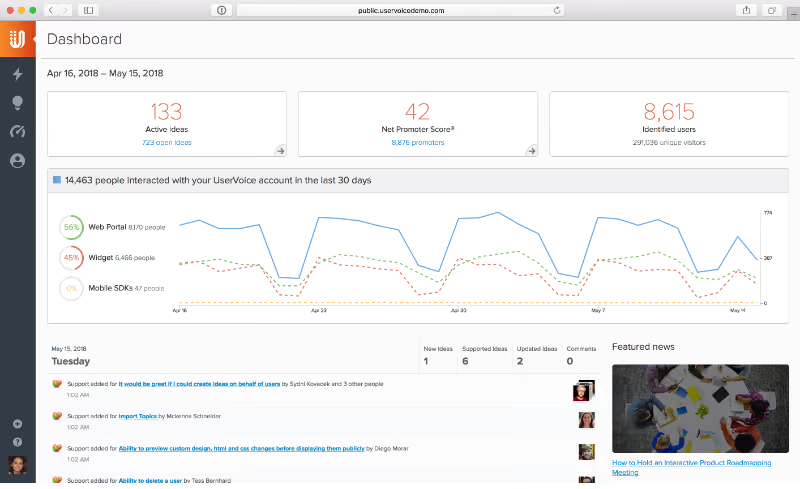
UserVoice is one of the longest-running feedback management platforms in the market, with a long track record in the feedback management category. The platform is built for enterprise teams that rely heavily on CRM data to prioritize feedback, offering deep integrations with Salesforce and HubSpot that connect feature requests to account revenue, deal stage, and customer segment data.
UserVoice's proxy voting feature allows customer-facing teams to submit feedback on behalf of clients, capturing input that might otherwise be lost in sales call notes or support tickets. For organizations evaluating customer experience tools with a strong CRM orientation, UserVoice is one of the few platforms purpose-built for that workflow.
UserVoice Key Features
- CRM-linked prioritization: Deep Salesforce and HubSpot integrations connect feedback to account revenue, deal value, and customer lifecycle stage
- Proxy voting: Sales and support teams can submit and upvote feedback on behalf of customers
- Revenue-weighted scoring: Automatically calculates the dollar impact of feature requests based on linked CRM data
- Feedback portal: Customizable customer-facing portal for submitting and tracking requests
- Smart vote merging: Detects and combines duplicate feedback to provide cleaner prioritization data
2026 Pricing
UserVoice does not publish pricing publicly. Plans are priced based on feedback volume and integrations, with all tiers requiring a sales conversation.
UserVoice Pros
- CRM integrations are among the deepest in the category, making it a natural fit for sales-driven organizations
- Proxy voting captures feedback from customers who would not submit it themselves
- Established platform with a long track record in enterprise feedback management
UserVoice Cons
- Higher starting price places it out of reach for smaller teams
- Feedback analysis capabilities are more basic than AI-native platforms; the platform focuses on collection and prioritization rather than deep analytics
- Interface feels dated compared to newer competitors
Best For
Enterprise product teams in sales-driven organizations that need CRM-integrated, revenue-linked feedback prioritization. Strongest when Salesforce or HubSpot is central to the feedback workflow.
8. Medallia
What Is Medallia?
Medallia is an enterprise customer experience platform that captures feedback across virtually every channel: surveys, social media, speech, digital behavior, IoT interactions, and contact center conversations. The platform's scope extends well beyond product feedback into full experience orchestration, making it a fit for large organizations managing CX as a company-wide function.
For feedback-to-roadmap use cases specifically, Medallia's AI-powered analytics can surface themes across channels and connect them to experience impact scores. However, the platform's breadth means product teams often share the tool with CX, marketing, and operations teams, which can add governance complexity. If your organization is evaluating enterprise voice of customer platforms, Medallia will likely appear on every shortlist, though teams focused specifically on product roadmap input may find the platform over-indexed on experience management breadth relative to analytics depth.
Medallia Key Features
- Omnichannel feedback capture: Collects data from surveys, social, speech, digital, video, and IoT channels
- Experience orchestration: Triggers personalized actions based on real-time feedback signals
- AI-powered analytics: Text analytics and theme detection across multiple data types
- Role-based dashboards: Tailored views for different organizational functions
- Enterprise-grade security: Comprehensive compliance and data governance features
2026 Pricing
Custom enterprise pricing. Contact the Medallia sales team for a quote.
Medallia Pros
- Broadest channel coverage in the category, capturing feedback from sources most tools miss
- Enterprise-scale infrastructure built for organizations processing millions of interactions
- Strong experience orchestration capabilities go beyond analytics into action
Medallia Cons
- Implementation is complex and resource-intensive, typically requiring dedicated CX program management
- Product teams may find the platform over-scoped for focused feedback-to-roadmap workflows
- Custom pricing and enterprise sales process can extend evaluation timelines significantly
Best For
Large enterprises managing customer experience as a cross-functional discipline that need omnichannel feedback capture and experience orchestration at scale. Less suited for teams looking for a focused, product-team-specific feedback analytics tool.
Feedback to Product Roadmap Tools: FAQs
What Is the Best Platform for Turning Customer Feedback into a Product Roadmap?
The best platform depends on your primary challenge. If you need to quantify large volumes of unstructured feedback and connect themes to business impact metrics like NPS, CSAT, and revenue, Chattermill provides the deepest analytics-first approach. If your focus is managing structured feature requests with public-facing transparency, Productboard and Canny are strong options. For teams that want behavioral usage data alongside feedback, Pendo offers a unique combination. Start by identifying whether your bottleneck is analysis depth, collection, or roadmap workflow integration.
How Do Feedback Analysis Tools Connect to Product Roadmaps?
Feedback analysis tools connect to product roadmaps through three main paths. First, direct integration: platforms like Productboard and Canny feed prioritized features straight into roadmap views. Second, prioritized export: analytics platforms like Chattermill and Enterpret surface ranked themes that product teams can import into their roadmap tool of choice. Third, behavioral correlation: tools like Pendo tie feedback to usage data, giving product managers context on how requested features relate to actual user behavior. The most effective approach combines deep analysis with a structured handoff to wherever your team plans its roadmap.
What Should You Look for in a Feedback-to-Roadmap Platform?
Six criteria separate strong platforms from basic feedback collectors: (1) feedback analysis depth, including whether the tool detects granular themes or just counts keywords; (2) AI and NLP capabilities that scale without manual rule maintenance; (3) business impact measurement that connects themes to NPS, revenue, or churn; (4) multi-channel coverage across surveys, support, reviews, social, and chat; (5) integration with your existing roadmap and project management tools; and (6) pricing transparency that lets you evaluate fit before a lengthy sales process. Prioritize the criteria that match your biggest bottleneck.
Can AI Automate Feedback Categorization for Product Teams?
Yes, and the maturity of AI-driven categorization varies significantly across platforms. Deep-learning approaches, like the one Chattermill uses, automatically detect themes and sub-themes across channels and languages without requiring predefined rules or taxonomies. Adaptive systems, like Enterpret's taxonomy, create and maintain categories as feedback patterns evolve. Lighter AI features, like Canny's Autopilot, handle basic capture and categorization for structured feature requests. The key distinction is whether the AI adapts to your data or requires you to adapt to it. For teams processing thousands of responses monthly across multiple feedback channels, automated categorization is not just a convenience but a necessity.
How Do You Prioritize Feedback by Business Impact Instead of Volume?
Volume-based prioritization is the default for most teams, and it is also the most misleading. A feature request mentioned 500 times by free-tier users may matter less than a pain point mentioned 50 times by enterprise accounts driving 40% of revenue. To prioritize by impact, you need two things: (1) a platform that connects feedback themes to business metrics such as NPS trends, revenue segmentation, or churn risk, and (2) a prioritization framework that weights those metrics against effort. Chattermill, Enterpret, UserVoice, and Canny each offer forms of revenue-linked prioritization, though they differ in depth. The goal is to shift roadmap conversations from "how many people asked for this" to "how much does this issue cost us."
The Bottom Line
The gap between collecting feedback and acting on it is where most product teams lose momentum. You have surveys, support tickets, reviews, and app store comments flowing in from every direction, but translating that volume into a prioritized, evidence-backed roadmap remains one of the hardest challenges in product management.
The 8 platforms in this guide represent different approaches to closing that gap. Some start from the analytics side, quantifying what customers are saying and measuring its business impact. Others start from the roadmap side, giving you the workflow to organize and ship what customers ask for. And some focus on a specific slice, whether that is CRM-linked revenue weighting or behavioral usage context.
How do you decide? Start with your bottleneck. If you already collect plenty of feedback but struggle to extract actionable themes and connect them to business outcomes, analytics-first platforms like Chattermill and Enterpret will deliver the most value. If your team is earlier in the journey and needs a structured way to collect, organize, and prioritize feature requests, Productboard, Canny, or UserVoice provide that workflow. And if your challenge is getting closer to users in the moment, Pendo adds behavioral context that retrospective analysis cannot replicate.
The strongest feedback-to-roadmap programs rarely rely on a single tool. Many teams pair an analytics platform for depth with a roadmap tool for workflow, or combine in-product research with cross-channel sentiment analysis to build a complete picture. The goal is not to find the one perfect platform but to close the gap between what customers tell you and what your roadmap reflects.
If your primary challenge is understanding the impact of feedback rather than simply collecting more of it, an analytics-first platform like Chattermill gives product teams the evidence they need to prioritize with confidence. When you can show leadership exactly which themes drive NPS, which pain points correlate with churn, and which improvements would affect revenue, roadmap conversations shift from opinion-based debates to data-driven decisions.
Ready to see how Chattermill turns your feedback into roadmap-ready intelligence? Book a demo and bring your own data.


See Chattermill in action on your own feedback
Book a demo


