


What is a Proactive Agent? (And Why We Built One)


The CX intelligence
platform that's AI-native by design
Book a demoWe’re entering the next era of agentic AI where agents no longer need a prompt to act autonomously. Here's how Chattermill’s Lyra Agent is changing what's possible in customer feedback analysis.
What is a proactive agent?
Most AI agents wait to be prompted by a user before actually doing anything. A person opens a chat and asks a question, or runs a query and waits for a result. The agent only acts once a human prompts it — and only within the scope of the exact question that was asked.
A proactive agent works the other way around. It doesn't wait to be asked. It acts on its own, surfacing what matters and offering assistance without a direct prompt. It runs in the background, monitors changes in your data, and acts on your behalf based on predefined goals and context.
That doesn't mean a proactive agent operates without direction or clear boundaries. Humans still set the rules – the specific outcomes the agent should achieve. A proactive agent isn't trying to anticipate every possible need across your business — it's working within clear parameters, continuously monitoring your data to find exactly what you've told it matters.
This way a proactive agent becomes a tool that operates on your behalf, autonomously. This marks a real shift in what AI agents are capable of — one already reshaping how organizations approach customer feedback analysis.
Proactive vs. reactive agents
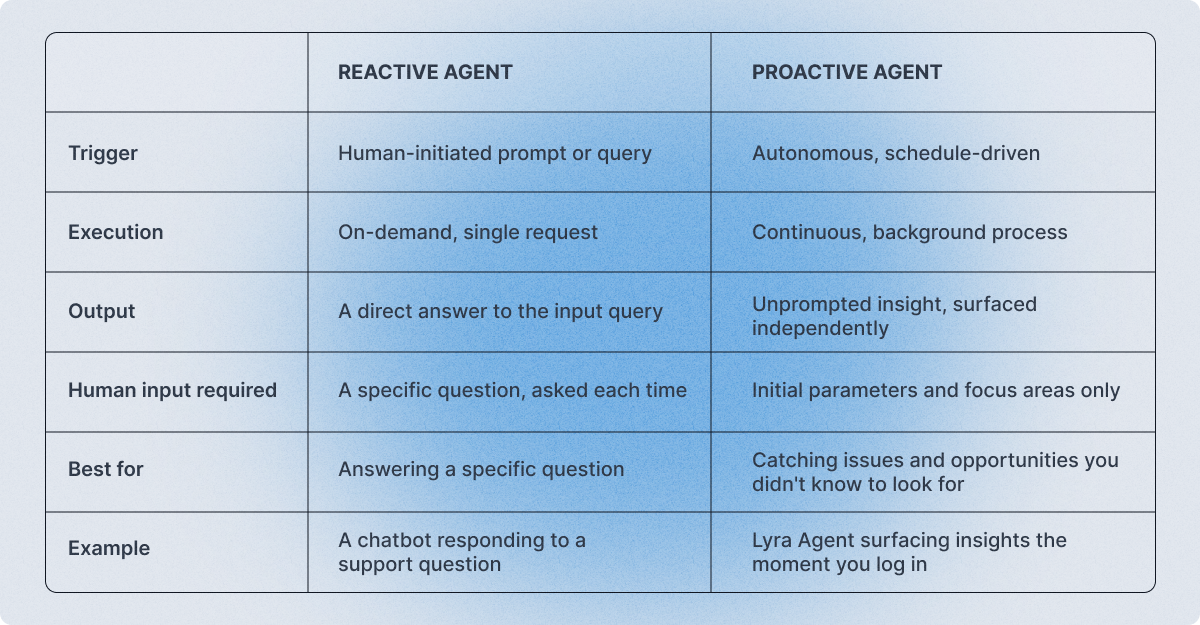
A reactive agent and a proactive agent can run on the same underlying model, but they behave like two different tools in practice — one you operate, one that operates for you.
Reactive AI agents sit idle until a human provides a question or a command, and only then do they act, producing an output scoped exactly to what was asked.
While a reactive agent requires you to know what to ask, and when to ask it, a proactive agent tells you what you need to know, before you know to look for it.
It works continuously against your data, recognizing when something meets the conditions it's been set to look for — an issue picking up pace, a pattern worth flagging — and it surfaces the finding the moment it's detected, independent of any human query.
Why proactive agents matter in customer feedback analysis
The most valuable insights in customer feedback analysis rarely come from a single prompt. They come from thorough customer research — understanding what happened and why, what matters most, and how it connects to the metrics your business actually cares about.
That kind of research is hard. It takes real effort to find what truly matters to customers, decide what's a priority, and figure out where to invest next.
A CX manager can build reports or dashboards to find the biggest friction points in the customer journey — or let a proactive agent flag them instead.
A product manager can dig through feedback to validate what should be added to the roadmap — or let a proactive agent surface the feature requests and product issues worth prioritizing.
Proactive agents close that gap, monitoring your customer feedback data continuously and delivering the insights that matter, before anyone has to ask.
Here's what changes when an agent works proactively on your customer feedback data:
It identifies what you didn't know
A proactive agent doesn't require building reports or dashboards to catch what's trending negatively in your customer feedback — it surfaces the issue the moment it starts gaining momentum, whether anyone was watching for it or not.
It improves prioritization
A proactive agent can score each customer issue on volume and relevance, ranked so prioritization follows from the data, not assumptions. Teams gain clarity on what needs fixing, what's worth building, and where to invest next.
It shortens the gap between signal and action
An issue buried in your feedback data is meaningless until someone finds it. A proactive agent removes that friction — your team spots important events, trends and changing conditions the moment they emerge, and can react accordingly as quickly as possible.
It cuts down manual work
Think about the hours that go into analyzing what’s driving this week’s negative feedback. A proactive agent starts that analysis on its own — cutting the time it takes, while holding a level of consistency and accuracy that manual analysis can't match at scale.
It scales your operations
No team can review every conversation as volume grows. A proactive agent gives every piece of feedback the same scrutiny, and keeps up with the growing demand for customer insights across the business. Organizations can scale their user research or voice of the customer programs without scaling headcount.
How we designed Lyra Agent to work proactively
Lyra Agent works both reactively and proactively.
In reactive mode, Lyra Agent answers any question about your customers — ask it a question or delegate a task, and it reasons across your customer feedback to deliver a precise, evidence-backed answer. This mode is used when you have a specific question or task — you initiate it, and Lyra Agent responds.
Ask why NPS or CSAT shifted, what's driving support ticket volume this week, or which complaints deserve attention first, and it comes back with structured answers: charts, quantified evidence, and real customer quotes you can dig into further — the same way you'd work with a seasoned analyst.
In a proactive mode, Lyra Agent works in the background, runs regularly on your feedback data, analyzes it, and automates the work behind the scenes, so actionable insights reach you without writing a single prompt.
Here’s how it works in three simple steps:
Step 1: Continuous monitoring across every channel
Lyra Agent monitors customer signals from every connected source — surveys, product reviews, support tickets, chat transcripts, or social media — and scans it on a regular schedule.
Step 2: Detection of issues and opportunities
It tracks shifts in feedback volume across negative and positive feedback, identifying the issues gaining traction and the opportunities worth acting on, all carefully curated for your specific team or project.
Step 3: Insights delivery the moment you log in
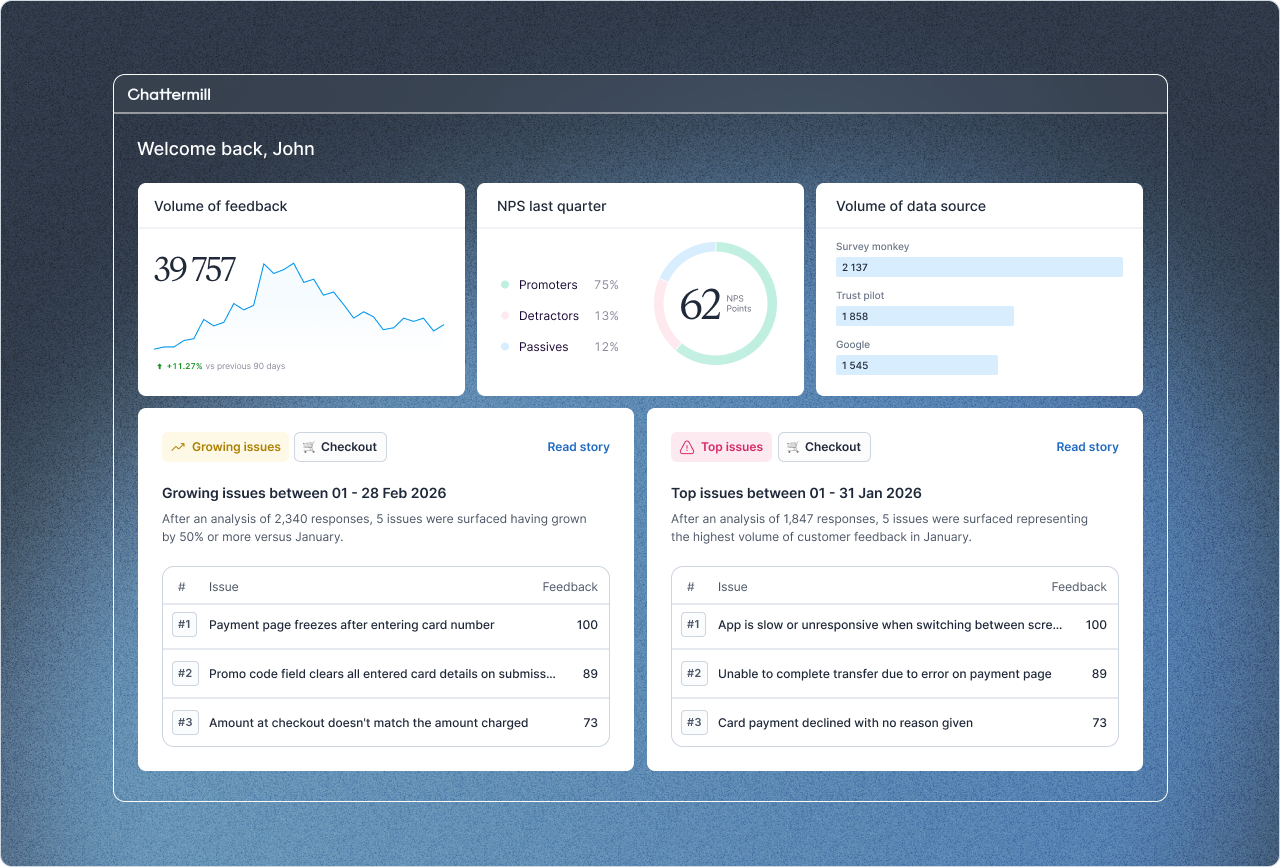
Insights are delivered as Stories, available when you open the platform — quantified, ranked, and traceable back to the exact customer quote. No dashboard to build, no query to write.
Lyra Agent currently surfaces four Story types:
- Top issues — the biggest sources of negative feedback in your customer data. Delivered weekly, covering the previous Monday through Sunday and benchmarked against the week before.
- Top praises — the biggest sources of positive feedback in your customer data. Delivered weekly, covering the previous Monday through Sunday and benchmarked against the week before.
- Growing issues — issues whose volume is climbing week over week. Delivered weekly, covering the previous Monday through Sunday and benchmarked against the week before.
- Feature requests — the most common asks customers are making within your customer feedback data. Delivered quarterly.
Top use cases
CX, Product, Insights, and Support teams are already putting Lyra Agent's proactive mode to work — here's where it delivers the most value today.
Surfacing top issues and wins
Lyra Agent ranks the issues customers raise most often, alongside the wins worth building on — so teams start each week already knowing what's working and what isn't. For product and user research teams, this means a ready starting point for identifying what belongs on the roadmap.
Flagging issues before they escalate
Not every issue is equally urgent. Lyra Agent tracks week-over-week volume shifts and flags the ones gaining momentum, so teams can act while an issue is still small, not after it's become a pattern. For a support team, that might mean catching a spike in checkout complaints, so they can act while an issue is still small. For a product team, it might mean spotting a rise in complaints about a recent release before it shows up as a drop in retention.
Catching what no one thought to look for
Some of the most useful insights aren't answers to a question anyone asked — they're patterns no one was watching for in the first place. Lyra Agent surfaces these automatically, without a query or a hypothesis to start from. For a product team, that might mean discovering a product issue, well before anyone thought to investigate it.
Pinpointing bugs and friction points
When negative feedback spikes, Lyra Agent identifies the issue behind it, whether that's a bug, a broken flow, or a recurring error, and backs it up with exact volume numbers and the customer quotes behind them. For a product team, that might mean going from "complaints are up this week" to a specific checkout error, backed by the evidence needed to be shared with the engineering.
Prioritizing what to build next
Lyra Agent automatically surfaces feature requests and ranks them by demand, giving product teams a data-backed starting point for what belongs on the roadmap. Instead of relying on the loudest customer or the most recent request, teams see which asks are actually recurring — bringing clarity to a decision that's often made on instinct.
What’s next
AI agents change what's even possible in customer feedback analysis — surfacing what teams didn't know to look for, not just answering the questions they already had.
The direction is clear: less time spent manually sifting through feedback, more time spent acting on it. By shortening the gap between signal and action, improving prioritization, and helping teams make decisions backed by data, proactive agents give teams a real edge in designing better customer experiences.
Lyra Agent, including its proactive mode, is now open for early access.


See Chattermill in action on your own feedback
Book a demo


