


12 Best Customer Experience Management Software (2026)


The CX intelligence
platform that's AI-native by design
Book a demoMost CX teams are drowning in feedback but starving for insight — the right customer experience management platform changes that equation entirely.
Quick Summary
We evaluated 12 customer experience management platforms across AI and NLP capabilities, feedback channel coverage, analytics depth, integrations, and pricing. Chattermill is the best CXM platform for teams that need AI-native feedback analytics across every channel — it unifies surveys, reviews, support tickets, and social data into a single source of truth with deep-learning-powered theme and sentiment detection. Qualtrics XM is the strongest option for enterprise experience management programs built around sophisticated survey design. Medallia is the best choice for large enterprises that need real-time CX intelligence at massive operational scale.
| Platform | Best For |
|---|---|
| Chattermill | AI-native enterprise customer experience intelligence |
| Qualtrics XM | Enterprise experience management and survey programs |
| Medallia | Real-time CX intelligence at enterprise scale |
Key Takeaways:
- AI-native analytics is the dividing line between platforms that report what happened and platforms that tell you why
- Most CXM platforms specialise in either data collection or data analysis — few do both well
- Pricing varies dramatically, from free plans (HubSpot, Freshdesk) to six-figure enterprise contracts
- The best platform depends on whether you need feedback analytics, service operations, or survey management
Why Listen To Us
At Chattermill, we help CX, insights, and product teams at companies like Uber, HelloFresh, and Tesco turn fragmented customer feedback into business-driving action. Our expertise in the CXM category comes from working directly with the teams that face these challenges at scale — unifying feedback across dozens of sources, surfacing actionable themes with AI, and connecting customer sentiment to business metrics.
What Is Customer Experience Management?
Customer experience management (CXM) is the practice of tracking, analysing, and improving every interaction a customer has with your organisation — from first discovery to post-purchase support. A CXM platform is the software that makes this possible at scale, unifying feedback from surveys, support tickets, social media, reviews, and other touchpoints into a single system where teams can detect patterns, measure sentiment, and act on insight.
Why does it matter? Because 86% of buyers are willing to pay more for a superior experience, and the organisations that systematically listen to and act on customer feedback outperform those that rely on gut instinct. CXM platforms serve three core use cases: understanding what customers feel and why (feedback analytics), managing service interactions at scale (helpdesk and contact centre), and collecting structured feedback through surveys.
12 Top Customer Experience Management Platforms: Head to Head Comparison
| Platform | Best For | Pricing | G2 Rating | AI/NLP Capabilities | Feedback Channels | Key Integrations |
|---|---|---|---|---|---|---|
| Chattermill | AI-driven feedback analytics | Custom (contact sales) | Deep learning: themes, sentiment, anomaly detection, MCP server | Surveys, reviews, support tickets, social, chat | Salesforce, Zendesk, Intercom, Slack, BI tools | |
| Qualtrics XM | Enterprise experience management | Custom (contact sales) | Text iQ, Stats iQ, predictive analytics | Surveys, web, app, email, SMS | SAP, Salesforce, Marketo, Slack, Tableau | |
| Medallia | Real-time CX intelligence at scale | Custom (contact sales) | Text analytics, speech analytics, video analytics | Surveys, social, contact centre, IoT, in-app | Salesforce, ServiceNow, Adobe, Workday | |
| Sprinklr | Unified CXM across marketing, sales, and service | Custom (from ~$249/user/month) | Sprinklr AI+, sentiment analysis, intent detection | Social, messaging, email, chat, voice, reviews | Salesforce, SAP, Microsoft Dynamics, Shopify | |
| Zendesk | Service-first customer experience | From $25/agent/month | Answer Bot, intelligent triage, sentiment detection | Email, chat, phone, social, web form | Salesforce, Shopify, Slack, Jira, 1,800+ apps | |
| Salesforce Service Cloud | CRM-integrated CX | From $25/user/month | Einstein AI: case classification, next-best-action, chatbots | Phone, email, chat, social, self-service, SMS | Native Salesforce ecosystem, MuleSoft, Tableau | |
| HubSpot Service Hub | Growing CX teams | Free plan; paid from $20/month | AI chatbot, ticket routing, conversation intelligence | Email, chat, phone, forms, social | HubSpot CRM, Slack, Jira, Salesforce, Zapier | |
| NICE CXone | Contact centre CX operations | From $71/agent/month | Enlighten AI: sentiment, auto-summary, quality scoring | Voice, email, chat, social, SMS, self-service | Salesforce, Microsoft Teams, Zendesk, Oracle | |
| Freshdesk | Budget-friendly customer support | Free plan; paid from $15/agent/month | Freddy AI: chatbot, auto-triage, suggested responses | Email, phone, chat, social, web, WhatsApp | Salesforce, Slack, Shopify, Jira, 1,000+ apps | |
| Birdeye | Multi-location reputation and CX | Custom (contact sales) | AI review response, sentiment analysis, NLP surveys | Reviews, social, surveys, listings, webchat, SMS | Google Business, Salesforce, HubSpot, QuickBooks | |
| SentiSum | AI-powered support ticket analytics | Custom (contact sales) | NLP ticket tagging, sentiment analysis, auto-prioritisation | Support tickets, chat, email, surveys, reviews | Zendesk, Intercom, Freshdesk, Dixa, Slack | |
| SurveySparrow | Conversational customer surveys | From $19/month | AI survey builder, sentiment analysis, text analytics | Surveys, NPS, offline, chat, email, SMS | Salesforce, HubSpot, Slack, Zapier, Webhooks |
1. Chattermill — Best for AI-Driven Feedback Analytics

Chattermill is an AI-native feedback analytics platform that unifies customer feedback from every channel — surveys, reviews, support tickets, social media, and chat — into a single source of truth. Unlike platforms that bolt AI onto legacy architectures, Chattermill was built from the ground up with deep learning at its core.
What sets Chattermill apart from broader CXM suites is its focus on the analysis layer. Rather than trying to be a survey tool, helpdesk, and analytics engine simultaneously, Chattermill integrates with the tools teams already use for data collection and applies AI-powered sentiment analysis and theme detection to every piece of feedback regardless of source or language.
For CX, insights, and product teams, this means a single view of what customers are saying, why sentiment is shifting, and which issues have the highest impact on business metrics. Brands like HelloFresh, Uber, and Tesco rely on Chattermill to turn fragmented feedback into decisions that improve retention and product quality.
Key Features
- Unified Customer Intelligence: Consolidates feedback from surveys, reviews, support tickets, social media, and chat into one platform — eliminating data silos that fragment customer insights
- Advanced AI Analytics: Deep learning automatically detects themes, sentiment, and emerging issues without manual tagging or rule configuration
- Real-Time Insights and Alerting: Proactive alerts when customer sentiment shifts or critical issues surface, so teams can respond before problems escalate
- Impact Analysis: Connects customer feedback directly to NPS, CSAT, CES, and churn risk — showing which issues drive business outcomes
- Advanced Segmentation: Filter insights by customer segment, product line, journey stage, or any custom dimension
- Custom Role-Based Dashboards: Tailored views for CX, product, and insights teams so each group sees the metrics they need
- Enterprise Integrations: Connects to Salesforce, Zendesk, Intercom, Slack, and BI platforms
- MCP Server: Query and act on customer feedback data directly inside AI agents, bringing customer intelligence into agentic workflows
Pros
- Unifies data from every feedback source into a single view — no manual tagging required
- Contextually rich insights that help teams prioritise the issues with the highest business impact
- Proactive anomaly detection and alerting catches emerging problems before they appear in aggregate reports
- Collaborative dashboards make it easy to share insights across teams and stakeholders
- Intuitive user experience with fast time-to-value
- Enterprise-grade security and scalability
Cons
- No data collection capabilities — Chattermill analyses feedback but does not collect it, so teams need separate survey or data collection tools
Pricing
Custom pricing based on feedback volume and integrations. See Chattermill plans.
Who It's For
High-growth startups, scaleups, and enterprise brands with CX, insights, or product teams that need to unify multi-channel feedback and turn it into business-driving action. Chattermill G2 Score: 4.5/5 (236 reviews).
2. Qualtrics XM — Best for Enterprise Experience Management
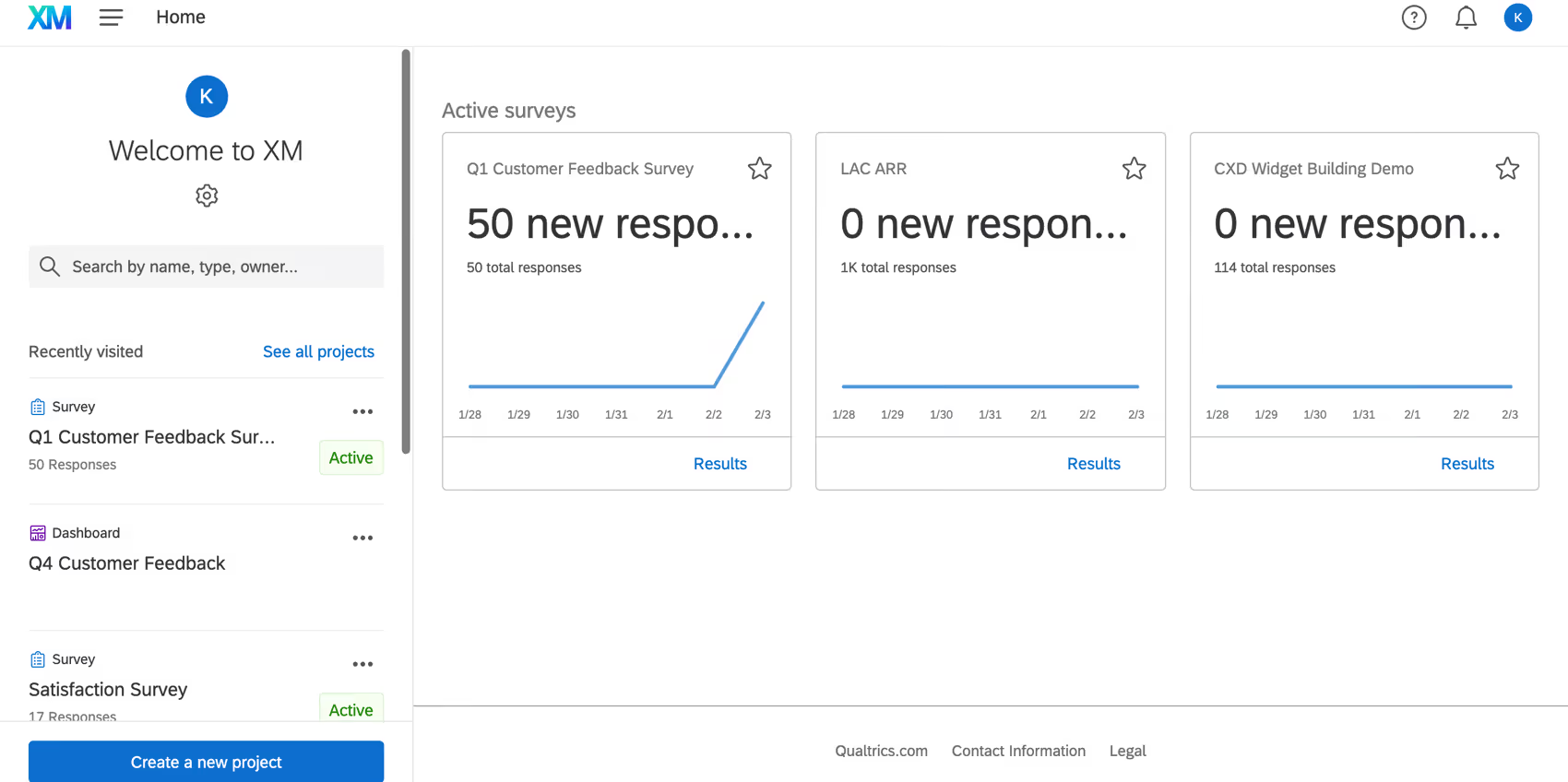
Qualtrics XM is an enterprise experience management platform that spans customer, employee, product, and brand experience programs. It is one of the most widely adopted CXM solutions among large organisations, particularly those that run complex, multi-wave survey programs.
The platform's core strength is survey design and distribution. Qualtrics offers sophisticated question logic, branching, and targeting that few competitors match. For organisations where structured survey data is the primary feedback channel, Qualtrics provides deep control over how data is collected and analysed.
Where Qualtrics faces challenges is in unifying unstructured feedback from channels beyond surveys. While its Text iQ module offers text analysis capabilities, the analytics depth for non-survey data — support tickets, reviews, social media — is less mature than dedicated feedback analytics tools. Enterprises also report that the platform's complexity demands significant internal expertise to manage effectively.
Key Features
- Experience Management Suite: Unified platform for CX, EX, product, and brand experience programs
- Advanced Survey Design: Sophisticated logic, branching, quotas, and multi-language support
- Text iQ and Stats iQ: AI-powered text analytics and statistical analysis of open-ended responses
- Predict iQ: Predictive modelling for churn risk and customer lifetime value
- XM Directory: Centralised contact management for longitudinal experience tracking
- Action Planning: Workflow automation to assign and track follow-up on feedback
Pros
- Industry-leading survey design capabilities with unmatched flexibility
- Comprehensive experience management across CX, EX, product, and brand
- Strong enterprise governance, compliance, and data residency options
- Large partner ecosystem and professional services network
Cons
- Steep learning curve — requires dedicated administrators and often professional services to configure
- Analytics for unstructured, non-survey feedback (tickets, reviews, social) are less powerful than specialist tools
- Premium pricing puts it out of reach for mid-market organisations
- Interface can feel dated compared to modern analytics platforms
Pricing
Custom pricing based on programme scope and licence count. Contact Qualtrics for a quote. For teams evaluating alternatives, see Qualtrics alternatives.
Who It's For
Large enterprises running structured, multi-programme experience management initiatives where surveys are the primary feedback mechanism. Qualtrics XM G2 Score: 4.3/5 (751 reviews).
3. Medallia — Best for Real-Time CX Intelligence at Scale

Medallia is an enterprise CX platform built for large, complex organisations that operate at massive scale across retail, hospitality, financial services, and telecommunications. Its real-time signal capture and role-based reporting make it a strong fit for companies with thousands of customer touchpoints.
Medallia's strength lies in operational CX — capturing signals across in-store, contact centre, digital, and social channels, then routing insights to frontline teams. Its breadth of signal capture, including IoT and video analytics, is broader than most competitors.
The trade-off is complexity. Medallia's text analytics engine relies on a more rule-based approach compared to AI-native platforms, which means teams often spend significant time configuring and maintaining taxonomy rules. Users consistently report a steep learning curve and an interface that requires training to navigate effectively. For a detailed comparison, see Chattermill vs Medallia.
Key Features
- Real-Time Signal Capture: Collects feedback across surveys, social, contact centre, IoT, and in-app interactions
- Text and Speech Analytics: NLP-driven analysis of open-ended feedback and call recordings
- Role-Based Reporting: Tailored dashboards for frontline, management, and executive audiences
- Action Management: Closed-loop workflows for escalation and follow-up
- Video Analytics: Captures in-store customer behaviour through video signal processing
- Athena AI: Medallia's AI engine for theme discovery and predictive analytics
Pros
- Unmatched breadth of signal capture across physical, digital, and contact centre channels
- Real-time operational insights designed for frontline decision-making
- Enterprise scale — proven at organisations with tens of thousands of locations
- Strong closed-loop action management workflow
Cons
- Rule-based approach to text analysis requires significant manual configuration and maintenance
- Complex interface — not intuitive, with a steep learning curve for new users
- Premium enterprise pricing is prohibitive for mid-market teams
- Struggles to unify metadata across disparate feedback sources
Pricing
Custom enterprise pricing. Contact Medallia for a quote.
Who It's For
Large enterprises in retail, hospitality, and financial services that need real-time CX intelligence across thousands of physical and digital touchpoints. Medallia G2 Score: 4.5/5 (206 reviews).
4. Sprinklr — Best for Unified CXM Across Marketing, Sales, and Service
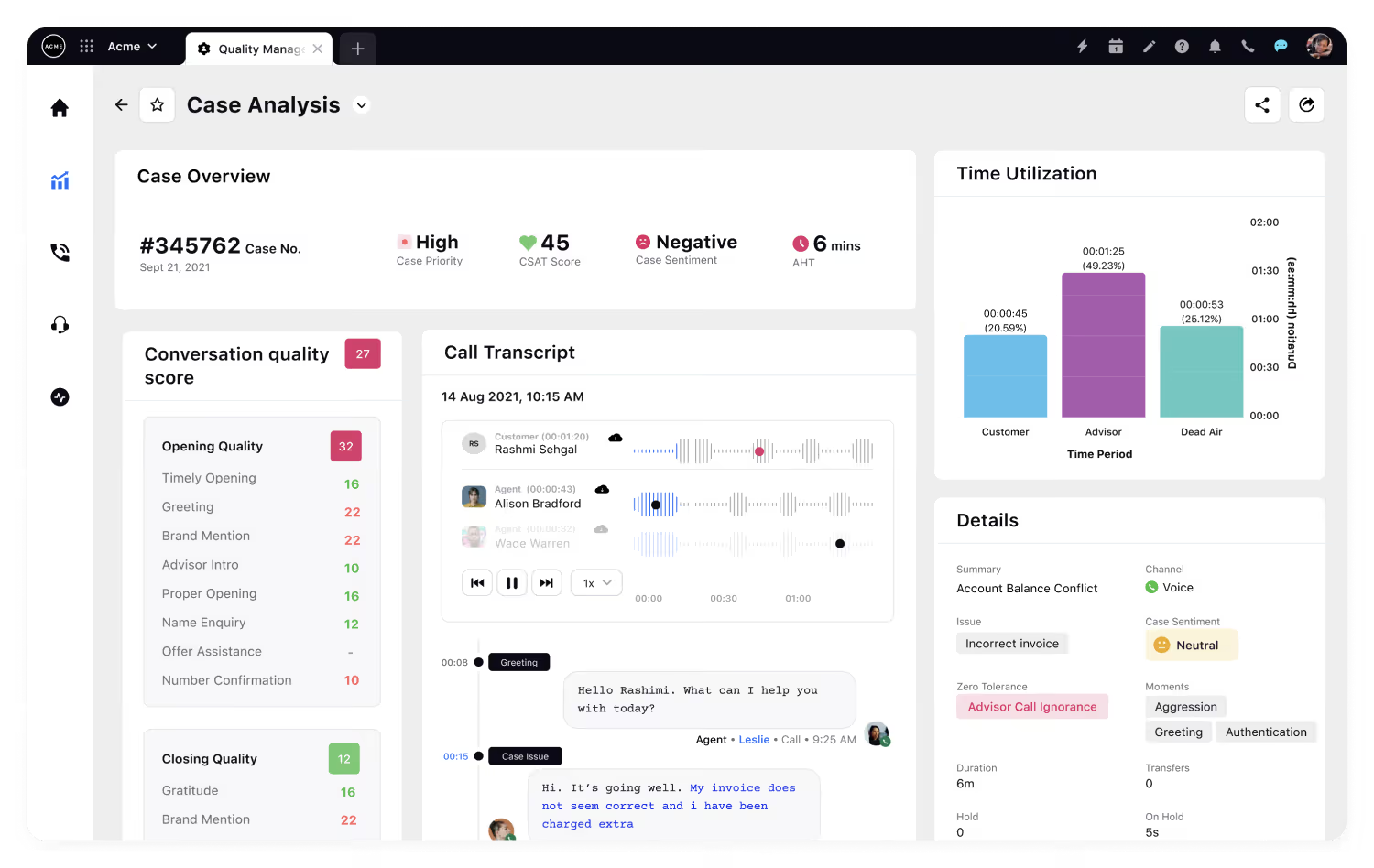
Sprinklr is a unified CXM platform that brings marketing, advertising, social media management, and customer service under a single architecture. It is designed for large organisations that want a single platform to manage every outbound and inbound customer interaction across 30+ digital channels.
Sprinklr's differentiator is breadth. Where most CXM platforms focus on either analytics or service, Sprinklr attempts to unify the entire customer-facing operation. Its AI+ engine powers sentiment analysis, intent detection, and smart routing across social listening, community management, and contact centre interactions.
The challenge is that Sprinklr's ambition creates complexity. Deployment timelines are typically measured in months, the interface has a steep learning curve, and pricing reflects the platform's enterprise positioning.
Key Features
- Unified CXM Architecture: Single platform for social, marketing, advertising, and service operations
- Sprinklr AI+: Generative AI for content creation, sentiment analysis, and smart routing
- Social Listening and Engagement: Monitor, analyse, and respond across 30+ social and messaging channels
- Contact Centre as a Service (CCaaS): Voice, chat, email, and social customer service
- Content Marketing and Advertising: Campaign management, asset creation, and paid media optimisation
- Insights and Reporting: Cross-channel analytics with customisable dashboards
Pros
- True cross-functional unification of marketing, service, and social under one platform
- Extensive channel coverage — 30+ digital channels for listening and engagement
- Strong social media management and listening capabilities
- Enterprise-grade governance and compliance features
Cons
- Very complex deployment — implementation often takes months with professional services
- Steep learning curve across modules
- Pricing is enterprise-tier, starting from approximately $249/user/month
- Feedback analytics depth is shallower than specialist customer feedback tools
Pricing
Custom pricing, starting from approximately $249/user/month. Contact Sprinklr for an enterprise quote.
Who It's For
Large enterprises seeking a single platform for social media management, marketing operations, and customer service. Sprinklr G2 Score: 4.2/5 (2,161 reviews).
5. Zendesk — Best for Service-First Customer Experience
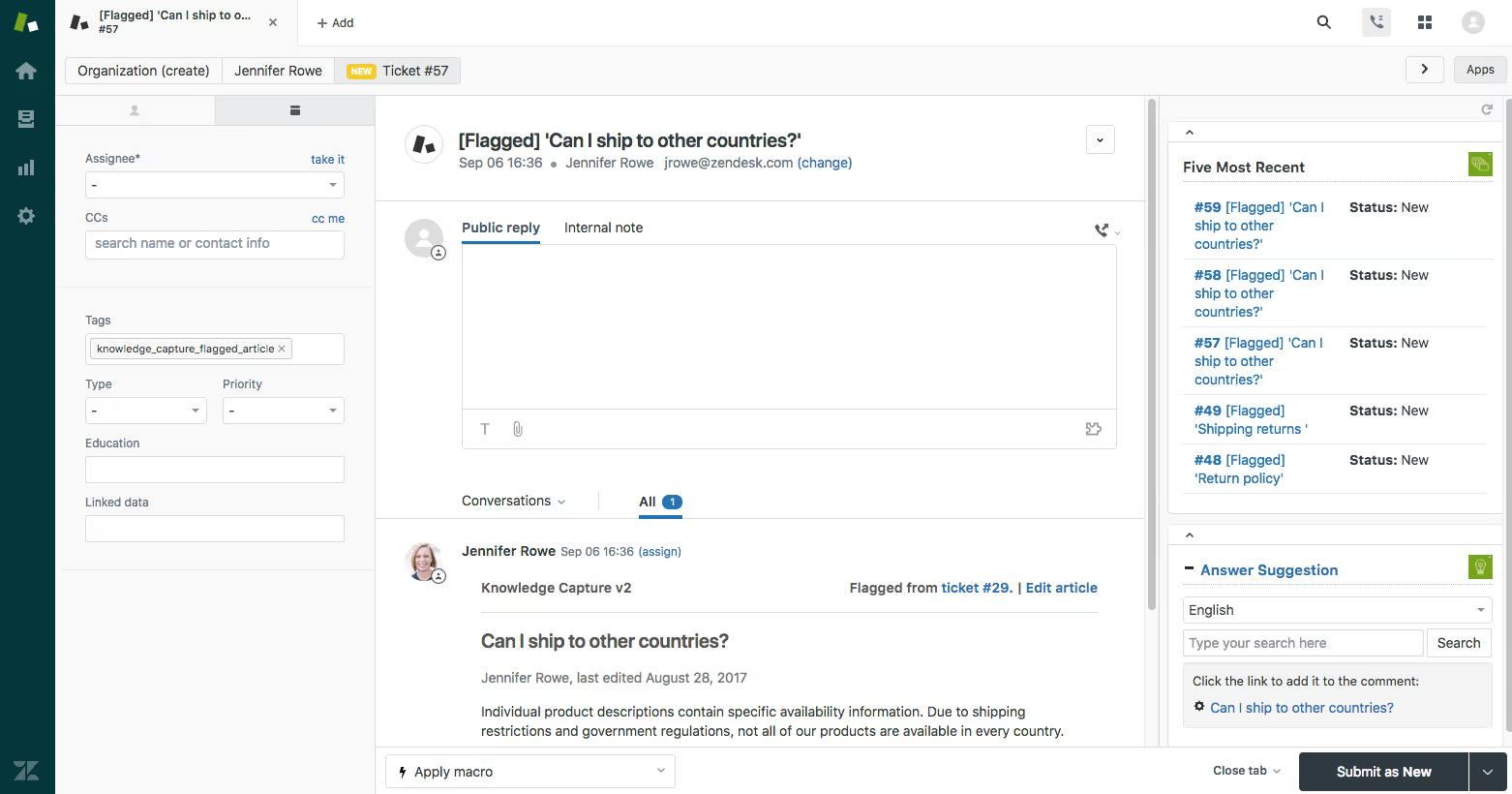
Zendesk is a customer service platform that has expanded into broader CX with AI-powered automation, self-service, and omnichannel support. It is one of the most widely adopted support platforms globally, known for fast deployment and an extensive app marketplace with 1,800+ integrations.
Zendesk excels at operational customer service — ticket management, live chat, knowledge bases, and automated workflows. Its AI features, including Answer Bot and intelligent triage, help teams handle high ticket volumes without proportionally scaling headcount.
Where Zendesk is less suited is deep feedback analytics. While it captures rich customer interaction data, its native analytics focus on operational metrics (resolution time, first response time, CSAT scores) rather than thematic analysis of why customers are reaching out. Teams seeking deeper voice of customer insights from support data often pair Zendesk with a dedicated analytics layer.
Key Features
- Omnichannel Ticketing: Unified inbox for email, chat, phone, social, and web form support
- Answer Bot and AI Agents: AI-powered self-service and automated resolution
- Intelligent Triage: Automatic ticket classification by intent, language, and sentiment
- Knowledge Base: Self-service help centre with AI-suggested articles
- Sunshine Platform: Open and flexible CRM for custom data models and integrations
- App Marketplace: 1,800+ pre-built integrations
Pros
- Fast deployment and intuitive agent interface
- Massive integration ecosystem — connects to nearly every business tool
- Strong AI-powered automation for ticket deflection and routing
- Transparent, scalable pricing from $25/agent/month
Cons
- Native analytics focus on operational metrics, not thematic feedback analysis
- Reporting and dashboards require add-ons for advanced use cases
- Enterprise features (sandbox environments, advanced security) only available on higher tiers
- Customisation can become complex at scale without developer resources
Pricing
From $25/agent/month (Support Team plan). Suite plans start from $55/agent/month.
Who It's For
Mid-market and enterprise teams that need a proven, scalable customer service platform with fast deployment and broad integrations. Zendesk G2 Score: 4.3/5 (6,948 reviews).
6. Salesforce Service Cloud — Best for CRM-Integrated CX
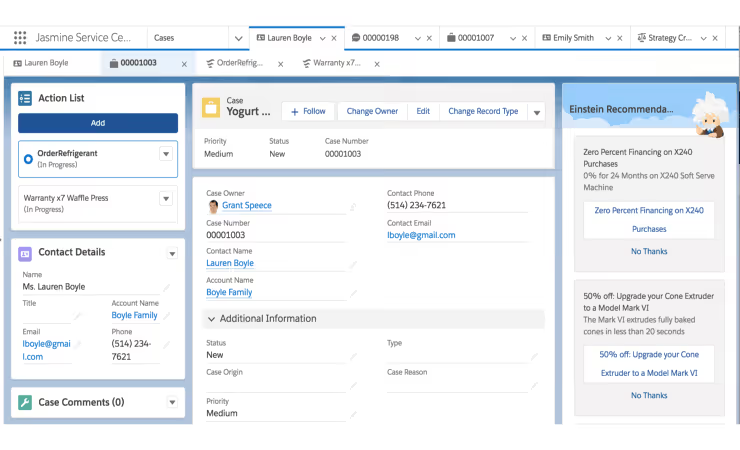
Salesforce Service Cloud is a customer service platform built on the Salesforce CRM ecosystem. For organisations already invested in Salesforce, it offers deep, native integration between customer service operations and the complete customer record — sales history, marketing interactions, and support cases in a single view.
The platform's AI layer, Einstein, powers case classification, next-best-action recommendations, and chatbot automation. Its strength is contextual service: agents see the full customer journey when they open a case, reducing time-to-resolution and improving personalisation.
The trade-off is ecosystem dependency. Salesforce Service Cloud delivers its best value within the broader Salesforce platform. Organisations not already on Salesforce face significant implementation overhead, and the pricing model — with add-ons for AI, telephony, and digital channels — can escalate quickly.
Key Features
- Omni-Channel Routing: Intelligent case routing across phone, email, chat, social, and self-service
- Einstein AI: Case classification, next-best-action, AI chatbots, and predictive analytics
- Knowledge Management: AI-powered article recommendations and self-service portals
- Field Service: Scheduling, dispatch, and mobile workforce management
- Customer 360: Unified customer view across sales, marketing, and service
- Flow Automation: No-code workflow builder for service processes
Pros
- Unmatched CRM integration — complete customer context in every service interaction
- Powerful Einstein AI for case automation and predictive analytics
- Highly customisable with AppExchange marketplace and Flow automation
- Scalable from small teams to global enterprises
Cons
- Best value requires commitment to the broader Salesforce ecosystem
- Add-on pricing for AI, digital channels, and telephony can make total cost significantly higher than base price
- Configuration complexity — often requires certified administrators or implementation partners
- Feedback analytics capabilities are limited compared to dedicated CX analytics platforms
Pricing
From $25/user/month (Starter Suite). Enterprise plans from $165/user/month. AI and telephony features are add-on priced.
Who It's For
Organisations already using Salesforce CRM that want deeply integrated customer service with Einstein AI and a unified customer record. Salesforce Service Cloud G2 Score: 4.4/5 (7,343 reviews).
7. HubSpot Service Hub — Best for Growing CX Teams

HubSpot Service Hub is a customer service platform that integrates natively with HubSpot's CRM, marketing, and sales tools. Its free plan and transparent pricing make it one of the most accessible CXM entry points for growing companies.
The platform is designed for teams that want a single system for ticketing, live chat, knowledge base, and customer feedback — without the complexity of enterprise CXM suites. Its conversation intelligence and AI chatbot features are surprisingly capable for the price point.
Where HubSpot Service Hub reaches its limits is at enterprise scale. Advanced reporting, custom objects, and sophisticated workflow automation require Professional or Enterprise tiers, and the platform's feedback analytics remain surface-level compared to dedicated customer satisfaction tools.
Key Features
- Shared Inbox and Ticketing: Unified conversation management across email, chat, and forms
- AI Chatbot and Live Chat: Automated and human-assisted support with handoff
- Knowledge Base: Self-service help centre with SEO optimisation
- Customer Feedback Surveys: NPS, CSAT, and CES surveys with built-in reporting
- Conversation Intelligence: AI-powered call transcription and analysis
- Native CRM Integration: Full visibility into the customer journey across marketing, sales, and service
Pros
- Free plan includes core ticketing, live chat, and CRM — genuinely usable without paying
- Intuitive interface that non-technical teams can set up independently
- Seamless integration with HubSpot's marketing and sales tools
- Transparent pricing with clear feature tiers
Cons
- Advanced features (custom reports, playbooks, conversation intelligence) locked behind Professional and Enterprise tiers
- Feedback analytics are basic — limited to survey results without deep thematic analysis
- Per-seat pricing at higher tiers can become expensive as teams grow
- Less suitable for complex, multi-brand enterprise environments
Pricing
Free plan available. Starter from $20/month. Professional from $100/month per seat. Enterprise from $150/month per seat.
Who It's For
Growing startups and mid-market companies that want an affordable, easy-to-deploy CX platform tightly integrated with CRM, marketing, and sales. HubSpot Service Hub G2 Score: 4.4/5 (2,914 reviews).
8. NICE CXone — Best for Contact Centre CX Operations
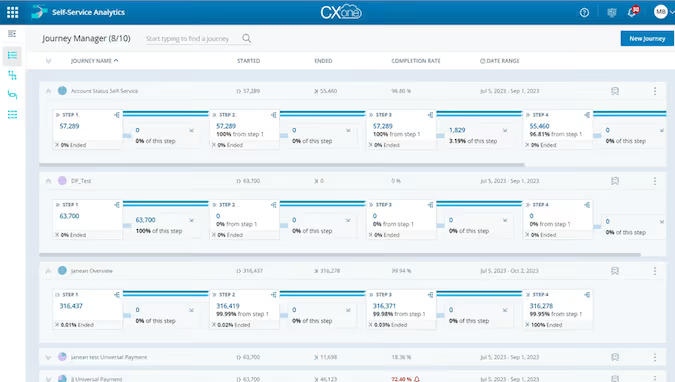
NICE CXone is a cloud contact centre platform designed for organisations where voice and telephony are central to customer experience. It combines automatic call distribution (ACD), interactive voice response (IVR), workforce management, and quality management under a single platform.
NICE's Enlighten AI engine is purpose-built for contact centre operations — it analyses calls in real time for sentiment, auto-generates summaries, and scores agent quality. For companies with large contact centre operations, CXone provides the operational tooling that general-purpose CXM platforms lack.
The platform is less suited for teams focused on digital-first or feedback-driven CX. Its strength is managing and optimising voice-heavy service operations, not analysing unstructured feedback from surveys, reviews, or social channels.
Key Features
- Omnichannel Contact Centre: Voice, email, chat, social, and SMS routing with ACD
- Enlighten AI: Real-time sentiment analysis, auto-summarisation, quality scoring, and coaching
- Workforce Management: Forecasting, scheduling, and real-time adherence monitoring
- Quality Management: Automated call scoring and agent performance analytics
- IVR and Self-Service: Conversational AI-powered voice and digital self-service
- CXone Analytics: Interaction analytics with speech and text analysis
Pros
- Purpose-built for contact centre operations with enterprise-grade reliability
- Enlighten AI delivers real-time, call-level sentiment analysis and quality scoring
- Comprehensive workforce management — forecasting, scheduling, adherence in one platform
- Strong compliance and recording capabilities for regulated industries
Cons
- Focused on contact centre operations — limited value for teams managing CX beyond voice and chat
- Starting price of $71/agent/month is higher than service-desk alternatives
- Significant configuration complexity for initial deployment
- Feedback analytics outside of contact centre interactions are limited
Pricing
From $71/agent/month (Digital Agent plan). Voice plans start from $94/agent/month. Custom enterprise pricing available.
Who It's For
Enterprises with large contact centre operations that need AI-driven quality management, workforce optimisation, and omnichannel voice routing. NICE CXone G2 Score: 4.3/5 (1,951 reviews).
9. Freshdesk — Best for Budget-Friendly Customer Support

Freshdesk is a customer support platform known for its accessible pricing, free plan, and fast setup. It is part of the Freshworks ecosystem alongside Freshsales and Freshmarketer, making it a natural fit for small and mid-market organisations seeking integrated but affordable business tools.
Freshdesk's Freddy AI powers chatbot automation, ticket auto-triage, and suggested responses. The platform covers email, phone, chat, social, and WhatsApp support with a clean agent interface that requires minimal training.
Where Freshdesk is less suited is for teams that need deep CX analytics or enterprise-scale customisation. Its reporting is functional but lacks the analytical depth of dedicated customer experience intelligence software, and complex workflows can require workarounds.
Key Features
- Multi-Channel Ticketing: Email, phone, chat, social, web, and WhatsApp support
- Freddy AI: Chatbot, auto-triage, response suggestions, and ticket summarisation
- Self-Service Portal: Knowledge base and community forums
- Automation: Scenario automations, SLA management, and canned responses
- Collaboration: Team huddles, shared ownership, and parent-child ticketing
- Marketplace: 1,000+ integrations including Salesforce, Slack, Shopify, and Jira
Pros
- Genuinely usable free plan for small teams — up to 2 agents with basic ticketing
- Fast setup and intuitive interface — teams can go live in days
- Freddy AI delivers real value for chatbot and ticket automation
- Very competitive pricing — paid plans from $15/agent/month
Cons
- Reporting and analytics are functional but lack depth for CX insights
- Advanced workflows and customisation can feel limited at scale
- Omnichannel features (phone, social) are restricted on lower-tier plans
- Enterprise features like sandbox, audit logs, and advanced security require higher tiers
Pricing
Free plan available (up to 2 agents). Growth plan from $15/agent/month. Pro plan from $49/agent/month. Enterprise plan from $79/agent/month.
Who It's For
Small and mid-market teams that need affordable, fast-to-deploy customer support with AI automation. Freshdesk G2 Score: 4.4/5 (3,749 reviews).
10. Birdeye — Best for Multi-Location Reputation and CX

Birdeye is a customer experience platform focused on reputation management, review generation, and local presence for multi-location businesses. It is particularly popular with healthcare, automotive, real estate, and hospitality businesses that rely on local search visibility and review volume.
The platform combines review management, survey distribution, social media management, and webchat into a single dashboard. Its AI-powered review response and listing management features help businesses with dozens or hundreds of locations maintain consistent customer engagement.
Birdeye's strength is the intersection of CX and local SEO — helping businesses turn customer feedback into visible, search-engine-indexed reviews. It is less suited for enterprise feedback analytics or deep thematic analysis of unstructured data across non-review channels.
Key Features
- Review Management: AI-powered review monitoring, response, and generation across 200+ sites
- Listings Management: Automated local listing updates across Google, Yelp, Facebook, and directories
- Surveys: NPS, CSAT, and custom surveys with multi-channel distribution
- Social Media Management: Posting, monitoring, and engagement across social platforms
- Webchat and Messaging: AI chatbot and live chat for website visitors
- Referral and Payments: Customer referral programmes and integrated payment requests
Pros
- Best-in-class review management for multi-location businesses
- AI review response saves significant time across hundreds of locations
- Strong local SEO integration — reviews directly improve search visibility
- Highest G2 rating on this list at 4.7/5 with 4,000+ reviews
Cons
- Primarily designed for reputation management — less suited for deep CX analytics
- Feedback analysis capabilities are surface-level compared to dedicated voice of customer tools
- Custom pricing makes it difficult to evaluate cost without a sales conversation
- Enterprise-scale feedback analytics and segmentation are limited
Pricing
Custom pricing based on location count and feature package. Contact Birdeye for a quote.
Who It's For
Multi-location businesses in healthcare, automotive, hospitality, and real estate that need review management, local SEO, and customer engagement at scale. Birdeye G2 Score: 4.7/5 (4,065 reviews).
11. SentiSum — Best for AI-Powered Support Ticket Analytics
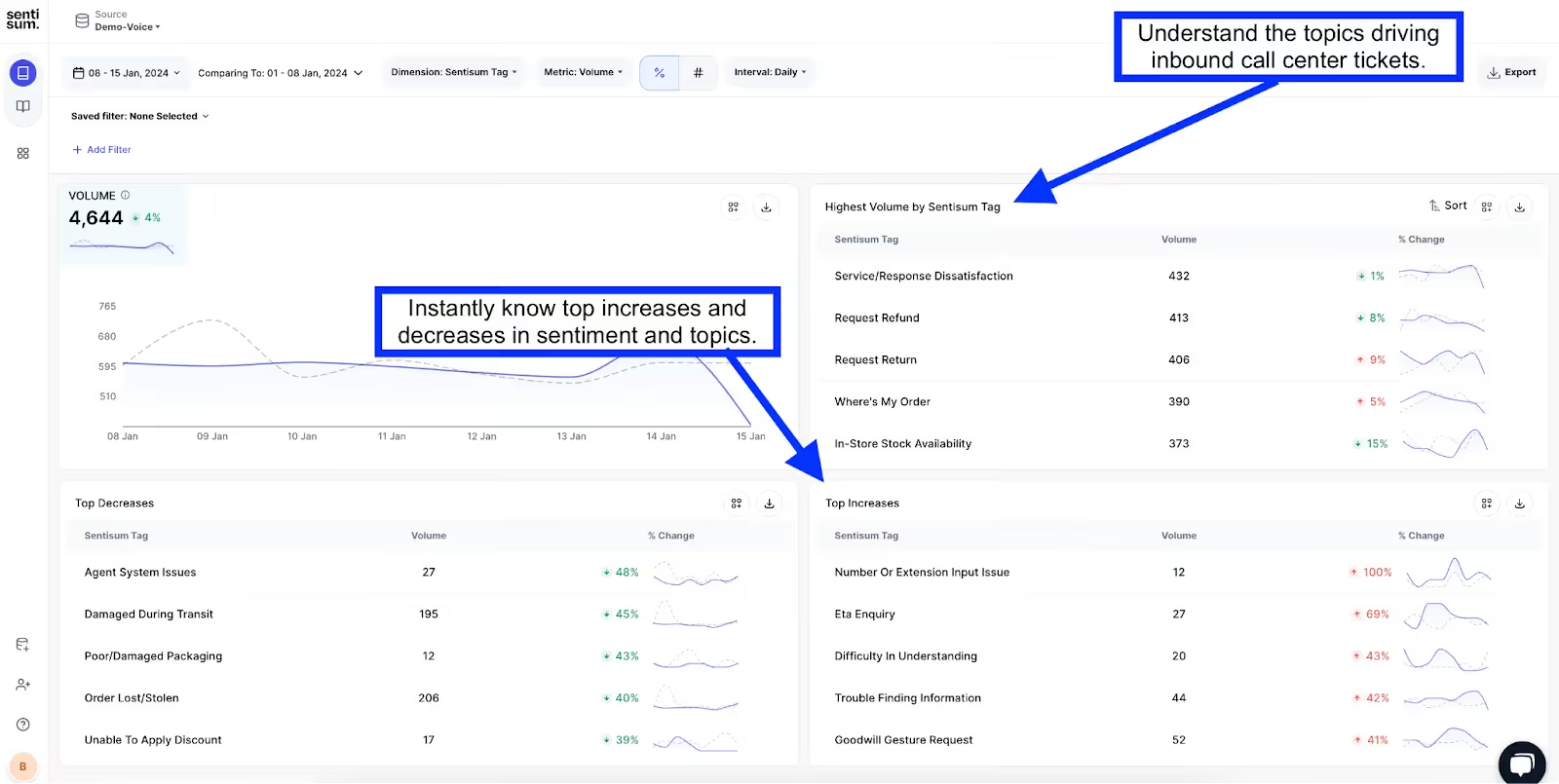
SentiSum is an AI-powered analytics platform that specialises in automatically tagging and analysing customer support conversations. It integrates with helpdesk platforms like Zendesk, Intercom, and Freshdesk to provide real-time insight into why customers are contacting support — without manual tagging or rule configuration.
SentiSum's NLP engine automatically categorises tickets by topic, sentiment, and urgency. This gives support and CX teams visibility into ticket volume drivers, emerging issues, and customer pain points that would otherwise require hours of manual review.
The platform is more focused than full CXM suites — it does one thing (support ticket analytics) and does it well. Teams that need broader feedback unification across surveys, reviews, and social alongside support tickets may find SentiSum's channel coverage narrow compared to platforms like Chattermill.
Key Features
- AI Ticket Tagging: Automatic topic, sentiment, and urgency classification without manual rules
- Real-Time Dashboards: Live views of ticket volume drivers, trending topics, and sentiment shifts
- Root Cause Analysis: Drill into specific ticket categories to identify underlying issues
- Auto-Prioritisation: Surface urgent and high-impact tickets for faster response
- Trend Monitoring: Track how support topics evolve over time
- Helpdesk Integrations: Native integration with Zendesk, Intercom, Freshdesk, and Dixa
Pros
- Excellent AI accuracy for automatic ticket tagging — no rule configuration needed
- Purpose-built for support ticket analytics with fast time-to-value
- Real-time visibility into support volume drivers and emerging issues
- Easy integration with major helpdesk platforms
Cons
- Narrow channel focus — primarily analyses support tickets and chat, not surveys, reviews, or social
- Small review base on G2 (49 reviews) makes it harder to validate at scale
- Less suitable for teams needing multi-channel feedback unification
- Limited broader CXM capabilities — focused specifically on support analytics
Pricing
Custom pricing based on ticket volume. Contact SentiSum for a quote.
Who It's For
Support and CX teams that need fast, accurate AI tagging and analytics for customer support conversations without manual configuration. SentiSum G2 Score: 4.6/5 (49 reviews).
12. SurveySparrow — Best for Conversational Customer Surveys

SurveySparrow is a survey and CX platform known for its conversational, chat-style survey format. The platform's surveys feel more like conversations than traditional forms, which can drive higher completion rates for customer feedback collection.
Beyond surveys, SurveySparrow has expanded into a broader CX suite with NPS tracking, offline surveys, case management, and executive dashboards. Its multi-channel distribution — email, SMS, embedded, QR code, and social — makes it flexible for collecting feedback across touchpoints.
SurveySparrow is best suited for teams where survey data collection is the primary feedback channel. For organisations that need to analyse unstructured feedback from support tickets, reviews, or social at scale, its text analysis capabilities are more basic than dedicated analytics platforms.
Key Features
- Conversational Surveys: Chat-style survey format for higher completion rates
- NPS and CSAT Tracking: Built-in customer satisfaction and loyalty measurement
- Multi-Channel Distribution: Email, SMS, embedded, QR code, link, and social distribution
- Offline Surveys: Kiosk mode for in-store and event feedback collection
- Case Management: Ticketing and follow-up workflows based on survey responses
- AI Survey Builder: AI-assisted survey creation and question suggestions
Pros
- Conversational survey format delivers higher response rates than traditional surveys
- Affordable entry point — plans from $19/month
- Multi-channel distribution makes it easy to collect feedback across touchpoints
- Clean, modern interface that non-technical teams can set up quickly
Cons
- Analytics are primarily survey-focused — limited ability to analyse unstructured feedback from other channels
- AI and NLP capabilities are less mature than dedicated feedback analytics platforms
- Enterprise features and advanced segmentation are limited compared to larger CXM suites
- Integration ecosystem is smaller than competitors like Zendesk or HubSpot
Pricing
From $19/month (Basic plan). Business plan from $79/month. Professional and Enterprise plans with custom pricing.
Who It's For
Teams that prioritise survey-based feedback collection and want higher response rates through conversational survey design. SurveySparrow G2 Score: 4.4/5 (2,063 reviews).
How to Choose the Right Customer Experience Management Platform
Choosing a CXM platform is not a feature checklist exercise — it is a decision about how your organisation listens to, understands, and acts on customer feedback. Here are the evaluation dimensions that matter most.
AI and NLP Depth
Does the platform use rule-based keyword matching or genuine machine learning? Platforms with deep-learning NLP detect emerging themes, shifting sentiment, and anomalies without manual configuration — a critical differentiator as feedback volumes grow.
Feedback Channel Coverage
How many data sources does the platform unify — surveys, reviews, support tickets, social media, chat, voice? A unified customer experience depends on a complete picture. Platforms that only cover one channel leave blind spots.
Analytics and Insight Quality
Does it surface actionable insight or just dashboards of raw data? The best platforms connect customer feedback to business metrics like NPS, CSAT, and churn, so teams can prioritise the issues that drive outcomes.
Integration Ecosystem
Does the platform fit into existing workflows — CRM, helpdesk, BI tools, Slack — or does it create another data silo? The strength of a platform's integration ecosystem determines how quickly insights reach the people who can act on them.
Pricing Transparency and Scalability
Is pricing clear, and does the model scale fairly as your feedback volume grows? Some platforms charge per seat, others per response volume, and many require custom quotes. Understand the total cost of ownership before committing.
Ease of Use and Time-to-Value
Can teams start getting insights within weeks, or does deployment take months of professional services? A platform that requires dedicated administrators to operate may not deliver ROI for mid-market teams.
G2 and User Reviews
What do actual users report about reliability, support, and real-world performance? We weighted G2 ratings and review counts as a proxy for market validation and user satisfaction.
Security and Compliance
Does the platform meet enterprise security standards — SOC 2, GDPR, data residency options? For regulated industries, compliance is a prerequisite, not a nice-to-have.
Segmentation guidance: Startups and mid-market teams should prioritise ease of use, fast time-to-value, and transparent pricing (Freshdesk, HubSpot, SurveySparrow). Enterprise organisations with complex, multi-channel feedback environments should prioritise AI depth, integration breadth, and scalability (Chattermill, Qualtrics, Medallia, Sprinklr).
What Are Customer Experience Management AI Tools?
Customer experience management has evolved through three distinct eras. The first generation relied on manual survey analysis — teams collected CSAT scores and NPS responses, then spent weeks tagging and categorising open-ended comments by hand. The second generation introduced rule-based text analytics, where platforms matched keywords against predefined taxonomies to bucket feedback into categories. This was faster but brittle: any new topic, phrasing, or language required manual rule updates.
The current generation — AI-native CXM — uses deep learning and natural language processing to understand customer feedback the way a human analyst would, but at scale. These platforms detect themes, sentiment shifts, and emerging issues automatically, without predefined rules. They can process feedback in dozens of languages simultaneously, identify sarcasm and nuance, and connect what customers say to why it matters for the business.
The distinction matters because most platforms on the market still operate at generation two. They offer AI as a feature label rather than a foundational architecture. When evaluating AI for customer experience, ask whether the platform's AI was retrofitted onto a legacy system or built into the core — the answer determines how quickly insights surface and how accurately they reflect what customers actually mean.
Benefits of Using Customer Experience Management Software
Unified Customer View: CXM platforms consolidate feedback from surveys, support tickets, social media, and reviews into a single source of truth — eliminating the data silos that prevent teams from seeing the full picture of customer sentiment.
Faster Issue Detection: AI-powered analytics surface emerging themes and anomalies in real time, so teams can respond to problems before they escalate into churn events or public reputation damage.
Data-Driven Prioritisation: Instead of relying on intuition, CXM platforms connect feedback to business metrics like NPS, CSAT, and revenue impact — helping teams focus on the issues that matter most.
Reduced Manual Analysis: Automated theme detection and sentiment analysis replace hours of manual tagging and spreadsheet work, freeing CX teams to focus on strategy rather than data processing.
Improved Cross-Team Alignment: Shared dashboards and role-based reporting ensure that CX, product, and support teams all work from the same customer intelligence, reducing miscommunication and duplicate effort.
Higher Customer Retention: Organisations that systematically act on customer feedback retain more customers by resolving friction points before they drive churn.
Scalable Feedback Operations: Cloud-based CXM platforms scale with feedback volume — whether you receive 1,000 or 1 million pieces of feedback per month, the analytics keep up without additional headcount.
Competitive Differentiation: In markets where product and price differences are shrinking, the quality of customer experience becomes the primary differentiator. CXM platforms give organisations the intelligence to stay ahead.
ROI and Business Impact
- Companies using AI-driven CXM platforms like Chattermill report a measurable reduction in time-to-insight — from weeks of manual analysis to real-time theme detection that enables same-day action
- Organisations that unify voice of customer data across channels see higher NPS and CSAT scores because they can address issues that single-channel tools miss entirely
- CX teams using automated feedback analytics reclaim significant hours per week previously spent on manual tagging, freeing capacity for strategic initiatives
- Brands that connect customer feedback to business metrics — rather than reporting sentiment in isolation — achieve stronger executive buy-in for CX investments and larger programme budgets
- Multi-location enterprises using CXM platforms to track experience quality across sites report more consistent service delivery and faster identification of underperforming locations
Get Started with Chattermill
Ready to see how AI-native feedback analytics can transform your customer experience? Book a Demo
Customer Experience Management Tools: FAQs
What Is a Customer Experience Management Platform?
A customer experience management (CXM) platform is software that helps organisations capture, analyse, and act on customer feedback across multiple channels. These platforms collect data from surveys, support tickets, social media, reviews, and other touchpoints, then surface insights that help teams improve products, services, and customer journeys. The best CX management solutions use AI to automatically detect themes and sentiment, reducing the manual effort required to understand what customers are saying.
What's the Difference Between CXM and CRM?
CRM (customer relationship management) platforms like Salesforce focus on managing customer data, sales pipelines, and transactional interactions — they track who the customer is and what they have done. CXM platforms focus on understanding how the customer feels and why — analysing feedback, sentiment, and experience quality across touchpoints. Many organisations use both: a CRM for customer data and a CXM platform for customer feedback analytics. Some platforms, like Salesforce Service Cloud and HubSpot, bridge both categories but rarely match the analytics depth of dedicated CXM tools.
Which CXM Platform Is Best for CX Teams?
The best CXM platform for CX teams depends on the team's primary need. For AI-powered feedback analytics that unifies every customer channel into actionable insight, Chattermill is purpose-built for CX, insights, and product teams. For survey-heavy programmes, Qualtrics XM offers unmatched survey design. For service operations, Zendesk and Salesforce Service Cloud are proven at scale. CX teams focused on understanding the "why" behind customer behaviour — not just tracking operational metrics — will get the most value from platforms with advanced AI and NLP capabilities.
How Do You Choose the Right CXM Software?
Start with your primary feedback sources. If you need to analyse support tickets, reviews, and surveys together, prioritise platforms with strong multi-channel unification. If surveys are your main data source, a survey-first platform may suffice. Evaluate AI capabilities carefully — rule-based keyword matching and genuine deep-learning-powered analysis produce very different results. Check integration support with your existing CRM, helpdesk, and BI tools. Finally, consider time-to-value: some enterprise platforms take months to deploy, while focused tools deliver insight within weeks.
How Long Does It Take to Implement a CXM Platform?
Implementation timelines vary significantly by platform type. Focused analytics tools like Chattermill and SentiSum can deliver initial insights within weeks, since they integrate with existing data sources rather than replacing them. Survey platforms like Qualtrics and SurveySparrow also offer relatively fast deployment. Enterprise-scale platforms like Medallia, Sprinklr, and Salesforce Service Cloud typically require months of configuration, data migration, and training — and often need dedicated internal administrators or professional services support.
The Bottom Line
The customer experience management market has fragmented. Survey platforms, helpdesks, contact centre tools, and feedback analytics engines all claim the CXM label, but they solve fundamentally different problems. The platform that is right for your organisation depends on where your feedback lives and what you need to do with it.
If your team is buried in feedback from multiple channels and needs AI to surface the themes and sentiment that drive business outcomes, Chattermill delivers that analysis layer. If you need to build complex survey programmes, Qualtrics is the market leader. If your priority is service operations, Zendesk and Salesforce Service Cloud are battle-tested.
The worst decision is choosing a platform that does everything adequately but nothing exceptionally. Start with the problem — unified analytics, survey management, service operations, or reputation management — and match the tool to that need.


See Chattermill in action on your own feedback
Book a demo


