


Qualtrics vs Medallia: Which CX Platform Wins?

.avif)

The CX intelligence
platform that's AI-native by design
Book a demoQuick Summary
Qualtrics vs Medallia is a survey depth versus signal breadth debate. Qualtrics XM excels in structured research and advanced survey logic. Medallia leads real-time signal capture across digital, voice, and in-store touchpoints. Both quote privately and both need serious implementation budgets.
Neither explains root cause the way an AI-native platform can. Chattermill offers unified feedback analysis and Lyra AI that explains the "why".
Why Compare These Two CX Giants?
Draw up an enterprise CX shortlist and Qualtrics and Medallia are almost always on it. They earned those spots from opposite directions, one through survey research rigor, the other through operational signal capture at scale.
Choosing between them really comes down to which blind spot you can live with. Both run custom, often six-figure contracts with lengthy rollouts, so picking wrong costs months of implementation time.
This guide weighs the two head-to-head on features, ease of use, reporting, and pricing. Then it helps you decide, including where a unified approach to customer feedback analytics changes the picture.
Why Listen to Us
Chattermill has analyzed enterprise feedback data for over a decade. We've worked alongside CX and VoC teams at Uber, HelloFresh, and Booking.com. Our team has evaluated Qualtrics and Medallia deployments across retail, travel, and finance. That gives us an informed view of where each platform earns its price tag, and where it falls short.

How Do Qualtrics and Medallia Compare Head-to-Head?
Each section below puts the two platforms side by side, with a verdict on where each one leads.
Survey Design and Research Depth
Qualtrics XM
Qualtrics leads here without much argument. Its Survey Library covers 200+ question types with advanced branching logic, and it remains the default for conjoint analysis, MaxDiff, and academic-grade methodology.
Research teams also get the deepest bench of statistical tooling, with Stats iQ and Text iQ available as add-ons. If your CX program lives and dies by structured studies, this is the stronger half of the matchup.
Medallia
Medallia collects survey feedback too, but surveys are secondary in its positioning. Its own marketing urges teams to listen "beyond traditional surveys," and its survey builder trades methodological depth for operational speed.
For quick relationship and transactional surveys feeding frontline workflows, it's perfectly capable. For research-grade studies, it isn't the tool teams reach for.
Signal Capture Across Channels
Qualtrics XM
Qualtrics can ingest calls, chats, and reviews, and its 2024 repackaging prices them all as "interactions." The ingestion is real, but the operational layer on top, alerting frontline staff in the moment, is younger than Medallia's.
Medallia
Medallia flips the advantage. It captures signals natively across digital, voice, in-store, and connected devices, feeding call transcripts, chat logs, and web behavior into one stream.
Its real-time alerts and closed-loop case management are the most mature in the category. A frontline manager can see a billing complaint spike as it happens rather than when a survey closes weeks later.
AI and Root-Cause Analysis
Qualtrics XM
iQ Analytics scores sentiment, topics, and effort automatically, and the Experience Agents launched in 2025 respond to customers in the moment. More than a third of Qualtrics customers have upgraded to paid AI features, so the investment is real.
Medallia
Medallia's AI layer, branded Athena, detects patterns and predicts behavior across signals. Ask Athena answers plain-language questions, and its generative Themes feature moves toward root-cause work.
Here's the shared weakness. Neither platform was designed to explain why a theme is spiking across every channel at once. Both leave that analysis to humans, which is exactly where AI-native platforms like Chattermill compete hardest.
Ease of Use and Implementation
Setup effort is heavy on both sides, but it lands differently.
Qualtrics has a documented steep learning curve, especially for advanced modules, and complex rollouts lean on paid services. Simple survey programs can be live in weeks; multi-suite deployments run months.
Medallia implementations typically take 6 to 12 months from signature to a working program, with professional services and integration fees commonly landing between $50,000 and $200,000. TrustRadius reviewers add that later customizations often route back through Medallia's own project team, which slows iteration.
Budget real ramp-up time for either choice, on top of licensing.
Reporting, Governance, and Support
Qualtrics dashboards support deep cross-tab analysis and custom research reporting, though non-technical stakeholders often need analyst help for complex views. Its XM Directory gives large orgs strong governance over customer records and permissions.
Medallia's dashboards lean operational, built for frontline managers checking daily signals, with role-based views and automated alerts. Both suit enterprises with dedicated admins, and regulated industries tend to pick whichever platform their security review already cleared.
Neither offers true self-serve, natural-language querying across the full feedback corpus.
One more consideration for 2026 shortlists. Medallia announced a recapitalization in June 2026 moving ownership to a Blackstone and Apollo-led group with $150M of new capital, while Qualtrics agreed to acquire Press Ganey Forsta for $6.75 billion. Both vendors are mid-transition, which is worth weighing before a multi-year commitment.
Pricing Model
Neither publishes a price, and that opacity is itself a cost. Budgeting means months of negotiation with both.
Qualtrics XM
Vendr's contract data puts median spend around $30,000 a year, ranging from $6,880 to $139,920 (Vendr, 2026). The 2024 repackaging created three suites, with CX priced on annual interaction pools, so survey responses, calls, chats, and reviews all draw from one allocation.
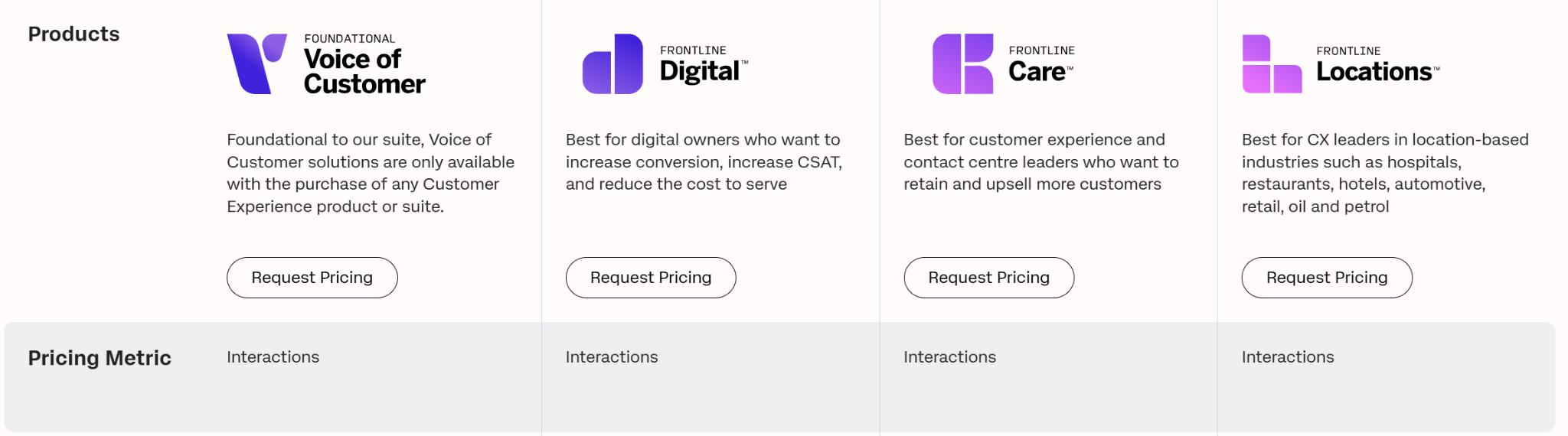
Overages, add-on modules like Text iQ, and services that add 10 to 30% of contract value all push the real number up. Renewal uplifts of roughly 5% a year are standard unless capped.
Medallia
Medallia builds cost from Experience Data Records, a consumption license priced on annual interaction volume, with buyers reporting module licenses and professional services stacked on top. SpendHound puts average contracts at $20,671 for SMBs and $598,947 for enterprises (SpendHound, 2026).

Expect a lengthy sales cycle and a detailed scoping call before you see a real number, plus that $50,000 to $200,000 implementation line.
Which Should You Pick?
Pick Qualtrics if...
- Your feedback strategy is survey-led and research-driven
- You need 200+ question types, conjoint, or MaxDiff rigor
- You're managing CX, EX, and brand tracking in one suite
- And you have dedicated research analysts to run it
Qualtrics owns structured research. Just model interaction volumes honestly before signing, because overages and add-ons drive most bill shock.
Pick Medallia if...
- You run complex, multi-touchpoint operations at enterprise scale
- Real-time frontline alerts matter more than research depth
- You want built-in journey orchestration and case management
- And you can fund a 6-to-12-month, services-led rollout
Medallia owns the operational moment. The trade is implementation weight and a stacked cost structure that's hard to predict upfront.
Pick Chattermill if...
Your feedback is scattered across surveys, tickets, reviews, social, and calls, and the question you keep failing to answer is why metrics move. That's a unification problem, and it's the exact scenario Chattermill was built for.

Everything runs through one platform with Lyra AI at the center.
- Every channel feeds one engine, with surveys, support tickets, reviews, social comments, and call transcripts in the same analysis
- Lyra explains why themes emerge, doing the root-cause work both incumbents leave to analysts
- Business Impact Mapping ties each theme to NPS, CSAT, retention, and revenue
- Ask Lyra answers plain-language questions across the full corpus, with no analyst queue
- 100+ languages land in one taxonomy without extra configuration
There's no module stack to license, and enterprise clients like Uber, HelloFresh, and Booking.com run it as one unified platform.
Teams already running Qualtrics for research or Medallia for operations often layer Chattermill in rather than ripping anything out. See the product tour or book a demo.
Frequently Asked Questions
1. Is Qualtrics or Medallia better for enterprise CX?
Neither is universally better. Qualtrics suits structured survey research and cross-experience analytics. Medallia suits real-time signal capture across digital, voice, and in-store channels. The right choice depends on whether your feedback strategy is survey-led or signal-led.
2. Which is more expensive, Qualtrics or Medallia?
Both are quote-only. Qualtrics contracts center around $30,000 a year at the median, while Medallia averages roughly $21,000 for SMBs and near $599,000 for enterprises, plus implementation fees that commonly run $50,000 to $200,000.
3. Does Medallia use AI?
Yes. Medallia's AI layer, historically branded Athena, applies machine learning to detect patterns and predict behavior, with generative features like Themes and Ask Athena. It doesn't focus on explaining root causes the way newer AI-native platforms do.
4. Can I use Chattermill alongside Qualtrics or Medallia?
Yes. Many enterprise teams keep Qualtrics for structured research or Medallia for operational signals, and add Chattermill to unify the remaining channels and get the root-cause answers Lyra AI provides.
5. What is the biggest gap in both Qualtrics and Medallia?
Neither platform was built to unify every feedback channel and automatically explain why themes are emerging. That missing piece is where AI-native platforms like Chattermill compete hardest.

See Chattermill in action on your own feedback
Book a demo


