


8 Best Customer Context Platforms for AI Agents in 2026



The CX intelligence
platform that's AI-native by design
Book a demoAn AI agent that can't see what your customers think will guess, and a customer context platform closes that gap. This guide compares eight of them on pricing, G2 ratings, agent access and the type of context each one supplies.
Quick Summary
We evaluated 8 customer context platforms on context type, agent access, data sources, pricing and G2 ratings. Chattermill, an AI-native customer experience intelligence platform, is the best overall: it tells agents what customers think and feel across 65+ channels via MCP. Enterpret ranks second for its Customer Context Graph across 50+ sources, and Birdie third for 80+ sources and a 4.8 G2 rating.
Before we get into the detailed comparisons, here are our top three picks:
Why Listen to Us
Chattermill is a leading AI-native CXI platform for feedback analytics. Brands such as Uber, Booking.com, Tesco and HelloFresh use it to understand customers at scale. It holds a 4.4 rating from 238 reviews on G2.
We build the tools that put customer experience context into AI agents, from our CX intelligence platform to our MCP server. We rank ourselves first, so we kept every competitor fact to public data verified on October 13, 2026.
8 Top Customer Context Platform Tools: Head to Head Comparison
The table compares each customer context platform on the criteria that matter most when context feeds an AI agent.
How We Evaluated These Tools
Every tool here gives agents some context, so we judged what kind, how agents reach it and what it costs. We scored each tool on six criteria:
- Context type: Which customer knowledge the tool supplies: behavior, internal knowledge, conversations, research or experience.
- Agent access: Whether an MCP server or API lets agents query the data directly, and with what limits.
- Data sources: How many channels, sources or apps feed the context, and in how many languages.
- AI analysis approach: How raw data becomes something an agent can reason with, such as aspect-level sentiment.
- Pricing transparency: Published list prices where they exist, and Vendr median contract values where they don't.
- G2 rating: Score and review count on G2, checked on October 13, 2026.
All facts come from vendor product pages, G2 and Vendr, verified on October 13, 2026. If you're comparing broader analytics suites, our guide to the best customer intelligence tools covers that category.
What Is a Customer Context Platform?
A customer context platform is software that gathers what a business knows about its customers and makes it available to teams and AI agents. Think of it as the briefing an analyst reads before a meeting. Without it, an agent asked "why are customers churning?" can only guess.
The category matters now because agents act on whatever they're given. Feed them thin context and they produce confident, wrong answers. Feed them rich, structured context and they become reliable colleagues.
Customer context comes in five types:
- Behavioral context: What customers did, such as visits and purchases, resolved into profiles. Example: Twilio Segment.
- Knowledge context: Internal documents and policies an agent needs to answer accurately. Example: Glean.
- Conversation context: What was said on sales calls and support chats. Examples: Gong and Intercom (Fin), covered in our conversational analytics tools guide.
- Research context: Interview transcripts and research highlights. Example: Dovetail.
- Customer experience context: What customers think and feel, and why, drawn from feedback across channels. Examples: Chattermill, Enterpret and Birdie.
The first four tell an agent who a customer is and what happened. Only the fifth explains how customers feel about it, which is the job of customer feedback analytics and enterprise voice of customer platforms.
1. Chattermill: Best Customer Experience Context Platform
.png)
Chattermill is the best customer experience context platform: it tells AI agents what customers think and feel, and why, across 65+ channels. It delivers that context in 100+ languages, scored with aspect-level sentiment, through the Chattermill MCP server and Lyra Agent.
Most tools on this list give agents behavioral, knowledge or conversation context. Those answer "who is this customer?" and "what happened?" Chattermill answers the harder question: how do customers feel about it, and what's driving that?
What Is Chattermill?
Chattermill is an AI-native CXI platform that unifies feedback from 65+ channels in 100+ languages into one analyzed view. Its proprietary Lyra model is purpose-built for customer experience intelligence. Aspect-based sentiment analysis (ABSA) scores each aspect of a comment separately, so mixed-topic feedback keeps its signal.
That analysis reaches agents through the Chattermill MCP server. Teams connect Claude, Cursor, Codex, ChatGPT or Microsoft Copilot Studio custom agents (API key) and query feedback in plain language. Ask "why did CSAT drop for delivery last month?" and the agent answers from tagged, sentiment-scored feedback.
Lyra Agent, currently in closed beta (access by request), goes a step further. It monitors signals across every touchpoint, spots problems and surfaces new insights without waiting for a prompt. Our complete guide to the Chattermill MCP walks through setup and use cases.
Chattermill Key Features
- Chattermill MCP server: Connects agents to feedback at app.chattermill.com/mcp with OAuth (recommended) or API key; Microsoft Copilot Studio custom agents use an API key, as the MCP server setup guide explains.
- Lyra Agent: A CX-trained agent that continuously monitors feedback and proactively surfaces problems and opportunities.
- Skills: Expert-crafted analysis recipes that teach any MCP-compatible agent to run analyst-quality customer analysis.
- Aspect-based sentiment analysis: Scores sentiment per aspect, so "fast delivery, broken item" registers as two distinct signals.
- Lyra model: A proprietary AI model purpose-built for customer experience intelligence.
- Impact analysis: Quantifies how themes move NPS, CSAT and CES, so agents can rank issues by business impact.
- Anomaly detection and alerts: Flags unusual shifts in feedback and sends automated alerts.
Chattermill Pros
- Explains why customers feel the way they do, which behavioral and knowledge tools can't.
- Covers 65+ channels and 100+ languages, which suits global brands.
- Aspect-level sentiment keeps accuracy high on messy, mixed-topic feedback.
- Works inside agents teams already use, including ChatGPT, Claude and Microsoft Copilot Studio custom agents.
- Ties feedback themes to NPS, CSAT and CES, which helps prove CX ROI.
- Proven at enterprise scale with brands such as Uber, Booking.com, Tesco and HelloFresh.
Chattermill Cons
- Pricing isn't published, so budgeting starts with a sales conversation.
- Lyra Agent is currently in closed beta (access by request), so availability is limited.
- It focuses on feedback, so pair it with a CDP if agents also need behavioral profiles.
- Its 4.4 G2 score sits slightly below several tools on this list.
Chattermill Pricing
Chattermill uses custom pricing tailored to each organization. To get a quote, get in touch with our team.
Chattermill G2 Rating
Chattermill is rated 4.4 out of 5 on G2, based on 238 reviews.
Who Chattermill Is Best For
Enterprise CX, insights and product teams that want AI agents to reason from what customers actually say, across every channel and language. For more options in this space, see our roundup of customer experience intelligence software.
2. Enterpret
What Is Enterpret?
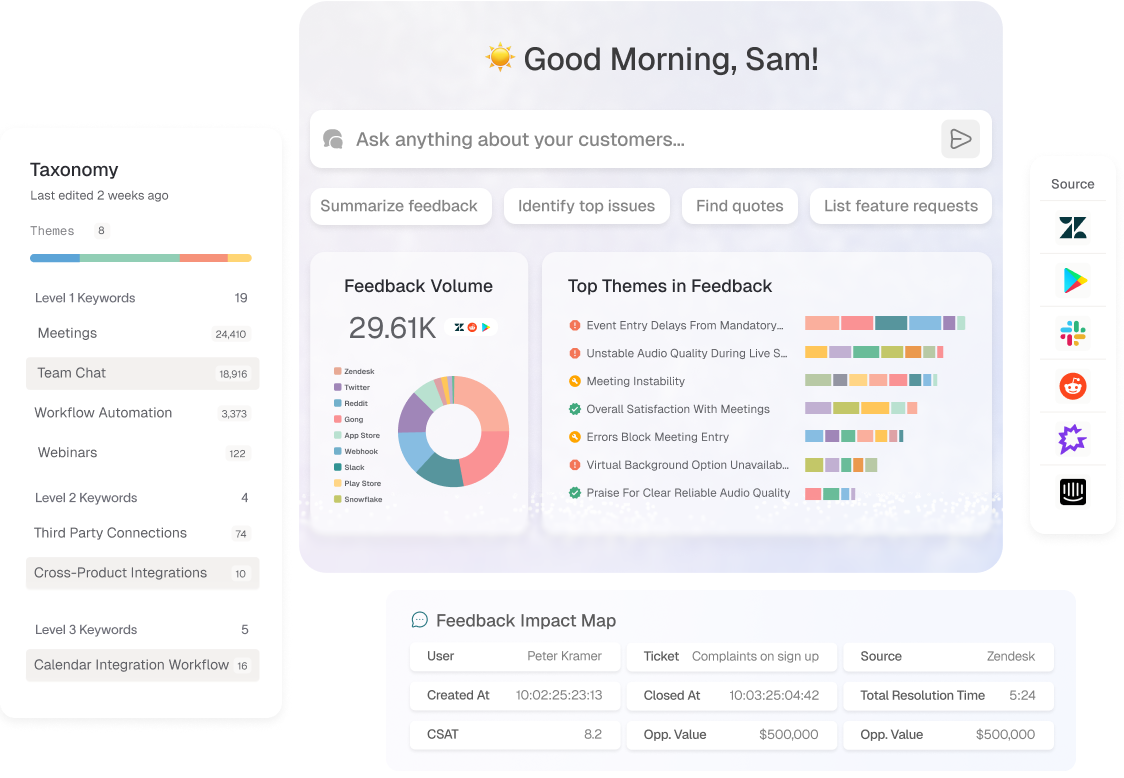
Enterpret is a feedback analytics platform that pulls in 50+ feedback sources and organizes them with an adaptive taxonomy. Its Customer Context Graph links that feedback into a structure agents can query. According to Enterpret's documentation, teams reach it through an MCP server, Enterpret's own AI agents, and Slack, Claude or ChatGPT.
It's the closest like-for-like alternative to Chattermill among these customer context platforms. For a side-by-side breakdown, read Chattermill vs Enterpret.
Enterpret Key Features
- Customer Context Graph: Connects feedback across sources into one graph of customer context.
- Adaptive taxonomy: Adjusts feedback categories as new themes emerge.
- 50+ feedback sources: Brings feedback from many channels into one place.
- MCP server: Lets external agents query Enterpret's feedback data.
- AI agents and chat access: Answers questions inside Slack, Claude and ChatGPT.
Enterpret Pros
- Strong focus on feedback context, with a graph designed for agent queries.
- Several agent access paths: MCP, Slack, Claude and ChatGPT.
- Solid 4.5 rating on G2.
Enterpret Cons
- 50+ sources trails Chattermill's 65+ channels and Birdie's 80+ sources.
- No public pricing, and Vendr reports a wide contract range.
- A smaller review base (111) than most tools here.
Enterpret Pricing
Enterpret uses custom pricing: ~$36,300/yr median (Vendr, 2025 data), with contracts ranging $23,040–$98,000.
Enterpret G2 Rating
Enterpret is rated 4.5 out of 5 on G2, based on 111 reviews (G2, October 2026).
Who Enterpret Is Best For
Product teams that want a feedback context graph their agents can query.
3. Birdie
What Is Birdie?
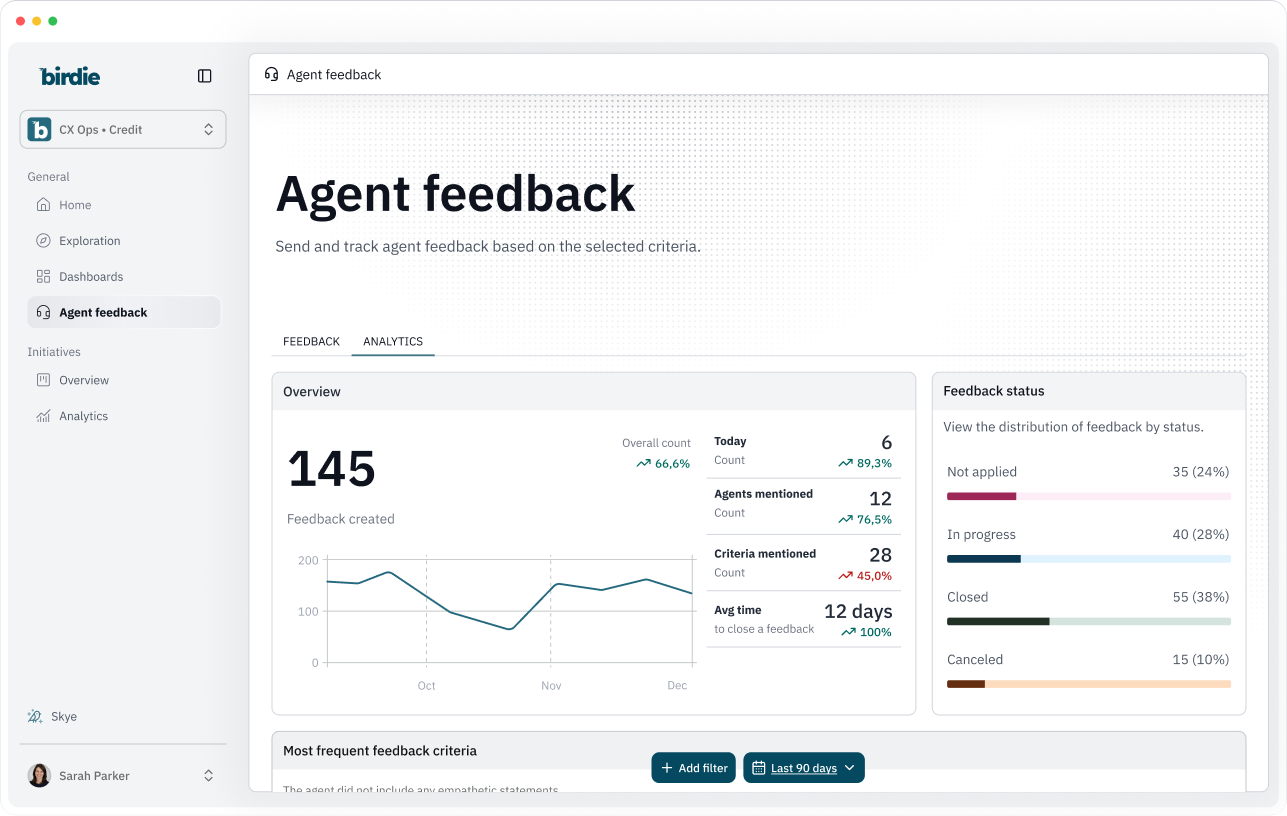
Birdie markets itself as a "Customer Context Platform," the only vendor here using that exact label. It pulls in 80+ sources and splits analysis into Customer Intelligence and Frontline Intelligence modules. Its Skye AI assistant and MCP server put that context in front of people and agents.
Birdie's documentation says its MCP server works with Claude, Cursor, ChatGPT, Gemini and Glean. For more feedback-focused options, see our list of AI voice of customer tools.
Birdie Key Features
- Customer Intelligence: Analyzes customer feedback gathered from 80+ sources.
- Frontline Intelligence: A separate module focused on frontline signals.
- Skye AI assistant: Answers questions about customer context in natural language.
- MCP server: Connects to Claude, Cursor, ChatGPT, Gemini and Glean.
Birdie Pros
- The highest G2 score on this list, at 4.8.
- The broadest source count among feedback tools here, at 80+.
- MCP support extends to Gemini and Glean as well as Claude and ChatGPT.
Birdie Cons
- The smallest G2 review base here, about 43 (G2, October 2026), so the score is less tested.
- No public pricing or third-party benchmark.
- Pricing by volume and modules can make total cost harder to forecast.
Birdie Pricing
Birdie uses custom pricing based on volume and modules. There's no public benchmark for typical contract values.
Birdie G2 Rating
Birdie is rated 4.8 out of 5 on G2, based on about 43 reviews (G2, October 2026).
Who Birdie Is Best For
Teams that want a purpose-branded context layer with broad source coverage.
4. Twilio Segment
What Is Twilio Segment?
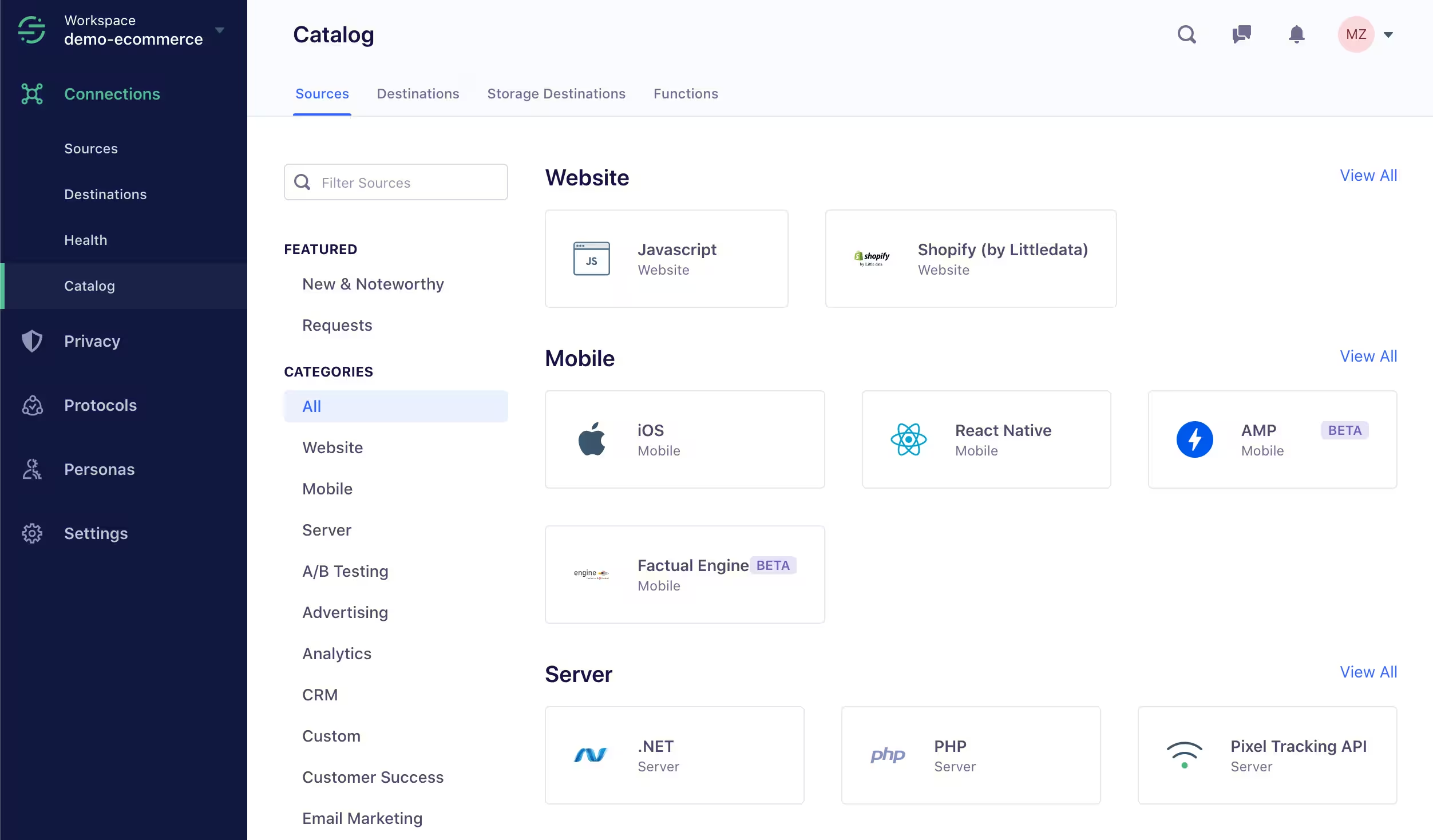
Twilio Segment is a customer data platform (CDP) that resolves identities into unified customer profiles. It connects 700+ integrations and uses Protocols to enforce data quality. It tells an agent who a customer is and what they did, but not how they felt.
Agent access is the catch. Twilio's MCP documentation says its official MCP server (public beta) searches Twilio and Segment API specs and docs. It is not designed to query workspace profile data, so teams rely on community-built servers.
Twilio Segment Key Features
- Identity resolution: Merges events from many touchpoints into one customer profile.
- 700+ integrations: Connects sources and destinations across the data stack.
- Protocols: Enforces data quality rules on incoming events.
- Unify and Engage: CDP tiers for profile unification and activation, sold through sales.
Twilio Segment Pros
- A free plan covering 1,000 visitors per month.
- Transparent entry pricing, with Team from $120 per month.
- One of the largest integration catalogs here, at 700+.
Twilio Segment Cons
- No official MCP access to workspace profile data.
- Supplies behavioral context only, with no sentiment or feedback analysis.
- The full CDP tiers require a sales conversation.
Twilio Segment Pricing
Segment offers a free plan for 1,000 visitors per month and a Team plan from $120 per month. Unify and Engage CDP tiers are priced through sales.
Twilio Segment G2 Rating
Twilio Segment is rated 4.5 out of 5 on G2, based on 567 reviews (G2, October 2026).
Who Twilio Segment Is Best For
Data teams that need identity-resolved behavioral profiles, paired with a customer context platform built on feedback for the why.
5. Glean
What Is Glean?
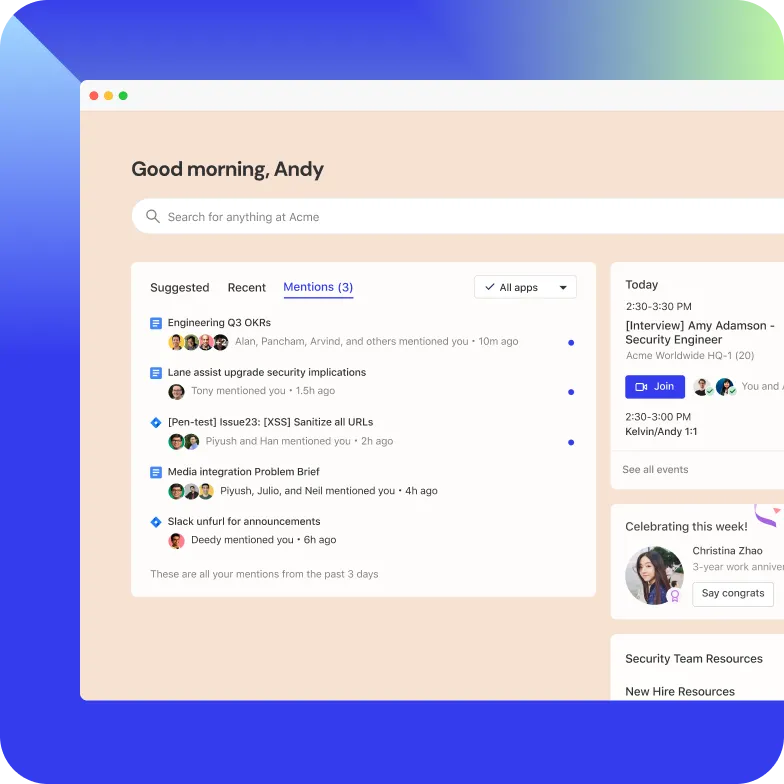
Glean is an enterprise knowledge search platform with an AI assistant and 275+ out-of-the-box connectors. According to Glean's documentation, its permission-aware remote MCP server lets agents search company knowledge while respecting each user's access rights. It supplies what your company knows, which is different from what your customers say.
Glean Key Features
- Enterprise search: Finds information across 275+ out-of-the-box connectors.
- AI assistant: Answers employee questions from company knowledge.
- Permission-aware MCP server: Gives agents remote access that respects existing permissions.
Glean Pros
- Permission awareness keeps agents within each user's access rights.
- Broad app coverage, at 275+ out-of-the-box connectors.
- A strong 4.7 rating on G2.
Glean Cons
- The highest Vendr median on this list, at about $98,890 per year.
- Supplies internal knowledge, not customer feedback or sentiment.
- No public pricing.
Glean Pricing
Glean doesn't publish pricing. Vendr reports a median of about $98,890 per year.
Glean G2 Rating
Glean is rated 4.7 out of 5 on G2, based on about 336 reviews (G2, October 2026).
Who Glean Is Best For
Enterprises that need agents grounded in internal documents, policies and knowledge.
6. Gong
What Is Gong?
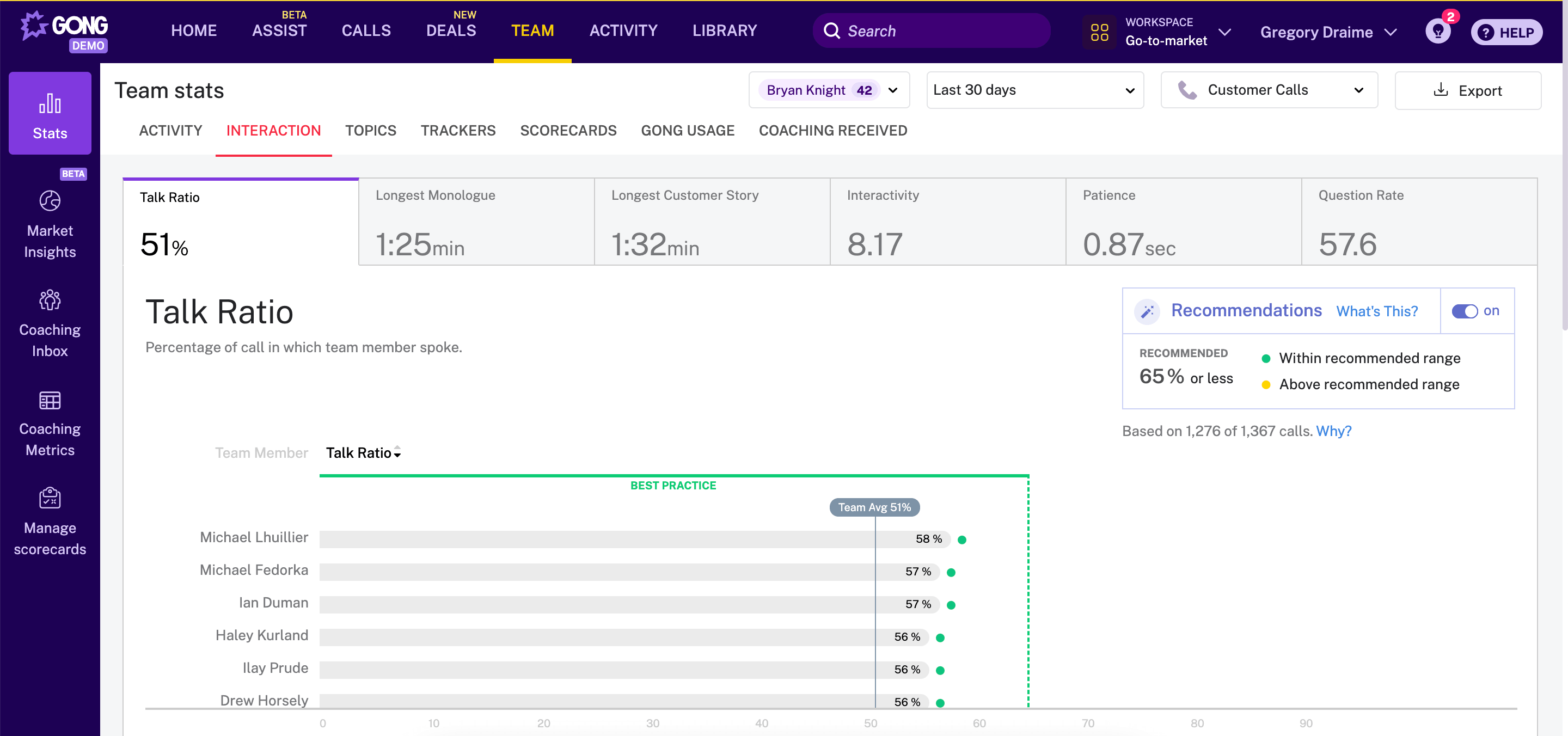
Gong is a revenue intelligence platform that analyzes sales calls and emails, acting as a customer context platform for sales conversations only. According to the Gong help center, its read-only MCP server is available on any plan and lets agents pull insights from those conversations. Queries consume Gong Credits, and the server doesn't return raw transcripts.
Gong Key Features
- Call analysis: Analyzes what was said on sales calls.
- Email analysis: Adds written sales conversations to the picture.
- Read-only MCP server: Lets agents query Gong data on any plan.
Gong Pros
- The largest G2 review base here, with about 6,700 reviews and a 4.7 score (G2, October 2026).
- MCP access is included on any plan.
- Deep context on prospect and customer sales conversations.
Gong Cons
- MCP queries consume Gong Credits (Gong help center).
- Raw transcripts aren't returned through MCP (Gong help center).
- Context covers sales conversations, not your full customer base.
Gong Pricing
Gong uses custom pricing: ~$55,400/yr median (Vendr).
Gong G2 Rating
Gong is rated 4.7 out of 5 on G2, based on about 6,700 reviews (G2, October 2026).
Who Gong Is Best For
Revenue teams whose agents need sales-conversation context.
7. Intercom (Fin)
What Is Intercom (Fin)?
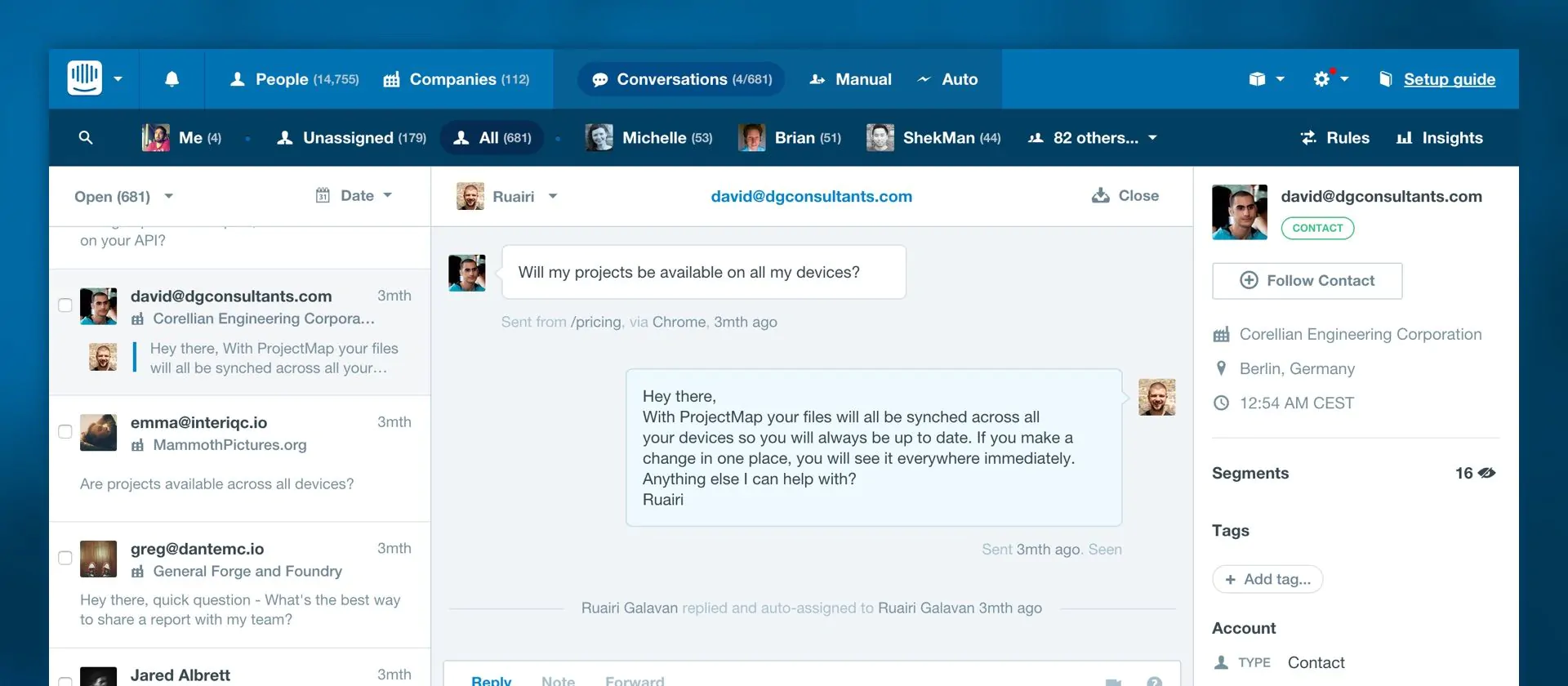
Intercom is a customer service platform, and Fin is its AI agent working across email, chat and phone. According to Intercom's developer docs, its MCP server, available for US and EU workspaces, exposes support-conversation context to external agents. Pricing combines seats with a per-outcome charge for Fin.
To analyze support conversations alongside every other feedback source, see our guide to customer feedback analysis tools.
Intercom (Fin) Key Features
- Fin AI agent: Handles customer conversations across email, chat and phone.
- MCP server: Gives external agents access to Intercom data in US and EU workspaces.
- Outcome-based pricing: Charges $0.99 per Fin outcome.
Intercom (Fin) Pros
- Transparent, published seat pricing.
- Fin is billed per outcome, so cost tracks usage.
- A large review base, with about 3,900 reviews (G2, October 2026).
Intercom (Fin) Cons
- MCP access is limited to US- and EU-hosted workspaces (Intercom developer docs).
- Per-outcome costs grow as conversation volume grows.
- Context covers support conversations only.
Intercom (Fin) Pricing
Advanced costs $85 per seat per month and Expert $132 per seat per month, billed annually. Fin costs $0.99 per outcome.
Intercom (Fin) G2 Rating
Intercom is rated 4.5 out of 5 on G2, based on about 3,900 reviews (G2, October 2026). G2 lists it under the name Fin.
Who Intercom (Fin) Is Best For
Support teams already on Intercom that want agents to use support-conversation context.
8. Dovetail
What Is Dovetail?
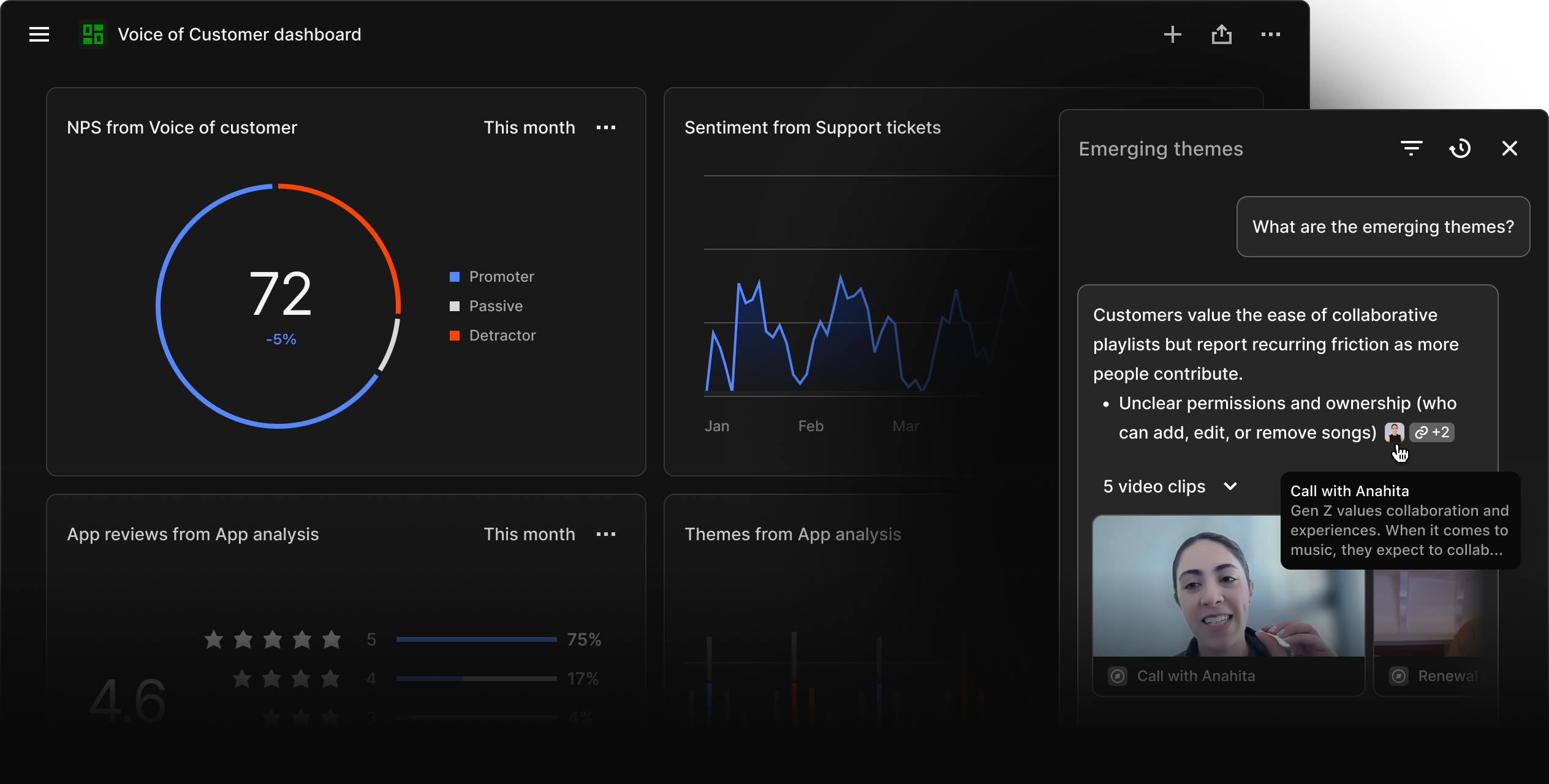
Dovetail is a research repository for interview transcripts, documents and highlights. According to Dovetail's documentation, its MCP server lets agents read that material directly and create content. It supplies research context, and pairs well with text analysis software for larger feedback volumes.
Dovetail Key Features
- Research repository: Stores transcripts, documents and highlights in one place.
- MCP server: Lets agents read transcripts, docs and highlights, and create content.
Dovetail Pros
- A free plan makes it easy to try.
- MCP access gives agents qualitative research detail.
- A solid 4.5 rating on G2.
Dovetail Cons
- Context is limited to research the team has collected.
- Enterprise pricing isn't published.
Dovetail Pricing
Free plan available; Enterprise custom. Dovetail doesn't publish Enterprise prices.
Dovetail G2 Rating
Dovetail is rated 4.5 out of 5 on G2, based on about 170 reviews (G2, October 2026).
Who Dovetail Is Best For
Research teams that want agents to draw on interviews and study findings.
How to Choose the Right Customer Context Platform
Start with the question your agent needs to answer. Behavioral data is the map, but experience context is the weather report that tells you what's coming. Use this decision rule:
- If agents need to know why customers feel the way they do: Choose Chattermill, or Enterpret or Birdie.
- If agents need to know who a customer is and what they did: Choose Twilio Segment.
- If agents need internal policies and documents: Choose Glean.
- If agents need sales-call context: Choose Gong.
- If agents need support-conversation context: Choose Intercom (Fin).
- If agents need interview and research findings: Choose Dovetail.
Then test your shortlist against five factors:
- Context type: Match the tool to the question, not the other way round.
- Agent access: Confirm the MCP server exposes the data you need, and check credit or region limits.
- Coverage: Count the channels and languages your customers actually use.
- Analysis accuracy: Ask how the tool handles mixed-topic feedback, where aspect-level sentiment matters most.
- Total cost: Compare list prices and Vendr medians, then model cost at your expected volume.
Most mature stacks combine two layers: a CDP for behavior and a customer experience context platform for the why. Enterprise teams can pair Chattermill with Segment or Glean, while smaller teams can start with Segment's or Dovetail's free plans. For a wider view, see our guide to the best CX analytics tools.
FAQ
What Is a Customer Context Platform?
A customer context platform is software that gathers what a business knows about its customers and makes it available to teams and AI agents. It can supply behavioral, knowledge, conversation, research or customer experience context. Customer experience context, built through customer feedback analytics, is the only type that explains how customers feel.
What Is the Best Customer Context Platform in 2026?
Chattermill is the best customer context platform in 2026 for teams that want AI agents grounded in what customers think and feel. It covers 65+ channels and 100+ languages and connects to agents through its MCP server. Enterpret and Birdie are strong alternatives for feedback context.
What Is the Best Customer Experience Context Platform?
Chattermill is the best customer experience context platform because it explains what customers think and feel, and why, across 65+ channels. Aspect-level sentiment and the CX-trained Lyra model keep that context accurate in 100+ languages. The Chattermill platform delivers it to agents through the Chattermill MCP server and Lyra Agent.
Is a Customer Data Platform Like Segment Enough to Give AI Agents Customer Context?
No, a CDP like Segment supplies behavioral and profile context but not how customers feel. Twilio's official MCP server (public beta) searches Twilio and Segment API specs and docs; it is not designed to query workspace profile data (Twilio MCP documentation). Most teams pair a CDP with a customer experience context platform.
How Do AI Agents Access Customer Context From These Platforms?
AI agents access customer context mainly through MCP servers, which let them query a tool's data directly. Chattermill's server runs at app.chattermill.com/mcp with OAuth (recommended) or API key; Microsoft Copilot Studio custom agents use an API key, as the Chattermill MCP server guide shows. Access rules vary: Gong's server is read-only (Gong help center), Glean's is permission-aware and Intercom's covers US and EU workspaces (Intercom developer docs).
The Bottom Line
Chattermill is the best customer context platform for AI agents in 2026. It supplies the context other tools miss: what customers think and feel, and why. Enterpret and Birdie are capable feedback-context alternatives, while Segment, Glean, Gong, Intercom and Dovetail each fill a narrower slot.
Agents that understand customer experience stop guessing and start spotting problems before customers walk away. Book a demo to see how Chattermill gives your agents that understanding.


See Chattermill in action on your own feedback
Book a demo


