


What Is AI VoC? Definition and How It Works


The CX intelligence
platform that's AI-native by design
Book a demoAI Voice of Customer (AI VoC) uses AI to analyze feedback from every channel and surface themes, sentiment, and intent automatically. So what is AI VoC in practice? It replaces slow, survey-only listening with real-time, evidence-backed insight you can trust and trace.
Quick Summary
Here is the fast version for teams researching the category. Use this table as a self-contained cheat sheet.
| Question | Short Answer |
|---|---|
| What is AI VoC? | Using AI to analyze customer feedback from every channel to surface themes, sentiment, and intent. |
| How is it different? | It reads unstructured feedback in real time, not just periodic survey scores. |
| What data does it use? | Surveys, support tickets, reviews, chat logs, social posts, and call transcripts. |
| Why now? | AI adoption in customer service is mainstream, and unstructured feedback is growing fast. |
| What makes it trustworthy? | Aspect-level sentiment accuracy and insights traceable back to source verbatims. |
Why Listen To Us
Chattermill is a Customer Experience Intelligence platform, purpose-built for AI-native teams and the agentic era. We unify feedback from every channel and analyze it with Lyra, our proprietary model built for customer experience intelligence. Our Aspect-Based Sentiment Analysis (ABSA) scores sentiment at the aspect level for accuracy on messy feedback.
We also measure the impact of that feedback on NPS, CSAT, and CES. And our MCP server lets teams query and act on customer feedback directly inside AI agents.

What Is AI VoC (AI Voice Of Customer)?
For decades, Voice of the Customer meant one workflow: send a survey, wait for responses, and report an NPS or CSAT score. That model captured a slice of your customers at a single moment in time.
But customers do not save their real opinions for your survey. They tell you what they think in support tickets, app reviews, chat threads, and phone calls every day.
AI VoC challenges the survey-only model. It applies AI to all of that unstructured feedback, not just the answers to questions you thought to ask. The result is a living picture of customer sentiment, built from what people actually say, rather than a quarterly snapshot from the few who reply.
How AI VoC Works
Think of the approach as a pipeline that turns scattered feedback into decisions. Here is the flow, from raw input to root cause.
- Ingest every channel. The platform pulls unstructured feedback from surveys, tickets, reviews, chat, social, and calls into one place.
- Transcribe and normalize. Voice is transcribed, and multilingual text is normalized, so feedback in any format or language is ready to analyze.
- Classify sentiment, emotion, and intent. Aspect-Based Sentiment Analysis (ABSA) scores sentiment at the aspect level, not per comment, preserving signal on mixed-topic feedback.
- Extract topics and themes. The model surfaces themes without a predefined taxonomy, so it catches emerging issues you never coded for.
- Summarize root cause with evidence. Insights are summarized and cited back to the specific conversations that drove them, so every finding is traceable.
AI VoC Vs. Traditional Survey-Based VoC
The two approaches answer different questions at different speeds. The table below shows where they diverge.
| Dimension | Traditional Survey-Based VoC | AI VoC |
|---|---|---|
| Primary data | Structured survey responses | Unstructured feedback from every channel |
| Coverage | The fraction of customers who reply | Every customer who leaves feedback anywhere |
| Latency | Periodic, batch reporting | Real-time and continuous |
| Taxonomy | Predefined codes set in advance | Themes discovered automatically as they emerge |
| Primary output | Aggregate scores and trends | Themes, sentiment, intent, and root cause |
| Operational fit | Reporting to leadership after the fact | Alerting and routing while issues are live |
| Evidence traceability | Aggregate scores, hard to trace to a cause | Insights traceable to the source verbatims |
Surveys still have a role for structured benchmarking. But relying on them alone leaves blind spots, especially as response rates fall and most of what customers say never enters a survey at all.
What Makes A VoC Platform AI-Native
Many tools bolt AI onto a survey engine and call it AI-native. Genuine AI-native platforms meet a higher bar across these criteria.
- LLM-first architecture: built around language models, not rule-based keyword matching retrofitted with AI features.
- No predefined taxonomy: themes emerge from the data automatically, rather than being coded by hand in advance.
- Omnichannel ingestion: feedback flows in from every channel and language, not one contact-center source.
- Real-time classification: sentiment, intent, and themes are scored continuously, not in periodic batches.
- Operational delivery: insights trigger alerts and routing, so teams act while issues are live.
- Accuracy and evidence traceability: aspect-level sentiment keeps signal on messy feedback, and every insight is grounded in the source evidence that produced it.
Why AI VoC Matters Now
The timing is not accidental. Four shifts have moved this approach from nice-to-have to necessary.
First, AI in customer service is now mainstream. Salesforce's 2026 State of Service: AI Agents Edition found 66% of service organizations now use at least one AI agent, up from 39% in 2025. Among those AI-agent teams, 70% report measurable value within 60 days, self-reported.
Second, leaders feel real urgency. Gartner reported in February 2026 that 91% of customer service and support leaders face executive pressure to implement AI in 2026. That is pressure to act, not proof of deployment.
Third, unstructured feedback keeps growing. Support tickets, chat logs, reviews, call transcripts, and social posts pile up far faster than the trickle of structured survey responses. So survey-only listening captures an ever-shrinking share of what customers actually say.
Fourth, measurement still lags the ambition. Adobe's 2026 AI and Digital Trends research, reported by CMSWire, found only 44% of organizations have a measurement framework for generative AI. Just 31% have one for agentic AI, while 59% report improved customer retention attributed to generative AI.
Meanwhile, survey response rates keep falling. Brookings reported in April 2026 that response rates have declined structurally for at least two decades. The opportunity is clear: listen everywhere, and measure it rigorously.
Common AI VoC Use Cases
AI VoC earns its keep when it changes what teams do next. These are the patterns we see most often.
- Detect churn drivers before renewal: surface the frustrations that predict cancellation while there is still time to act.
- Catch emerging product issues early: spot a spike in a new complaint before it floods your support queue.
- Measure sentiment by cohort, channel, and product area: compare how different segments feel about specific features.
- Prioritize fixes by loyalty and revenue impact: rank issues by their effect on retention, not raw ticket volume.
- Route feedback by intent: send each piece of feedback to the team that can act on it.
- Unify voice, text, and reviews: build one source of truth from every channel your customers use. See our best AI Voice of Customer tools guide for a fuller comparison.
Common Pitfalls When Adopting AI VoC
Adopting AI VoC without the right guardrails creates new risks. Watch for these four, and the fix for each.
- Black-box insights you cannot trust or trace: if you cannot see the evidence behind a claim, you cannot defend it. Fix: demand evidence traceability so every insight links to source verbatims.
- Accuracy loss on mixed-topic feedback: rule-based or per-comment sentiment blurs feedback that praises one thing and criticizes another. Fix: use aspect-based sentiment that scores each topic separately.
- AI hallucination risk: ungrounded models can invent themes that were never in the data. Fix: insist that insights are grounded in real verbatims, not generated freely.
- Single-channel tools that miss the picture: a contact-center-only view ignores reviews, chat, and surveys. Fix: unify every channel into one analysis.
How Chattermill Delivers AI-Native VoC
Chattermill was built for this shift, not adapted to it. We unify feedback from every channel, then analyze it with Lyra, our proprietary model built for customer experience intelligence.
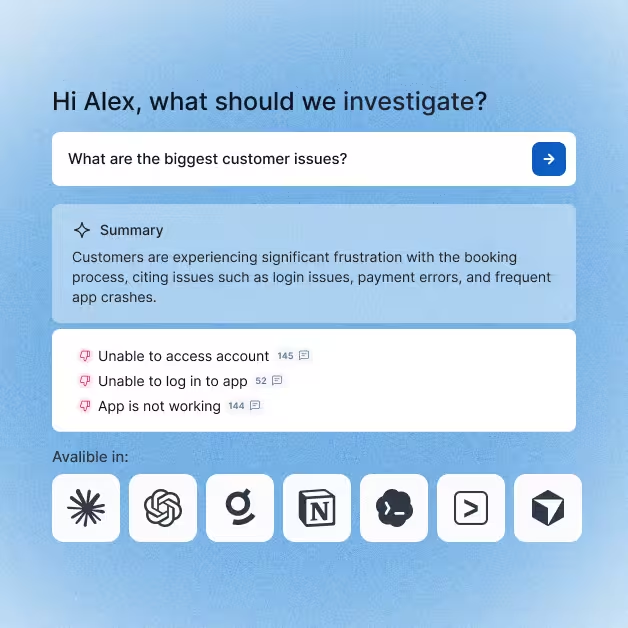
Our Aspect-Based Sentiment Analysis keeps accuracy high on messy, mixed-topic feedback where rule-based tools lose the signal. Every insight is evidence-backed, so you can trace a theme to the exact conversations behind it. We measure the impact of that feedback on NPS, CSAT, and CES, and alert teams the moment sentiment shifts.
This is our Customer Experience Intelligence platform in practice, powered by AI-driven customer feedback analytics across every source. And with our MCP server, teams can query and act on feedback directly inside AI agents, bringing customer intelligence into the agentic era. For a wider view of the market, see our best enterprise VoC platforms guide.
In Practice — How Qonto Strengthens Its Voice Of Customer Strategy With Conversation Analytics
Consider a real-world example. Qonto uses Chattermill to bring speech and conversation analytics into its Voice of the Customer strategy.
Rather than listening through surveys alone, Qonto analyzes the content of actual customer conversations. It is a practical illustration of the approach at work: turning what customers really say into insight the business can act on.
The Next Step For Your VoC Strategy
The move from survey-only listening to AI VoC is a move from waiting for scores to acting on evidence. You capture more of what customers say, in real time, and you can trust and trace every insight it produces.
That is the future of customer listening, and it is available today. Book a demo to see how Chattermill turns feedback from every channel into decisions you can stand behind.
Frequently Asked Questions
What Is AI VoC?
AI VoC is the practice of using AI to analyze customer feedback from every channel, including surveys, tickets, reviews, chat, and calls. It automatically surfaces themes, sentiment, and intent, giving teams a real-time view of what customers actually think.
How Is AI VoC Different From Traditional VoC?
Traditional VoC relies on structured survey responses and periodic scores. AI VoC reads unstructured feedback from every channel in real time, discovers themes without a predefined taxonomy, and traces each insight back to the conversations that drove it.
What Data Does An AI VoC Platform Analyze?
An AI VoC platform analyzes unstructured feedback from many sources: surveys, support tickets, product reviews, chat logs, social posts, and call transcripts. It transcribes voice and normalizes multiple languages so all of it can be analyzed together.
Does AI VoC Replace Surveys?
No. Surveys still provide useful structured benchmarks. AI VoC complements them by capturing the far larger volume of feedback customers leave outside surveys, so you are not limited to the small fraction of people who reply.
What Is An AI-Native VoC Platform?
An AI-native VoC platform is built around language models from the ground up, not a survey tool with AI added on. It ingests every channel, classifies feedback in real time, discovers themes without a fixed taxonomy, and grounds insights in source evidence.
How Do You Know AI VoC Insights Are Accurate And Trustworthy?
Accuracy comes from aspect-based sentiment analysis, which scores each topic in a comment separately instead of averaging it into one blurred score. Trust comes from evidence traceability: every insight links back to the specific verbatims behind it, so nothing is a black box.
Why Is AI VoC Important Right Now?
AI adoption in customer service is now mainstream, with 66% of service organizations using at least one AI agent, per Salesforce. Unstructured feedback keeps growing, survey response rates keep falling, and measurement frameworks still lag, making rigorous AI VoC a timely advantage.



See Chattermill in action on your own feedback
Book a demo


