


Chattermill vs Survicate: Which Feedback Analytics Platform Fits Your Team?



The CX intelligence
platform that's AI-native by design
Book a demoMost teams start their feedback journey the same way: pick a survey tool, collect responses, read through them manually. It works until it doesn't. The moment feedback volume crosses a threshold — multiple channels, multiple languages, thousands of responses a week — that approach collapses. Chattermill and Survicate both address this problem, but from fundamentally different starting points. Chattermill is an AI-native analytics platform built to unify and analyze feedback from every channel at enterprise scale. Survicate is a feedback collection and analysis platform designed to help teams build survey programs and extract insights from the responses. This guide breaks down where each platform excels, where it falls short, and which one fits your team's specific needs.
Quick Summary
- Core approach: Chattermill analyzes feedback from every source with deep AI (ABSA, driver analysis, anomaly detection). Survicate collects feedback through multichannel surveys and layers AI-assisted analysis on top.
- Analytical depth: Chattermill uses Lyra AI for aspect-based sentiment analysis, phrasal analysis, and deep learning theme detection across 99+ languages. Survicate offers AI Research Assistant and auto-generated topics for theme discovery across survey data.
- Scale: Chattermill handles millions of feedback data points from 90+ integrations with no volume caps. Survicate's plans include response limits (250/mo on Growth, custom pools on Pro and Enterprise).
- Social and speech analytics: Chattermill natively analyzes Facebook, Instagram, TikTok, X, YouTube, and Reddit mentions plus call recordings. Survicate does not offer social CX or speech analytics.
- Reviews (G2, Capterra, Gartner Peer Insights — verified June 2026): Chattermill holds 4.5/5 across G2 (237 reviews), Capterra (25 reviews), and Gartner (93 reviews) — 355 total. Survicate holds 4.6/5 across G2 (208 reviews), Capterra (99 reviews), and Gartner (39 reviews) — 346 total.
- Pricing: Chattermill uses custom pricing based on feedback volume and feature requirements. Survicate offers transparent tiers: Free, Growth from $114/mo, Pro from $349/mo, Enterprise from $569/mo (annual billing).
- Best for: Chattermill suits enterprise CX, insights, and product teams that need deep, cross-channel feedback analytics with anomaly detection and business metric impact analysis. Survicate suits teams that need to build and scale a survey-driven feedback program with accessible pricing and a growing AI analysis layer.
Why Listen to Us
Chattermill's platform processes millions of feedback data points for enterprise CX teams at organisations like HelloFresh, Booking.com, Amazon, Uber, and H&M. This guide draws on that operational depth to offer a fair, detailed comparison across capabilities, pricing, reviews, and use cases — covering everything from AI analysis and integrations to social CX analytics and security.
What Is Survicate?
Survicate is a customer feedback platform that combines survey creation, distribution, and AI-assisted theme detection and natural language querying. The platform helps teams deploy surveys across websites, in-app experiences, email, links, and mobile SDKs — then centralise responses in a single dashboard. Since its founding in Warsaw, Survicate reports serving over 2,000 digital businesses (per survicate.com), with customers including Spotify, Bolt, Automattic, Activision, Vercel, and Amplitude.
Survicate's product has evolved significantly beyond its origins as a pure survey tool. Its Research Hub now serves as a research repository that unifies surveys, support tickets, call recordings, and reviews into a queryable knowledge base. The AI Research Assistant lets teams ask natural language questions across all their feedback data, while auto-generated topics automatically categorise responses into themes like user experience, technical issues, and feature requests.
The platform also includes automated flows that sync feedback data with CRMs and trigger follow-up campaigns, automatic enrichment that appends CRM and product data to survey responses, multilingual survey translation, and a recently launched transcriptions feature for processing call recordings. Survicate's pricing is transparent and self-serve, with a free tier and paid plans starting at $114/month — making it accessible to teams that aren't ready for enterprise-level commitments.
How Does Survicate Compare to Chattermill?
The core distinction sits at the level of analytical architecture. Survicate starts with collection — surveys deployed across channels — and layers AI analysis on top of that survey data. Chattermill starts with analysis — ingesting feedback from every channel (surveys, support tickets, reviews, social media, call recordings) and applying deep learning to surface patterns that manual review or basic categorisation would miss. Both platforms now offer AI-driven theme detection, but the depth, scope, and automation differ considerably. So the real question isn't which platform is "better" — it's which analytical model matches how your team actually works with feedback?
Head-to-Head Comparison Table: Chattermill vs Survicate
| Dimension | Chattermill | Survicate |
|---|---|---|
| Core Strength | Deep AI analytics across all feedback channels | Multichannel survey collection + AI-assisted analysis |
| Native Integrations | 90+ (Zendesk, Salesforce, Intercom, Slack, and more) | 25+ (HubSpot, Intercom, Segment, and more) |
| Multilingual Support | Native analysis in 99+ languages | Multilingual survey translation |
| Sentiment Analysis | Aspect-based sentiment analysis (ABSA) with phrasal granularity | Theme-level sentiment via auto-generated topics |
| Feedback Response / Close-the-Loop | Anomaly alerts, automated routing, driver analysis | Automated flows, CRM syncs, campaign triggers |
| Speech Analytics | Native call recording analysis | Transcriptions feature (survey-focused) |
| Social CX Analytics | Facebook, Instagram, TikTok, X, YouTube, Reddit + competitor benchmarking | Not available |
| AI Agent Integration | MCP server for querying feedback data inside AI agents | Not available |
| G2 Rating / Reviews | ||
| Notable Customers | HelloFresh, Booking.com, Amazon, Uber, H&M | Spotify, Bolt, Automattic, Activision, Vercel, Amplitude |
| Best For | Enterprise CX/insights teams needing cross-channel deep analytics | Teams building scalable survey programs with growing analytics needs |
| Pricing | Custom (volume-based) | Free; Growth $114/mo; Pro $349/mo; Enterprise $569/mo |
Chattermill Review
Overview
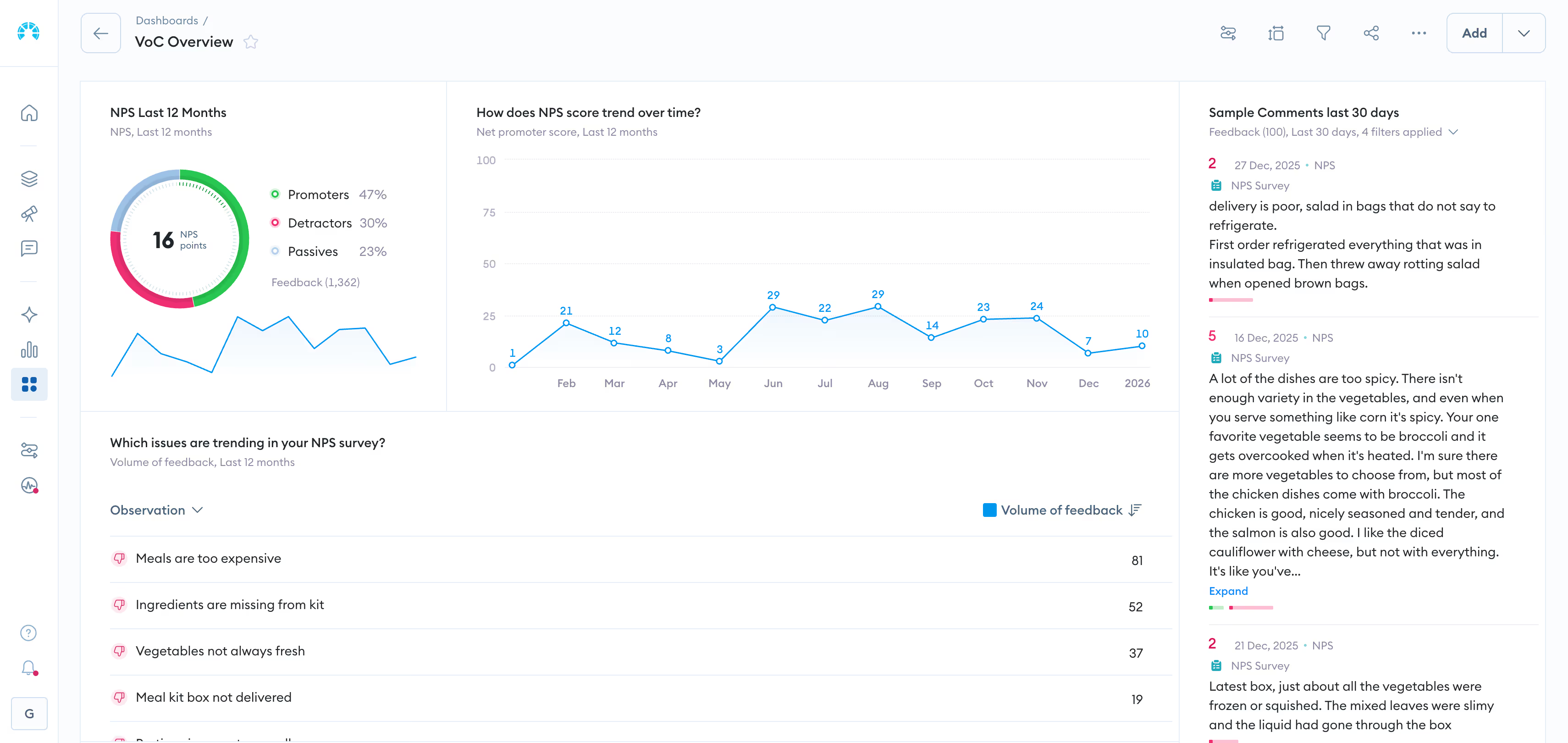
Chattermill is an AI-native feedback analytics platform that unifies data from surveys, support tickets, reviews, social media, and call recordings into a single analytical layer. Rather than requiring teams to build separate analysis workflows for each feedback channel, the platform consolidates everything and applies deep learning models to surface themes, sentiment, anomalies, and business drivers automatically.
The platform's analytical engine, Lyra AI, goes beyond standard topic categorisation. It uses aspect-based sentiment analysis (ABSA) to identify sentiment at the concept level — not just "customers are unhappy about delivery" but "customers are unhappy about delivery speed specifically when orders exceed two items." Phrasal analysis and deep learning theme detection add further granularity, while anomaly alerting flags statistically significant shifts in sentiment before they become visible in aggregate metrics.
For teams that need to connect feedback patterns to business outcomes, Chattermill offers driver and impact analysis that ties theme-level sentiment directly to NPS, CSAT, and CES movements. The Ask Lyra and AI CoPilot features let analysts query feedback data in natural language and generate evidence-backed reports, while the MCP server extends this capability into AI agent workflows — a differentiator with no direct equivalent in the market.
Chattermill Features
- Lyra AI with ABSA: Aspect-based sentiment analysis that detects sentiment at the phrase and concept level, not just the topic level
- Deep learning theme detection: Automatically identifies and clusters feedback themes using neural networks rather than keyword matching
- Anomaly alerting: Flags statistically significant shifts in sentiment or volume with automated notifications to relevant teams
- Driver and impact analysis: Connects feedback themes directly to business metrics (NPS, CSAT, CES) to show what's actually moving the numbers
- Ask Lyra + AI CoPilot: Natural language interface for querying feedback data and generating evidence-backed reports
- Social CX analytics: Native analysis of mentions and sentiment across Facebook, Instagram, TikTok, X, YouTube, and Reddit — with competitor benchmarking
- Speech analytics: Processes and analyses call recordings alongside all other feedback channels
- MCP server: Enables AI agents to query and act on customer feedback data programmatically
- 90+ integrations: Connects with Zendesk, Salesforce, Intercom, Slack, Qualtrics, and dozens more
2026 Pricing
Chattermill uses custom pricing based on feedback volume and feature requirements — contact the team for a tailored quote.
Chattermill Pros
- Deep analytical granularity with ABSA and phrasal-level sentiment — goes well beyond topic-level categorisation
- Genuine cross-channel unification: surveys, support tickets, reviews, social media, and calls analysed in one platform
- Anomaly detection catches sentiment shifts before they surface in aggregate reporting
- Driver analysis directly links feedback themes to NPS, CSAT, and CES impact
- Social CX analytics with competitor benchmarking fills a gap most feedback platforms ignore entirely
- MCP server enables feedback data to flow into AI agent workflows — a unique differentiator
Chattermill Cons
- No survey creation or distribution tools — teams need a separate tool (or existing stack) for feedback collection
- Custom pricing with no self-serve tier means longer procurement cycles for smaller teams
- The depth of configuration and analysis may exceed what leaner teams need day-to-day
- Capterra review volume (25 reviews) is relatively low compared to Survicate's 99 reviews on the same platform
Who It's For
Enterprise CX, insights, and product teams that need to analyse high-volume, multi-channel feedback with deep AI and connect those insights to measurable business outcomes.
G2 Rating
Chattermill holds a 4.5/5 rating on G2 (237 reviews), a 4.5/5 on Capterra (25 reviews), and a 4.5/5 on Gartner Peer Insights (93 reviews) — totalling 355 verified reviews across platforms. Reviewers consistently highlight the platform's analytical depth, theme detection accuracy, and the quality of customer success support.
Survicate Review

Overview
Survicate is a customer feedback platform built around multichannel survey deployment and AI-assisted analysis. The platform lets teams create, distribute, and analyse surveys across websites, in-app experiences, email, links, and mobile SDKs — then consolidate responses with other feedback sources in its Research Hub.
Since its early days as a focused survey tool, Survicate has expanded meaningfully. The Research Hub now functions as an AI research repository that combines survey data with support tickets, call recordings, and reviews. This evolution positions Survicate as more than a survey builder, though its analytical depth still centres on data collected through its own survey infrastructure rather than ingesting unsolicited feedback at scale from external channels.
The platform serves over 2,000 businesses, including recognisable names like Spotify, Bolt, and Activision. Its transparent, self-serve pricing — with a free tier and paid plans starting at $114/month — makes it one of the more accessible feedback platforms for teams that want to start collecting and analysing survey data without a lengthy enterprise procurement process.
Survicate Features
- Customer surveys: Multichannel deployment across website, in-app, email, link, and mobile SDK with advanced survey logic
- Research Hub: Repository unifying surveys, support tickets, call recordings, and reviews into a queryable knowledge base with natural language querying and auto-generated topic categorisation
- AI Research Assistant: Natural language querying across all feedback data for cross-survey theme discovery
- Feedback analytics with auto-generated topics: Automatic categorisation of responses into themes (user experience, technical issues, feature requests)
- Automated flows: Workflow automations that sync feedback with CRMs, trigger campaigns, and enrich customer profiles
- Automatic enrichment: CRM and product data appended to survey responses for deeper segmentation
- Transcriptions: Recently launched feature for processing call recordings (survey-focused)
- Multilingual survey translation: Surveys deployed in multiple languages
2026 Pricing
Survicate offers four tiers: Free (limited features), Growth from $114/mo, Pro from $349/mo, and Enterprise from $569/mo — all on annual billing, with response and data point limits that scale by plan.
Survicate Pros
- Transparent, self-serve pricing with a free tier removes procurement barriers for smaller teams
- Intuitive survey builder with strong multichannel deployment options (website, in-app, email, mobile SDK)
- Research Hub adds meaningful analytical capability beyond basic survey reporting
- Strong integrations with HubSpot and Intercom for close-the-loop workflows
- Quick onboarding — reviewers frequently cite speed of deployment as a standout strength
- Recognised customers (Spotify, Bolt, Activision) demonstrate credibility beyond the SMB segment
Survicate Cons
- Response and data point limits on all plans can become constraining at higher volumes
- No native analysis of unsolicited feedback sources (social media, review sites) at scale
- No aspect-based sentiment analysis — theme-level categorisation lacks the granularity of ABSA
- No social CX analytics or competitor benchmarking
- Multiple reviewers cite audience targeting issues (surveys appearing in wrong language or on wrong pages)
- No anomaly detection or proactive alerting when sentiment shifts
Who It's For
Teams that need to build and scale a survey-driven feedback program with accessible pricing, strong survey tooling, and a growing AI analysis layer — particularly when feedback collection is the primary gap to fill.
G2 Rating
Survicate holds a 4.6/5 rating on G2 (208 reviews), a 4.6/5 on Capterra (99 reviews), and a 4.6/5 on Gartner Peer Insights (39 reviews) — totalling 346 verified reviews across platforms. Reviewers frequently praise the platform's ease of use, responsive support team, and intuitive survey builder.
Who Should Use Survicate?
Survicate is a strong fit for teams where feedback collection is the primary challenge — and where the analytical needs centre on understanding survey responses rather than unifying feedback from dozens of unsolicited channels.
- You need to build a survey program from scratch. Survicate's multichannel survey tools (website, in-app, email, mobile SDK) cover the full collection workflow with an intuitive builder.
- Your team operates on a fixed, transparent budget. Self-serve pricing starting at $114/month with a free tier means no procurement bottleneck.
- Survey data is your primary feedback source. If most of your customer insights come from NPS, CSAT, or product surveys, Survicate's Research Hub and AI Research Assistant provide solid analytical tools.
- You want CRM-integrated feedback workflows. Automated flows with HubSpot, Intercom, and other CRMs make it straightforward to close the loop on individual responses.
- Your analytical needs are theme-level, not aspect-level. Auto-generated topics and the AI Research Assistant handle categorisation and trend identification well for survey-focused programs.
- You need quick deployment. Survicate's onboarding is consistently cited as fast in user reviews — teams can start collecting feedback within days.
If your feedback program is primarily survey-driven and your team needs accessible tooling to collect, categorise, and act on responses, Survicate delivers clear value. The platform's evolution with Research Hub and the AI Research Assistant makes it more capable than a pure survey tool, though teams with enterprise-scale, multi-channel analytics requirements will likely need a dedicated analytics layer.
Who Should Use Chattermill?
Chattermill fits teams where the challenge isn't collecting feedback — it's making sense of the feedback they already have. When data flows in from surveys, support tickets, reviews, social media, and call recordings across multiple languages, the analytical gap becomes the bottleneck. That's where Chattermill's architecture is designed to operate.
- You receive feedback from five or more channels. Chattermill unifies surveys, support tickets, review sites, social media, and call recordings into a single analytical layer — no separate tools or manual aggregation required.
- Your team needs aspect-level sentiment, not just topic tags. Lyra AI's ABSA identifies sentiment at the concept level ("delivery speed when orders exceed two items"), not just the category level ("delivery").
- You operate across multiple markets and languages. Native analysis across 99+ languages means no translation layer, no accuracy loss, and no separate workflows per region.
- You need to connect feedback to NPS, CSAT, or CES movements. Driver and impact analysis shows exactly which themes are moving your key metrics — critical for prioritising product and CX investments.
- Anomaly detection matters more than scheduled reporting. Proactive alerts flag sentiment shifts in real-time, before they show up in monthly dashboards. Enterprise teams use anomaly detection to catch emerging issues before they surface in monthly reporting.
- Your AI stack needs access to feedback data. The Chattermill MCP server lets AI agents query and act on customer feedback programmatically — a capability with no equivalent in Survicate or most competing platforms.
- You need social CX analytics with competitor benchmarking. Native analysis across Facebook, Instagram, TikTok, X, YouTube, and Reddit — with the ability to benchmark sentiment against competitors — fills a gap that standalone survey tools cannot address.
If your team is ready to move from collecting feedback to systematically analysing it at scale, Chattermill provides the analytical depth, automation, and cross-channel coverage that enterprise CX programs require.
Choosing the Right Feedback Analytics Platform
The right platform depends on where your team sits in its feedback maturity and what specific problems you need to solve. Here's a framework for evaluating the decision.
Feedback Volume and Channels. Start with a practical inventory: how many feedback sources do you have, and how many data points flow through them monthly? If your feedback lives primarily in surveys you control, Survicate's collection-first model covers it well. If you also need to analyse support tickets, review sites, social mentions, and call recordings, you need a platform built for that scope — and that's Chattermill's core architecture.
Language Requirements. Teams operating in a single language can use either platform effectively. Multilingual operations face a different calculation. Survicate offers multilingual survey translation, which solves the collection side. Chattermill analyses feedback natively in 99+ languages without a translation step, which matters when you need accurate sentiment analysis — not just translated text — across markets.
Analysis Depth. Theme-level categorisation ("customers are talking about delivery") is sufficient for many use cases. Aspect-based sentiment analysis ("customers are frustrated with delivery speed on multi-item orders, but satisfied with delivery communication") enables a different class of decision-making. Evaluate honestly which level your team needs today and in 12 months.
Team Structure. Consider who will use the platform daily. Survicate's intuitive builder and transparent pricing make it accessible for marketing teams, product managers, and customer success leads who need to deploy surveys and review results. Chattermill's depth is designed for dedicated CX, insights, and analytics teams that will build dashboards, configure alerts, and run cross-channel analysis as a core part of their workflow.
Automation Goals. Both platforms offer automation, but the type differs. Survicate's automated flows focus on closing the loop — syncing responses to CRMs and triggering follow-up campaigns. Chattermill's automation centres on detection — surfacing anomalies, flagging emerging themes, and delivering proactive alerts that prevent issues from escalating.
Enterprise Validation. Review the customer logos and use cases that match your industry and scale. Chattermill's enterprise roster (HelloFresh, Booking.com, Amazon, Uber, H&M) signals proven performance at high volume and complexity. Survicate's customer base (Spotify, Bolt, Activision, Vercel) demonstrates breadth across tech and digital businesses with a range of team sizes.
Security and Compliance. Enterprise procurement requires more than features — it requires security posture. Evaluate SOC 2 compliance, data residency options, SSO capabilities, and access controls. Survicate offers SAML SSO and access logs on its Enterprise plan. Chattermill's security and compliance framework is tailored to enterprise requirements at scale.
Get Started With Chattermill
If your team is dealing with feedback from multiple channels and languages, and you need the analytical depth to connect customer sentiment to business outcomes, Chattermill is built for that challenge. The platform's combination of ABSA, anomaly detection, social CX analytics, and AI agent integration gives enterprise CX teams the precision and automation they need to act on feedback — not just read it.
Book a personalised demo to see how Chattermill analyses your feedback data and surfaces the insights your team needs to prioritise what matters most.
Feedback Analytics Platforms: FAQs
What Is the Main Difference Between Chattermill and Survicate?
Chattermill is an AI-native analytics platform that ingests feedback from every channel (surveys, support tickets, reviews, social media, call recordings) and applies aspect-based sentiment analysis, anomaly detection, and driver analysis to surface deep insights. Survicate is a feedback collection platform with a growing analytics layer — it excels at multichannel survey deployment and offers AI-assisted theme detection through its Research Hub and AI Research Assistant. The core distinction: Chattermill specialises in analysing feedback at scale, while Survicate specialises in collecting it.
Is Survicate Good for Enterprise Teams?
Survicate serves enterprise customers including Spotify, Bolt, and Activision, and its Enterprise plan (from $569/month) includes SAML SSO, access logs, and a dedicated customer success manager. However, its analytical capabilities centre on survey data rather than cross-channel feedback unification. Enterprise teams with high feedback volume across multiple channels and languages may find Survicate's response limits and theme-level analysis insufficient compared to platforms purpose-built for enterprise-scale feedback analytics.
How Do Chattermill and Survicate Compare on Pricing?
Survicate offers transparent, self-serve pricing: Free, Growth from $114/month, Pro from $349/month, and Enterprise from $569/month (annual billing). All plans include unlimited surveys and Research Hub access, with response and data point limits that scale by tier. Chattermill uses custom pricing based on feedback volume and feature requirements, with no published tiers or self-serve option. Survicate's model suits teams with predictable budgets; Chattermill's model suits enterprises that need pricing scaled to their specific data volume and analytical needs.
Can Survicate Replace a Full VoC Platform?
Survicate's Research Hub, AI Research Assistant, and automated flows bring it closer to a VoC platform than a pure survey tool. It can unify surveys, support tickets, call recordings, and reviews in a single repository. However, it lacks native social CX analytics, aspect-based sentiment analysis, anomaly detection, driver/impact analysis, and speech analytics — capabilities that full VoC platforms like Chattermill provide. For teams whose feedback program is primarily survey-driven, Survicate may be sufficient. For teams that need cross-channel analytics at enterprise depth, a dedicated VoC platform remains necessary.
What Are the G2, Capterra, and Gartner Ratings for Each Platform?
Chattermill holds a 4.5/5 on G2 (237 reviews), 4.5/5 on Capterra (25 reviews), and 4.5/5 on Gartner Peer Insights (93 reviews) — 355 total verified reviews. Survicate holds a 4.6/5 on G2 (208 reviews), 4.6/5 on Capterra (99 reviews), and 4.6/5 on Gartner Peer Insights (39 reviews) — 346 total verified reviews. Both platforms are well-reviewed, with Survicate scoring slightly higher on ratings and Chattermill holding a slight edge on total review volume.
Does Chattermill Offer Social Media and Speech Analytics?
Yes. Chattermill provides native social CX analytics covering Facebook, Instagram, TikTok, X, YouTube, and Reddit — including competitor sentiment benchmarking across those channels. The platform also offers speech analytics that processes call recordings alongside all other feedback sources. Survicate does not offer social CX analytics, and its recently launched transcriptions feature is focused on survey-adjacent call recordings rather than full speech analytics.



See Chattermill in action on your own feedback
Book a demo


