


What to Include in a Customer Feedback Analytics RFP: 7 Requirements to Include


The CX intelligence
platform that's AI-native by design
Book a demoA customer feedback analytics RFP should score testable requirements, not tick a feature checklist. Your voice of the customer program is only as strong as the platform behind it. Before you compare the best voice of the customer tools, decide what evidence you will score. Here are the seven requirements that separate a platform you can trust from one that only demos well.
The Short Version
Score each requirement against evidence a vendor can produce on your data, not a claim on a slide. Use this table as your skim layer.
| Requirement | Evidence to require |
|---|---|
| Measurable accuracy | Precision, recall, and F1 from a benchmark run on your own feedback, not one marketing accuracy figure. |
| Traceable themes | Every theme, score, and summary links to the exact verbatims, with LLM summaries citing source comments. |
| Editable taxonomy | A no-code demo where your team merges, splits, or renames a theme live, with no retrain or consultant. |
| One taxonomy across sources | Two different sources resolving to the same theme, so "billing problem" means one thing everywhere. |
| Themes tied to metrics | A view showing which themes move NPS, CSAT, or CES, not just frequency counts. |
| Open connectors and API | Native source and BI connectors, warehouse read/write, and an open API you can test. |
| Security, portability, and AI governance | SOC 2 Type II, GDPR, SSO, RBAC, open-format export with certified deletion, plus NIST AI RMF and ISO/IEC 42001 mapping. |
Why Listen to Us
Chattermill is a Customer Experience Intelligence platform that unifies feedback from every channel into one place for CX, insights, and product teams. We consolidate, tag, and analyze multi-source, multi-language feedback, then measure its impact on NPS, CSAT, and CES. Our proprietary Lyra AI model is built for customer experience intelligence, and our Aspect-Based Sentiment Analysis holds accuracy on messy, mixed-topic feedback. With the Chattermill MCP server, teams query and act on feedback data directly inside AI agents.

Require Measurable Accuracy on Your Own Feedback
Most vendors lead with one number: "95% accurate." It looks reassuring on a slide and tells you almost nothing.
Accuracy alone hides errors when your feedback is class-imbalanced, which it almost always is. If 90% of comments are neutral, a model can score 90% accuracy by ignoring the negatives you most need to catch. That gap is why text analytics platforms keep misclassifying feedback.
Require three figures instead, measured on a labeled sample of your own feedback: precision, recall, and F1. F1 balances precision and recall, so the majority class cannot inflate it. That is established evaluation practice, not a vendor metric.
Set a realistic bar. Human annotators agree on sentiment only about 80% of the time, an industry benchmark noted by LabelYourData (January 2026). A model that scores near that range is already near human level, so treat a claim of 99% accuracy as a red flag.
This is where Chattermill's Aspect-Based Sentiment Analysis earns its keep. Scoring sentiment at the aspect level keeps signal on mixed-topic comments where per-comment or rule-based methods blur it.
Insist That Every Theme Traces Back to the Raw Comments
A theme is only as trustworthy as your ability to check it. If a platform reports "shipping complaints up 30%" but cannot show you the comments behind it, you are trusting a black box.
Require every theme, score, and summary to link back to the exact verbatims. When the platform uses an LLM to summarize, require it to cite the source comments so a hallucinated insight cannot slip into a board deck.
This is not just hygiene; it is the direction of AI governance. The NIST AI Risk Management Framework names "explainable and interpretable" and "accountable and transparent" as trustworthiness characteristics, per IS Partners (May 2026).
Unverifiable AI summaries create real risk when executives act on content no one can trace. Comment-level evidence is how you avoid that. Good text analytics puts that evidence one click away.
Demand an Editable, Governed Taxonomy
Your themes will be wrong on day one. Categories drift, new issues emerge, and a launch creates language no model has seen. The question is who fixes it, and how fast.
Require a no-code, governed taxonomy your own team can edit. You should be able to merge, split, rename, and refine themes without a consultant, a support ticket, or a full model retrain. Keep a human in the loop so changes stay deliberate.
Test it live. In the demo, hand the vendor a miscategorized theme from your data and ask them to fix it on the spot. If the answer is "our services team will handle that next sprint," you have found a bottleneck you will feel every quarter.
Require One Consistent Taxonomy Across Every Source
Feedback arrives from surveys, support tickets, reviews, app stores, calls, chat, and social. If each source has its own tagging scheme, "billing problem" means one thing in tickets and something else in reviews. You cannot add up what you cannot compare.
Require one consistent taxonomy that every source resolves into. A billing complaint should map to the same theme whether it arrives by survey or by chat transcript.
Test it directly. Ask the vendor to show two different sources resolving to a single theme in one view. This is the foundation of customer feedback analytics that leaders can trust, and it is core to how Chattermill unifies channels.
Connect Themes to the Metrics You Already Report
A word cloud tells you what customers mention. It does not tell you what is costing you loyalty. Frequency and impact are different things, and confusing them wastes roadmap time.
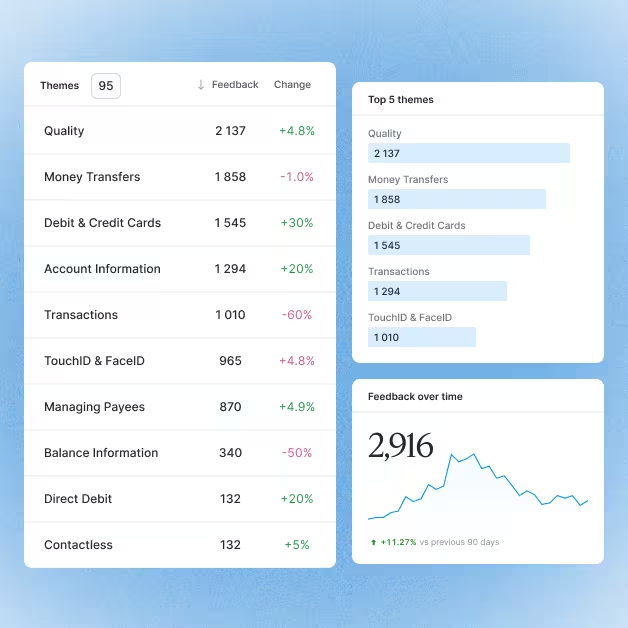
Require the platform to connect themes to the metrics you already report: NPS, CSAT, and CES. The right view shows which themes move the score, not just which appear most often. A low-volume theme that drags NPS can matter more than a high-volume one that does not.
Chattermill measures the impact of feedback on NPS, CSAT, and CES directly. That connection is also how you measure the ROI of a text analytics platform, so teams prioritize by business outcome rather than by mention count.
Check the Connectors and Open API for Your Stack
Your customer feedback analytics software is one node in a larger stack. If it cannot read from your sources and write to where your team already works, insights stay trapped.
Require native connectors to your feedback sources and BI tools, plus read and write access to your warehouse: Snowflake, BigQuery, or Databricks. Require an open API you can test during evaluation, not a roadmap promise.
Look ahead, too. With the Chattermill MCP server, teams can query and act on feedback data directly inside AI agents. That matters as more work moves into the agentic era.
Require Enterprise Security, Data Portability, and AI Governance
Enterprise security is table stakes, but data portability and AI governance now sit in the same conversation. Buyers who defer all three to legal redlines lose the chance to score them.
Require the essentials up front: SOC 2 Type II, GDPR compliance, data residency options, SSO, role-based access control, and audit logging.
Then ask the awkward question before you sign: how do we leave? Require documented export of all raw feedback, themes, and metadata in an open format, within a defined window, with no egress fees. Require certified deletion when the contract ends.
The principle is simple: you own your data and your taxonomy, not the vendor. Put it in the RFP so it is priced and agreed up front, not negotiated under pressure later.
Finally, ask how the vendor maps to emerging AI standards. The NIST AI RMF is voluntary but increasingly covered in audits for explainability and transparency, per IS Partners (May 2026). ISO/IEC 42001 is the first certifiable AI management system standard, per Konfirmity (July 2026), requiring documented transparency and lifecycle risk assessment. Score these answers in the RFP; do not defer them.
How to Score a Customer Feedback Analytics RFP You Can Run
A list of requirements is not an RFP. To make it one, turn each requirement into a scored line item with a weight and a defined piece of evidence that clears it. For structure, this guide to writing an RFP is a useful starting point. If you are still building the shortlist, scan the customer feedback analysis tools on the market first, then bring the strongest into this scorecard.
Start by splitting the seven into must-haves and nice-to-haves for your context. A regulated enterprise may treat governance as a must-have; a fast-moving team may weight integrations higher. Assign weights that sum to 100 so no single vendor demo can skew the total.
Then define, per requirement, the evidence that earns the points. Vague claims score zero. A benchmark on your data, a live taxonomy edit, or a documented export policy scores full marks.
For a fuller evaluation frame, see what CX leaders should look for in a text analytics platform in 2026. If AI capability is a priority, weigh it against the best AI voice of the customer tools before you finalize weights. Add a mandatory proof-of-value clause, too: the vendor must demonstrate the top requirements on your own feedback before you sign. The scorecard below is a starting template.
| Requirement | Priority | Evidence that clears it |
|---|---|---|
| Measurable accuracy on your data | Must-have | Precision, recall, and F1 from a benchmark on your labeled feedback sample. |
| Comment-level traceability | Must-have | Every theme and summary links to source verbatims in the live demo. |
| Editable, governed taxonomy | Must-have | A no-code theme edit performed live, with no retrain or consultant. |
| One taxonomy across sources | Must-have | Two sources resolving to a single theme in one view. |
| Themes tied to NPS, CSAT, CES | Must-have | A view ranking themes by metric impact, not just frequency. |
| Connectors and open API | Nice-to-have | Working source and BI connectors, warehouse read/write, and a testable API. |
| Security, portability, and AI governance | Must-have | SOC 2 Type II, GDPR, SSO, RBAC, open-format export with certified deletion, plus NIST AI RMF and ISO/IEC 42001 mapping. |
In Practice — How Uber Scaled Trustworthy CX Intelligence Across Five Global Regions
The requirements above are not theoretical. Consider how Uber scaled feedback analytics with Chattermill.
Uber partnered with Chattermill in 2018, starting in Latin America. Over a seven-year partnership, that footprint grew from one region to five global mega-regions. It now serves more than 400 Uber users across CX, Operations, Product, and Support.
At that scale, Uber needed an enterprise-grade platform that could surface global strategic trends and granular local insights at the same time. Chattermill turns large volumes of unstructured feedback into granular, actionable insights. It goes beyond positive and negative tone to identify emerging themes across trip quality, cancellations, pricing, and app usability.
It is a working example of the same principles an RFP should test: unification across regions, traceable insight, and themes specific enough to act on.
Build an RFP That Rewards Proof, Not Polish
The best feedback analytics decisions are not won in the demo. They are won in the evidence a platform can produce on your own data, under your own governance, on your timeline.
Score these seven requirements, weight them for your context, and make proof-of-value a condition of signing. Do that, and you stop buying a tool that demos well. You start choosing a platform you can trust as customer intelligence moves into the agentic era.
Book a Demo to see how Chattermill meets these requirements on your feedback.



See Chattermill in action on your own feedback
Book a demo


