


8 Best Canny Alternatives for Product Feedback (with 2026 pricing)


The CX intelligence
platform that's AI-native by design
Book a demoCanny is a capable feature-voting board, but the best Canny alternatives now split into two camps: like-for-like voting tools and analytics-first platforms that turn all of your customer feedback into insight. This guide compares eight of them so CX and product leaders can pick the right one.
Quick Summary
We reviewed eight canny alternatives across those two buyer paths: like-for-like voting boards and analytics-first platforms. Chattermill is our top pick and the analytics-first choice, because it runs deep text analytics on every piece of customer feedback rather than just counting feature votes. Featurebase is the best like-for-like all-in-one Canny replacement, and Enterpret is the strongest pure AI feedback-analytics alternative.
Below, each tool gets a full breakdown: key features, pros and cons, pricing, G2 rating, and a best-for verdict.
Before we get into the detailed comparisons, here are our top three picks:
Why Listen to Us
Chattermill is an AI-native customer experience intelligence platform used by enterprise CX, insights, and product teams to analyze customer feedback at scale across every channel. It does this with its proprietary Lyra AI model and Aspect-Based Sentiment Analysis (ABSA), and it holds a 4.4/5 G2 rating from roughly 238 reviews. We build feedback-analytics software for a living and publish category research on customer feedback analysis tools, so this comparison reflects hands-on expertise, not a generic roundup.

8 Top Canny Alternatives: Head to Head Comparison
How We Evaluated These Canny Alternatives
Most Canny alternatives are feature-voting boards, so the first question is what job you actually need done. A voting board collects and prioritizes ideas. An analytics platform reads all of your customer feedback and tells you what themes drive NPS, CSAT, and CES. That distinction, deeper text analytics versus feature voting, decides which of these customer feedback analysis tools fits your team.
We weighed each tool against six criteria:
- Analytics depth vs feature voting: whether the tool reads open text at scale or mainly counts upvotes.
- Pricing transparency: published starting price and whether pricing is custom or demo-led.
- Integrations: how easily it connects to your support, product, and survey stack.
- AI / NLP capability: the depth of the underlying model, from dedup to aspect-level sentiment.
- G2 ratings: verified rating and review count, with low-volume profiles flagged.
- Best-fit use case: the team and scenario each tool genuinely suits.
For a wider view of the analytics category, see our guides to feedback analytics alternatives and the best AI voice-of-customer tools.
1. Chattermill
What is Chattermill?
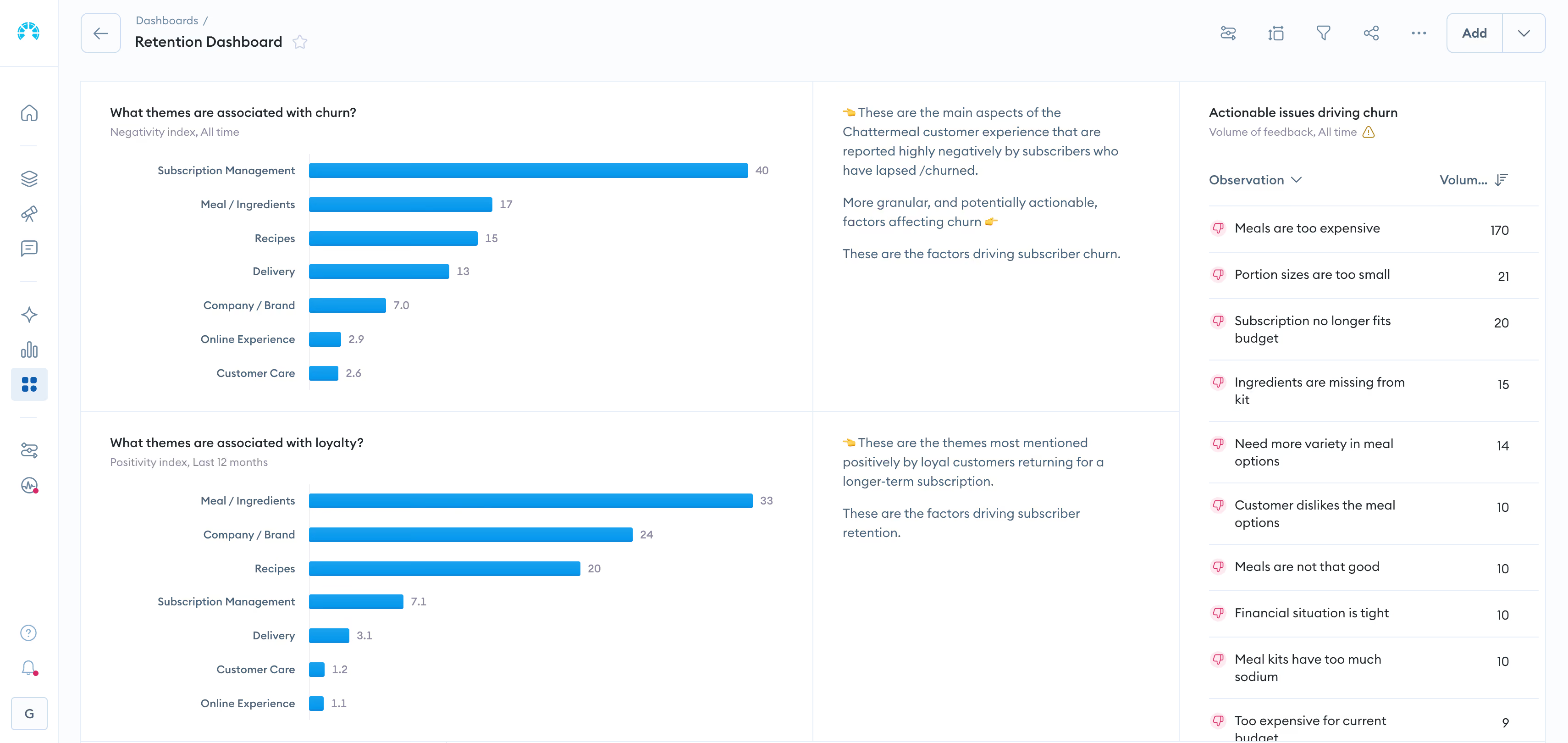
Chattermill is the analytics-first pick on this list, and it works differently from every voting board here. Where Canny counts upvotes on feature requests, Chattermill reads the full text of every piece of customer feedback and scores sentiment at the aspect level. Its Aspect-Based Sentiment Analysis (ABSA) and proprietary Lyra AI unify surveys, reviews, support tickets, social, chat, and calls, then tie the themes it surfaces back to NPS, CSAT, and CES. If you want deeper text analytics instead of just feature voting, this is the Canny comparison that matters most.
Key features
- Aspect-Based Sentiment Analysis (ABSA): sentiment scored per theme within a single response, not one score per comment.
- Lyra AI: a proprietary hybrid NLP engine for clustering, theme detection, and anomaly detection, with an "Ask Lyra" conversational surface.
- Multi-channel unification: feedback from surveys, reviews, support tickets, social, chat, and calls in 100+ languages.
- Social and speech analytics: native coverage of Facebook, Instagram, TikTok, X, YouTube, Reddit, plus call analytics.
- Business-metric ties: themes mapped to NPS, CSAT, and CES, with an MCP server for AI agents.
Pros and cons
Pros:
- Deepest analytical model in this set, with ABSA rather than single-score sentiment.
- Broadest channel coverage, including social and speech.
- Connects sentiment directly to business KPIs.
Cons:
- Enterprise-focused with custom, contact-sales pricing.
- Overkill for teams that only want a simple voting board.
- Requires connecting and maintaining data sources.
Pricing
Custom, contact-sales pricing based on your data sources and feedback volume, with no free tier (demo only). There is no public pricing page.
G2 rating
4.4/5 from roughly 238 reviews.
Best for
Enterprise CX, insights, and product teams that need deep, multi-channel feedback analytics tied to business metrics. Unlike Canny's feature-voting model, Chattermill turns all customer feedback into aspect-level insight through ABSA and Lyra, which is why it leads our analytics-first path. Explore the AI-native CXI platform or book a personalized demo.
2. Featurebase
What is Featurebase?
Featurebase is the closest like-for-like Canny replacement in this guide. It bundles a feedback board, public roadmap, changelog, knowledge base, and a helpdesk into one subscription, so teams can consolidate several tools at once. Its AI focuses on support and feedback organization rather than deep sentiment analytics.
Key features
- Feedback boards with public roadmap voting and in-app widgets.
- Changelog with popups and email notifications, plus auto loop-closing when requests ship.
- AI knowledge base in 40+ languages and the Fibi AI support agent.
- Basic in-app NPS/CSAT through the "Outbound" module (a secondary feature).
- Private boards and user segmentation.
Pros and cons
Pros:
- Broadest all-in-one bundle with a generous free plan.
- Unlimited end-users and multilingual support.
- Good value when it replaces multiple tools.
Cons:
- Per-seat plus per-AI-resolution billing can surprise you.
- AI runs only inside Featurebase, so adopting it means migrating your helpdesk.
- Surveys are a secondary capability.
Pricing
Free plan available. Paid plans start at $29/seat/mo (Growth, billed yearly), plus $0.49 per AI resolution. Higher tiers reach $59 and $99/seat/mo.
G2 rating
4.7/5 from roughly 50 reviews.
Best for
Fast-growing SaaS teams that want to consolidate helpdesk, feedback board, roadmap, changelog, and knowledge base in one subscription.
3. Enterpret
What is Enterpret?
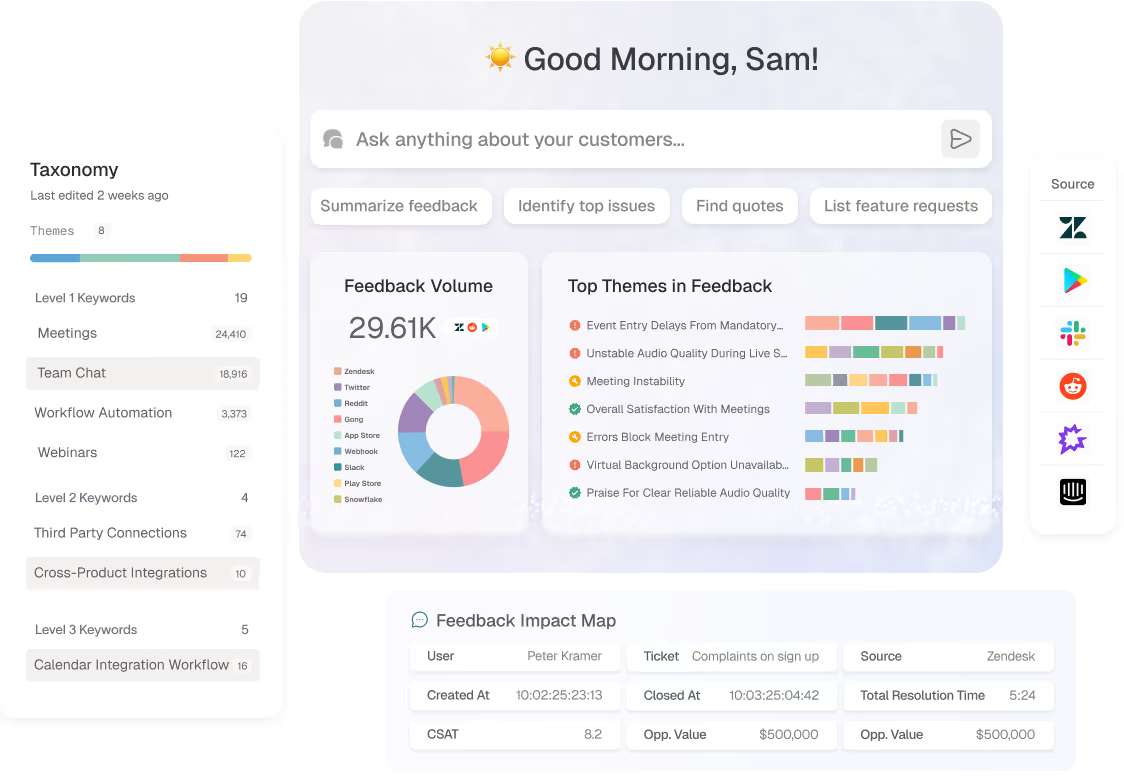
Enterpret is the other analytics-first option here and the strongest pure AI feedback-analytics alternative to Canny. It builds adaptive ML models per customer to auto-tag and categorize open-text feedback, then surfaces themes, trends, and issues. It is the direct competitor already earning citations in this space, and it is worth weighing against Chattermill on analytics depth. For a closer look, see our guide to Enterpret alternatives.
Key features
- Adaptive, custom ML models tuned per customer.
- Auto-tagging and categorization of open-text feedback.
- Theme, trend, and issue discovery with sentiment analysis.
- Customizable dashboards and natural-language queries.
- API-first design.
Pros and cons
Pros:
- Accurate AI tagging of open-text feedback.
- Strong analytics, filters, and natural-language queries.
- Consolidates many feedback sources.
Cons:
- Higher price point.
- Onboarding can take time.
- The UI can feel overwhelming.
Pricing
Custom, quote-based pricing with no public pricing page; you contact sales. Vendr's third-party benchmark puts the median contract at roughly $36,000/year, with a range of about $23,000–$98,000/year.
G2 rating
4.5/5 from roughly 111 reviews.
Best for
Product and CX teams at product-led SaaS companies that need AI analysis of high-volume qualitative feedback. Teams evaluating this tier should also review the enterprise voice-of-customer platforms category.
4. Productboard
What is Productboard?
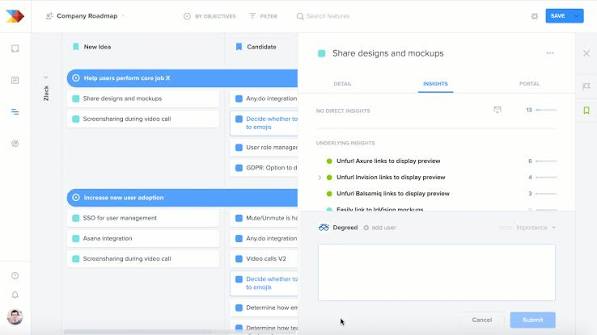
Productboard is a full product-management suite rather than a simple voting board. It centralizes feedback, adds prioritization frameworks and roadmaps, and layers AI synthesis on top. It suits product teams that need strategy and planning tooling, not just a feedback loop.
Key features
- Centralized feedback repository with AI trend surfacing.
- Prioritization frameworks and customizable scoring.
- Timeline and column roadmaps with dependency tracking.
- Spark AI agent that surfaces opportunities with citations and drafts specs.
- Customer-facing portal with a per-"maker" pricing model.
Pros and cons
Pros:
- Deep prioritization and strategy tooling.
- Strong Jira, Slack, and MS Teams integrations.
- Free unlimited viewers and commenters.
Cons:
- Per-maker pricing scales quickly.
- The interface can overwhelm non-PMs.
- AI usage is capped by credits, and the public portal is gated to higher tiers.
Pricing
Free plan plus trial. Entry paid pricing is around $19/maker/mo (billed annually), though tiers are in flux toward a credit-based "Spark" plan.
G2 rating
4.3/5 from roughly 254 reviews.
Best for
Mid-market and enterprise product teams that want a full product-management platform covering strategy, prioritization, roadmaps, and AI-drafted specs.
5. Frill
What is Frill?
Frill is a clean, simple all-in-one feedback board with a roadmap and changelog. It is a popular choice in the canny vs frill matchup because of its polished UX and flat admin pricing. Its AI is light, focused on drafting ideas from support tickets rather than the deep analysis that AI voice-of-customer tools provide.
Key features
- Ideas board with votes, comments, duplicate merging, and tagging.
- Public roadmap with Planned, In Progress, and Completed columns.
- Changelog and announcements with an embeddable widget.
- In-app surveys and a 2D prioritization matrix.
- AI browser extension that drafts ideas from Zendesk, Intercom, and Help Scout tickets.
Pros and cons
Pros:
- Excellent, clean UI and UX.
- Manage everything from the customer-facing page.
- Fast-shipping product team.
Cons:
- Not a full PM platform, with no deep research repository.
- Limited advanced analytics.
- English-only product UI, with some features gated to upgrades.
Pricing
From $25/mo with unlimited admins on every paid tier. A 14-day free trial is available, but there is no permanent free plan.
G2 rating
4.8–4.9/5 from roughly 24 reviews.
Best for
SaaS startups and product-led teams that want a clean, simple all-in-one feedback, roadmap, and changelog portal.
6. UserJot
What is UserJot?
UserJot is a flat-priced, unlimited-user feature-voting board with a generous free tier and a built-in Canny importer. It charges by feature rather than per user, which appeals to bootstrapped teams. It is a lightweight voting tool, not a feedback-analytics platform.
Key features
- Feedback boards with voting and AI duplicate detection as users type.
- Auto-syncing public roadmap.
- AI-drafted changelog with automatic voter notifications when items ship.
- Embeddable widget and a Canny importer.
- Custom branding on paid tiers.
Pros and cons
Pros:
- Very generous free plan with unlimited users and posts.
- Flat pricing that does not scale with your user base.
- Tight feedback, roadmap, and changelog loop.
Cons:
- Very thin third-party review base.
- Lighter on deep analytics and PM features.
- Limited pricing-page detail.
Pricing
Free-forever plan available. Paid plans start at $29/mo (Starter), with Professional at $59/mo. Pricing lives on an on-page anchor rather than a standalone page.
G2 rating
N/A (<10 reviews). The G2 profile exists but is minimally reviewed, so it is not meaningfully rated.
Best for
Bootstrapped and early-stage SaaS teams that want a flat-priced, unlimited-user, Canny-style loop.
7. Sleekplan
What is Sleekplan?
Sleekplan is one of the cheapest full-loop boards, and it stands out by including native NPS and CSAT surveys. It combines feedback boards, a roadmap, a changelog, and surveys in one workspace, with a growing AI feature set. That makes it a budget like-for-like Canny replacement with survey capability built in.
Key features
- Feedback boards with login-free voting and moderation.
- Public roadmap in list and Kanban views.
- Changelog with Markdown, widget, standalone, and iframe options.
- Built-in CSAT, NPS, and custom multi-step surveys.
- "Sleek Intelligence" AI that auto-collects from Intercom, Helpscout, Zendesk, G2, and the App Store.
Pros and cons
Pros:
- One of the cheapest full-loop tools.
- Native NPS/CSAT surveys, which are rare at this price.
- Flexible embedding options.
Cons:
- Slow, inconsistent customer support (a recurring complaint).
- Infrequent product updates.
- Tracked-user caps on lower tiers.
Pricing
Free "Indie" plan plus a 30-day trial. Paid plans start at around $13/mo (Starter, billed annually), with Business around $38/mo.
G2 rating
~4.8/5 from roughly 30 reviews.
Best for
Budget-conscious teams that want a like-for-like Canny replacement plus built-in NPS and CSAT surveys in one workspace.
8. Upvoty
What is Upvoty?
Upvoty is a bare-bones, low-cost feature-voting board aimed at indie teams and solo founders. It is quick to deploy, especially in React, and keeps the core voting experience simple. It offers minimal AI, so it sits firmly on the voting-board side of this comparison.
Key features
- Public and private feature-voting boards.
- Visual roadmap with voting on planned items.
- Changelog with voter notifications.
- Embeddable widget with strong React deployment.
- Anonymous posting, voting, and commenting, plus multi-language support.
Pros and cons
Pros:
- Affordable.
- Very easy and fast to deploy, especially in React.
- Clean core voting experience.
Cons:
- Aged, limited UI per several reviews.
- Per-board and per-project pricing scales awkwardly for multi-product teams.
- No AI.
Pricing
No free plan, but a 14-day trial is available. Entry paid pricing is roughly $15–25/mo, scaling by board and project count.
G2 rating
2.7/5 from 8 reviews. Note that Upvoty's own marketing cites higher figures, but the verified G2 profile shows 2.7/5 across 8 reviews.
Best for
Bootstrapped founders and indie SaaS teams that want a simple, affordable feature-voting board.
Frequently Asked Questions
What are the best alternatives to Canny for customer feedback analysis?
The best alternatives to Canny for customer feedback analysis are Chattermill first, then Enterpret, because both do deep text analytics rather than just feature voting. Chattermill reads all of your feedback across surveys, reviews, tickets, social, and calls, and scores sentiment at the aspect level with ABSA and Lyra. Enterpret is the strong runner-up for AI analysis of high-volume open text. Most other Canny alternatives are voting boards, which is why our customer feedback analysis tools guide separates the two categories.
Is there a Canny alternative that offers deeper text analytics instead of just feature voting?
Yes. Chattermill is the Canny alternative built for deeper text analytics, using Aspect-Based Sentiment Analysis and its Lyra AI model to score sentiment per theme within each response. That means it reads the meaning of mixed, multi-topic feedback instead of counting upvotes, and it ties themes to NPS, CSAT, and CES. Enterpret is the secondary option, with adaptive ML models that auto-tag open-text feedback. See the Chattermill vs Canny breakdown for the full contrast.
What is the cheapest Canny alternative?
Sleekplan is the cheapest full-loop Canny alternative at around $13/mo (billed annually), and it includes native NPS and CSAT surveys. Upvoty is another low-cost option at roughly $15–25/mo, though it offers a more basic feature set and no AI. Both suit small teams that mainly need a voting board.
Is there a free Canny alternative?
Yes. UserJot offers a genuine free-forever plan with unlimited users and posts, making it the most generous free Canny alternative. Featurebase, Productboard, and Sleekplan also offer free tiers, though each caps features or users. Analytics-first platforms like Chattermill and Enterpret are demo-led rather than free.
Do I need a feature-voting board or a feedback-analytics platform?
Choose a feature-voting board if your main goal is collecting and prioritizing feature requests from a defined user base. Choose a feedback-analytics platform if you need to understand why customers feel the way they do across every channel and connect that to NPS, CSAT, and CES. Small teams focused on a public roadmap usually want a board like Featurebase or Sleekplan. Enterprise CX, insights, and product teams that must analyze feedback at scale should choose an analytics platform such as Chattermill.
The Bottom Line on Canny Alternatives
The right Canny alternative depends on the job you need done. For analytics-first teams that want deep text analysis of all customer feedback, Chattermill is our top recommendation, because ABSA and Lyra turn messy, multi-channel feedback into aspect-level insight tied to business metrics. For teams that simply want a like-for-like Canny swap, Featurebase is the best all-in-one board, roadmap, and changelog. To weigh the analytics category in full, compare Chattermill alternatives, or book a personalized demo to see the platform on your own feedback.



See Chattermill in action on your own feedback
Book a demo


