


InMoment Pricing 2026: Costs, Contracts and What Buyers Pay



The CX intelligence
platform that's AI-native by design
Book a demoInMoment Pricing in 2026: What It Costs and What Buyers Actually Pay
Quick Summary
InMoment doesn't publish prices, so every package is quoted after a demo. The quote depends on the products you choose, how much feedback you collect, how many people need access, and how long you sign for. Vendr's data from 38 purchases puts the median contract at $13,488 a year. Implementation and services may also be quoted separately.
Why InMoment's Cost Is So Hard to Pin Down
InMoment's Plans & Packages page lists six specialist product lines, an Integrated CX bundle, and three service models, but none comes with a published price. Instead, what you pay depends on the products you choose, how much feedback you analyze, and the level of support you need.
That helps explain why public pricing figures vary so widely. Vendr reports contracts as low as $5,424 a year, while estimating that larger enterprise deployments can exceed $300,000 annually. These aren't directly comparable prices. A lower-cost contract might cover survey software managed in-house, while a larger one could include surveys, call analytics, review management, and ongoing managed services.
Rather than treating these figures as standard prices, this guide examines InMoment's pricing structure, what buyers report paying, and the implementation fees, services, and contract terms that can affect your total cost.
Why Listen to Us
HelloFresh has used Chattermill to analyze its customer feedback since 2015. Teams at Uber, Footasylum, and E.ON Next run their feedback programs on our platform too. This gives us experience with the requirements enterprise teams need to consider when investing in customer feedback software.
For this guide, we've used InMoment's own product information alongside publicly available contract data and buyer reviews, distinguishing actual prices paid from estimates to help you evaluate the potential costs.

InMoment Pricing at a Glance
How InMoment Prices Its Platform
InMoment sells individual product lines alongside an Integrated CX bundle, but there's no public price for any of them. You pick the products you need, choose how much help you want running them, and your quote is built around those choices.
InMoment's Six Specialist Product Lines
InMoment offers six specialist product lines, each designed for a different team or use case. The products you choose determine which capabilities are included in your quote:
- Customer Feedback Surveys for CX and research teams, with a survey builder, dashboards, text analytics, and case management.
- Conversational Intelligence for contact centers, covering call, chat, and email transcription, conversation summaries, and agent scorecards.
- Reputation Management for marketing teams, with review requests, local listings, competitor analysis, and AI review replies.
- Advanced Analytics & AI for insights teams, including multichannel feedback analysis, journey insights, and impact prediction.
- Digital Listening for product teams, with microsurveys for web, mobile, and chat.
- Employee Feedback Surveys for HR, with the same features as the customer survey product.
Each product line can be a separate part of the contract. Say your CX team buys surveys this year, and your contact center wants call analytics next year. That could mean another line item and another negotiation.
Integrated CX: InMoment's Multi-Product Bundle
Instead of purchasing individual product lines separately, businesses that need multiple capabilities can opt for InMoment's Integrated CX package. InMoment describes it as its "most popular package," designed for brands managing customer experiences across multiple channels.
The potential pricing advantage is that bundling can cost less than purchasing each module separately. Vendr estimates that bundled modules can attract discounts of 10% to 15%. However, InMoment doesn't publish the bundle's price or specify exactly which products are included, so you'll need to confirm both when requesting a quote.
InMoment's Service Models and Professional Support
InMoment offers three service models, each with a different level of support that can affect your total cost:
- Out-of-the-Box, where you get the technology and run it yourself.
- Guided Approach, where InMoment's experts and technical services support your team.
- White-Glove, where InMoment manages the program and helps your team act on the insights.
The support InMoment provides falls into three categories: advisory services for survey and program design, research and data science for specialized projects like linking customer feedback to financial results, and managed program services for ongoing updates to surveys, dashboards, and case management rules.
When reviewing a quote, check which services are included in your chosen model, how much support is covered, and what would cost extra.
What Determines Your InMoment Quote?
According to Vendr, four main factors influence how much you'll pay:
- Response volume: How much customer feedback you collect and analyze each year.
- Users: The number of people who need access to the platform.
- Modules: Which InMoment products you license, either individually or as part of a bundle.
- Contract term: How long you commit to the platform, with multi-year agreements potentially qualifying for lower annual rates.
What Buyers Report Paying for InMoment
To get a clearer picture of InMoment's costs, we can look at actual contract data from Vendr and customer reviews on G2 and Capterra.
Vendr's Contract Data
Vendr, which negotiates software purchases for its customers, reports a median InMoment contract of $13,488 a year. That figure comes from 38 purchases, with a low of $5,424 and a high of $61,752. Vendr last updated the page in February 2026.
Alongside its recorded contract data, Vendr provides pricing estimates for larger deployments. It estimates mid-market and enterprise contracts at $40,000 to over $300,000 a year, and over $500,000 for high-volume or complex deployments. For a mid-market setup handling 50,000 to 150,000 responses with 10 to 20 users, it estimates $80,000 to $180,000 annually.
However, Vendr doesn't specify which modules or services were included in those 38 purchases. If you're planning to combine surveys, call analytics, review management, and managed services, the $13,488 median may be too low to budget against. Vendr's higher estimates may be more relevant to your needs, but your actual cost will depend on what's included in your contract.
G2 and Capterra Ratings on Cost and Value
InMoment rates well overall. It holds 4.7 out of 5 from 319 reviews on G2 and 4.3 out of 5 from 29 reviews on Capterra.
On cost specifically, feedback is mixed. One G2 reviewer described the price as fair and praised InMoment's account managers, but complained that even simple survey or report changes could take months under a managed service arrangement. Other reviewers flagged the platform's cost as a drawback for smaller businesses and noted that additions cost extra.
A more specific complaint comes from a 2-star Capterra review from April 2024, titled "Not worth the price." The reviewer said poorly designed surveys used up more than their contracted deployment hours. They also complained about limited flexibility to change emails and surveys and said they hadn't received the eight hours of monthly management support included in their agreement.
Of course, that's just one customer's experience and may not reflect InMoment's service quality overall. Still, it highlights why buyers should check how many deployment and support hours their contract includes, what counts against those hours, and what happens when they're exhausted.
Implementation, Services, and Contract Terms That Change the Total
The license is only part of what you'll pay. Implementation, additional services, and contract terms can all affect your upfront costs and ongoing InMoment bill.
Implementation Fees
Vendr estimates InMoment implementation at $10,000 to $25,000 for a standard setup, $25,000 to $50,000 for a moderate one, and over $50,000 for complex programs. It puts implementation at 15% to 30% of first-year contract value.
Setup time itself can be short, with G2 reporting an average implementation time of one month. A bigger, multi-module rollout with integrations may take longer.
Given how much implementation costs can vary, ask InMoment to list the setup fee separately from the software license. Confirm what's included and whether you're paying a fixed fee or for a set number of hours. This will help you understand your upfront costs and avoid unexpected charges if the setup requires additional work.
Professional and Managed Services
Guided and White-Glove programs bring in InMoment's team for survey design, reporting, and ongoing program changes. That support is useful if you're short on analysts, but it can also increase your costs. Vendr estimates that support and maintenance can cost 15% to 20% of the platform fee in some contracts.
If your agreement includes a set number of service hours, find out what counts toward them. For example, do survey changes, dashboard updates, and reporting requests all use up your allocated hours? Also, check what happens if you need more support than your contract covers and whether unused hours carry over.
Add-On Modules and Extra Users
Vendr says InMoment often prices text analytics, case management, integrations, and advanced reporting as separate line items. It estimates the text analytics add-on alone at $10,000 to $40,000 a year, and each extra named user at $1,000 to $3,000 annually. At those rates, growing from 10 to 30 users could add $20,000 to $60,000 a year in seat fees, if all 20 additional users are charged separately.
If analyzing open-ended customer feedback is your main priority, it's worth comparing the cost of InMoment's text analytics add-on with dedicated text analysis software before committing.
Multi-Year Terms, Discounts, and Renewals
Vendr reports that two- and three-year InMoment deals can come in 10% to 20% below annual pricing. It also recommends negotiating an extra 10% to 20% allowance above your contracted feedback volume, so you can handle seasonal spikes without paying overage fees.
On renewals, Vendr recommends negotiating a shorter cancellation notice period of 30 to 60 days instead of 90, giving you more time to decide whether to renew. Vendr also identifies December as InMoment's fiscal year-end, suggesting buyers may have more room to negotiate discounts in Q4.
Before you sign, cap renewal price increases in writing. A good first-year discount won't mean much if subsequent increases wipe out the savings.
Ownership Changes Worth Asking About
InMoment has changed hands twice since May 2025. Press Ganey Forsta acquired InMoment in May 2025. Then Qualtrics completed its $6.75 billion acquisition of Press Ganey Forsta on May 18, 2026, bringing InMoment under Qualtrics ownership.
What this means for InMoment's long-term product roadmap is less clear. Forrester analysts expect Qualtrics to integrate some InMoment components into its own offering, although the timing and extent of that integration remain uncertain.
That doesn't necessarily make InMoment a bad investment, but it's worth asking your rep about the product roadmap, renewal pricing, and what would happen to your contract if the platform changes.
Our Qualtrics pricing guide also provides a useful comparison of how Qualtrics packages and prices its platform.
Who InMoment Is a Good Fit For
InMoment makes the most sense when you want one vendor to run several kinds of feedback programs, with experts on hand to help. It's a strong fit if you:
- Run survey programs at scale across stores, branches, or locations, and want case management to close the loop with each customer.
- Need reputation management in the same contract, with review requests, local listings, and AI review replies for marketing.
- Want a managed program, because you'd rather pay InMoment's team to design surveys and build reports than hire analysts.
- Work in a sector InMoment knows well. The Press Ganey Forsta announcement names retail, hospitality, financial services, automotive, and consumer services as its core industries.
Who Should Look Elsewhere
InMoment may not be the right choice if:
- You're a smaller business with a limited budget. Some G2 reviewers flagged the platform's cost as a drawback for smaller businesses and noted that additions cost extra.
- You want to see a price before talking to sales. InMoment publishes no list prices, and every package goes through a demo and a quote.
- You need to change surveys and reports quickly. One G2 reviewer said even simple changes could take months under a managed service arrangement.
- You want certainty about the product roadmap. InMoment has changed owners twice since May 2025, and the timing and extent of its integration into Qualtrics remain uncertain.
If your main priority is analyzing feedback you already collect across surveys, support tickets, reviews, and calls, it's worth comparing InMoment with dedicated feedback analytics platforms to see which offers the capabilities you need at a reasonable cost. Our roundup of InMoment alternatives covers other options worth considering.
How to Negotiate InMoment Pricing
With no list price to anchor against, the quote you receive is a starting point. Vendr describes InMoment pricing as highly negotiable, especially for multi-year commitments, bundled modules, and competitive evaluations. These six tactics can help:
- Start 90 to 120 days early. Vendr recommends engaging that far ahead of your decision deadline, so you have time to evaluate alternatives, refine your requirements, and negotiate.
- Get competing quotes. According to Vendr, buyers who evaluate alternatives and share competing prices often receive lower quotes or extra concessions. Ask each vendor for a detailed breakdown so you can compare the total cost.
- Trade a longer term for flexibility. Two- and three-year deals can come in 10% to 20% below annual pricing. In return for that commitment, ask for the right to add users or volume mid-term, and avoid auto-renewal clauses that weaken your position later.
- Ask for a volume buffer. Request a 10% to 20% allowance above your contracted feedback volume, plus the right to move to a higher tier mid-term at prorated pricing instead of paying overage fees.
- Challenge the implementation fee. Vendr says implementation and professional services fees are often negotiable. Ask for a detailed breakdown of the setup costs and, if you're renewing, request that the fee be reduced or waived.
- Time the deal for Q4. InMoment's fiscal year ends in December, so buyers purchasing or renewing between October and December may find the sales team more willing to discount.
Whatever you agree, get it in writing, including the cap on renewal increases.
The Alternative for Unified Feedback Analysis: Chattermill
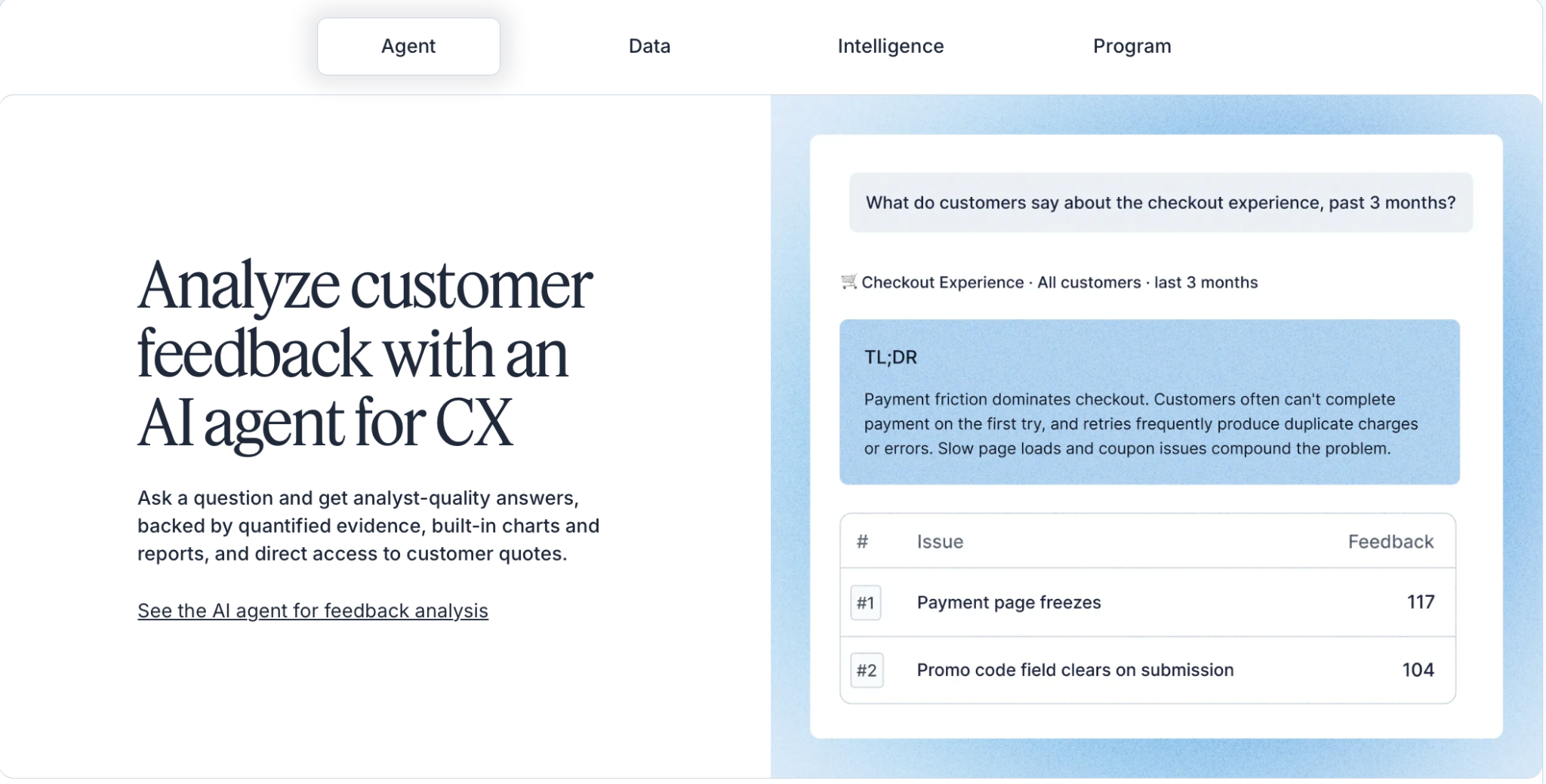
Chattermill is a customer experience intelligence platform that brings feedback from multiple channels into one place and uses AI to uncover what's driving customer sentiment. We connect to 65+ feedback channels, so surveys, reviews, support tickets, and call transcripts can all be analyzed in one platform, without buying separate analytics modules for each source.
That also makes pricing more straightforward. Our pricing is based on the number of data sources you connect and the volume of feedback you analyze, with no per-user fees. This means your CX, product, and support teams can access the same insights without paying for additional seats. Pricing is tailored to your requirements, so you'll need to request a quote.
Our AI engine, Lyra AI, goes beyond basic sentiment analysis to identify specific issues within customer feedback. For example, a customer might praise delivery speed but complain about a difficult refund process. Lyra identifies both themes and their respective sentiment, then helps you understand how recurring issues affect metrics like NPS and CSAT. The platform also supports feedback analysis in 100+ languages, with automated translation and transcription.
Footasylum uses Chattermill to analyze its NPS surveys, CSAT responses, and Trustpilot reviews, including around 2,500 NPS responses each week. This helps its team identify recurring customer issues across thousands of comments and share insights across departments. As James McGhee, Footasylum's Director of Customer Experience, puts it: "The number of people required to do that project manually would far exceed the cost of the product."
If you're comparing both platforms, our Chattermill vs. InMoment comparison breaks down their features and use cases.
Getting an InMoment Quote You Can Compare
The fastest way to understand InMoment pricing is to ask for an itemized quote, with separate costs for the software license, implementation, service hours, extra users, and add-ons. Use Vendr's figures as a reference, but remember that your quote may cover different products and services. Also, ask your rep about renewal price caps and InMoment's product roadmap under Qualtrics.
If you're also considering Chattermill, request quotes for the same feedback sources and expected volume. That way, you can compare what each platform would cost for your requirements rather than relying on general pricing estimates.
Our guide to building a business case for unified customer intelligence can help you evaluate your options. Or book a Chattermill demo to see how the platform works and get a quote based on your feedback sources and volume.
Frequently Asked Questions
What Is InMoment Used For?
InMoment is used to collect and analyze customer and employee feedback. Brands use it to run surveys, analyze contact center calls and chats, manage reviews and local listings, and track feedback on websites and apps. Its XI Platform brings together feedback from these channels and uses AI to identify trends and recommend actions.
What Type of Company Is InMoment?
InMoment is a customer experience software and services company headquartered in Salt Lake City, Utah. Originally founded as Mindshare Technologies in 2002, it provides tools for collecting, analyzing, and acting on customer feedback. According to InMoment, more than 3,000 brands use its platform.
What Is an InMoment Survey?
An InMoment survey is a feedback survey a business creates and distributes using InMoment's software. You might receive one by email, through an app, or after a store visit or purchase. InMoment provides the tools to build surveys, collect responses, and analyze the results.
What Does InMoment Mean?
InMoment is the name adopted by Mindshare Technologies and Empathica when the two companies united under a single brand in June 2014, following Mindshare's acquisition of Empathica in 2013. The company later merged with MaritzCX in 2020, retaining the InMoment name.


See Chattermill in action on your own feedback
Book a demo


