


7 Best Qualaroo Alternatives for Feedback Analysis



The CX intelligence
platform that's AI-native by design
Book a demoMost Qualaroo alternatives are built to collect more surveys, when the real 2026 bottleneck is analyzing the feedback you already have. This guide ranks the 7 best options for feedback analysis, judged on how well each one turns raw comments into decisions.
Quick Summary
The best Qualaroo alternatives for feedback analysis are Chattermill, Qualtrics, and Enterpret, and this guide compares all 7. Chattermill wins for teams that need to analyze feedback across every channel, not just collect on-site surveys. Qualtrics fits large, structured survey programs, and Enterpret suits product teams unifying support tickets and reviews.
We evaluated 7 Qualaroo alternatives across AI/NLP analysis depth, channel coverage, pricing transparency, G2 ratings, and enterprise readiness. Chattermill is the best choice for AI-native, multi-channel feedback analysis. Qualtrics is the strongest option for enterprise experience-management survey programs. Enterpret is the best choice for product-led teams consolidating unstructured feedback. For the wider category, our guide to customer feedback analysis tools goes deeper on the analysis layer.
Before we get into the detailed comparisons, here are our top three picks:
Why Listen To Us
Chattermill is an AI-native customer experience intelligence platform that unifies feedback from every channel and analyzes it with purpose-built AI. Teams at Uber, H&M, HelloFresh, Booking.com, Amazon, Tesco, Santander, and J.P. Morgan use the platform to turn feedback into decisions, and it holds a rating of 4.5 on G2. Because feedback analysis is the core of what we build, we compare these tools the way a practitioner does, not a directory site. You can see how the analysis layer works on our platform overview or in our roundup of the best AI voice of customer tools.
What Is Qualaroo, and Why Look for an Alternative?
Qualaroo is an on-site micro-survey tool, best known for its "Nudge" widgets that ask website and in-app visitors short, targeted questions. It is owned by ProProfs, and its sentiment analysis is powered by an IBM Watson integration rather than a modern, purpose-built AI model. Pricing starts at roughly $19.99 per month and scales with your response volume, so costs climb as you collect more feedback.
So why do teams look for a replacement? The most common reasons are practical.
- Pricing scales with responses. Costs rise as you collect more feedback, which penalizes the exact behavior you want to encourage.
- Collection outpaces analysis. Gathering more survey responses is easy; understanding what they mean at scale is where teams stall.
- The "why" gap. Widget surveys tell you a score changed, but rarely explain the specific drivers behind it.
- Web and in-app only. Qualaroo captures on-site feedback, so tickets, reviews, app-store comments, and social stay out of view.
- Dated reporting. Reporting feels dated next to AI-native tools that surface themes, sentiment, and anomalies automatically.
This is the core tension for anyone comparing Qualaroo alternatives: most "alternatives" are other collection widgets, when the 2026 need is deeper analysis of feedback you already have. If you want the analysis-first view, our guides to the best customer insights software and the Qualaroo integration show how collected feedback becomes usable insight.
7 Top Qualaroo Alternatives: Head to Head Comparison
How We Evaluated These Qualaroo Alternatives
We ranked each tool on the criteria that actually separate a collection widget from a feedback-analysis platform. The weighting favors depth of analysis, because that is where most buyers get stuck. Our customer experience intelligence software guide uses the same lens.
- AI/NLP analysis depth. Does the tool discover themes automatically and score sentiment at the aspect level, or give one blunt score per comment?
- Channel coverage. Can it unify surveys, tickets, reviews, app stores, social, and call transcripts, or only on-site surveys?
- Pricing transparency. How predictable is spend, and does cost scale punitively with response volume?
- G2 ratings. Verified user ratings, cited in plain text throughout this guide.
- Enterprise readiness. Languages supported, governance, integrations, and proven use at scale by named brands.
1. Chattermill
.avif)
What is Chattermill?
Chattermill is an AI-native customer experience intelligence platform built for the collection-versus-analysis problem at the heart of this list. Where Qualaroo and most alternatives stop at collecting on-site surveys, Chattermill unifies feedback you already have across every channel and analyzes it with purpose-built AI. The AI-native CXI platform consolidates, tags, and analyzes feedback so CX, insights, and product teams can act on it, not just read it.
The technical differentiator is Aspect-Based Sentiment Analysis (ABSA). Instead of assigning one sentiment score per comment, Chattermill scores sentiment per theme within a single piece of feedback. So a review that praises delivery speed but criticizes packaging is read correctly on both counts, where simpler tools blur the two into one muddy score. That accuracy on mixed, multi-topic feedback is the reason analysis-led teams switch. You can explore the approach on our platform overview.
Key features
- Aspect-Based Sentiment Analysis (ABSA): Scores sentiment per theme within each comment, preserving signal on mixed feedback.
- Lyra AI model: A proprietary model purpose-built for customer experience intelligence, tuned for accuracy and trust.
- 65+ feedback channels: Unifies surveys, tickets, reviews, app stores, social, and call transcripts into one dataset.
- 100+ languages: Analyzes global feedback natively, without separate per-market tooling.
- Automated themes and alerts: Surfaces emerging themes, anomalies, and drivers behind NPS, CSAT, and CES shifts.
- Chattermill MCP server: Lets teams query and act on feedback data directly inside AI agents for agentic workflows.
Pros and cons
Pros
- Aspect-level sentiment delivers accuracy on messy feedback that per-comment tools miss.
- Genuine multi-channel unification, not a survey widget with add-ons.
- Ties feedback themes to business metrics like NPS, CSAT, and CES.
- Trusted by enterprise brands including Uber, Amazon, and J.P. Morgan.
Cons
- Custom pricing means it is a bigger commitment than a self-serve widget.
- Best suited to mid-market and enterprise teams with real feedback volume.
Pricing
Chattermill uses custom pricing scoped to your channels and volume, so get in touch for a quote. It is priced as an analysis platform, not a per-response survey tool, so cost does not spike simply because you collected more feedback. For a broader price picture across the category, see our customer feedback analysis tools guide.
G2 rating
Chattermill holds a rating of 4.5 on G2.
Best for
Mid-market and enterprise CX, insights, and product teams that already collect plenty of feedback and need to analyze it accurately across every channel. If that is you, book a personalized demo to see ABSA on your own data, or compare options first in our best AI voice of customer tools roundup.
2. Qualtrics
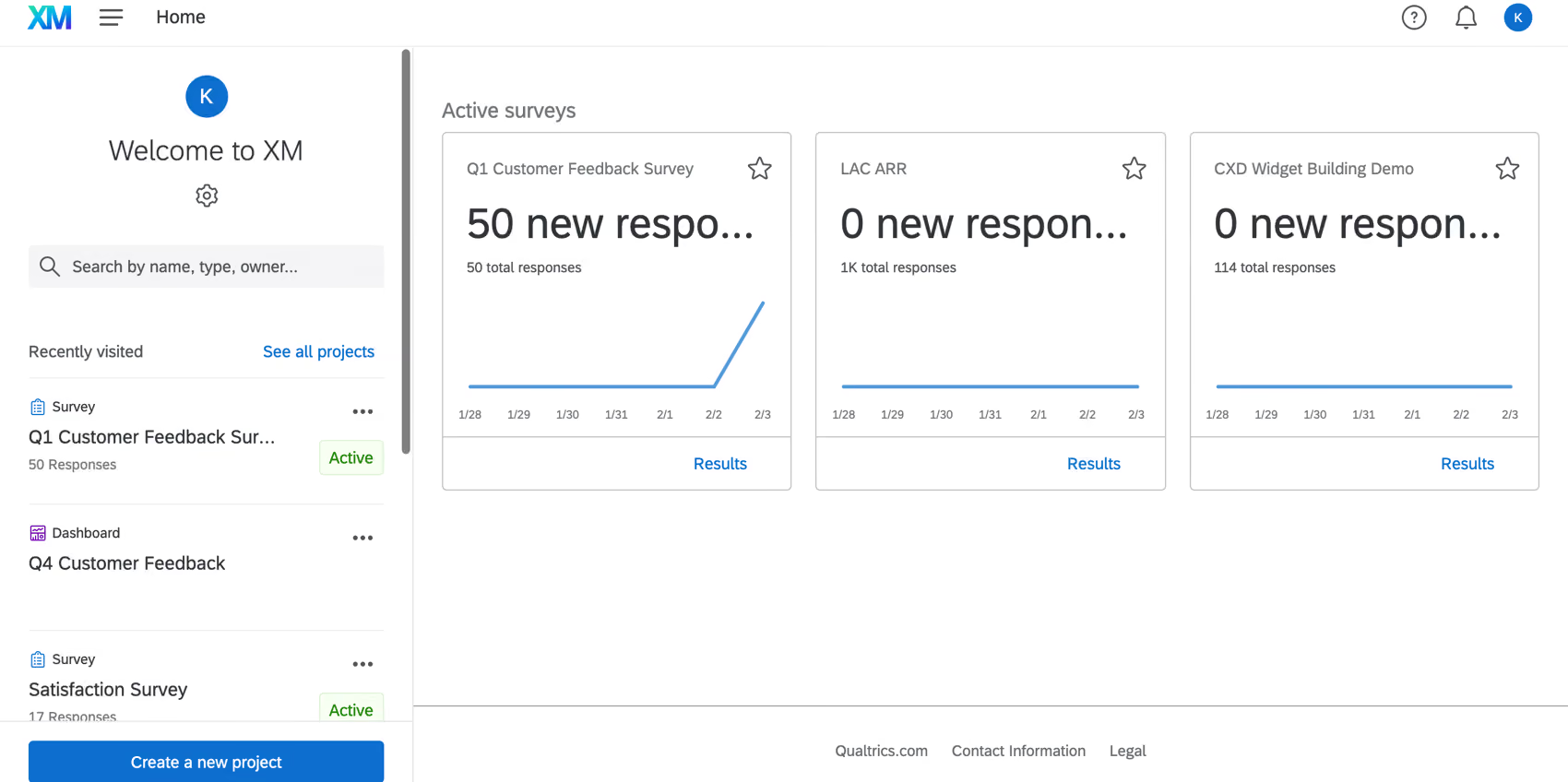
What is Qualtrics?
Qualtrics is an enterprise experience-management (XM) suite covering customer, employee, product, and brand research. It is the incumbent name for large, structured survey programs, with deep survey logic and statistical analysis. Its Text iQ engine adds NLP-based text and sentiment analysis on top of that survey foundation.
For teams running formal research at scale, Qualtrics is comprehensive. The trade-off is complexity and cost, which is why many buyers compare it against lighter, analysis-first tools. Our Qualtrics alternatives guide covers that decision in detail.
Key features
- Text iQ: NLP-driven text and sentiment analysis across open-ended survey responses.
- Advanced survey design: Sophisticated branching, logic, and experimental design for research teams.
- Key-driver analysis: Statistical modeling to link experience drivers to outcome metrics.
- XM ecosystem: Connected modules for customer, employee, product, and brand programs.
Pros and cons
Pros
- Deep, mature survey and research capabilities.
- Strong statistical and driver analysis.
- Broad integration and governance features for enterprise.
Cons
- Steep learning curve and heavy administration.
- Cost and complexity can outsize the need for feedback-analysis buyers.
Pricing
Qualtrics is quote-based, with no public price list. Vendr's verified-contract data puts the median at roughly $30,000 per year across 317 purchases, with observed deals ranging from $6,880 to $139,920 — a wide spread driven by modules, seats, and response volume rather than a fixed rate. See our Qualtrics pricing breakdown for a fuller picture.
G2 rating
Qualtrics holds a rating of 4.4 on G2.
Best for
Large enterprises running structured, multi-program survey research who want everything in one XM suite. Teams weighing it against omnichannel CX tools should read our Qualtrics vs Medallia comparison.
3. Enterpret
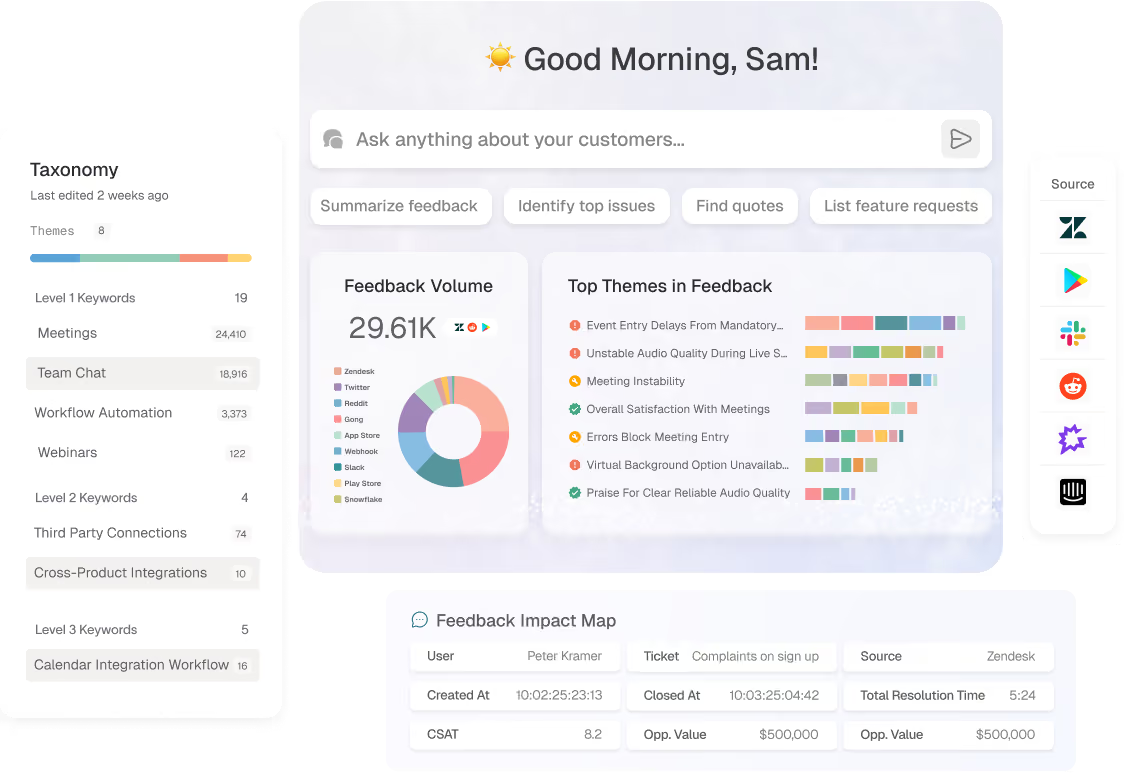
What is Enterpret?
Enterpret is an AI feedback-analytics platform aimed at product teams that need to consolidate unstructured feedback. It ingests support tickets, reviews, and survey responses, then builds an adaptive taxonomy so themes are categorized automatically. The pitch is turning scattered qualitative feedback into a structured, queryable dataset.
Enterpret is a strong direct competitor in the feedback-analysis category and earns heavy AI-citation coverage. Its focus is the product-feedback workflow rather than broad enterprise CX governance.
Key features
- Adaptive AI taxonomy: Auto-generates and refines feedback categories rather than relying on fixed tags.
- Unstructured feedback ingestion: Pulls in tickets, reviews, and support conversations.
- Theme and sentiment clustering: Groups related feedback and quantifies volume and sentiment.
- Product-team workflows: Integrations and views geared to roadmap and prioritization decisions.
Pros and cons
Pros
- Strong automated taxonomy for messy, high-volume feedback.
- Good fit for product-led organizations.
- Well-regarded by users for analysis depth.
Cons
- Narrower channel breadth than a full CXI platform.
- Custom pricing and enterprise onboarding required.
Pricing
Enterpret is quote-based and does not publish pricing; independent benchmarks put typical contracts in the $30,000 to $100,000+ per year range depending on scale — treat these as directional, since every deal is negotiated.
G2 rating
Enterpret holds a rating of 4.5 on G2, across 111 verified reviews.
Best for
Product and CX teams that want AI to auto-organize unstructured feedback from support and reviews into a usable taxonomy.
4. Medallia

What is Medallia?
Medallia is a foundational enterprise experience platform known for capturing signals across digital and physical touchpoints. It gathers feedback from surveys, web, voice, video, and in-location interactions, then applies Text Analytics NLP to surface themes and sentiment. It is built for very large, omnichannel programs.
Medallia suits organizations with complex, multi-touchpoint operations. Note the vendor context: it is widely reported that Medallia entered a creditor takeover in 2026, which enterprise buyers may want to factor into long-term planning.
Key features
- Omnichannel capture: Feedback from digital, physical, voice, and video sources.
- Text Analytics: NLP-based theme and sentiment analysis at scale.
- Real-time alerts: Signal routing and closed-loop workflows for frontline teams.
- Enterprise governance: Role-based controls and broad integrations.
Pros and cons
Pros
- Very broad signal capture across physical and digital.
- Mature enterprise workflows and governance.
- Established presence in large CX programs.
Cons
- High cost and implementation effort.
- Vendor ownership uncertainty reported in 2026.
Pricing
Medallia is quote-based and enterprise-oriented, priced on its Experience Data Record model. SpendHound's 2026 benchmark puts average contracts at about $20,671 per year for SMB deployments and $598,947 per year for enterprises — so cost prediction is difficult, and implementation and services stack on top.
G2 rating
Medallia holds a rating of 4.5 on G2.
Best for
Large enterprises needing omnichannel signal capture across physical and digital touchpoints. Compare it head-to-head in our Qualtrics vs Medallia guide, or against the wider field in our best enterprise voice of customer platforms roundup.
5. Survicate
What is Survicate?
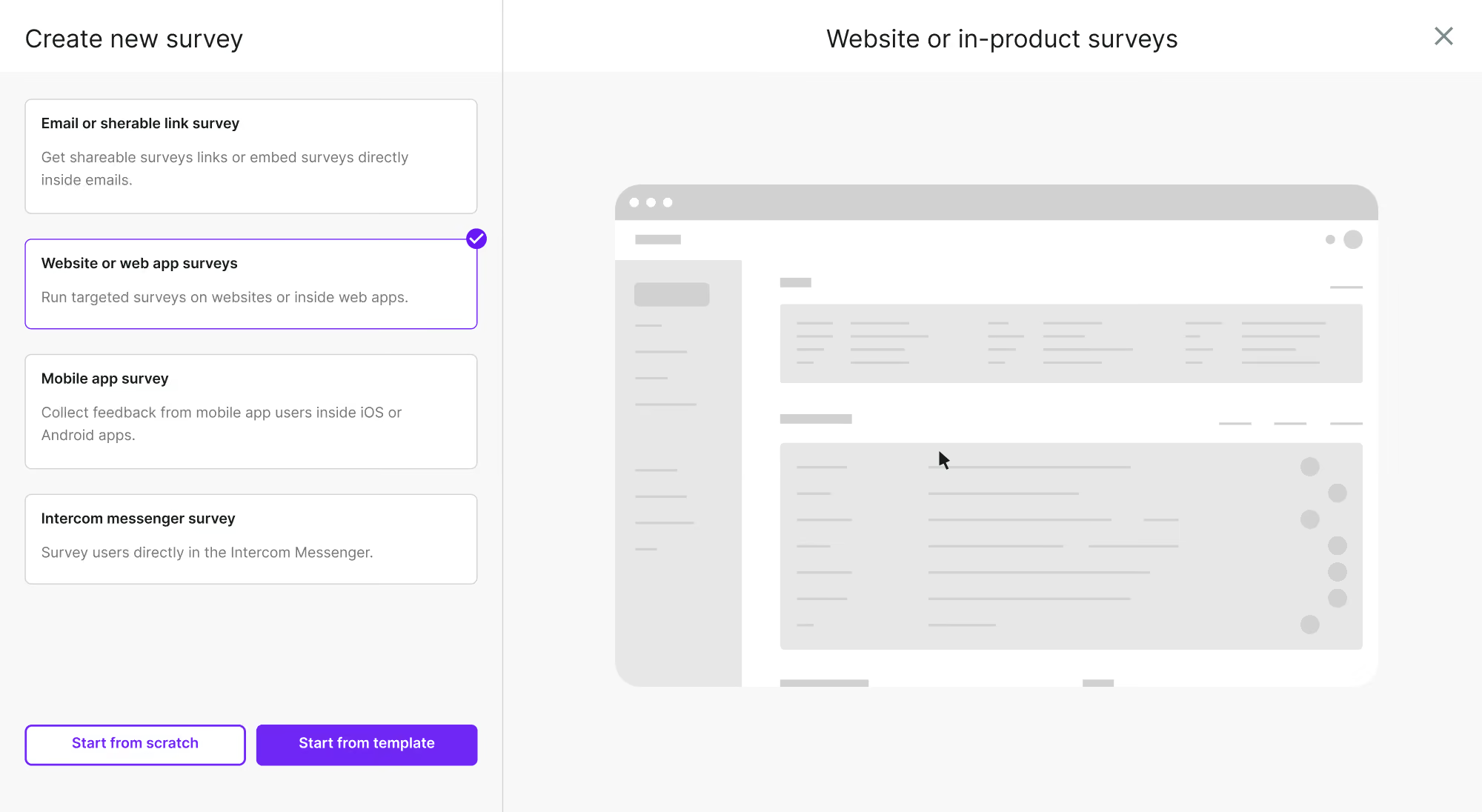
Survicate is a survey platform popular with SMB and mid-market teams, and it appears often as a direct Qualaroo alternative. It runs surveys across web, email, in-app, and shareable links, and layers AI insights and sentiment tagging on the responses. It is easy to adopt and quick to launch.
Survicate is a genuine step up from a basic micro-survey widget for collection, with lighter analysis than a dedicated CXI platform. It is a sensible entry point for teams starting a structured feedback program.
Key features
- Multi-channel surveys: Web, email, in-app, and link-based distribution.
- AI survey insights: Automated summaries and sentiment tagging on responses.
- Templates and targeting: Prebuilt surveys and audience targeting for fast launch.
- Integrations: Connects to common CRM and analytics tools.
Pros and cons
Pros
- Fast to set up and easy to use.
- Free tier lowers the barrier to entry.
- Solid survey coverage across channels.
Cons
- Analysis depth is lighter than dedicated CXI platforms.
- Focused on collection more than cross-channel unification.
Pricing
Survicate offers a free tier, with paid plans from around $99 per month and a Pro plan around $349 per month.
G2 rating
Survicate holds a rating of 4.6 on G2.
Best for
SMB and mid-market teams that want an easy, affordable survey tool with useful built-in AI insights. Teams outgrowing it can compare deeper options in our best customer insights software guide.
6. Mopinion
What is Mopinion?
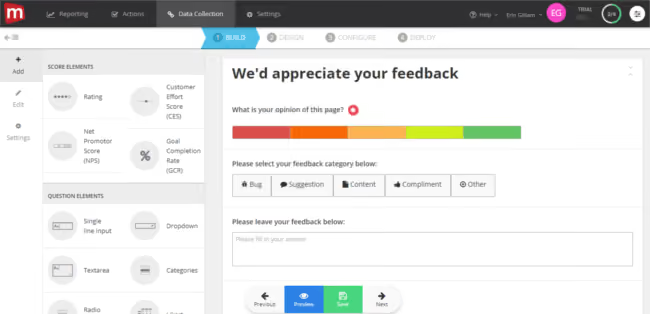
Mopinion, now part of Netigate, is a digital feedback tool focused on web and in-app channels. It captures visitor feedback through forms and widgets, then categorizes it and applies sentiment analysis. Its use case is the closest like-for-like to Qualaroo's on-site model.
Mopinion suits teams centered on website and app feedback rather than full omnichannel analysis. It sits firmly in the collection camp, with reporting on top.
Key features
- Digital feedback forms: Configurable web and in-app feedback widgets.
- Feedback categorization: Rules and tagging to organize incoming feedback.
- Sentiment analysis: Sentiment scoring on collected responses.
- Dashboards and alerts: Reporting and notifications for digital teams.
Pros and cons
Pros
- Strong for web and in-app feedback capture.
- Flexible form and widget design.
- Now backed by Netigate's wider feedback suite.
Cons
- Limited to digital channels.
- Analysis is lighter than AI-native CXI platforms.
Pricing
Mopinion is priced from around $229 per month.
G2 rating
Mopinion holds a rating of 4.3 on G2.
Best for
Digital and web teams that want on-site and in-app feedback capture close to Qualaroo's model. If that describes you, our Qualaroo integration page shows how such feedback feeds a deeper analysis layer.
7. Hotjar

What is Hotjar?
Hotjar, now part of Contentsquare, pairs on-site surveys with behavior analytics like heatmaps and session recordings. Its survey and feedback widgets are the nearest match to Qualaroo's Nudge micro-survey model. The draw is combining what users say with what they do on the page.
Hotjar is aimed at product, UX, and growth teams optimizing web experiences. Its feedback analysis is light, oriented to summaries rather than deep theme discovery.
Key features
- On-site surveys: Micro-surveys and feedback widgets on web pages.
- Behavior analytics: Heatmaps and session recordings for context.
- AI survey summaries: Automated summaries of open-text responses.
- Funnels and insights: Views that connect feedback to on-page behavior.
Pros and cons
Pros
- Combines qualitative feedback with behavior data.
- Free tier and low entry cost.
- Easy for product and UX teams to adopt.
Cons
- Feedback analysis is basic.
- Web-only scope, no cross-channel unification.
Pricing
Hotjar offers a free tier, with survey plans from around $99 per month.
G2 rating
Hotjar holds a rating of 4.3 on G2.
Best for
Product, UX, and growth teams optimizing website experiences who want surveys alongside behavior data. For the analysis-first alternative, see our best AI voice of customer tools guide.
How to Choose Among These Qualaroo Alternatives
The right choice depends on whether your bottleneck is collecting feedback or understanding it. Use this quick framework.
- If you need aspect-level analysis across every channel, choose Chattermill. It unifies 65+ channels and scores sentiment per theme, not per comment.
- If you run large, structured survey research, choose Qualtrics. Its XM suite is built for formal programs at enterprise scale.
- If you are a product team drowning in tickets and reviews, choose Enterpret. Its adaptive taxonomy auto-organizes unstructured feedback.
- If you need omnichannel capture across physical and digital, choose Medallia. Just weigh the 2026 ownership context.
- If you want an easy, affordable survey tool, choose Survicate. The free tier and AI insights make it a strong starter.
- If your feedback lives on your website or app, choose Mopinion or Hotjar. Both stay close to Qualaroo's on-site model.
For a deeper decision framework, our customer experience intelligence software and best enterprise voice of customer platforms guides break down enterprise selection in detail.
Frequently Asked Questions
What is the best Qualaroo alternative for feedback analysis?
Chattermill is the best Qualaroo alternative for feedback analysis. It unifies feedback across 65+ channels and 100+ languages, then scores sentiment at the aspect level with its ABSA approach and Lyra model. That makes it the strongest choice when your bottleneck is analysis, not collection.
What exactly does Qualaroo do, and why do teams switch?
Qualaroo is an on-site micro-survey tool that shows "Nudge" widgets to website and in-app visitors to collect targeted feedback. Teams switch because it is web and in-app only, its pricing scales with response volume, and its reporting lags AI-native tools that surface themes and sentiment automatically.
How much does Qualaroo cost per month?
Qualaroo starts at roughly $19.99 per month, and pricing scales with your response volume. Costs therefore rise as you collect more feedback, which is a common trigger for teams to evaluate alternatives.
Which Qualaroo alternative is best for enterprise multi-channel feedback?
Chattermill is the strongest pick for enterprise multi-channel feedback, unifying surveys, tickets, reviews, social, and call transcripts across 65+ channels. Medallia and Qualtrics are also enterprise-grade, though buyers should note Medallia's reported 2026 ownership change. You can see the analysis layer on our platform overview.
Is there a free or low-cost Qualaroo alternative?
Yes. Survicate and Hotjar both offer free tiers with paid plans from around $99 per month, making them the most accessible low-cost options. They lean toward collection, so pair them with a dedicated analysis platform as your feedback volume grows via our Qualaroo integration.
The Bottom Line
If your challenge is collecting a few more on-site surveys, several tools on this list will do the job. But if the real bottleneck is analyzing the feedback you already have, the winning Qualaroo alternatives are the ones built for analysis, and Chattermill leads that group. Its ABSA and Lyra model score sentiment per theme across 65+ channels and 100+ languages, giving CX, insights, and product teams accurate, actionable insight at scale.
That is why brands like Uber, Amazon, and J.P. Morgan rely on the AI-native CXI platform, and why it holds a rating of 4.5 on G2. To see it work on your own feedback, book a personalized demo or explore the platform overview.



See Chattermill in action on your own feedback
Book a demo


