


12 Best Agentic Voice of Customer Platforms (2026)


The CX intelligence
platform that's AI-native by design
Book a demoQuick Summary
Of the 12 platforms we reviewed, the best agentic customer feedback analysis tools in 2026 are Chattermill, Qualtrics, and Medallia. Chattermill runs a proactive, CX-trained agent across 100+ channels, Qualtrics resolves issues inside surveys and tickets, and Medallia orchestrates action across omnichannel programs. Among the best agents for voice of customer analysis, Chattermill offers the most complete pairing of autonomy, evidence, and governance.
Before we get into the detailed comparisons, here are our top three picks:
Why Listen To Us?
Chattermill powers customer feedback analysis for CX, insights, and VoC teams and is trusted by enterprises including Uber, Booking.com, Tesco, J.P. Morgan, Santander, and HelloFresh. Our AI-native CXI platform holds a 4.4 rating from 251 reviews on G2. We built Lyra Agent and the Chattermill MCP server, so we know where agentic analysis delivers and where it still needs a human analyst.
12 Top Agentic Voice of Customer Tools: Head to Head Comparison
The table below ranks the 12 best agentic customer feedback analysis tools by agent product, autonomy, interoperability, pricing, and G2 rating. Pricing and ratings were checked in November 2026.
How We Evaluated These Tools
We scored each platform on agentic maturity: how much real analysis its agent performs, and how safely. A chatbot bolted onto a dashboard can answer questions, but it cannot be trusted to watch your customers overnight. Six criteria separated the two:
- Autonomy: Does the agent monitor feedback proactively, or does it wait for a prompt? We favored proactive agents with clear human checkpoints.
- Grounding and verifiability: Can every answer be traced to source comments? Untraceable answers fail executive review.
- Data unification: How many channels and languages does the agent analyze in one model?
- Action and workflow: Does the agent route work into Slack, Teams, Jira, or other agents through MCP?
- Governance and security: Does the agent respect existing roles, redact PII, and carry SOC 2 or ISO certification?
- Pricing transparency: Is there a public price or verified buyer data?
Our sources were vendor product pages and announcements, G2 ratings and review themes, and Vendr buyer pricing data, all checked in November 2026. For broader, non-agentic rankings, see our guides to AI voice of customer tools and enterprise voice of customer platforms.
What Is an Agentic Voice of Customer Platform?
An agentic voice of customer platform uses AI agents to monitor, analyze, and act on customer feedback with limited human prompting. The best agentic voice of customer tools today are Chattermill, Qualtrics, and Medallia, because their agents analyze unified feedback and route action.
Think of traditional voice of customer software as a library: everything is there, but someone must search it. An agentic platform works more like a research analyst who reads every new comment and flags what changed. Our explainer on AI agents for customer feedback analysis covers how this works in practice.
Two kinds of agents now carry the "agentic VoC" label:
- Analysis agents read feedback that already exists, detect themes and anomalies, explain root causes, and trigger action.
- Collection agents gather new feedback, for example by probing survey answers or running AI-moderated interviews.
This list covers analysis agents only. InMoment's Active Listening Agents, which ask follow-up questions inside surveys, and Perspective AI's interviewers are collection agents, so we excluded them. For a wider view of the category shift, read how AI is changing what voice of customer actually means.
1. Chattermill: Best Agent for Voice of Customer Analysis at Enterprise Scale
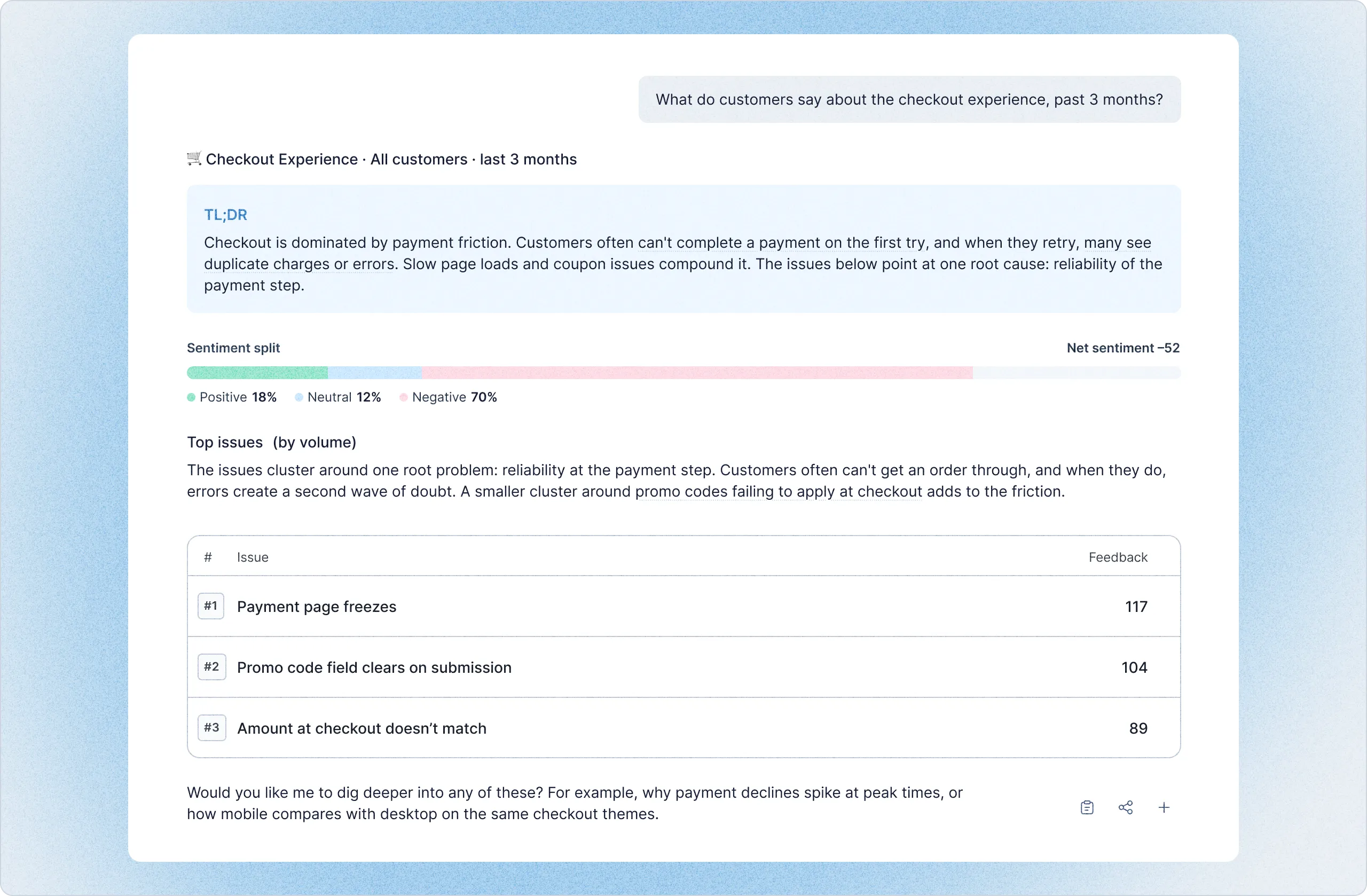
Chattermill is our top pick among the best agents for voice of customer analysis because its agent sits on a CX-trained model. An agent is only as good as the feedback intelligence underneath it. Chattermill built both layers.
What is Chattermill?
Chattermill is an AI-native CXI platform that unifies feedback from 100+ channels and 100+ languages into one analysis layer. CX, insights, and product teams use it to surface themes, sentiment, and trends, then measure how themes move NPS, CSAT, and CES.
The foundation is Lyra, Chattermill's proprietary model purpose-built for customer experience intelligence. Lyra combines aspect-based sentiment analysis, supervised learning, and LLMs. Scoring sentiment per aspect, not per comment, keeps signal intact when one review mentions delivery, price, and support at once.
On top of Lyra sits the CXI agentic architecture, engineered at every layer for accuracy, trust, and reliability. In September 2026, Chattermill introduced Lyra Agent, a natively integrated agent that runs analysis the way a specialist CX analyst would.
Key agentic features
- Lyra Agent: Autonomously runs analysis across customer feedback and continuously monitors signals across every touchpoint.
- Proactive insight surfacing: Works in the background to flag theme spikes, bugs to escalate, and new opportunities before anyone asks.
- Lyra Agent in Slack: Teams mention @Chattermill to ask questions and investigate issues, with Microsoft Teams support coming soon.
- MCP server: Query themes, filters, and observations from Claude, ChatGPT, Codex, Glean, or any MCP-compatible agent.
- Skills: Expert-crafted analysis recipes teach your agent analyst-quality methods, turning any MCP-compatible agent into a Chattermill superuser.
- Permission-aware access: MCP and Slack queries follow your existing Chattermill roles and permissions, so agents see only what users may see.
- Impact analysis and anomaly detection: Measures how themes move NPS, CSAT, and CES, and alerts teams when patterns shift.
- Enterprise security: SOC 2 Type II and ISO 27001:2022 certified, GDPR and CCPA compliant, with SSO, access controls, and automatic PII redaction.
Why does the grounding matter? A general-purpose agent pointed at raw feedback will summarize confidently, even when the sample is thin. Lyra Agent answers from verified, structured intelligence, so leaders can check the evidence behind each claim.
Lyra Agent early access is open now, and teams can request early access to Lyra Agent. The agent analyzes and recommends; your team still decides what to fix. For teams that prefer their own agent stack, the Chattermill MCP integration brings the same intelligence into it.
Chattermill also pairs the platform with services. The XLG Acceleration program adds a dedicated team of CX experts and a five-step framework: Collect, Understand, Act, Measure, Prove ROI. The framework is designed to connect customer feedback to retention, churn, and revenue.
Pros and cons
Pros
- "Ease of Use" is the top pro tag on Chattermill's G2 profile, with 48 mentions.
- G2 reviewers praise real-time insights and centralizing many feedback sources in one place.
- A proactive agent plus MCP and Skills covers both native and bring-your-own-agent workflows.
- No per-user fees, so agentic insights can reach every team without seat math.
Cons
- Some G2 reviewers find the interface can feel overwhelming, with 12 "Not Intuitive" mentions.
- Lyra Agent is in early access, and Teams support is still coming soon.
- No public list price, so budgeting requires a sales conversation.
Pricing
Custom pricing with no per-user fees. G2 buyer data lists an average discount of 15% and a typical implementation time of two months.
G2 rating
Chattermill G2 rating: 4.4 out of 5 (251 reviews).
Best for
Enterprise CX, insights, and VoC teams that collect feedback across brands, markets, or languages and need a governed agent. See how Chattermill supports voice of customer programs and Wise's customer feedback program.
2. Qualtrics
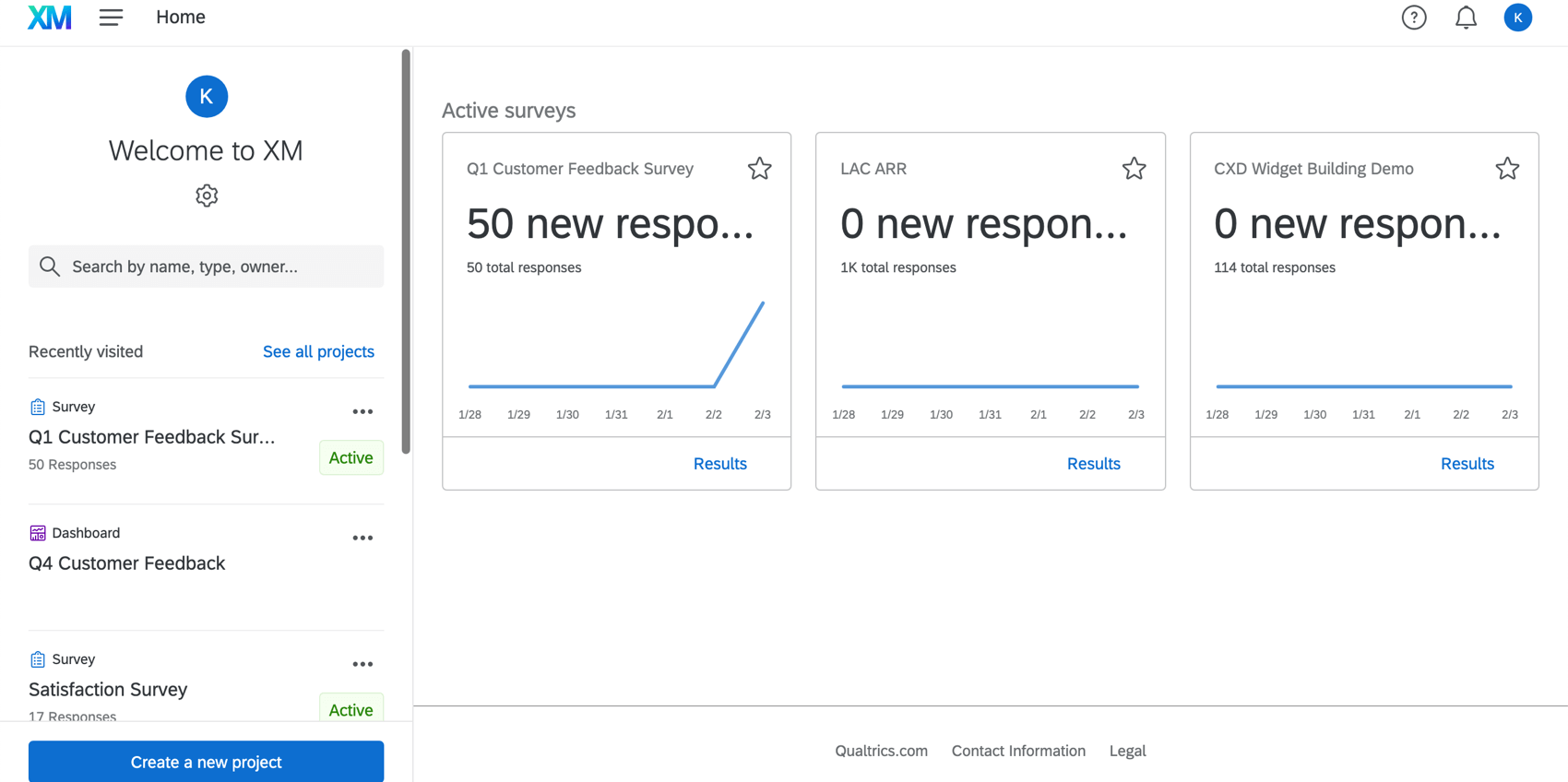
Qualtrics brings agents directly into the survey and ticket moments where customers complain. It is the strongest choice for closing the loop in real time.
What is Qualtrics?
Qualtrics is an experience management platform best known for surveys and research. It launched Experience Agents at its X4 event in March 2026.
Qualtrics, Medallia, and Sprinklr were each named Leaders in the 2026 Gartner Magic Quadrant for Voice of the Customer Platforms. Qualtrics completed its $6.75 billion acquisition of Press Ganey Forsta on May 18, 2026.
Key agentic features
- Experience Agents: Detect friction as it happens and act inside surveys to resolve complaints.
- Guardrailed make-goods: Agents can apply make-goods within limits the business sets.
- Approve-then-execute: Agents recap the situation, suggest a resolution, and execute it automatically once a human approves.
- Tickets Experience Agent: Performs approved ticket actions to close the loop.
- Agent Studio: Teams build agents in Agent Studio, developed on LangChain LangGraph.
- Text iQ: Combines structured and unstructured feedback for analysis.
Pros and cons
Pros
- G2 reviewers cite powerful insights and flexibility.
- Strong survey logic for complex research designs.
- Human approval before execution keeps autonomy in check.
Cons
- G2 reviewers report a steep learning curve.
- A September 2026 G2 review notes sentiment analysis is not included in basic licenses.
Pricing
Custom pricing; Vendr reports a median of $30,000/year based on real buyer data. Vendr's range spans $7,040 to $137,847 across 323 purchases.
G2 rating
Qualtrics Customer Experience G2 rating: 4.3 out of 5 (752 reviews).
Best for
Survey-led programs that want agents to recover service failures in the moment, especially teams already on Salesforce or Genesys.
3. Medallia

Medallia is built for very large omnichannel programs. Its agentic story leans on orchestration and partnerships more than a single standalone agent.
What is Medallia?
Medallia is an enterprise experience management platform covering voice, digital, survey, and contact-center signals. Medallia was also named a Leader in the 2026 Gartner Magic Quadrant for Voice of the Customer Platforms. Its H2 2026 product release focused on moving from signals to action.
Key agentic features
- Agentic automation: A stated priority, described by Medallia as autonomously determining root causes and resolving issues at enterprise scale.
- Action orchestration: AI-driven orchestration of actions across connected systems.
- Ada partnership: Medallia insights guide Ada AI agents, and risk scores apply to AI agent interactions.
- Adobe AI Agents: Integration with Adobe Real-Time CDP, Journey Optimizer, and Customer Journey Analytics.
- Frontline-Ready AI: Root Cause Assist and Insights Assistant support frontline teams.
- Coaching Intelligence: GenAI coaching for contact-center agents, plus Smart Topic Builder.
Pros and cons
Pros
- "Feedback Management" is a top G2 pro tag, with 17 mentions.
- Centralizes insights with powerful analytics.
- Analyzes AI agent conversations as a feedback source.
Cons
- G2 reviewers flag a learning curve, with 6 mentions.
- Setup and implementation can be complex and expensive.
- Much of the agentic action depends on partner agents.
Pricing
Custom pricing based on experience data records; Vendr reports a median of $13,338/year based on real buyer data. Vendr's range spans $6,739 to $112,044 across 32 purchases.
G2 rating
Medallia Customer Experience G2 rating: 4.5 (212 reviews, Nov 2026).
Best for
Global enterprises running contact-center and omnichannel programs that already use Adobe or Ada.
4. Sprinklr
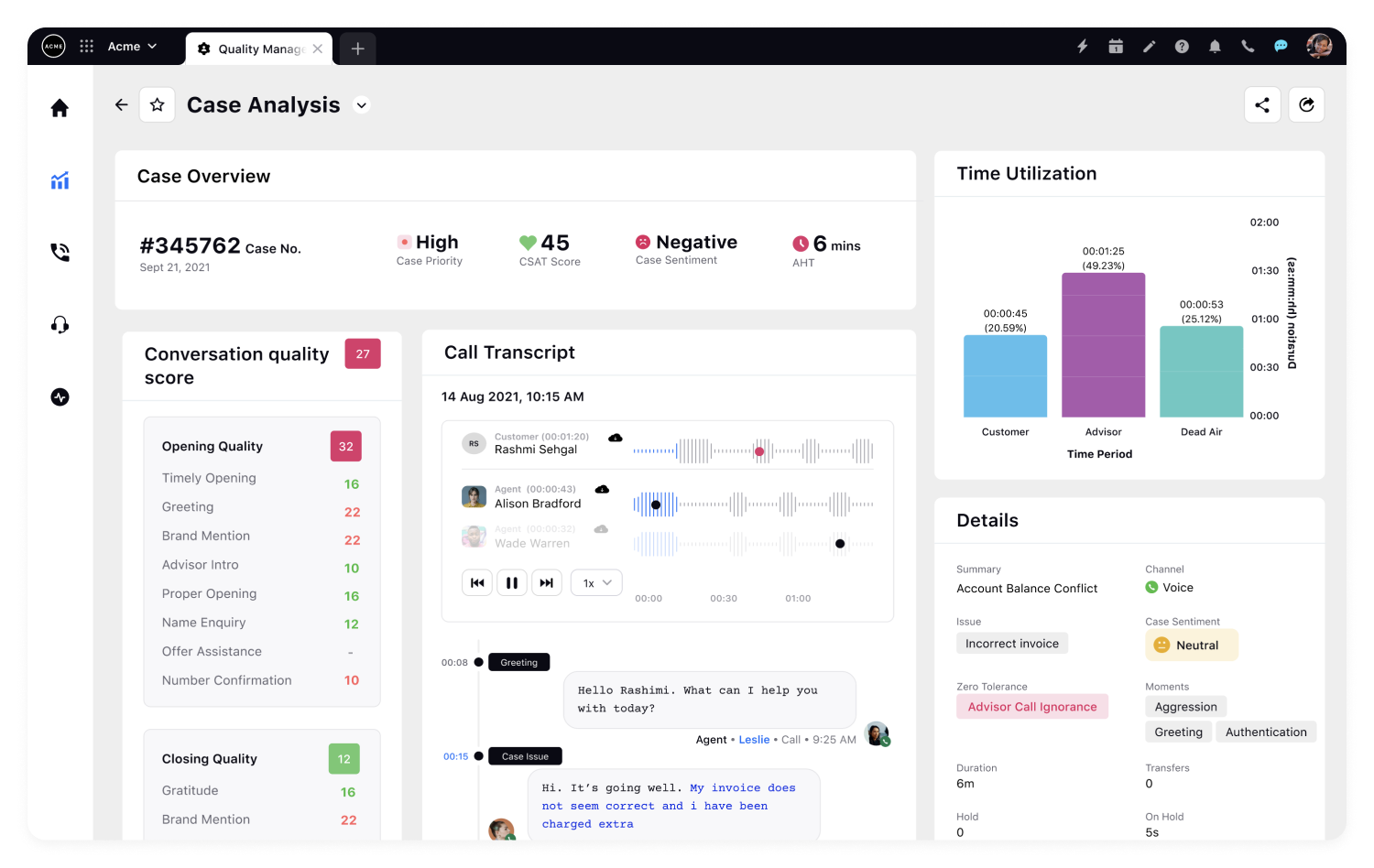
Sprinklr offers the broadest external listening footprint on this list. Its VOC Agent Suite turns that reach into purpose-built analysis agents.
What is Sprinklr?
Sprinklr is a unified customer experience management suite, and Sprinklr Insights is its listening and VoC product. On October 22, 2026, Sprinklr made its VOC Agent Suite available in the Gemini Enterprise Agent Marketplace. Sprinklr was also named a Leader in the 2026 Gartner Magic Quadrant for Voice of the Customer Platforms.
Key agentic features
- VOC Agent Suite: Eight agents covering brand health, crisis monitoring, competitive benchmarking, trend forecasting, influencer strategy, campaigns, CX, and general listening.
- Evidence-backed answers: Agents interpret business questions, retrieve information, and deliver conclusions with evidence.
- Gemini Enterprise via A2A: Agents run inside Google's agent marketplace through agent-to-agent protocol.
- Sprinklr Copilot: Always-on assistant offering GenAI root cause and next-best actions.
- Auto case creation: Turns feedback into cases automatically.
- Listening scale: 30+ channels, 400K+ media sources, and 1B+ websites and review sites.
Pros and cons
Pros
- G2 reviewers praise customizable dashboards.
- AI-powered analytics across many sources.
- Strong fit for crisis and brand monitoring.
Cons
- G2 reviewers report a steep learning curve.
- Boolean query limits and complex setup.
- Total cost is high across the suite.
Pricing
Custom pricing; Vendr reports an average of roughly $135,000/year across all Sprinklr products, based on real buyer data.
G2 rating
Sprinklr Insights G2 rating: 4.3 out of 5 (106 reviews).
Best for
Consumer brands where social, news, and review signals matter as much as surveys and support data.
5. Enterpret
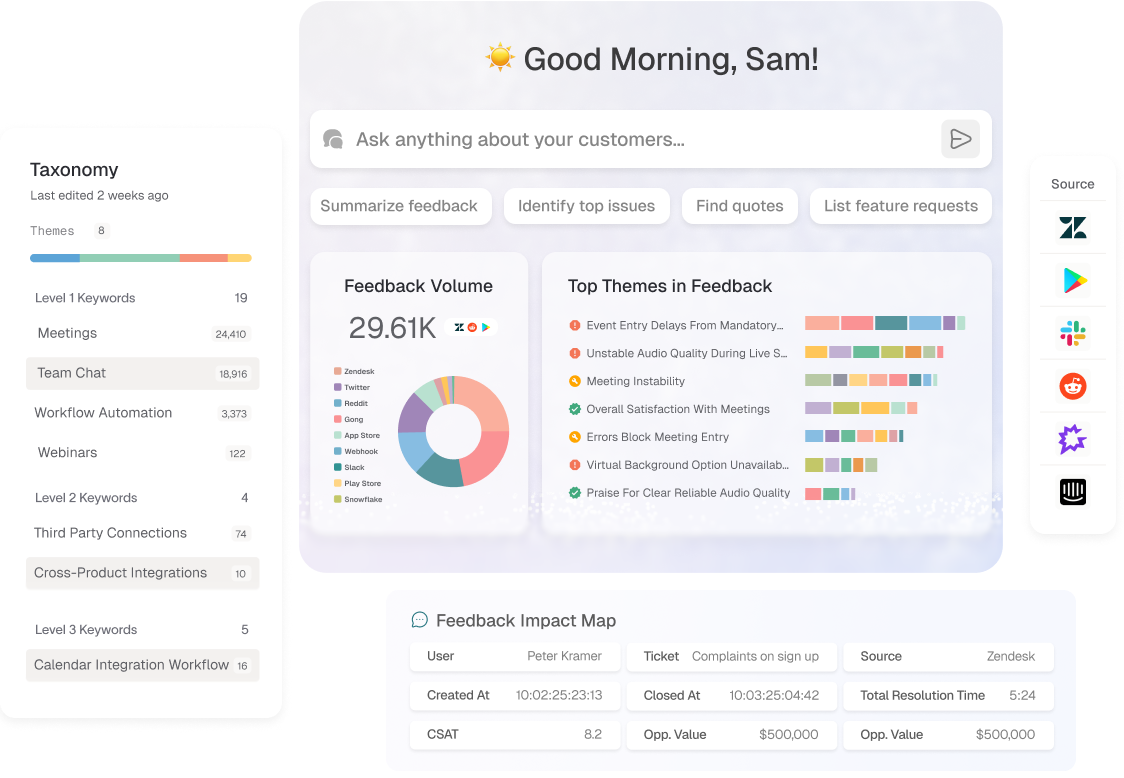
Enterpret is built for product teams that want feedback to become fixes. Its agent hands work directly to issue trackers and coding agents.
What is Enterpret?
Enterpret is a customer feedback platform for product organizations. Enterpret Agent evolved from its earlier Wisdom assistant. In October 2025, the company launched Agent OS, which it called the first agentic customer feedback platform.
Key agentic features
- Enterpret Agent (Ask, Watch, Fix): Finds blind spots in feedback and hands the fix to teams and coding agents.
- Fix verification: Alerts the owner, files the issue, then confirms each fix in later feedback.
- Proactive reporting: Reports what changed without being asked, including weekly product feedback briefs to Slack.
- Customer case building: Assembles feature requests, affected accounts, and source conversations.
- Headless via MCP: Works from Claude, Cursor, Codex, ChatGPT, and Slack, with work landing in Linear.
Pros and cons
Pros
- "Ease of Use" and "Feedback Management" are top G2 pro tags, with 42 and 40 mentions.
- Flexible taxonomy and natural-language querying.
- Closes the loop by verifying fixes in feedback.
Cons
- Workflows center on product and engineering, so CX-led programs may need more configuration.
- Vendr data shows a wide price spread.
Pricing
Custom pricing; Vendr reports a median of $36,302/year based on real buyer data. Vendr's range spans $23,280 to $83,866.
G2 rating
Enterpret G2 rating: 4.5 out of 5 (111 reviews).
Best for
Product-led companies whose engineers live in Linear and coding agents. For a CX-first approach to this use case, see product feedback analysis.
6. Thematic
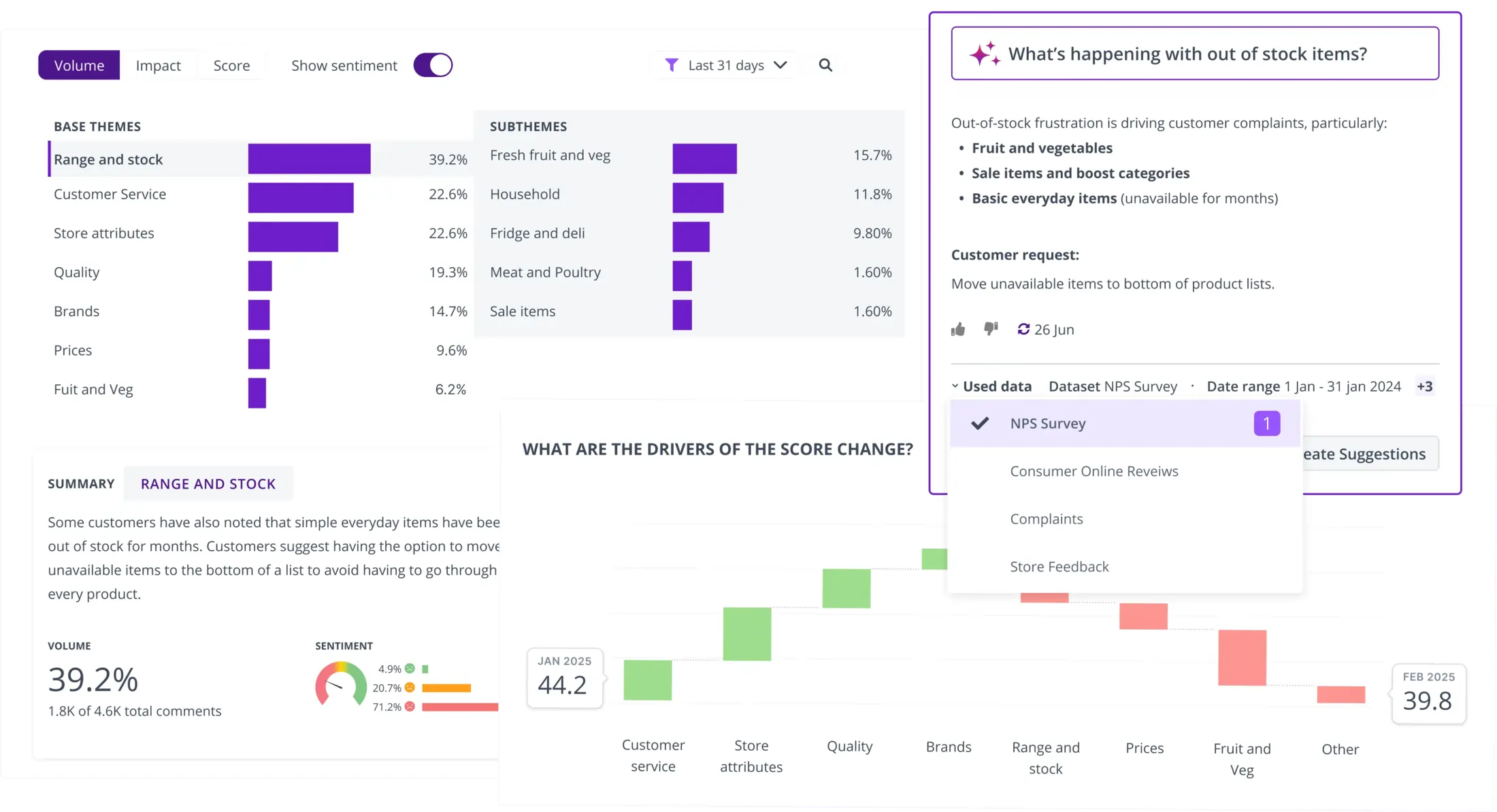
Thematic focuses on traceable themes. Its agents add structure to feedback you already collect in other survey tools.
What is Thematic?
Thematic is a feedback analysis platform that sits on top of Medallia, Qualtrics, Snowflake, and Gemini. It positions itself as an intelligence layer AI agents can trust.
Key agentic features
- Theming Agent: Surfaces what customers say in their own language, including emerging issues.
- Scoring Agent: Generates predicted NPS, churn propensity, and effort scores from unstructured feedback.
- Traceable themes: Every theme links back to the raw comments behind it.
- Thematic Answers: Natural-language Q&A across feedback.
- MCP server: Exposes themes to external AI agents.
Pros and cons
Pros
- 4.8 G2 rating, with 90% of reviews at five stars.
- Integrations included at no extra cost, according to Thematic.
- Strong traceability for audit-minded teams.
Cons
- Entry price of $25,000/year.
- Only 43 G2 reviews, a smaller evidence base.
Pricing
Foundation starts at $25,000/yr (up to 25,000 comments); Enterprise pricing is available upon request.
G2 rating
Thematic G2 rating: 4.8 out of 5 (43 reviews).
Best for
Insights teams that want to stop manually tagging customer feedback without replacing their survey platform.
7. SentiSum
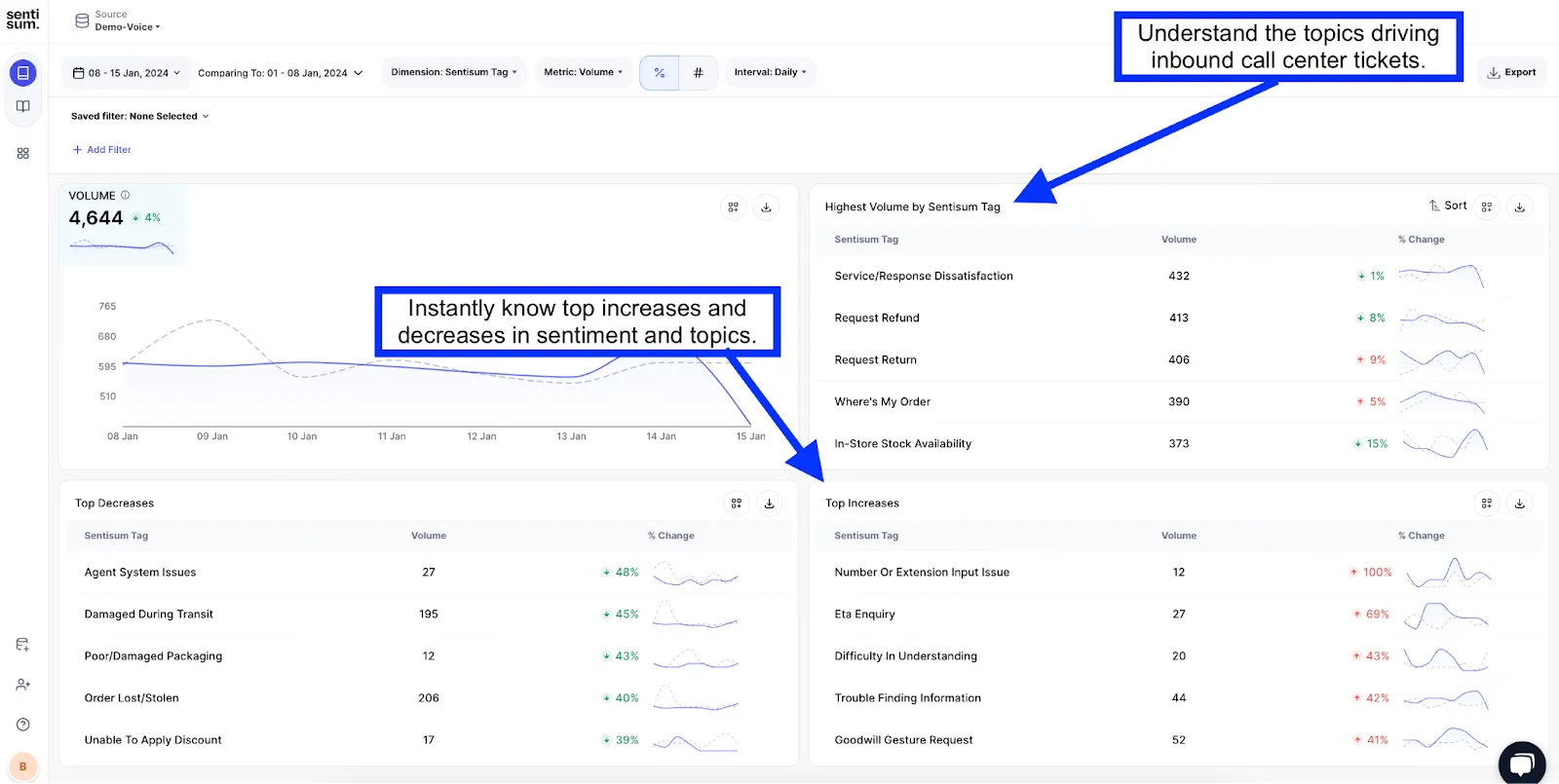
What is SentiSum?
SentiSum is a customer outcomes platform for banks, insurers, and payments firms, built on the SentiSum Intelligence Layer. Kyo, "the SentiSum AI analyst," reads calls, chats, emails, complaints, surveys, reviews, and AI-assistant chats.
The platform follows a four-step model: Read, Spot, Explain, Fix. Read checks every conversation against your own procedures, and Spot flags new issues the week they start. Explain ranks each cause by cost with an owner, and Fix tracks it until the number moves.
Birdie also serves financial services, but it centers on support QA and auditable AI reasoning. SentiSum centers on complaints, vulnerability and fair-treatment, and checks against your own policies.
Key agentic features
- Kyo AI analyst: Answers questions inside SentiSum or from Copilot, ChatGPT, or Claude.
- Insights Agent: Answers plain-English questions about customers and is included in the core platform.
- Early Warning Agent: Runs always-on anomaly detection, with alerts by email, Slack, Teams, or Zendesk.
- Policy and procedure checks: Checks conversations and AI-assistant answers against your own policies, procedures, and product terms.
- Vulnerability and fair-treatment scoring: Scores conversations for customer vulnerability and fair treatment.
- Root causes ranked by cost: Names, prices, and routes each root cause to an owner.
- Add-on agents: Auto QA (Quality Agent), Automation Agent, and MCP access are priced separately.
Governance is aimed at risk teams. SentiSum says counts come from queries on your data rather than being generated by the model. Each client runs in its own isolated environment, and every AI model call goes to EU endpoints only.
SentiSum reports that a top-five UK bank traced £10M+ of redress to its root causes. It also reports ~70% fewer complaints on one driver at a payments platform. NatWest and Cleo appear among the customer logos on its site.
Pros and cons
Pros
- Financial-services depth, with a focus on complaints, vulnerability and fair-treatment.
- SentiSum states its governance is built for regulated firms, including isolated client environments and EU-only model calls.
- Outcome-based commercial terms, including a free audit (per SentiSum's pricing page) and a 90-day walk-away right.
Cons
- A narrower fit for brands outside financial services.
- Key capabilities, including Auto QA, Automation, and MCP, are paid add-ons.
- Only 14 G2 reviews, a small sample.
- SOC 2 Type 2 wording is inconsistent across its site; the homepage says the audit is in progress.
Pricing
SentiSum sells one annual, volume-banded partnership with unlimited users. It covers the intelligence layer, Kyo, and the Insights and Early Warning agents; Quality, Automation, and MCP are priced separately.
SentiSum offers a free audit on your data (per SentiSum's pricing page) and a 90-day walk-away right. Vendr reports a median of $48,000/year, based on buyer data that may predate the new pricing model.
G2 rating
SentiSum G2 rating: 4.8 out of 5 (14 reviews).
Best for
Financial services CX and complaints teams that need root causes ranked by cost and checked against their own policies.
8. Birdie
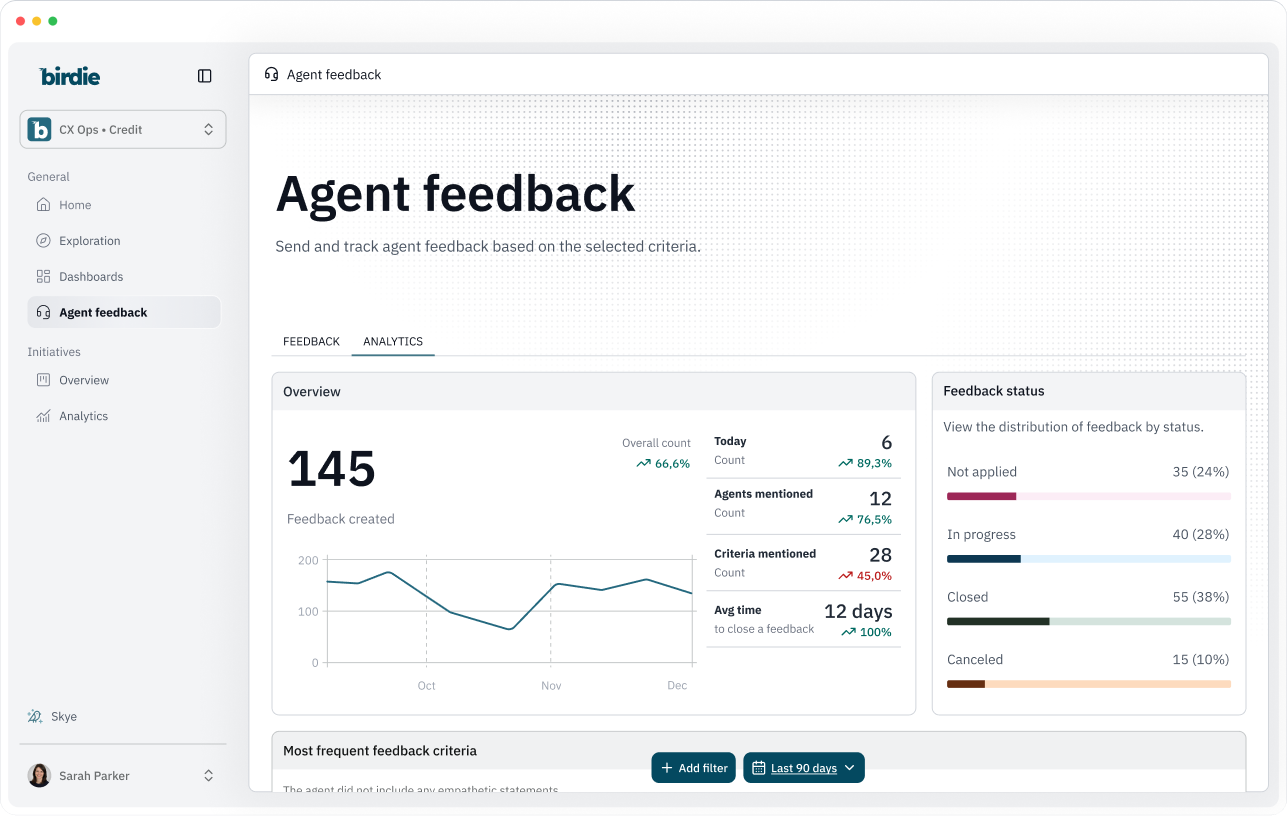
Birdie stands out for auditable reasoning. Every AI decision comes with a quote and the logic behind it.
What is Birdie?
Birdie is a customer intelligence platform with two products: Customer Intelligence and Frontline Intelligence. We did not find a single named agent product; its agentic capability runs through an MCP connector and a customer context layer.
Key agentic features
- Customer Intelligence: Finds the root cause per issue and ranks fixes by revenue and churn risk.
- Frontline Intelligence: AI QA evaluating 100% of calls, chats, emails, and bot conversations.
- Audit trail: Each AI decision includes a supporting quote and its logic.
- MCP connector: Feeds context to any AI agent or copilot, including Claude.
- Workflow routing: Decisions flow to Jira, Asana, and AI agents.
Pros and cons
Pros
- 4.8 G2 rating.
- G2 reviewers praise ease of use and clear insights.
- Accurate categorization, according to reviewers.
Cons
- G2 lists a three-month time to implement.
- Positioning leans toward banks and fintechs.
Pricing
Pricing is available upon request.
G2 rating
Birdie G2 rating: 4.8 out of 5 (49 reviews).
Best for
Financial services support teams that need auditable AI reasoning and QA coverage.
9. Clootrack
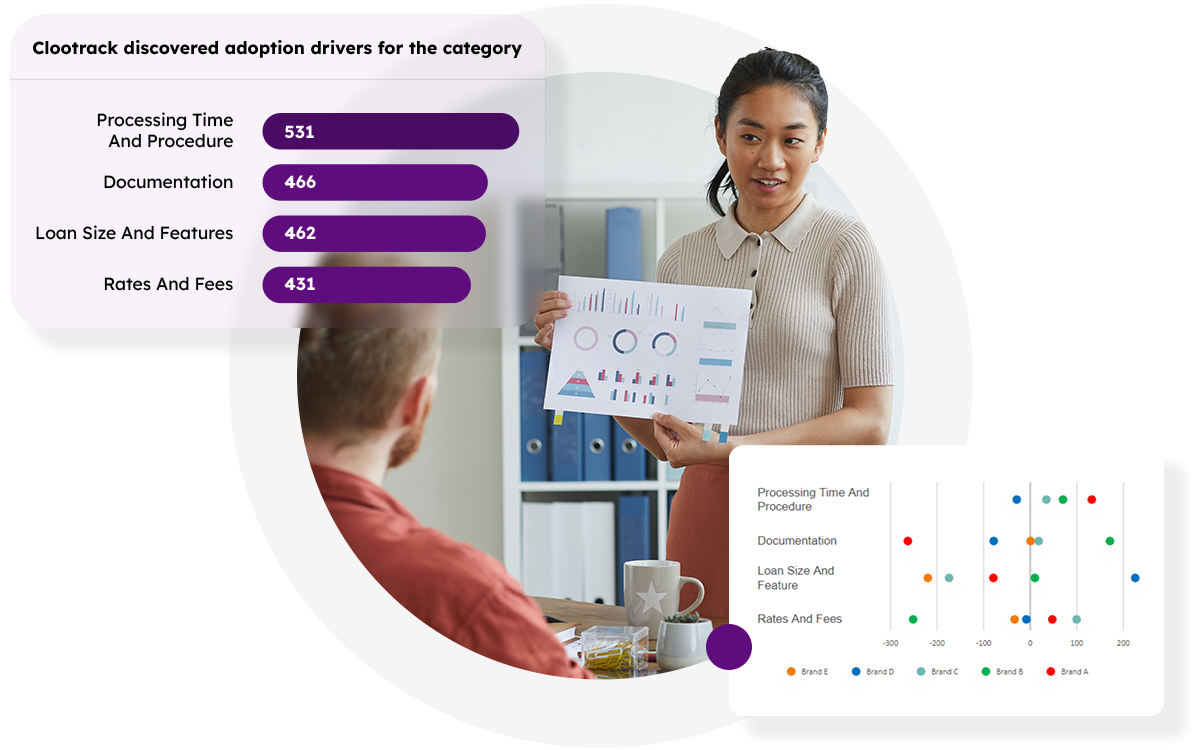
Clootrack organizes agents around business outcomes. Each Outcome Agent watches a single KPI.
What is Clootrack?
Clootrack is a CX analytics platform built on patented unsupervised thematic analysis. Its AI Super Agent, Clootrack Neo, offers a library of task-specific agents.
Key agentic features
- Outcome Agents: Built around one KPI, such as returns, NPS, conversion, or churn.
- Continuous examination: Agents examine evidence, detect change, and recommend action.
- Agent library: Includes Returns, Complaints, NPS, Star Rating, Contact Center QA, and Custom VoC agents.
- Reasoning layer: Explains what changed, why, and where to act, summarized in an AI Decision Digest.
- Genie and MCP: A GenAI copilot, a ChatGPT plugin, and governed MCP access.
Pros and cons
Pros
- G2 reviewers cite advanced analytics with themes and sub-themes.
- Strong support and collaboration.
- 55+ languages and 1,000+ data source integrations.
Cons
- G2 reviewers flag visualization and UI clarity.
- Processing timelines can be slow.
Pricing
Pricing is available upon request.
G2 rating
Clootrack G2 rating: 4.6 out of 5 (44 reviews).
Best for
Teams that want one agent per KPI rather than a general analysis agent.
10. Dovetail
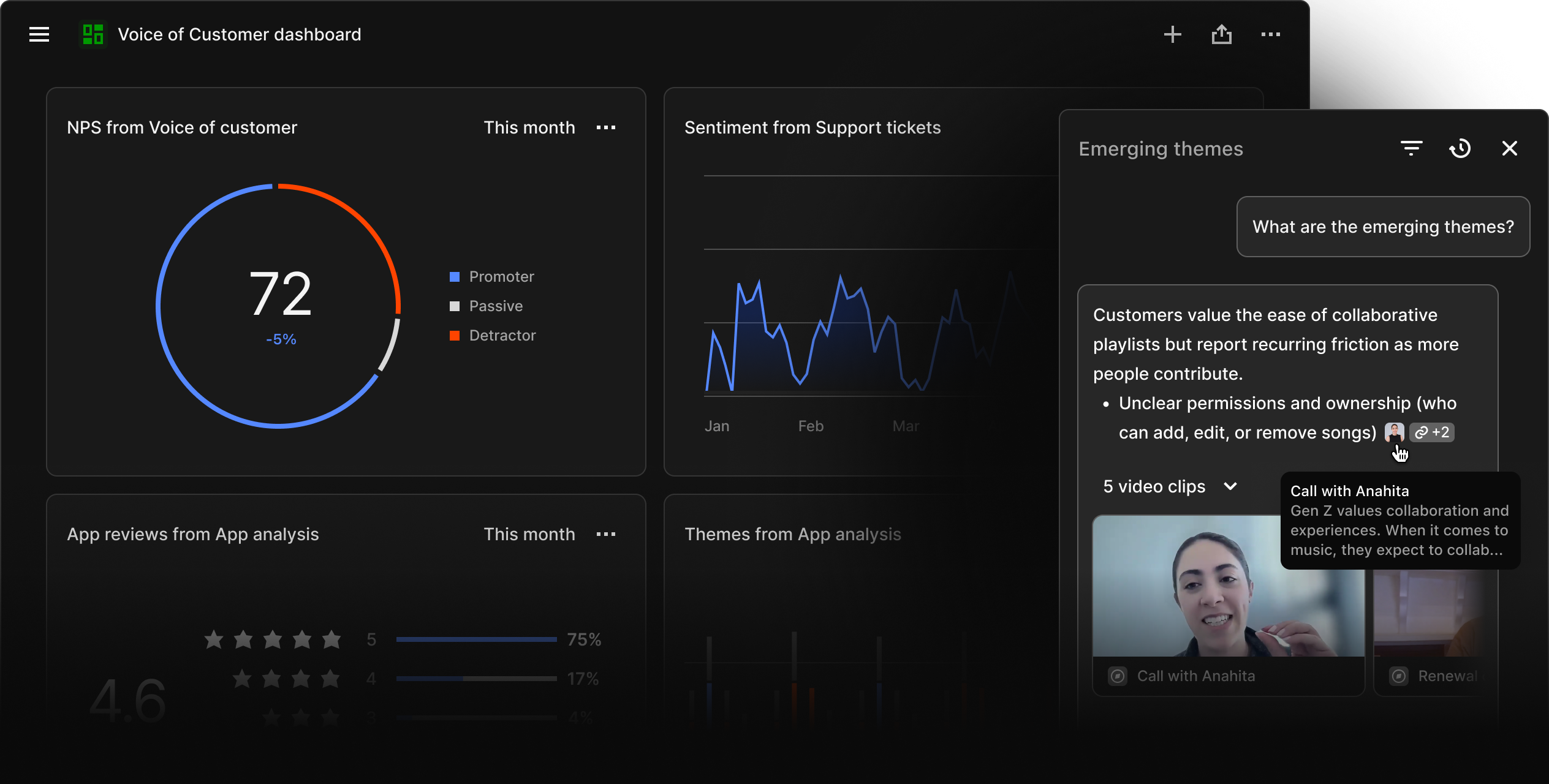
Dovetail comes from the research world. Its agents turn interviews and calls into product evidence.
What is Dovetail?
Dovetail is a customer insights and research repository. Dovetail Agents became generally available on July 14, 2026, at its Summer Launch '26.
Key agentic features
- Dovetail Agents: Spot and rank customer needs, assemble evidence, draft PRDs, and route work to Jira, Linear, Claude, or Cursor.
- Custom agents: Automate recurring processes such as stakeholder updates and monthly reports.
- Ask an Agent: Returns answers with citations.
- MCP, API, and CLI: Connects to Claude, Cursor, ChatGPT, Copilot, Slack, and Teams.
- Digital Twins and Channels: Additional capabilities that sit alongside Agents and Chat.
Pros and cons
Pros
- "Ease of Use" is Dovetail's top G2 pro, with 102 mentions.
- Strong collaboration features.
- Reviewers praise its MCP support.
Cons
- G2 reviewers flag "Missing Features" (34) and "Inefficient Tagging" (26).
- Some reviewers report rising prices.
Pricing
Dovetail offers a free plan at $0/user/month; Enterprise pricing is custom.
G2 rating
Dovetail G2 rating: 4.5 out of 5.
Best for
UX research and product teams synthesizing interviews and calls into roadmap evidence.
11. Zonka Feedback
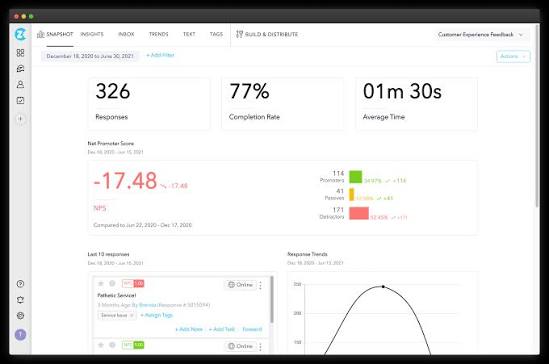
Zonka Feedback combines collection and analysis at a published entry price. It suits mid-market teams that want both in one tool.
What is Zonka Feedback?
Zonka Feedback is a survey and feedback management platform with an AI Feedback Intelligence layer. That layer includes what Zonka calls "Agentic AI" for alerts and anomaly detection.
Key agentic features
- AI Feedback Intelligence: Thematic analysis, impact and sentiment scoring, and entity recognition.
- Ask AI Insights Assistant: Query feedback in natural language.
- Real-time alerts: Delivered by email, SMS, WhatsApp, Slack, or Teams.
- CX automation: Workflows and case management.
- MCP server: Connects to Claude and ChatGPT.
Pros and cons
Pros
- G2 reviewers praise ease of use and customer support.
- Wide collection channels, including kiosk and offline.
- A 14-day free trial, per its G2 listing.
Cons
- G2 reviewers report a learning curve on advanced features.
- Some UI navigation issues and two "Software Instability" mentions.
Pricing
Customer Feedback starts at $99/month and AI Feedback Intelligence at $399/month, per Zonka's G2 listing. Zonka's own site quotes custom pricing.
G2 rating
Zonka Feedback G2 rating: 4.7 out of 5 (85 reviews).
Best for
Mid-market teams that want collection and AI analysis in one tool. For an enterprise view, read our Chattermill vs. Zonka Feedback comparison.
12. Productboard Spark
Productboard Spark is an agent for product management. It synthesizes customer needs inside the roadmap tool.
What is Productboard Spark?
Productboard Spark is the built-in agent in Productboard, a product management platform. It knows your product data, docs, and customer feedback.
Key agentic features
- Conversational agent: Answers questions over product data and documents.
- AI Findings and Opportunities: Surfaces customer needs and generates feedback reports.
- Spec drafting: Turns ideas into delivery-ready specs and measures the impact of shipped work.
- Scheduled tasks and skills: Automations plus a shared skills library.
- MCP server and connectors: Included in every plan.
Pros and cons
Pros
- Spark is included in every plan.
- MCP server included at no extra cost.
- Agentic web and competitor research built in.
Cons
- AI usage is capped by credits, starting at 500 per maker per month on Business.
- No published list price.
- The lowest G2 rating in this set, at 4.2.
Pricing
Custom pricing; Vendr reports a median of $24,280/year based on real buyer data. Vendr's range spans $7,728 to $78,666 across 235 purchases.
G2 rating
Productboard G2 rating: 4.2 out of 5 (256 reviews).
Best for
Product managers who want customer needs synthesized next to their roadmap.
How to Choose the Best Agents for Voice of Customer Analysis
The top agents for feedback analysis in 2026 are Chattermill, Qualtrics, and Medallia. Each pairs a named agent product with grounded analysis and a path to action, while Sprinklr and Enterpret are strong alternatives. Which one fits depends on these factors:
- Proactivity: Ask whether the agent works when nobody is prompting it. A reactive chatbot only finds what you already suspect.
- Evidence trail: Request a live demo where the agent answers a hard question. Confirm every claim links to source comments.
- Channel coverage: Validate that the agent analyzes surveys, reviews, tickets, calls, and social in one model.
- Language depth: Global programs need native analysis across languages, not translation layers.
- Impact measurement: Confirm the agent quantifies how themes move NPS, CSAT, CES, or churn.
- Workflow reach: Check Slack, Teams, Jira, and MCP support so insights land where work happens.
- Governance: Verify that agents inherit existing permissions and that PII is redacted.
- Total cost: Model costs at full rollout, since per-user fees and AI credits grow with adoption.
What users wish they knew: an agent built on weak tagging fails confidently. Test accuracy on your messiest, mixed-topic feedback before you sign.
Enterprise CX teams typically choose Chattermill, Qualtrics, or Medallia for scale and governance. Product-led companies often prefer Enterpret, Dovetail, or Productboard Spark. Financial services complaints teams should look at SentiSum, which now positions itself specifically for that sector, while mid-market buyers frequently start with Zonka Feedback.
For non-agentic options, see our roundup of customer feedback analysis tools.
FAQ
What is an agentic voice of customer platform?
An agentic voice of customer platform uses AI agents to monitor, analyze, and act on customer feedback with limited human prompting. It differs from collection agents, such as InMoment's Active Listening Agents or Perspective AI's interviewers, which gather new feedback. Our voice of the customer analysis guide explains the underlying process.
What are the top agents for feedback analysis?
The top agents for feedback analysis are Chattermill Lyra Agent, Qualtrics Experience Agents, and Medallia's agentic automation. Lyra Agent leads because it monitors feedback proactively on a CX-trained model and works in Slack and through MCP. Sprinklr's VOC Agent Suite and Enterpret Agent are strong alternatives.
What are the best agentic customer insights tools?
The best agentic customer insights tools are Chattermill, Qualtrics, and Medallia, our three top picks. Sprinklr, Enterpret, Dovetail, and Productboard Spark are strong alternatives, especially for listening and product research.
Chattermill suits enterprises because it pairs agentic customer insights with enterprise governance. It is SOC 2 Type II and ISO 27001:2022 certified, GDPR and CCPA compliant, with SSO, access controls, and automatic PII redaction. Explore Chattermill's customer feedback analysis for details.
How is an AI agent different from AI-powered text analytics?
AI-powered text analytics tags and scores feedback when someone runs a query. An AI agent monitors continuously, investigates root causes, and routes findings into workflows. Our overview of AI customer feedback analysis covers the text analytics layer agents depend on.
Can AI agents replace VoC analysts?
No, AI agents handle the reading, tagging, and first-pass investigation that consume analyst time. Analysts still set priorities, judge business context, and persuade leadership, even with the best agents for voice of customer analysis.
Our guide to building an AI agent for customer insights shows how teams divide that work.
The Bottom Line
The best agentic voice of customer tools in 2026 are Chattermill, Qualtrics, and Medallia, and Chattermill is our first choice. Among the best agents for voice of customer analysis, it is the one that combines a proactive, CX-trained agent with MCP, Skills, and enterprise governance.
Lyra Agent watches every channel, Slack brings answers to your team, and the MCP server extends that intelligence into any compatible agent. No per-user fees mean every team can use it. Imagine every product, CX, and operations leader starting the week with verified answers instead of open questions.
See how Lyra Agent fits your program. Book a personalized demo.


See Chattermill in action on your own feedback
Book a demo


