


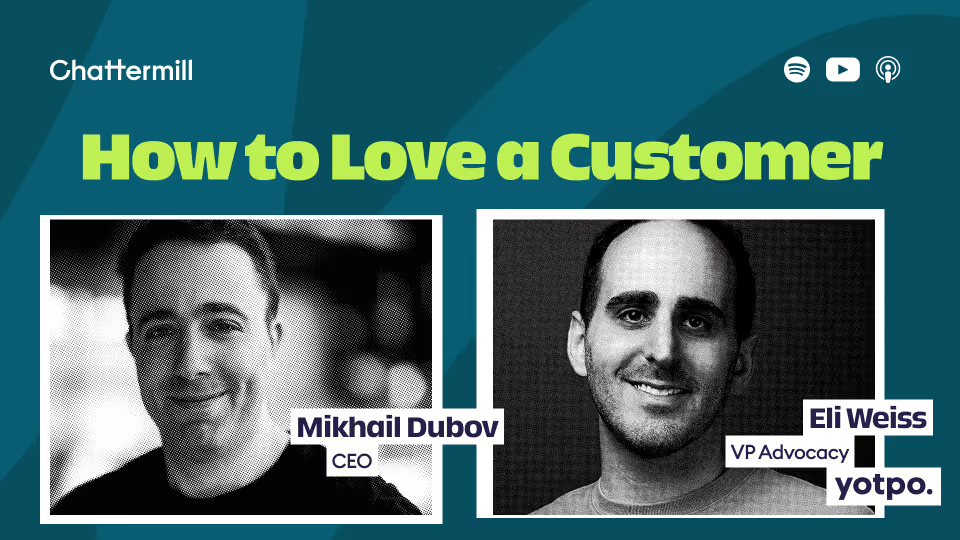
How To Love a Customer Podcast: Episode 8 with Eli Weiss, Yotpo


The CX intelligence
platform that's AI-native by design
Book a demoSome customer experiences are too important to ignore — even when they sound wrong.
Like a customer insisting their cola tastes like root beer.
That’s the moment that stayed with Eli Weiss, customer experience leader at brands like OLIPOP and Jones Road Beauty — and one that fundamentally shaped how he thinks about CX today.
In the latest episode of How to Love a Customer, Chattermill CEO & Co-Founder Mikhail Dubov sits down with Eli to explore what really happens when companies listen deeply to customers — and what breaks when they don’t.
From scaling DTC brands through hyper-growth to navigating AI, profitability, and expectation-setting, this episode is a masterclass in customer-led decision-making.
👉 Subscribe & listen to the full episode here
🔑 Key Takeaways from the Episode
1. Customer Signals Are Often Quiet — Until They’re Critical
A customer reached out to say their Vintage Cola tasted like Root Beer.
At first glance, it sounded impossible. Different SKUs. Different production days. Different lines.
But context changed everything.
This wasn’t a new customer. It was a long-term subscriber who knew the product inside out. Taking that signal seriously helped OLIPOP uncover a production error before it escalated into a nationwide retail issue.
“If this were a first-time customer, maybe you’d dismiss it. But someone who’s bought the product for 10 months? They know what it tastes like.” — Eli Weiss
Takeaway: The most valuable insights rarely announce themselves loudly. They reveal their importance when you zoom out.
2. Trust + Speed Turns CX Into a Risk-Reduction Engine
Because the CX team was trusted, they didn’t need to navigate layers of approval. They moved fast, pulled inventory, and prevented what could have become an FDA-level incident.
Many organisations fail here — not because they lack data, but because CX teams aren’t empowered to act.
“If we hadn’t moved at the speed of light, this would’ve been everywhere.” — Eli Weiss
This is what it looks like when customer insight functions as early warning infrastructure, not post-incident reporting.
3. Expectation Setting Is the Most Underrated CX Lever
Across DTC, SaaS, and hospitality, Eli returns to the same truth:
Most bad experiences aren’t caused by delays or issues — they’re caused by misaligned expectations.
Customers will wait weeks — even months — if they understand why. What breaks trust is silence, vague promises, or misleading timelines.
“Most of customer experience is just expectation versus reality — and expectations aren’t being set.” — Eli Weiss
Before brands chase “delight,” they need to fill the valleys.
4. Customer Delight Without Insight Is Just Noise
OLIPOP experimented with discretionary surprise-and-delight budgets — and quickly learned that generic gestures rarely land.
A plant sent to a Silicon Valley VC? Forgotten.
A thoughtful wedding registry gift to a loyal customer? Unforgettable.
“All it takes is someone giving a shit — not just spending the money.” — Eli Weiss
True delight isn’t about scale. It’s about relevance — which only comes from understanding customers properly.
This is why leading teams pair qualitative feedback with behavioral insight, using platforms like Chattermill to identify what actually matters at scale.
5. CX Can’t Be Bolted On — It Has to Be Led From the Top
Eli is direct: if founders don’t genuinely care about customers, no tooling or hiring plan will fix it.
Customer-centric companies don’t just talk about CX. They fund it, prioritise it, and listen to frontline teams.
“You can hire anyone. If leadership doesn’t care, nothing changes.” — Eli Weiss
This is where CX stops being a support function and becomes strategic infrastructure.
💡 The Reality Check: CX ≠ Guaranteed Short-Term Growth
Some brands grow despite poor experiences. Others invest deeply in CX without seeing immediate revenue impact.
So why do it?
Because brand trust, advocacy, and long-term loyalty compound, even when they don’t show up instantly in dashboards.
“I might still buy — but I won’t tell anyone.” — Eli Weiss
CX doesn’t just shape transactions. It shapes who talks about you — and how.
🤖 AI in CX: Power Tool, Not Autopilot
AI is everywhere — but Eli warns against confusing automation with resolution.
Many companies mark issues as “resolved” simply because a customer stopped replying. That doesn’t mean the experience worked.
“I know within two seconds when a response is AI-generated.” — Eli Weiss
The future isn’t AI replacing humans — it’s AI accelerating insight, freeing teams to focus on judgment, empathy, and action.
🔥 Bonus Hot Takes
- Overhyped Trend: “AI will replace CX jobs”
- Common CX Mistake: Creating peaks without fixing the basics
- Underrated Skill: Deep listening
- CX Inspiration: Hyatt — for consistency over flash
🧳 Why This Episode Matters
This conversation goes beyond tactics. It shows what customer experience looks like when it’s treated as:
- An early risk-detection system
- A driver of operational clarity
- A foundation for brand trust
- A discipline powered by insight — not guesswork
Listening is only the first step. Acting is what changes outcomes.
🎧 Listen to How to Love a Customer
If you work in CX, Product, Research, or Growth, this episode is packed with lessons you can apply immediately.
Episode Notes:
00:00 — Meet Eli Weiss: CX Leader, DTC Operator & Newsletter Voice
From high-school dropout to one of the most influential voices in customer experience — with stops at Away-style startups, OLIPOP, Jones Road Beauty, and now Yotpo.
01:00 — How Eli Fell Into CX (and Why It Changed Everything)
Started in “customer service” before CX was a function. Learned the craft the hard way — handling angry Kickstarter backers and building transparency through radical honesty.
03:00 — The DTC Journey: Luggage → Vegan Nuggets → OLIPOP → Jones Road
Eli explains how he became the go-to CX + Retention leader across high-growth brands, taking OLIPOP from ~$6M to $75M and Jones Road from $20M to $120M.
06:00 — What Makes DTC Brands Win (or Fail)
DTC 1.0: grow fast, ignore profits.
DTC 2.0: profitability + fundamentals.
DTC 3.0: tiny teams, huge revenue, extreme leverage.
CX becomes a differentiator only if leadership cares.
09:00 — Why Many Fast-Growing Brands Still Have Awful CX
Some products are so desirable that experience almost doesn’t matter — but brands that want loyalty and word-of-mouth must invest early.
13:00 — CX Is More Than Support
Experience = product quality, delivery reliability, expectation setting, communication, and brand tone — not just helpdesk responses.
17:00 — The OLIPOP Story: When Root Beer Was Labeled as Vintage Cola
A customer said their Vintage Cola tasted like root beer… and they were right.
Ops missed a production error, but CX caught it.
Quick escalation prevented a nationwide retail disaster.
20:00 — Lessons: Move Fast, Trust CX, Look at Customer History
Context matters: a long-time subscriber knows the product better than anyone.
Most companies ignore these signals — OLIPOP didn’t.
23:00 — Culture Is the Real Accelerator
At OLIPOP, founder buy-in meant CX could escalate directly to the top.
In other companies, that same ticket would have been dismissed as “spam.”
24:00 — How to Operationalise CX Excellence
Fix the basics before “delight.”
Audit your experience like a customer.
Set expectations clearly.
Then — and only then — create memorable moments.
27:00 — How to Do Surprise & Delight Properly
Don’t send random gifts.
Learn who your customer is, what they care about, and personalise.
The “wedding registry” example shows how small effort → huge emotional payoff.
32:00 — Hot Take: AI Everywhere Needs to Chill
AI is useful, but generic responses destroy trust.
Most brands mis-measure AI success by counting “resolved tickets” that were never actually resolved.
35:00 — On Omnichannel & Retail Expansion
Retail reduces support volume, but brands lose insight.
Stores can be gold mines for real-world learning if they’re staffed with people who feel like the brand.
38:00 — Brands Killing CX (Outside DTC)
Hyatt — for consistency, reliability, and doing the basics exceptionally well.
And in DTC: Vuori — understated, consistent, founder-led CX quality.



See Chattermill in action on your own feedback
Book a demo


