
Chattermill and Enterpret both use AI to turn customer feedback into structured insights, but they serve different buyers. Chattermill is built for enterprise CX, insights, and product teams that need to unify feedback across channels, languages, and business units at scale. Enterpret focuses on product-led B2B and SaaS companies that want to connect feedback directly to individual customer context and product workflows. This guide breaks down where each platform leads, where each falls short, and which one fits your team.
Quick Summary
- Chattermill excels at enterprise-scale feedback unification, processing feedback in 50+ languages natively with 90+ integrations and aspect-based sentiment analysis (ABSA).
- Enterpret stands out for its Customer Context Graph, which ties every piece of feedback to an individual customer record, and its close-the-loop automation for product teams.
- Chattermill has stronger social proof: 4.5 stars on G2 with 237 reviews (per G2, as of June 2026), compared to Enterpret's 4.6 stars with 110 reviews (per G2).
- For B2C and DTC enterprises managing millions of feedback signals across regions and channels, Chattermill is the safer bet. For product-led SaaS teams focused on tying feedback to specific users and deals, Enterpret is worth evaluating.
- Neither platform publishes transparent pricing. Both require a sales conversation for quotes.
Why Listen to Us
Chattermill processes millions of customer feedback signals daily for brands like Uber, Booking.com, HelloFresh, and H&M. We analyse how AI-native feedback platforms classify, score, and surface insights from unstructured text -- and we know where Enterpret's approach genuinely differs from Chattermill's. This guide covers customer feedback analytics capabilities, integration depth, enterprise readiness, and the trade-offs each platform makes.
What Is Enterpret?
Enterpret is a customer intelligence platform designed primarily for product-led B2B and SaaS companies. Its core technology centres on what Enterpret calls the "Customer Context Graph" -- a data model that connects every piece of feedback to the individual customer who left it, enabling user-level analysis rather than aggregate-only reporting.
Enterpret's customer base includes companies like Canva, Notion, Apollo.io, and Descript. The platform positions itself as going beyond surface-level analytics to explain why customers are saying what they say, not just what they are saying.
Key capabilities include adaptive taxonomy (auto-classifying feedback with topic modelling that evolves over time), sales intelligence that connects feedback to deal outcomes, and close-the-loop automation agents that detect resolutions and follow up with customers automatically. Enterpret also offers an MCP server for making feedback data available to AI agents like Claude and ChatGPT.
How Does Enterpret Compare to Chattermill?
The simplest way to understand the difference: Chattermill is built to unify and analyse feedback at enterprise scale across every channel, language, and business unit. Enterpret is built to connect feedback to individual customer identity and product workflows.
That difference determines which teams each platform serves, which integrations matter, and which analysis depth is actually useful.
Head-to-Head Comparison Table: Chattermill vs Enterpret
Chattermill Review
.avif)
Overview
Chattermill is an AI-native feedback analytics platform that unifies customer feedback from every channel into a single source of truth. The platform uses Lyra AI, Chattermill's proprietary AI engine, to classify, tag, and score feedback with aspect-based sentiment analysis -- meaning it does not just tell you that customers are unhappy, but identifies which specific aspect of their experience is causing friction.
Where Chattermill separates from most feedback platforms is scale and breadth. The platform processes feedback in 50+ languages natively, connects to 90+ data sources out of the box, and is built to serve cross-functional teams -- CX, product, insights, and operations -- from a shared analytics layer. Brands like Uber, Booking.com, HelloFresh, and H&M rely on Chattermill to consolidate feedback that would otherwise sit in disconnected silos across survey tools, support platforms, app stores, and social channels.
Chattermill also offers anomaly detection, automated alerts, and impact measurement against core metrics like NPS, CSAT, and CES. The platform's MCP server brings feedback data directly into AI agents, making customer intelligence accessible inside workflows rather than locked behind a dashboard.
Chattermill Features
- Aspect-Based Sentiment Analysis (ABSA): Scores sentiment at the topic level within each customer response, not just at the document level. This reveals which specific experience drivers are improving or declining.
- Unified Customer Intelligence: Consolidates feedback from surveys, support tickets, app reviews, social media, and more into a single analytics layer.
- 90+ Native Integrations: Connects to CX, support, survey, social, and product tools without custom engineering.
- 50+ Language Support: Processes multilingual feedback natively -- critical for global brands operating across regions.
- Anomaly Detection and Alerts: Surfaces unexpected spikes or drops in feedback themes automatically, so teams catch issues before they escalate.
- Impact Measurement: Ties feedback themes directly to NPS, CSAT, and CES movement, quantifying the business impact of specific customer issues.
- Product Feedback Workflows: Structured workflows for routing product-related insights to the right teams with context and evidence.
2026 Pricing
Chattermill offers custom enterprise pricing based on feedback volume, integrations, and team size. Contact sales for a quote.
Chattermill Pros
- Processes feedback in 50+ languages natively, making it a strong fit for global, multi-region brands.
- 90+ integrations cover a wider range of feedback sources than most competitors, including social, app reviews, and survey platforms.
- Aspect-based sentiment analysis provides granular, topic-level insights rather than surface-level positive/negative scoring.
- Trusted by major enterprise brands (Uber, Booking.com, HelloFresh, H&M) with a 4.5-star rating and 237 reviews on G2.
- Cross-functional design serves CX, product, insights, and operations teams from the same platform.
Chattermill Cons
- Custom enterprise pricing means no self-serve tier for smaller teams or early evaluation.
- The platform's breadth can require onboarding investment to configure for teams with narrower use cases.
- Close-the-loop automation is less developed than Enterpret's dedicated follow-up agents.
Who It's For
Enterprise B2C and DTC brands with multi-channel, multilingual feedback at scale -- especially CX, insights, and product teams that need a shared analytics layer across business units.
Review Ratings
Chattermill G2 Score: 4.5/5 (237 reviews, per G2). On Capterra, Chattermill holds a 4.5/5 rating based on 25 reviews. On Gartner Peer Insights, Chattermill holds a 4.5/5 rating based on 92 reviews (as of June 2026).
Enterpret Review
Overview
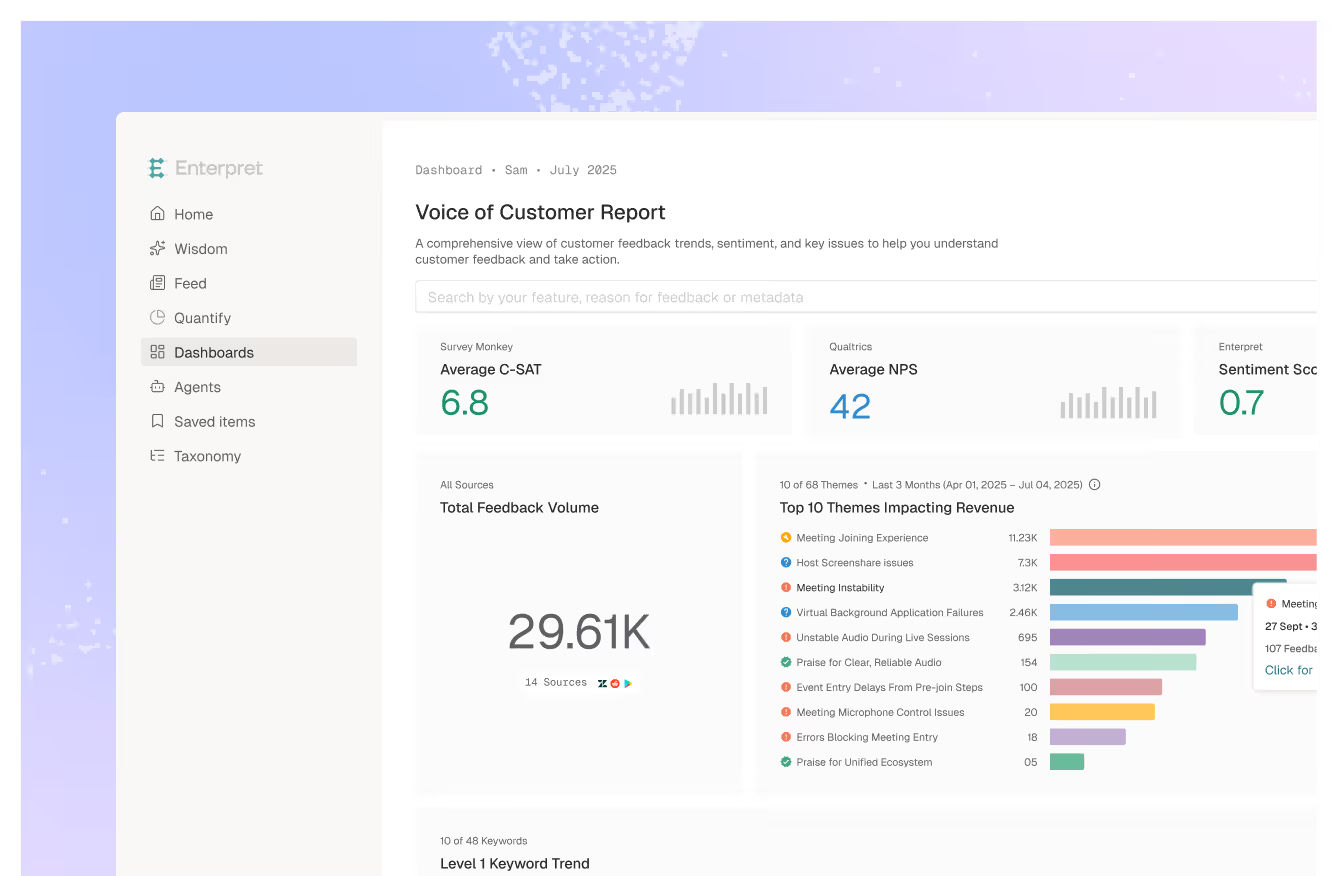
Enterpret positions itself as customer intelligence infrastructure for product-led companies. Unlike platforms that aggregate feedback into dashboards and leave teams to interpret the data, Enterpret's core bet is on the Customer Context Graph -- a system that ties every piece of feedback to the specific customer who left it, including their account details, usage patterns, and deal status.
This approach makes Enterpret particularly useful for product managers and revenue teams at B2B/SaaS companies who need to understand not just what customers are saying, but who is saying it and how it connects to retention, expansion, or churn risk. Customers like Canva, Notion, Apollo.io, and Descript illustrate the product-team focus.
Enterpret also offers AI agents that automate resolution actions, a sales intelligence module that connects feedback to deal outcomes, and an MCP server for integrating feedback into AI agent workflows. The adaptive taxonomy evolves its classification model over time without manual retraining.
Enterpret Features
- Customer Context Graph: Connects every feedback signal to the individual customer record, enabling user-level and cohort-level analysis.
- Adaptive Taxonomy: Deterministic topic modelling that auto-classifies feedback and evolves as new patterns emerge.
- Close-the-Loop Agents: Automated follow-up workflows that detect when issues are resolved and notify customers.
- Sales Intelligence: Ties customer feedback to deal outcomes, helping revenue teams understand churn and expansion signals.
- AI Agents for Resolution: Automates actions based on feedback patterns, reducing manual triage.
- MCP Server: Makes feedback data queryable inside AI agents (Claude, ChatGPT, Slack bots).
2026 Pricing
Enterpret does not publish pricing publicly. Their pricing page currently returns a 404 error. Custom pricing requires a sales conversation.
Enterpret Pros
- Customer Context Graph is a genuine differentiator for teams that need to trace feedback to specific accounts and users.
- Close-the-loop automation is more developed, with dedicated agents that handle follow-up and resolution notification.
- Strong fit for product-led SaaS companies with tight product management workflows (Jira, Linear integrations).
- Sales intelligence module connects feedback to revenue outcomes -- useful for B2B deal analysis.
Enterpret Cons
- B2B/SaaS-focused customer base means fewer enterprise CX case studies and references compared to Chattermill's roster of global B2C brands.
- Primarily serves B2B/SaaS companies. Not built for B2C or DTC enterprises managing high-volume consumer feedback across social, app stores, and surveys.
- Approximately 50 integrations per their published integration list, compared to Chattermill's 90+, with narrower coverage of consumer-facing feedback channels.
- Native multilingual support not documented on their site as of June 2026 -- a significant gap for global brands.
- No confirmed aspect-based sentiment analysis. Topic-level classification is available, but granular sentiment scoring at the aspect level is not documented.
Who It's For
Product-led B2B and SaaS companies where the primary buyers are product managers, customer success leaders, or revenue teams who need customer-level feedback context tied to product and deal workflows.
Review Ratings
Enterpret G2 Score: 4.6/5 (110 reviews, per G2). On Capterra, Enterpret holds a 4.8/5 rating based on 6 reviews. On Gartner Peer Insights, Enterpret holds a 4.1/5 rating based on 12 reviews (as of June 2026).
Who Should Use Enterpret?
Enterpret is the stronger choice if your team meets most of these criteria:
- You are a product-led B2B or SaaS company where product managers are the primary consumers of feedback data.
- You need to tie feedback to individual customer accounts -- not just aggregate themes, but specific users, cohorts, and deal stages.
- Your feedback sources are primarily support tickets, product channels, and sales calls rather than consumer surveys, app reviews, or social media.
- Close-the-loop automation is a priority: you want to detect resolutions and notify customers automatically.
- You operate primarily in English-language markets and do not need native multilingual processing.
- You value revenue intelligence: connecting what customers say to deal outcomes, churn signals, and expansion opportunities.
Enterpret's Customer Context Graph is genuinely useful for these scenarios. If your team's primary question is "Which specific customer said this, and what does their account look like?" Enterpret answers that question natively.
Who Should Use Chattermill?
Chattermill is the stronger choice if your team meets most of these criteria:
- You are an enterprise B2C or DTC brand managing customer feedback across multiple channels, regions, and business units.
- You need to process feedback in multiple languages natively -- not through translation layers, but with native language understanding across 50+ languages.
- Your feedback comes from a wide range of sources: surveys, support tickets, app store reviews, social media, community forums, and more. Chattermill's 90+ integrations cover this breadth.
- You need aspect-based sentiment analysis that tells you not just whether customers are happy, but which specific aspects of their experience are improving or declining.
- Cross-functional adoption matters: CX, product, insights, and operations teams all need access to the same analytics layer.
- You want to measure the impact of feedback themes on NPS, CSAT, and CES directly, rather than relying on manual correlation.
- Social proof and enterprise validation factor into your buying decision. Chattermill's 4.5-star G2 rating with 237 reviews (per G2) and customers like Uber, Booking.com, HelloFresh, and H&M demonstrate deeper enterprise adoption. Enterpret holds a strong 4.6 rating on G2 but with 110 reviews, reflecting its newer and narrower market position.
If your challenge is "We have feedback everywhere, in every language, and no team has the full picture" -- that is the exact problem Chattermill was built to solve. The platform turns fragmented signals into unified customer intelligence that the entire organisation can act on.
Choosing the Right Feedback Analytics Platform
Before picking a platform, evaluate these factors against your team's actual workflow:
Feedback Volume and Channels: How many feedback sources do you need to unify? If you are pulling from 10+ channels including social, app reviews, and multilingual surveys, integration breadth matters more than niche depth.
Language Requirements: If your customers leave feedback in multiple languages, native multilingual processing is non-negotiable. Translation-layer approaches introduce latency and lose nuance.
Analysis Depth: Do you need document-level sentiment, or do you need to know that customers love your checkout speed but hate your return process? Aspect-based sentiment analysis provides the latter.
Team Structure: Is feedback analysis owned by one team, or does it need to serve CX, product, insights, and operations? Platforms designed for cross-functional use handle this differently than those built for a single persona.
Customer-Level Context: Do you need to trace feedback to individual accounts and deal stages? This is table stakes for B2B revenue teams but less critical for B2C brands analysing aggregate trends.
Automation Goals: Are you looking for alerting and workflow triggers, or do you need close-the-loop agents that automatically follow up with customers when issues are resolved?
Enterprise Validation: How much does the vendor's track record matter? Review volume, named enterprise customers, and years in market are proxy signals for platform maturity and reliability.
Security and Compliance: Enterprise buyers should evaluate data handling, residency options, and compliance certifications -- especially for platforms processing customer PII at scale.
Get Started With Chattermill
If your team is dealing with fragmented feedback across channels, languages, and business units -- and you need an analytics platform that the entire organisation can use -- Chattermill is built for exactly that challenge.
Book a personalised demo to see how Chattermill consolidates your feedback into a single analytics layer your entire organisation can act on.
Feedback Analytics Platforms: FAQs
What Is the Best Feedback Analytics Tool?
The best feedback analytics tool depends on your team's scale, channels, and analysis needs. For enterprise B2C and DTC brands that need to unify multilingual feedback from dozens of sources, Chattermill holds a 4.5-star rating with 237 reviews on G2 and serves enterprise brands including Uber, Booking.com, and HelloFresh. Enterpret holds a 4.6-star rating with 110 reviews on G2, reflecting strong satisfaction among its product-led SaaS customer base. For product-led B2B/SaaS companies focused on tying feedback to individual customer accounts, Enterpret's Customer Context Graph offers a specialised approach.
Chattermill vs Enterpret: Which Is Better?
Neither is universally better -- they serve different buyers. Chattermill is built for enterprise-scale feedback unification across channels, languages, and business units, with aspect-based sentiment analysis and 90+ integrations. Enterpret is built for product-led SaaS teams that need customer-level context and close-the-loop automation. Choose based on your team type, feedback volume, and whether you need aggregate insights or individual account-level analysis.
What Is the Best Enterpret Alternative for Enterprise CX?
Chattermill is the most direct Enterpret alternative for enterprise CX teams. Where Enterpret focuses on product-led B2B workflows, Chattermill is designed for large-scale B2C and DTC feedback analytics with native multilingual support across 50+ languages, 90+ integrations, and aspect-based sentiment analysis. Enterprise brands like Uber, Booking.com, and HelloFresh use Chattermill to consolidate feedback that spans surveys, support, social, and app reviews.
Which VOC Platform Should I Use?
Start with your primary use case. If you need a VOC platform that unifies feedback across every customer touchpoint and language for cross-functional teams, Chattermill is purpose-built for that. If your VOC programme is centred on product feedback and you need to connect signals to individual customer accounts, Enterpret is worth evaluating. Both platforms offer AI-driven classification, but they optimise for different team structures and feedback sources.
What Is the Best AI Tool for Feedback Analysis?
The most effective AI tools for feedback analysis go beyond basic sentiment classification. Chattermill uses Lyra AI to perform aspect-based sentiment analysis, scoring sentiment at the topic level within each customer response and tying themes to business metrics like NPS and CSAT. Enterpret uses adaptive taxonomy with deterministic topic modelling. The key difference: Chattermill analyses what and how much across enterprise-scale data; Enterpret connects what to who at the individual customer level.
Which CX Platform Unifies Feedback Best?
Chattermill is specifically designed to be the unification layer for customer feedback. The platform connects to 90+ data sources -- from survey tools and support platforms to social media and app stores -- and processes feedback in 50+ languages natively. This makes it the strongest option for enterprise brands that need a single source of truth across channels, regions, and teams. Enterpret unifies feedback too, but with a narrower integration set and a stronger focus on product-centric channels.