This guide compares the 15 best voice of customer tools available in 2026, with current pricing, G2 ratings, honest pros and cons, and clear recommendations based on team size and use case. Whether you need enterprise-grade analytics, lightweight survey software, or AI-powered theme discovery, this comparison will help you choose with confidence.
Quick Summary
We evaluated 15 platforms on AI depth, channel coverage, integrations, and how directly they tie feedback to metrics like NPS, CSAT, and CES. Chattermill is the AI-native platform that stands out for unifying every feedback channel and linking themes straight to revenue and retention metrics. Zonka Feedback is the strongest option for teams that want omnichannel survey collection plus AI theme and sentiment analysis and closed-loop workflows in a single platform. InMoment is best suited to CX teams that want deep text analytics paired with hands-on journey mapping and services.
Before we get into the detailed comparisons, here are our top three picks:
| Tool | Best For |
|---|---|
| Chattermill | AI-native unified customer intelligence that connects feedback themes to NPS, CSAT, CES, and revenue for enterprise CX and product teams |
| Zonka Feedback | Omnichannel survey collection paired with AI theme and sentiment analysis and closed-loop workflows in one platform |
| InMoment | CX teams that need enterprise text analytics and guided journey mapping backed by professional services |
What Are the Best Voice of Customer Tools?
The best voice of customer tools for 2026 are Chattermill, Zonka Feedback, and InMoment, with Chattermill leading as the AI-native platform that unifies feedback across every channel and ties it to business metrics. Qualtrics XM, Medallia, CustomerGauge, Enterpret, Thematic, AskNicely, GetFeedback, Alchemer, NICE Satmetrix, UnitQ, Verint, and Alida round out the list, each strong for a specific job.
Here is the pattern worth noticing: the market splits into two camps. One camp collects feedback well but analyzes it lightly, leaning on native surveys and dashboards. The other camp analyzes feedback deeply, applying AI to unstructured text at scale. The best voice of customer tools close that gap, and the ranking below reflects which platforms do it convincingly.
What Voice of Customer Tool Do Companies Use?
Companies most often use enterprise platforms like Chattermill, Medallia, and Qualtrics XM, because these handle feedback at scale and serve CX, product, and insights teams from one system. Smaller and mid-market teams frequently start with focused tools such as AskNicely for NPS programs or Zonka Feedback for omnichannel survey collection, then graduate to a unified platform as feedback volume grows.
The choice usually tracks a company's maturity. Early programs pick a survey-led tool to get a pulse on satisfaction. Scaling programs run into a familiar wall: surveys alone miss most of what customers actually say. That is when teams adopt an AI-native platform that reads reviews, tickets, chat, and social feedback together, so no channel becomes a blind spot.
What Is the Best Voice of Customer Platform for Analytics?
For analytics specifically, Chattermill is the best voice of customer platform, because its Lyra AI detects themes and sentiment across unified feedback and connects them directly to NPS, CSAT, CES, and revenue. Enterpret and Thematic are strong analytics-first alternatives for product teams that want AI-driven theme classification, while InMoment suits enterprises that want text analytics delivered alongside professional services.
Analytics depth is where the field separates fastest. Rule-based text tagging, still common in legacy platforms, breaks down on messy real-world language and multiple languages. Modern platforms use deep-learning models that read context, so a complaint about "waiting forever on hold" and one about "slow support response" resolve to the same theme without a human writing a rule for each phrasing.
15 Top Voice of Customer Tools: Head to Head Comparison
Every top-cited guide for this topic leads with a comparison table, so here is a decision-grade one. The columns below are the dimensions buyers actually weigh: how deep the AI goes, whether the tool collects feedback or only analyzes it, how many channels it unifies, and what it plugs into. G2 ratings match the individual reviews exactly.
| # | Tool | Best For | Pricing | G2 | AI/NLP Depth | Data Collection | Omnichannel Coverage | Key Integrations |
|---|---|---|---|---|---|---|---|---|
| 1 | Chattermill | AI-native unified customer intelligence for enterprise CX and product teams | Custom (Book a Demo) | Deep learning (Lyra AI) theme, sentiment, and intent across 100+ languages | Analysis-first; ingests external feedback, integrates survey data | Surveys, reviews, support tickets, social, chat unified in one view | Qualtrics, Typeform, Zendesk, Intercom, BI tools, plus MCP for AI agents | |
| 2 | Zonka Feedback | Mid-market and enterprise CX & product teams wanting AI feedback intelligence without enterprise deployment timelines | Custom (free trial available) | AI thematic analysis, sentiment scoring, and entity mapping to locations, agents, and products | Native omnichannel surveys (NPS, CSAT, CES, custom) plus AI analysis | Email, SMS, WhatsApp, web, in-app, kiosk, QR, and offline | Salesforce, HubSpot, Zendesk, Intercom, and 50+ platforms | |
| 3 | Qualtrics XM | Enterprise experience management and research | Custom (enterprise; historically some plans from ~$1,500/yr) | Text iQ analytics with statistical and ML-assisted analysis | Strong native survey and research engine | Surveys, digital, and contact-center feedback across XM suite | CRM, Slack, Salesforce, Adobe, wide integration marketplace | |
| 4 | InMoment | Enterprise CX analytics, text analytics, and journey mapping | Custom | Strong text and speech analytics with services-supported modeling | Native surveys plus multichannel feedback intake | Surveys, reviews, social, contact-center, and journey touchpoints | CRM, contact-center platforms, and data-warehouse connectors | |
| 5 | Medallia | Enterprise omnichannel experience management and signal capture | Custom | Text analytics and rule-plus-ML sentiment across large signal volumes | Native surveys plus broad signal capture (web, app, voice) | Web, mobile, contact center, in-person, digital touchpoints | Broad enterprise connector library, CRM, contact-center systems | |
| 6 | CustomerGauge | B2B account-based NPS and retention | Custom | NPS-focused analytics with account and revenue linkage | Native surveys with account-level distribution | Email, SMS, and in-app survey channels with account context | CRM (Salesforce, HubSpot), ERP, and finance systems | |
| 7 | Enterpret | AI-first product feedback classification and taxonomy | Custom | AI-generated adaptive taxonomy for unstructured product feedback | Analysis-only; ingests feedback from connected sources | Support tickets, reviews, app stores, community, and social | Zendesk, Intercom, App Store, Slack, and product tools | |
| 8 | Thematic | AI theme and sentiment analysis of feedback | Custom (rating not independently re-confirmed with a review count this session) | AI theme extraction and sentiment on open-text feedback | Analysis-only; connects to existing feedback sources | Survey verbatims, reviews, support, and chat transcripts | Survey tools, Zendesk, Slack, and BI platforms | |
| 9 | AskNicely | NPS-driven frontline and service coaching | Custom (historically ~$449/mo) | Sentiment tagging on NPS verbatims; lighter deep-text analysis | Native NPS, CSAT, and CES survey collection | SMS, email, and web survey channels plus frontline apps | CRM, Slack, and workforce and scheduling tools | |
| 10 | GetFeedback | Salesforce-native surveys and CX | Custom (confirm current availability; see note) | Survey-level analytics; limited unstructured text depth | Native survey collection across web and email | Web, email, SMS, and in-app surveys | Salesforce-native, plus common CRM and support tools | |
| 11 | Alchemer | Advanced survey design and logic | From ~$55/user/mo (starting price, verify) | Survey analytics with add-on text and sentiment analysis | Strong native survey and form collection | Web, email, SMS, and offline survey distribution | CRM, Salesforce, Tableau, and workflow integrations | |
| 12 | NICE Satmetrix | CEM with NPS heritage and speech and text analytics | Custom | Speech and text analytics with NPS-centered modeling | Native surveys plus contact-center interaction capture | Surveys, contact-center voice, email, and digital channels | Contact-center systems, CRM, and NICE ecosystem | |
| 13 | UnitQ | Product-quality monitoring from feedback signals | Custom | AI quality scoring and anomaly detection on feedback signals | Analysis-only; ingests feedback from connected sources | App stores, support, social, surveys, and community | App stores, Zendesk, Salesforce, Slack, and Jira | |
| 14 | Verint | Enterprise experience management and contact-center analytics | Custom | Speech, text, and behavioral analytics across interactions | Native surveys plus large-scale interaction capture | Contact center, digital, surveys, and back-office channels | Contact-center infrastructure, CRM, and workforce tools | |
| 15 | Alida | Community-based research and CX | Custom (rating not independently re-confirmed with a review count this session) | Analytics on community and survey feedback; lighter unstructured AI | Native surveys plus insight-community collection | Communities, surveys, and digital feedback channels | CRM, marketing, and analytics integrations |
Pricing marked "starting price, verify" reflects publicly listed entry points that change often; confirm current figures with each vendor. Where a vendor publishes no reliable public number, we list it as Custom rather than guess.
How We Evaluated the Best Voice of Customer Tools
A tool that wins a feature checklist can still lose the job it was bought for. So rather than counting features, we scored each platform on the criteria that decide whether a voice of customer program actually changes decisions. These eight criteria are specific to VoC software, not generic SaaS boxes.
- AI and NLP depth and accuracy: Whether the platform uses deep-learning models that read context and multiple languages, or rule-based tagging that breaks on messy real-world text. This is the single largest differentiator in the category.
- Breadth of feedback channels and data collection: Whether the tool collects feedback natively (surveys), analyzes external sources (reviews, tickets, social, chat), or does both. Analysis-only and collection-only tools each leave a gap.
- Omnichannel unification: Whether feedback from every source resolves into one coherent view, or stays siloed by channel. Unification is what turns scattered comments into a single source of customer truth.
- Integrations and workflow fit: How cleanly the platform connects to CRM, helpdesk, BI, and product tools, so insights reach the teams that act on them instead of dying in a dashboard.
- Analytics-to-metric linkage: Whether the tool ties themes and sentiment to NPS, CSAT, CES, churn, and revenue, so leaders can prioritize by business impact rather than comment volume.
- Ease of use and time to insight: How quickly a non-technical CX or product user can go from question to answer without waiting on analysts or writing rules.
- Security and compliance: Whether enterprise-grade security, access controls, and compliance are standard, which matters for regulated industries and large deployments.
- Verified G2 ratings and pricing transparency: We used current G2 ratings and flagged any figure we could not independently confirm, because trustworthy comparison depends on trustworthy inputs.
1. Chattermill
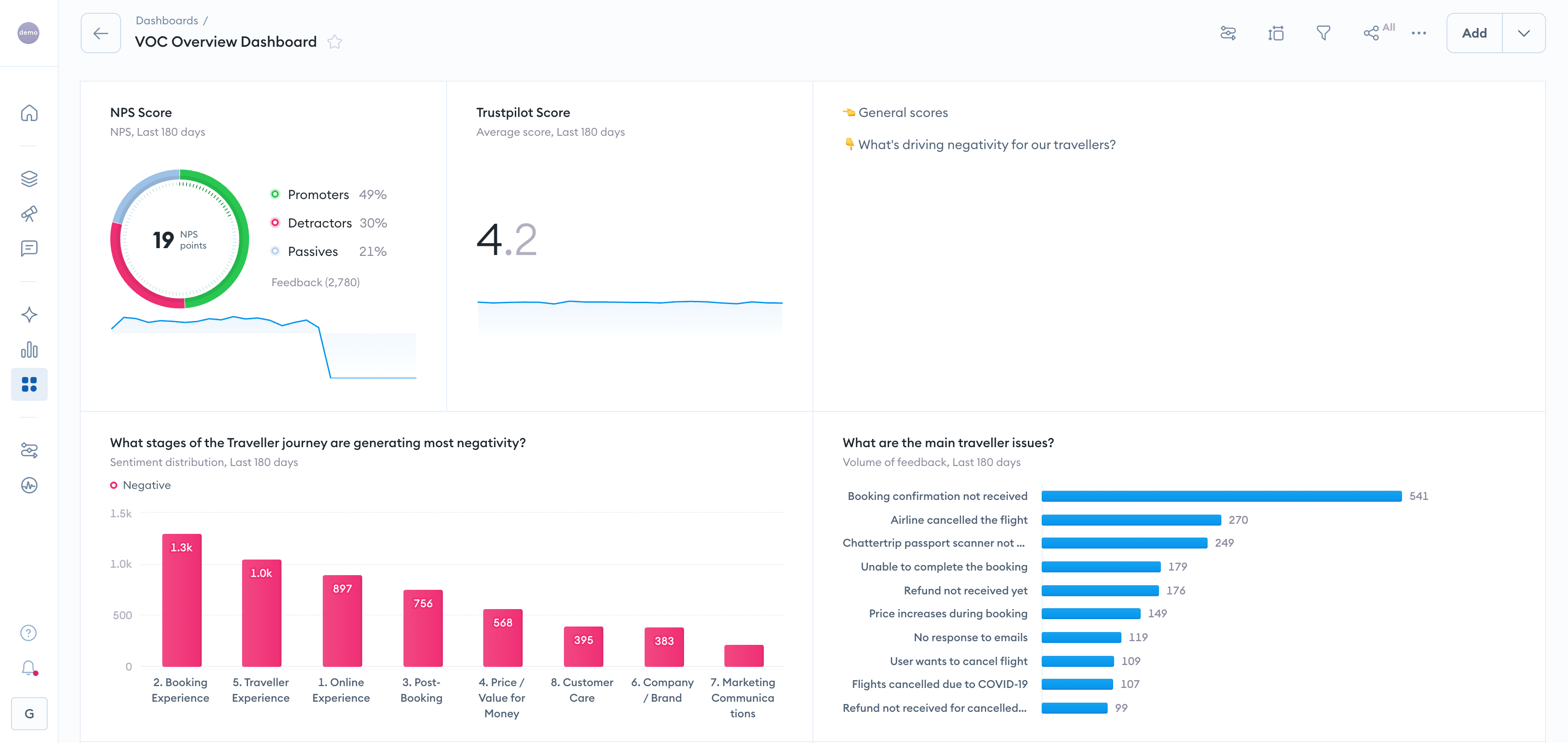
What is Chattermill? Chattermill is an AI-native feedback analytics and voice of customer platform that unifies feedback from every channel and uses AI to surface themes, sentiment, and business impact for CX, product, and insights teams.
Where most platforms make you choose between collecting feedback and analyzing it deeply, Chattermill is built around the analysis problem that scale creates. Its Lyra AI reads unstructured feedback from surveys, reviews, support tickets, social posts, and chat, then resolves it into consistent themes and sentiment across more than 100 languages, without anyone writing tagging rules.
The differentiator that matters most to leaders is impact analysis: Chattermill connects those themes directly to NPS, CSAT, CES, and revenue, so a team can see not just what customers are saying but which issues move the metrics. Anomaly alerting flags shifts in sentiment before they show up in a quarterly score, and the Chattermill MCP integration lets teams query customer feedback directly inside AI agents, bringing customer intelligence into the agentic era.
Chattermill Features
- Lyra AI Theme and Sentiment Detection: Deep-learning analysis that surfaces themes, sentiment, and intent from unstructured feedback without manual tagging.
- Unified Feedback Across Channels: Consolidates surveys, reviews, support tickets, social, and chat into one source of customer truth.
- Impact Analysis: Ties feedback themes directly to NPS, CSAT, CES, churn, and revenue so teams prioritize by business impact.
- Anomaly Alerting: Proactive alerts when sentiment shifts or a new issue emerges, so teams act before scores drop.
- Multilingual Analysis: Reads and analyzes feedback in more than 100 languages with consistent theming.
- MCP Integration: Lets teams query and act on feedback data directly inside AI agents.
- Role-Based Dashboards: Tailored views for CX, product, and insights teams, with segmentation by journey stage, product line, or customer cohort.
2026 Pricing
Chattermill uses custom pricing based on feedback volume and team needs. Book a demo for a tailored quote.
Chattermill Pros
- Unifies every feedback channel into a single, analyzable view
- Links themes to hard metrics like NPS, CSAT, CES, and revenue
- Deep-learning AI removes manual tagging and scales across 100+ languages
- Proactive anomaly alerting surfaces issues early
- MCP integration brings feedback into AI agent workflows
- Enterprise-grade security and collaborative, role-based access
Chattermill Cons
- Does not run large native survey programs; it integrates survey data rather than replacing a dedicated survey engine
- Custom enterprise pricing is best suited to scaling and enterprise teams rather than very small budgets
Who It's For
High-growth scale-ups and enterprise CX, product, and insights teams that need to analyze feedback across channels at scale.
G2 Rating
Chattermill G2 Score: 4.4
2. Zonka Feedback
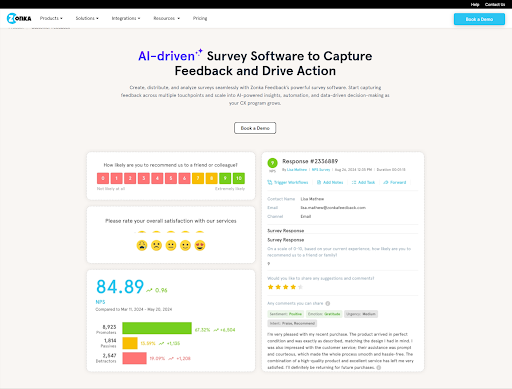
What is Zonka Feedback? Zonka Feedback is a feedback platform that combines omnichannel survey collection with AI-powered analysis and closed-loop workflow automation in a single system.
Teams can launch NPS, CSAT, CES, and custom surveys across email, SMS, WhatsApp, websites, in-app experiences, kiosks, QR codes, and offline touchpoints, then use AI to identify sentiment, recurring themes, and customer pain points. Unlike feedback analytics platforms that primarily analyze existing customer conversations, Zonka also includes built-in survey creation and closed-loop workflows.
That combination makes it a fit for organizations that need both feedback collection and action in one platform, without layering a separate analytics tool on top of an existing survey stack. Its impact analysis ties feedback themes to NPS, CSAT, and CES movement, which helps teams prioritize the fixes that matter.
Zonka Feedback Features
- Omnichannel Feedback Collection: Surveys via email, SMS, WhatsApp, web, in-app, kiosk, and offline channels.
- AI Feedback Intelligence: Thematic analysis, sentiment scoring, and entity mapping to locations, agents, and products.
- Impact Analysis: Connects feedback themes to NPS, CSAT, and CES movement to help prioritize fixes.
- Anomaly Detection and Alerts: Flags sentiment or score shifts in real time rather than waiting on scheduled reports.
- Closed-Loop Workflows: Centralized inbox, case assignment, and automated routing for flagged feedback.
- Role-Based Dashboards: Agent, manager, and executive views built from the same underlying data.
- Enterprise Integrations: Native connections to Salesforce, HubSpot, Zendesk, Intercom, and 50+ platforms.
2026 Pricing
Zonka Feedback uses custom pricing with a free trial available. Confirm current figures with Zonka Feedback directly.
Zonka Feedback Pros
- Omnichannel collection covers digital, in-app, and offline touchpoints without adding separate tools
- AI theme and sentiment analysis goes beyond basic NPS and CSAT scoring
- Impact analysis ties feedback themes directly to metric movement, useful for prioritization
- Deployment is faster than most enterprise-scale platforms in this category
Zonka Feedback Cons
- Pricing is not publicly available
- Best suited for teams ready to build workflows around signals, not just collect scores
Who It's For
Mid-market and enterprise CX, product, and support teams that want survey collection and AI-driven feedback intelligence in one platform, without layering a separate analytics tool on top of their existing survey stack.
G2 Rating
Zonka Feedback G2 Score: 4.7
3. Qualtrics XM
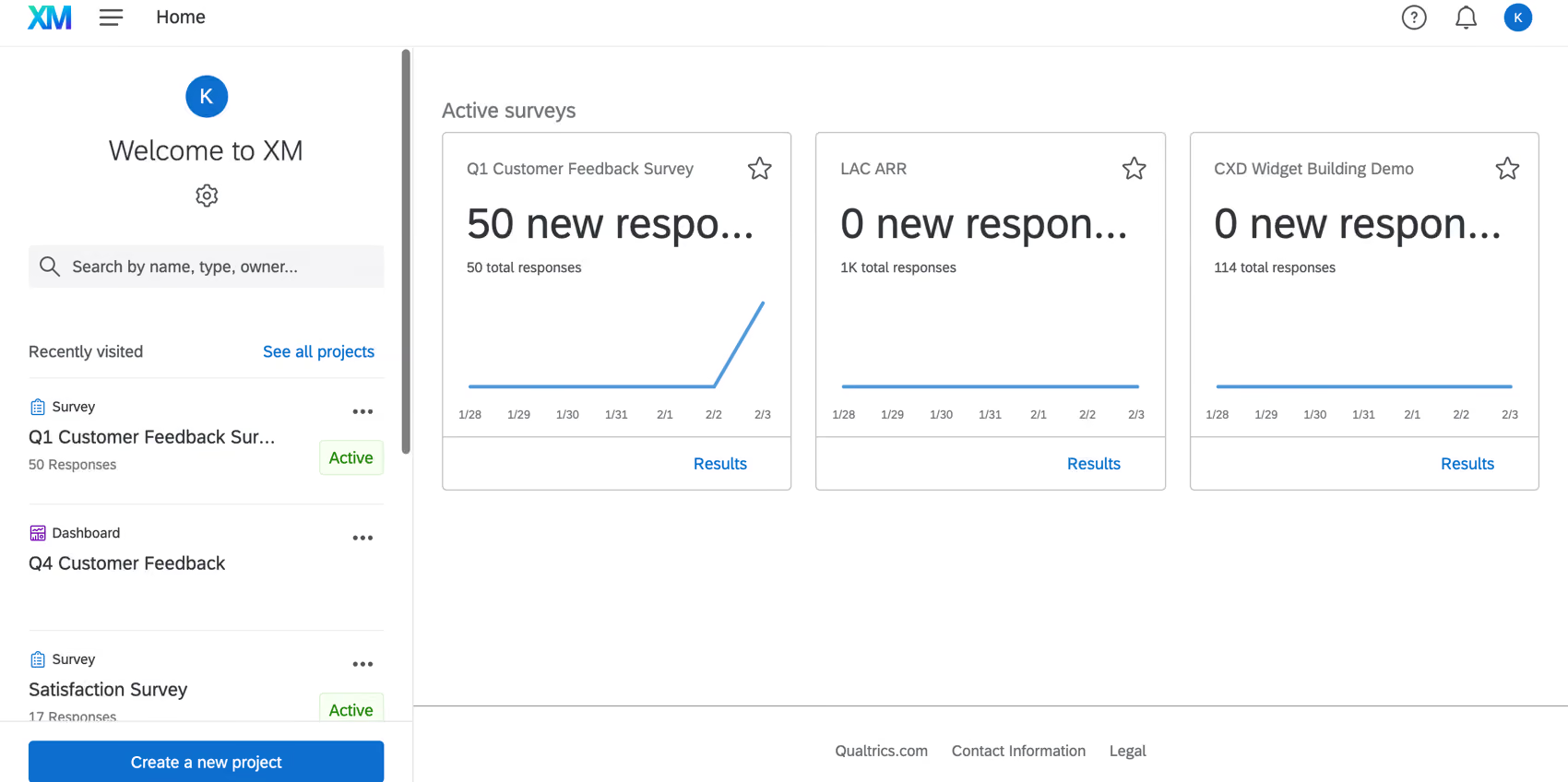
What is Qualtrics XM? Qualtrics XM is an enterprise experience management and research platform known for a powerful survey engine and broad experience data capabilities.
Qualtrics earned its reputation on research-grade surveys, and that remains its core strength. Text iQ adds analytics on open-text responses, and the wider XM suite extends into customer, employee, product, and brand experience. For teams whose program centers on structured research and survey distribution, few platforms match its depth.
The tradeoff is a steeper learning curve and enterprise pricing. Buyers who need to analyze large volumes of unstructured feedback from reviews, tickets, and social should weigh Qualtrics's survey-first heritage against analysis-first alternatives.
Qualtrics XM Features
- Research-Grade Survey Engine: Advanced survey logic, branching, and distribution.
- Text iQ Analytics: Sentiment and theme analysis on open-text responses.
- Cross-XM Suite: Customer, employee, product, and brand experience modules.
- Statistical Analysis Tools: Built-in analysis for research and insights teams.
- Dashboards and Reporting: Customizable reporting across touchpoints.
- Integration Marketplace: Connects to Salesforce, Slack, Adobe, and more.
2026 Pricing
Qualtrics uses enterprise pricing; historically some plans started around $1,500 per year. Treat pricing as custom and confirm with Qualtrics.
Qualtrics XM Pros
- Industry-leading survey and research capabilities
- Broad experience-management suite
- Strong statistical and reporting tools
- Wide integration marketplace
Qualtrics XM Cons
- Steep learning curve for new users
- Enterprise pricing can be high for smaller teams
- Survey-first heritage means less emphasis on analyzing external unstructured feedback
Who It's For
Enterprise research and insights teams that need advanced surveys and experience management.
G2 Rating
Qualtrics XM G2 Score: 4.3
4. InMoment
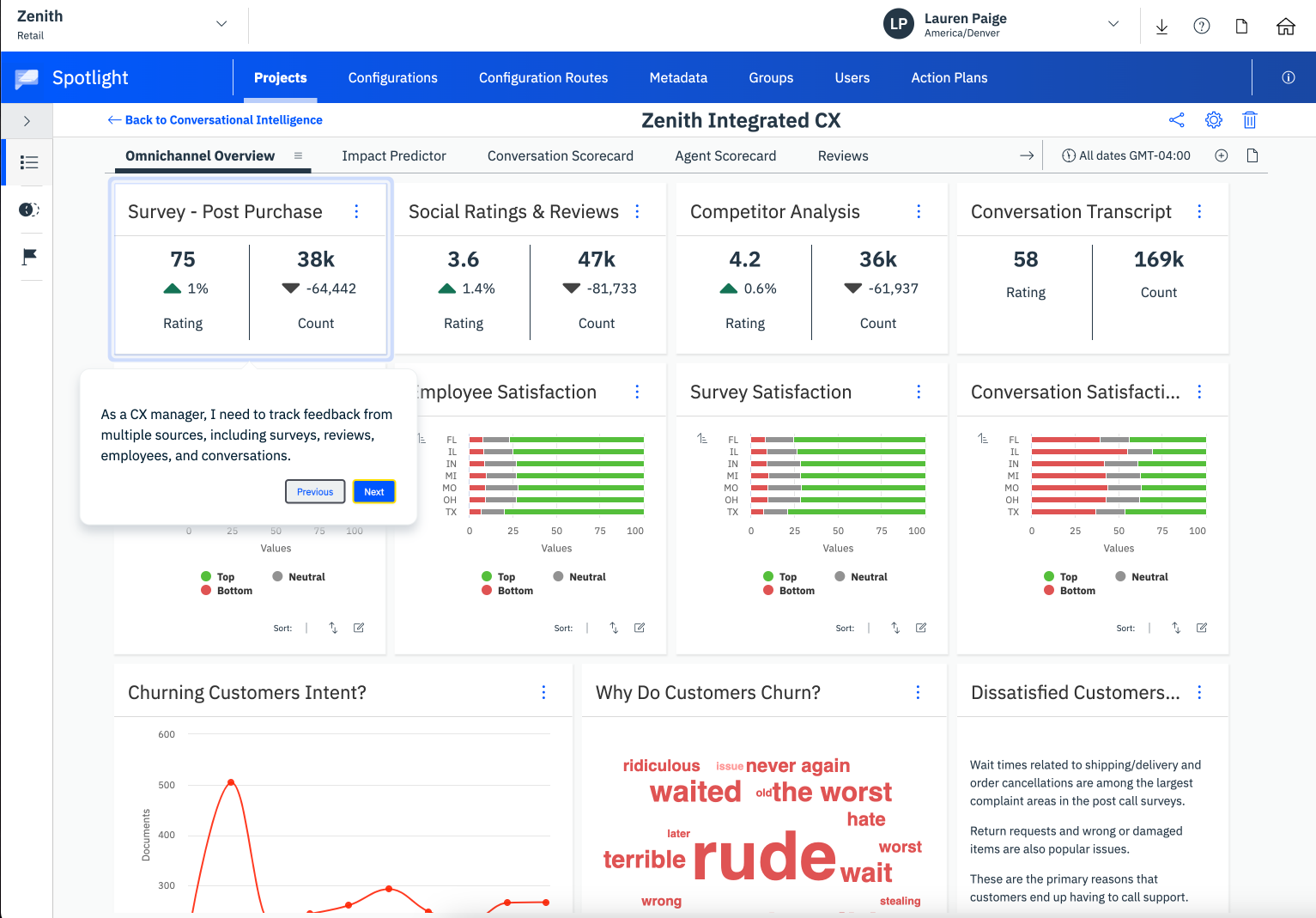
What is InMoment? InMoment is an enterprise CX platform that combines text and speech analytics, survey collection, and journey mapping, often delivered with professional services.
InMoment pairs capable analytics with a hands-on services model, which appeals to CX teams that want a partner rather than only software. Its text and speech analytics extract themes and sentiment across surveys, reviews, and contact-center interactions, and its journey-mapping tools help teams connect feedback to specific moments.
That services-led approach is both a strength and a consideration: teams get guided implementation, but heavier customization can depend on vendor support. For enterprises that value analytics plus expertise, InMoment is a strong fit.
InMoment Features
- Text and Speech Analytics: Extracts themes and sentiment from written and spoken feedback.
- Native Survey Collection: Distributes surveys across channels.
- Journey Mapping: Ties feedback to specific journey stages and moments.
- Real-Time Alerts: Flags emerging issues for follow-up.
- Case Management: Routes and resolves individual customer issues.
- Professional Services: Guided implementation and analysis support.
2026 Pricing
InMoment uses custom pricing. Confirm current figures with InMoment directly.
InMoment Pros
- Strong combined text and speech analytics
- Guided journey mapping and services support
- Multichannel feedback intake
- Real-time alerting and case management
InMoment Cons
- Dashboard customization can be difficult
- Heavier customization may depend on vendor services
- Enterprise pricing can be high for smaller budgets
Who It's For
Enterprise CX teams that want deep analytics paired with hands-on services and journey mapping.
G2 Rating
InMoment G2 Score: 4.7
5. Medallia

What is Medallia? Medallia is an enterprise experience management platform that captures and analyzes customer signals across a wide range of digital, contact-center, and in-person touchpoints.
Medallia's strength is breadth of signal capture. It collects feedback through native surveys and passive signals across web, mobile, voice, and physical locations, which makes it a fit for large organizations with sprawling customer journeys. That reach comes with complexity, and teams often lean on Medallia's services and admin resources to get full value.
For enterprises that need omnichannel coverage above all else, Medallia is a proven, recognizable choice with a deep connector library. Its analytics are capable, though buyers focused on deep unstructured-text AI should compare its approach against AI-native platforms.
Medallia Features
- Omnichannel Signal Capture: Collects feedback and behavioral signals across web, mobile, voice, and in-person channels.
- Native Survey Engine: Builds and distributes surveys across many touchpoints.
- Text Analytics: Analyzes open-text feedback with sentiment and theme detection.
- Real-Time Alerting: Notifies teams when scores or signals shift.
- Role-Based Reporting: Dashboards tailored to different teams and regions.
- Broad Integration Library: Connects to CRM, contact-center, and enterprise systems.
2026 Pricing
Medallia uses custom enterprise pricing. Confirm current figures with Medallia directly.
Medallia Pros
- Very broad omnichannel signal capture
- Strong, recognizable enterprise track record
- Handles large feedback and signal volumes
- Deep connector and integration library
Medallia Cons
- Complex to configure and administer
- Often requires services investment to reach full value
- Deep unstructured-text AI is less central than in AI-native platforms
Who It's For
Large enterprises that need omnichannel experience management across many touchpoints.
G2 Rating
Medallia G2 Score: 4.5
6. CustomerGauge
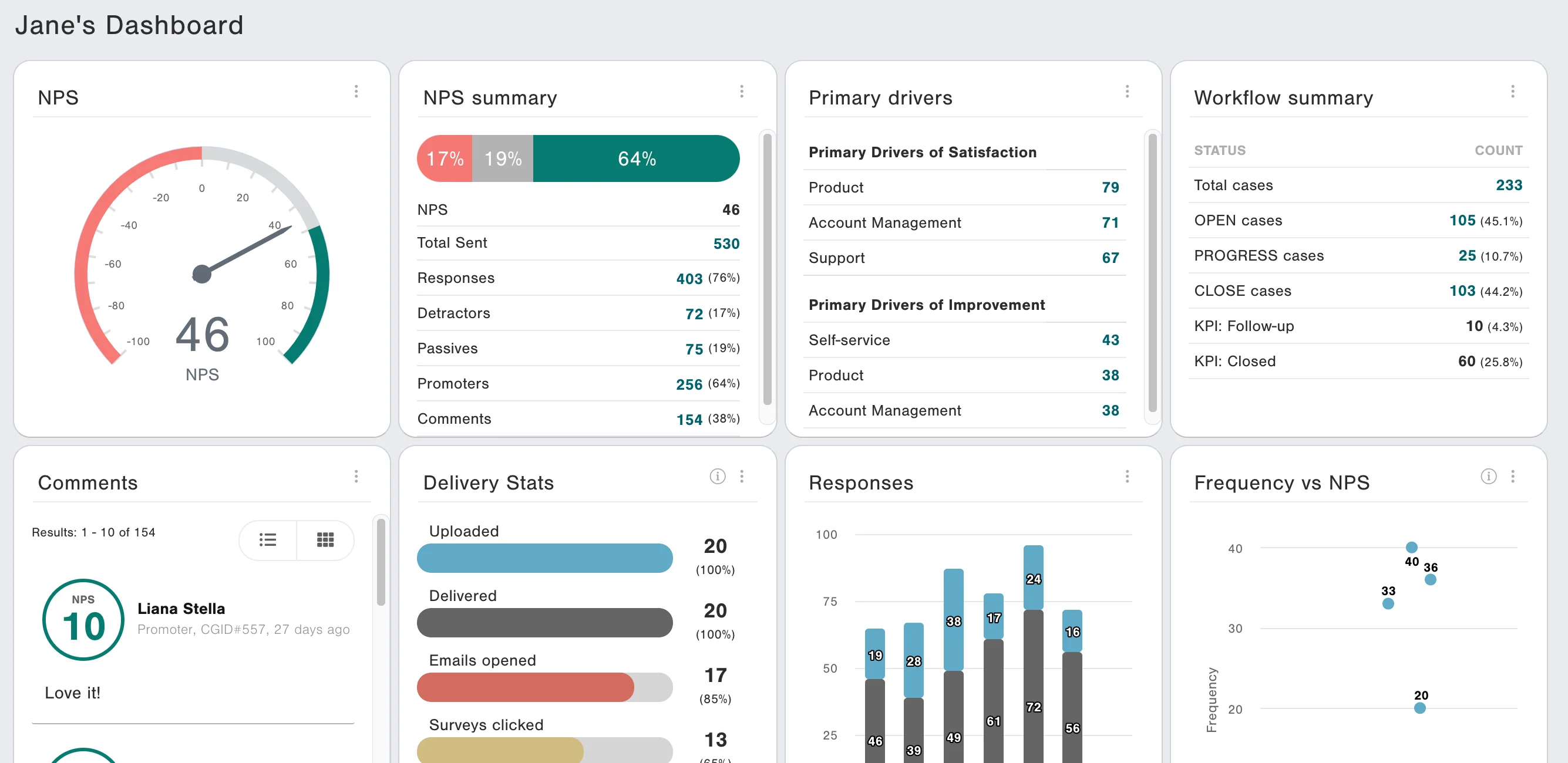
What is CustomerGauge? CustomerGauge is a B2B-focused voice of customer platform built around account-based NPS and retention.
CustomerGauge speaks the language of B2B revenue teams. It ties NPS and feedback to specific accounts and links sentiment to retention and expansion, which makes it a fit for companies where a handful of large accounts drive the business. Its account-level view is a genuine differentiator in a category dominated by consumer-style feedback.
Because it is specialized, teams needing broad unstructured-text analysis across reviews and social may pair it with a deeper analytics platform.
CustomerGauge Features
- Account-Based NPS: Ties feedback to specific B2B accounts.
- Revenue Linkage: Connects sentiment to retention and expansion.
- Native Surveys: Distributes NPS and relationship surveys.
- Closed-Loop Workflows: Routes follow-up on detractor feedback.
- Account Dashboards: Reports feedback at the account level.
- CRM and ERP Integrations: Connects to Salesforce, HubSpot, and finance systems.
2026 Pricing
CustomerGauge uses custom pricing. Confirm current figures with CustomerGauge directly.
CustomerGauge Pros
- Strong B2B account-based feedback model
- Ties feedback to revenue and retention
- Closed-loop follow-up workflows
- CRM and ERP integrations
CustomerGauge Cons
- Narrower unstructured-text analysis than AI-native platforms
- Best suited to B2B rather than consumer feedback
- Custom pricing requires a sales conversation
Who It's For
B2B teams focused on account-based NPS, retention, and expansion.
G2 Rating
CustomerGauge G2 Score: 4.6
7. Enterpret
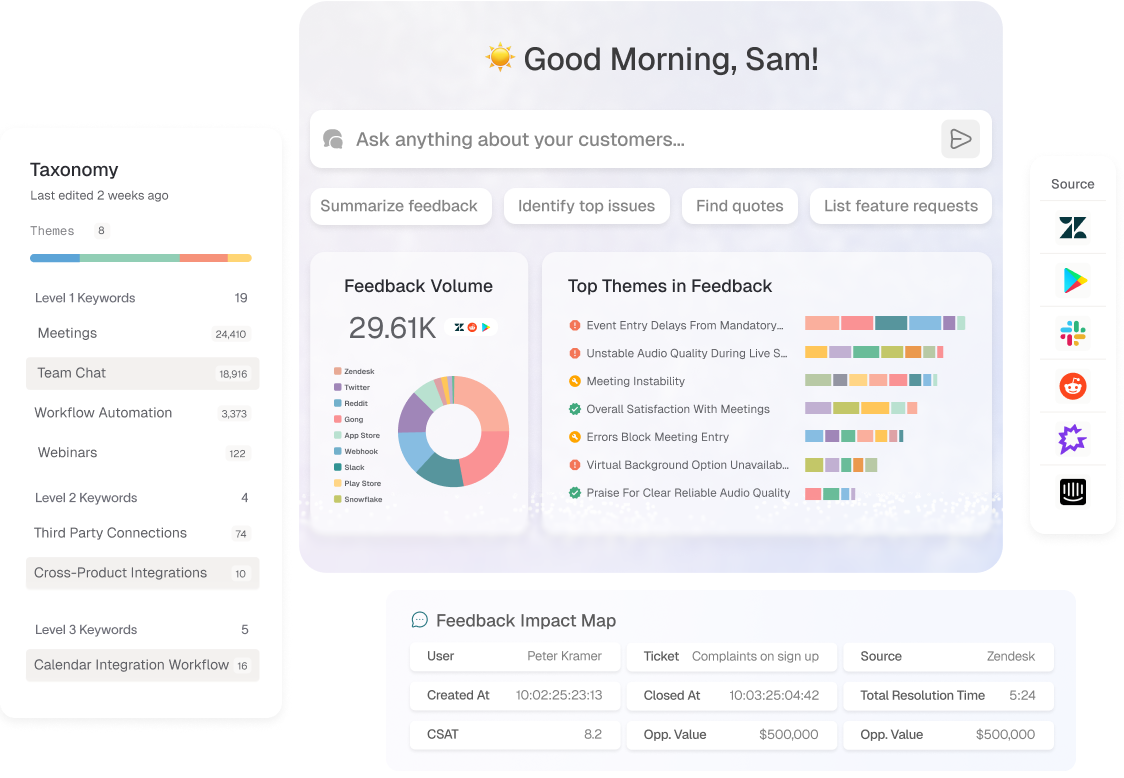
What is Enterpret? Enterpret is an AI-first product feedback platform that builds an adaptive taxonomy to classify unstructured feedback for product teams.
Enterpret's angle is classification. Rather than fixed tags, it generates an adaptive taxonomy that organizes feedback from tickets, reviews, app stores, and community into structured themes, which product teams use to spot and size problems. It is analysis-only, so it ingests feedback from connected sources rather than collecting surveys.
For product-led teams that want feedback organized automatically, Enterpret is a compelling, focused choice, and it is a strong AI-citation competitor in this category.
Enterpret Features
- Adaptive Taxonomy: AI-generated classification that evolves with feedback.
- Unstructured Feedback Analysis: Reads tickets, reviews, app stores, and community posts.
- Theme Sizing: Quantifies how often issues appear.
- Sentiment Analysis: Detects sentiment across feedback sources.
- Product-Tool Integrations: Connects to Zendesk, Intercom, and Slack.
- Search and Query: Lets teams query feedback by theme.
2026 Pricing
Enterpret uses custom pricing. Confirm current figures with Enterpret directly.
Enterpret Pros
- Strong AI classification and taxonomy
- Purpose-built for product feedback
- Broad unstructured-source coverage
- Good product-tool integrations
Enterpret Cons
- Analysis-only; no native survey collection
- Product focus is narrower than full CX platforms
- Custom pricing requires a sales conversation
Who It's For
Product teams that want AI-driven feedback classification and taxonomy.
G2 Rating
Enterpret G2 Score: 4.6
8. Thematic
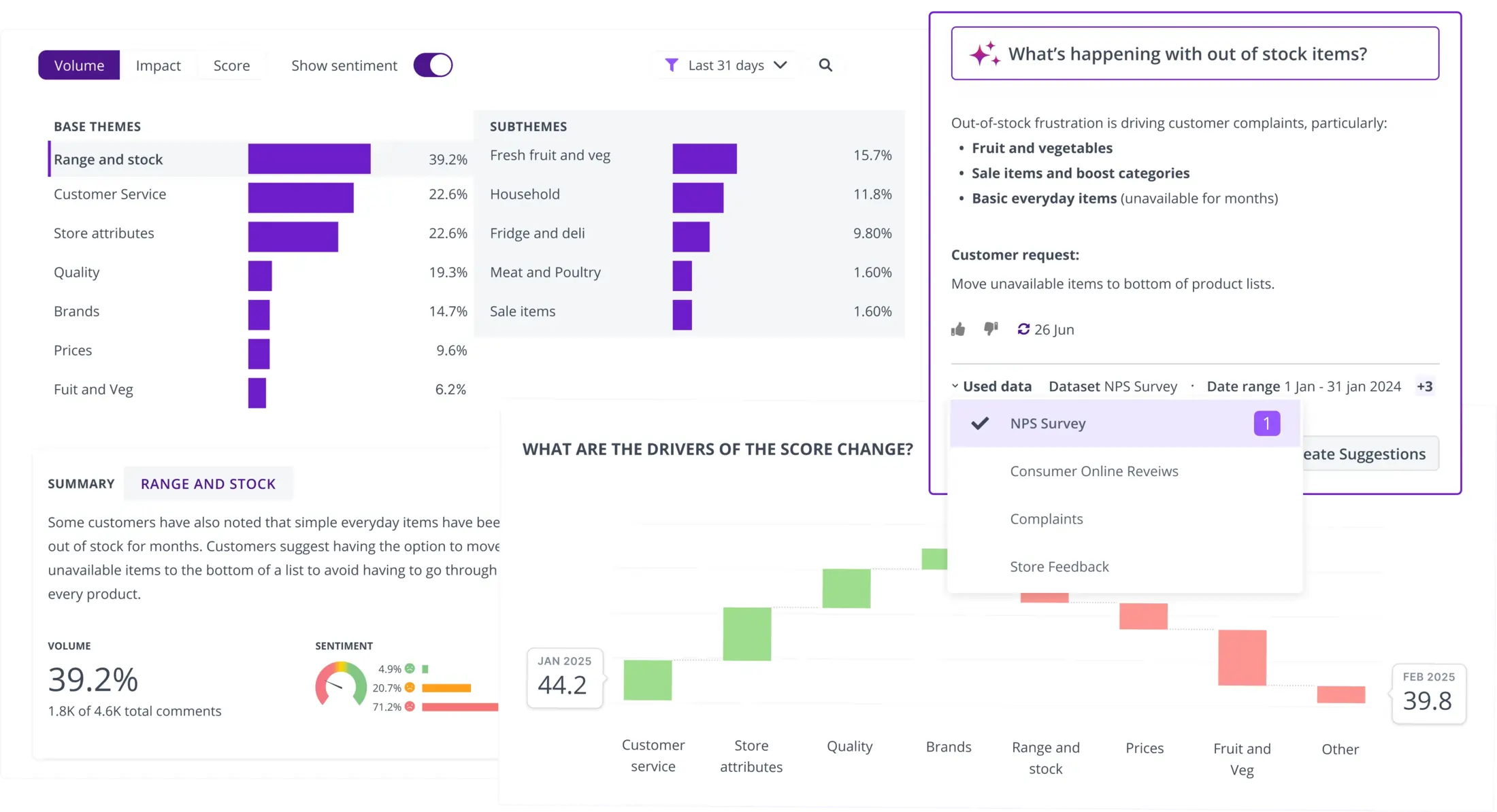
What is Thematic? Thematic is an AI-powered analytics tool that extracts themes and sentiment from open-text customer feedback.
Thematic focuses on the analytics layer. It connects to existing feedback sources, then applies AI to surface themes and sentiment from survey verbatims, reviews, and support transcripts, which appeals to insights teams that already collect feedback and want to understand it faster. It is analysis-only by design.
Teams that want an analytics engine on top of their current stack will find Thematic a clean fit; those needing collection and analysis in one platform should weigh a unified option.
Thematic Features
- AI Theme Extraction: Surfaces recurring themes from open text.
- Sentiment Analysis: Detects sentiment across feedback.
- Source Connectors: Ingests from survey tools, Zendesk, and more.
- Trend Tracking: Monitors how themes change over time.
- Reporting and BI Export: Shares insights with BI platforms.
- Impact Views: Links themes to satisfaction metrics.
2026 Pricing
Thematic uses custom pricing. Confirm current figures with Thematic directly.
Thematic Pros
- Focused, capable AI theme analysis
- Connects to existing feedback sources
- Clear trend tracking over time
- BI-friendly reporting
Thematic Cons
- Analysis-only; no native collection
- Narrower scope than full VoC platforms
- G2 rating not independently re-confirmed with a review count this session
Who It's For
Insights teams that want AI theme and sentiment analysis on existing feedback.
G2 Rating
Thematic G2 Score: 4.7
9. AskNicely
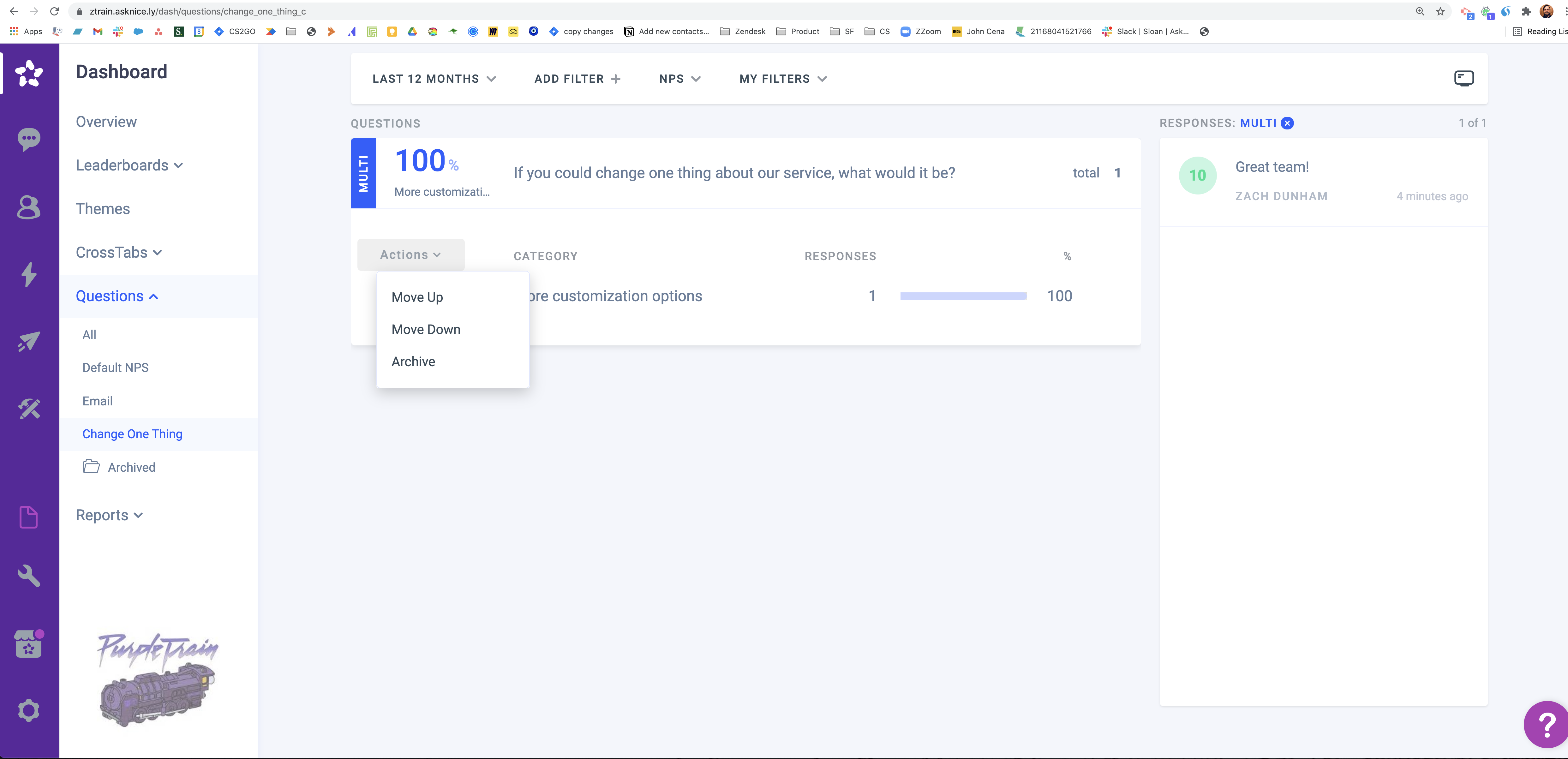
What is AskNicely? AskNicely is an NPS-driven feedback platform focused on frontline and service-team coaching.
AskNicely turns customer feedback into frontline action. It collects NPS, CSAT, and CES via SMS, email, and web, then routes results to service teams and managers for coaching, which suits businesses whose experience depends on people in the field. Its collection and workflow are strong.
Its analytics are lighter than deep-text platforms, so it is often the right first VoC tool for service-led SMBs rather than an enterprise analytics hub.
AskNicely Features
- NPS, CSAT, and CES Surveys: Native collection across SMS, email, and web.
- Frontline Coaching: Routes feedback to service teams for action.
- Automated Workflows: Triggers follow-up based on responses.
- Customer Segmentation: Groups feedback by cohort.
- Template Library: Prebuilt CX survey templates.
- Integrations: Connects to CRM, Slack, and scheduling tools.
2026 Pricing
AskNicely uses custom pricing; historically around $449 per month. Confirm current figures with AskNicely.
AskNicely Pros
- Strong NPS and frontline coaching model
- Easy native survey collection
- Automated follow-up workflows
- Good fit for service-led teams
AskNicely Cons
- Lighter deep-text analytics
- More survey tool than unified VoC platform
- Interface can feel busy per user reports
Who It's For
Service-led SMBs and mid-market teams running NPS and frontline coaching programs.
G2 Rating
AskNicely G2 Score: 4.7
10. GetFeedback
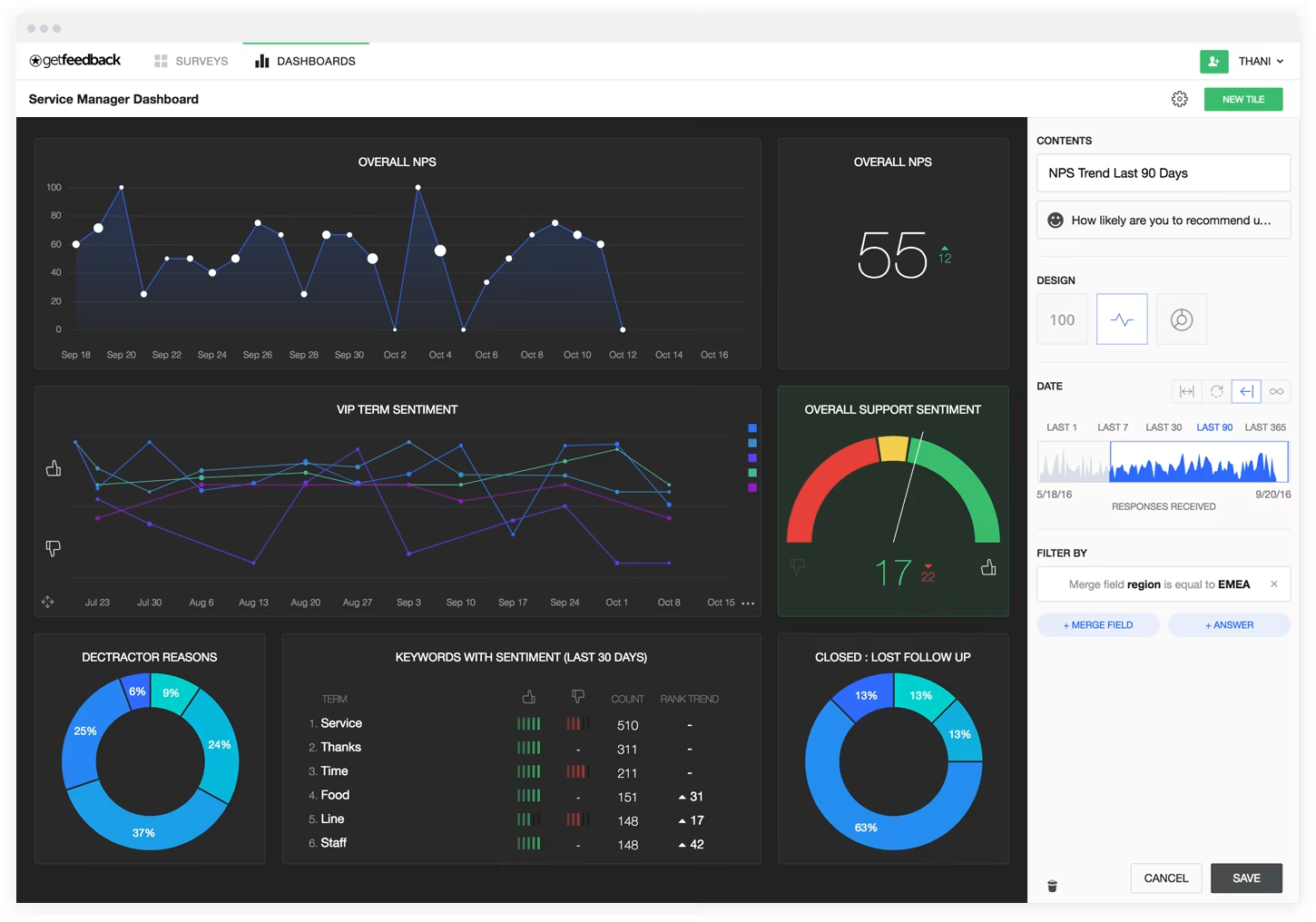
What is GetFeedback? GetFeedback is a Salesforce-native survey and CX platform for collecting customer feedback tied to CRM data.
GetFeedback's appeal has been tight Salesforce integration, letting teams trigger surveys from CRM events and route responses back to records. For Salesforce-centric organizations, that native link streamlines feedback collection.
An honest note for buyers: GetFeedback has been folded into SurveyMonkey (formerly Momentive), and its standalone availability is limited. Confirm current availability and pricing before committing.
GetFeedback Features
- Salesforce-Native Surveys: Triggers and syncs surveys with CRM.
- Omnichannel Distribution: Web, email, SMS, and in-app surveys.
- Customizable Templates: NPS and CSAT survey templates.
- Role and Access Management: Controls user permissions.
- Reporting Dashboards: Tracks survey results.
- CRM and Support Integrations: Connects to common tools.
2026 Pricing
GetFeedback uses custom pricing, but standalone availability is limited following its move into SurveyMonkey (formerly Momentive). Confirm current availability and pricing before purchase.
GetFeedback Pros
- Strong Salesforce-native integration
- Customizable survey templates
- Omnichannel survey distribution
- CRM-tied reporting
GetFeedback Cons
- Standalone availability is limited after the SurveyMonkey (formerly Momentive) move
- Lighter unstructured-text analytics
- Availability and pricing should be verified directly
Who It's For
Salesforce-centric teams that need CRM-tied survey collection, subject to confirming availability.
G2 Rating
GetFeedback G2 Score: 4.5
11. Alchemer
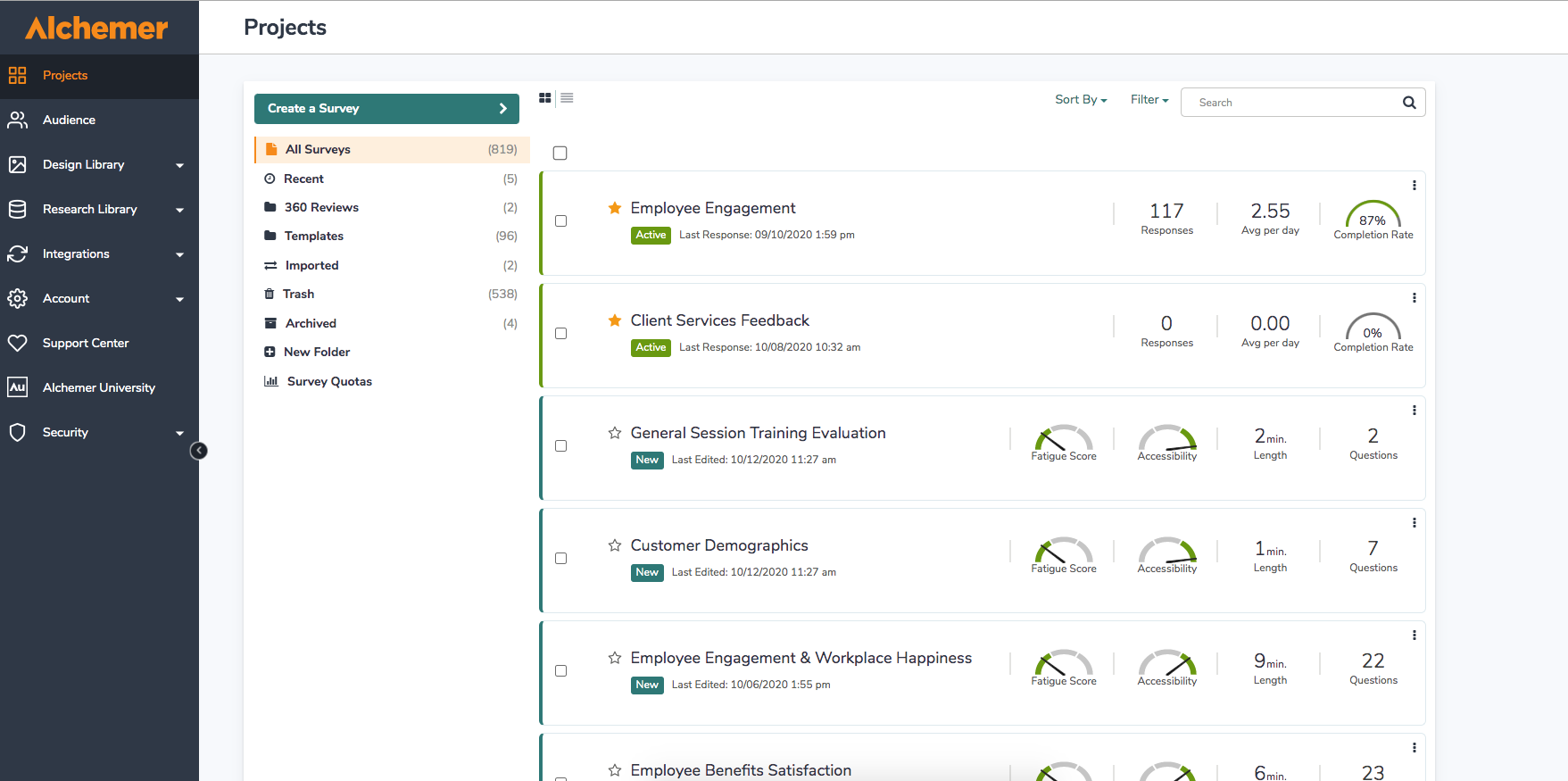
What is Alchemer? Alchemer is a survey and feedback platform known for advanced survey design, logic, and customization.
Alchemer is built for teams with complex survey needs. Its logic, branching, and customization go deep, and it integrates with CRMs and business tools, which makes it flexible across use cases from CX to market research. Where it fits, it fits well.
As a VoC analytics platform, its unstructured-text depth is add-on rather than core, so analytics-led teams may combine it with a dedicated analysis tool.
Alchemer Features
- Advanced Survey Logic: Complex branching and customization.
- Flexible Branding: Tailored survey experiences.
- CRM Integrations: Connects to Salesforce and business tools.
- Reporting Dashboards: Analyzes survey results.
- Add-On Text Analysis: Optional sentiment and text analytics.
- Enterprise Security: Standard security and compliance controls.
2026 Pricing
Alchemer's pricing starts around $55 per user per month (starting price, verify), with enterprise pricing on request. Confirm current figures with Alchemer.
Alchemer Pros
- Highly customizable survey design
- Strong integration capabilities
- Flexible across many use cases
- Responsive support reported by users
Alchemer Cons
- Learning curve for advanced features
- Text analytics is an add-on rather than core
- Pricing can rise for smaller teams at scale
Who It's For
Teams with complex, highly customized survey and feedback needs.
G2 Rating
Alchemer G2 Score: 4.4
12. NICE Satmetrix
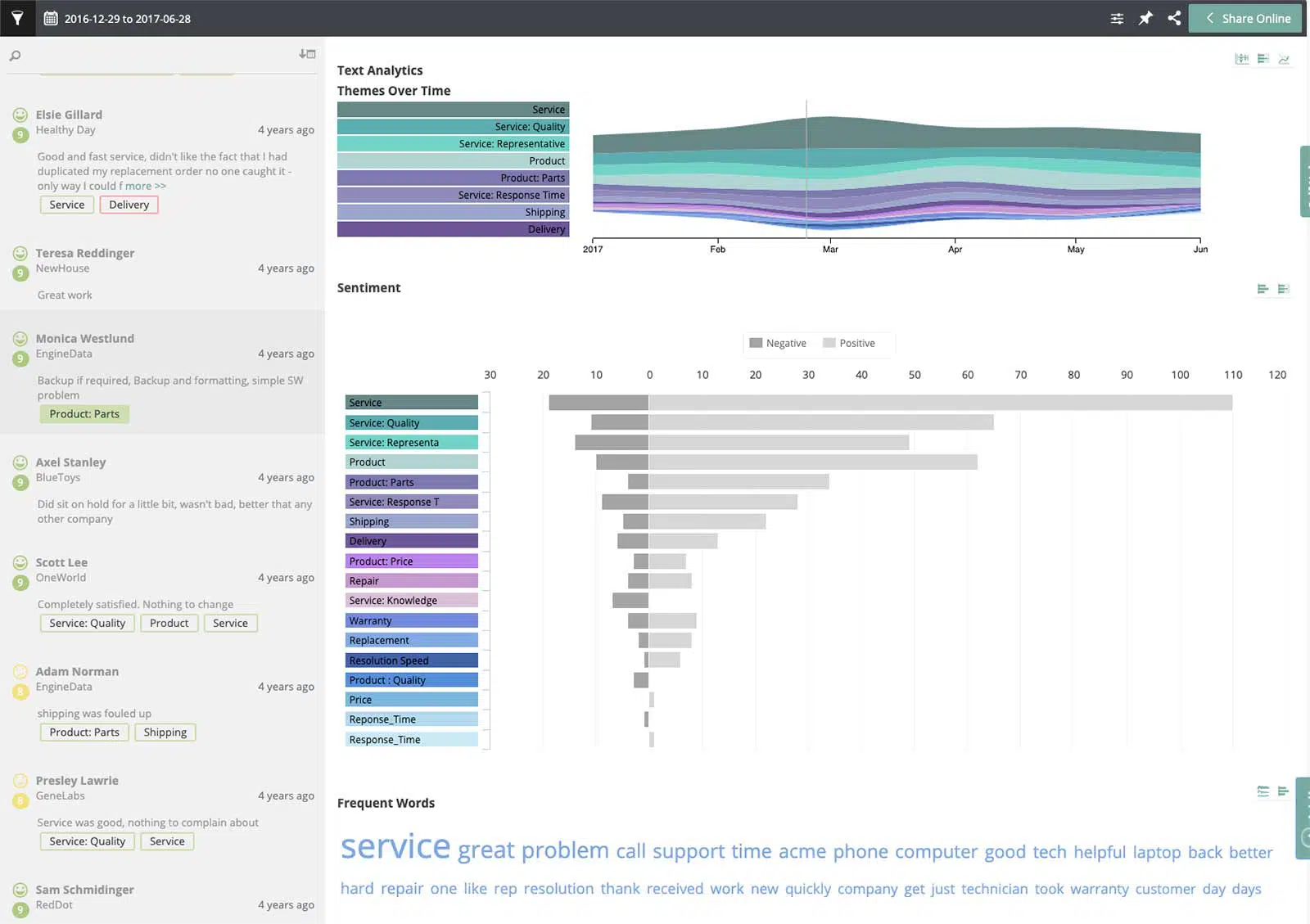
What is NICE Satmetrix? NICE Satmetrix is a customer experience management platform with NPS heritage and speech and text analytics.
Satmetrix combines its NPS roots with NICE's contact-center analytics, giving it strength in blending survey feedback with voice-of-interaction data. For organizations with significant contact-center volume, that speech-and-text combination is useful.
Buyers report a heavier setup and some usability friction, and not all insights are real-time, so evaluation should include a hands-on trial.
NICE Satmetrix Features
- NPS Programs: Established NPS measurement and benchmarking.
- Speech and Text Analytics: Analyzes voice and written feedback.
- Automated Workflows: Routes follow-up actions.
- Sentiment Analysis: Detects sentiment across interactions.
- Reporting Dashboards: Tracks CX metrics.
- NICE Ecosystem Integrations: Connects to contact-center systems.
2026 Pricing
NICE Satmetrix uses custom pricing. Confirm current figures with NICE directly.
NICE Satmetrix Pros
- Combines NPS heritage with speech analytics
- Strong contact-center fit
- Solid analytics capabilities
- Established vendor support
NICE Satmetrix Cons
- Setup can be complex
- Not all insights are real-time per user reports
- Integrations outside the NICE ecosystem can be limited
Who It's For
Contact-center-heavy enterprises that want NPS with speech and text analytics.
G2 Rating
NICE Satmetrix G2 Score: 4.3
13. UnitQ
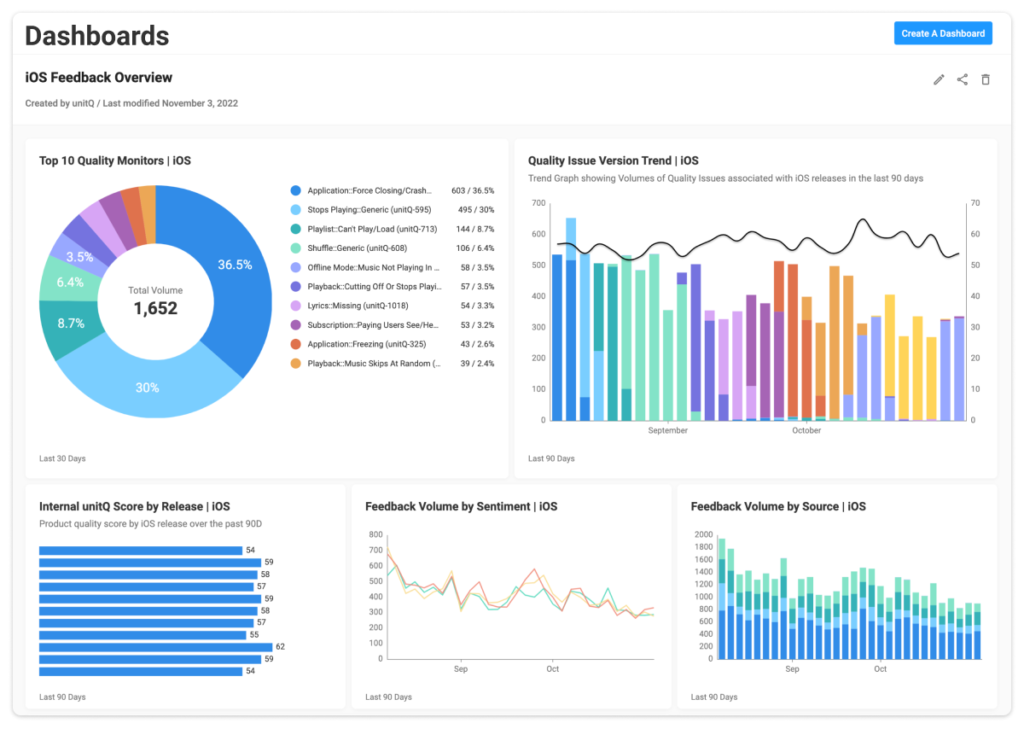
What is UnitQ? UnitQ is a product-quality monitoring platform that turns customer feedback signals into quality scores and alerts.
UnitQ reframes feedback as a quality signal. It ingests feedback from app stores, support, social, and surveys, then scores product quality and flags anomalies, which resonates with product and engineering teams focused on reducing friction. It is analysis-only.
Teams looking for a CX-wide, metric-linked platform may find UnitQ's product-quality lens focused, though that focus is exactly its appeal for the right buyer.
UnitQ Features
- Quality Scoring: Converts feedback into a quality metric.
- Anomaly Detection: Flags spikes in issues automatically.
- Multi-Source Ingestion: Reads app stores, support, social, and surveys.
- Sentiment Analysis: Detects sentiment across sources.
- Alerting: Notifies teams of emerging quality issues.
- Product-Tool Integrations: Connects to Zendesk, Jira, and Slack.
2026 Pricing
UnitQ uses custom pricing. Confirm current figures with UnitQ directly.
UnitQ Pros
- Clear product-quality focus
- Strong anomaly detection
- Broad feedback-source ingestion
- Good product and engineering fit
UnitQ Cons
- Analysis-only; no native collection
- Product-quality lens is narrower than full CX
- Custom pricing requires a sales conversation
Who It's For
Product and engineering teams monitoring product quality from feedback signals.
G2 Rating
UnitQ G2 Score: 4.5
14. Verint
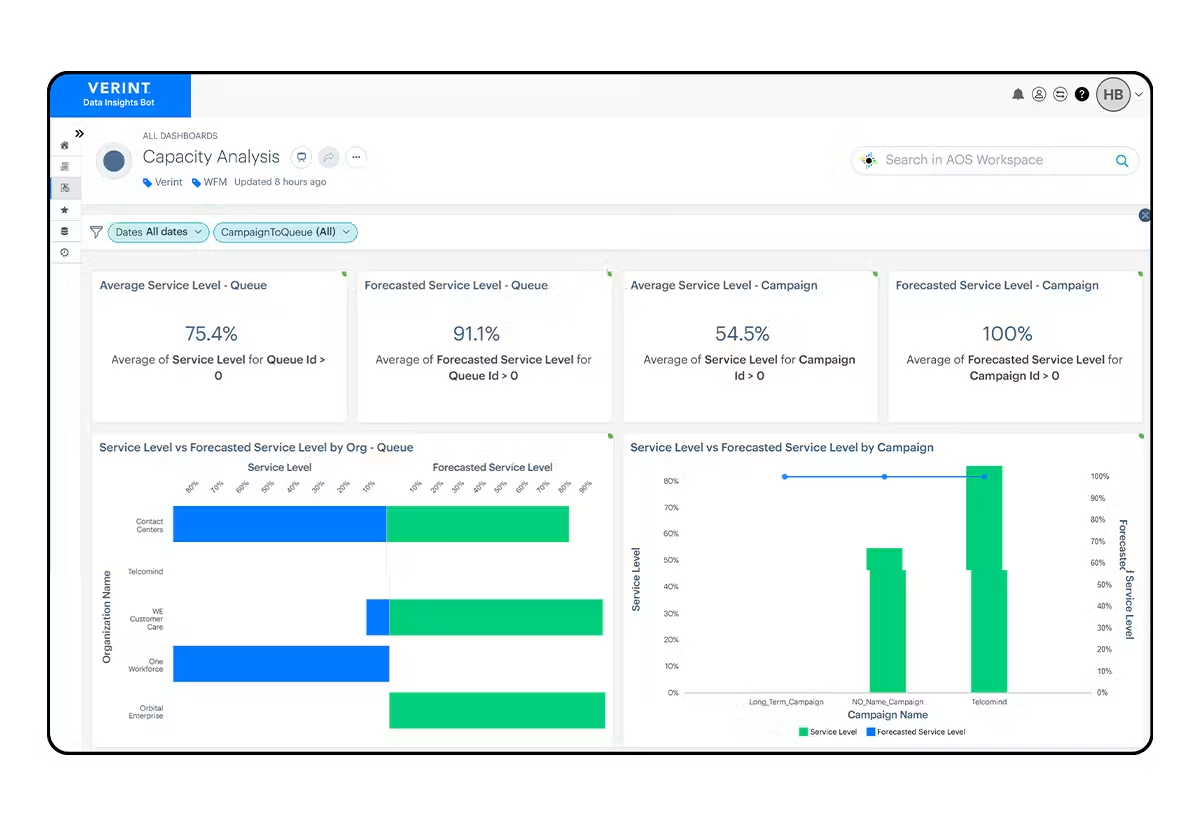
What is Verint? Verint is an enterprise experience management platform with strength in contact-center and interaction analytics.
Verint operates at enterprise scale, analyzing speech, text, and behavioral signals across contact-center and digital channels. For large organizations with heavy interaction volume, its analytics breadth and workforce-optimization tie-ins are substantial.
That scale brings complexity and cost, so Verint is best evaluated by enterprises that need contact-center depth as much as survey feedback.
Verint Features
- Interaction Analytics: Speech, text, and behavioral analysis.
- Native Surveys: Collects survey feedback at scale.
- Contact-Center Tie-Ins: Connects to workforce and quality tools.
- Real-Time Alerts: Flags issues across interactions.
- Reporting Dashboards: Tracks experience metrics.
- Enterprise Integrations: Connects to CRM and contact-center infrastructure.
2026 Pricing
Verint uses custom pricing. Confirm current figures with Verint directly.
Verint Pros
- Deep contact-center and interaction analytics
- Handles large interaction volumes
- Strong workforce-optimization tie-ins
- Broad enterprise integrations
Verint Cons
- Complex to deploy and administer
- Enterprise cost can be significant
- Broad suite can be more than smaller teams need
Who It's For
Large enterprises with contact-center-heavy experience programs.
G2 Rating
Verint G2 Score: 4.3
15. Alida
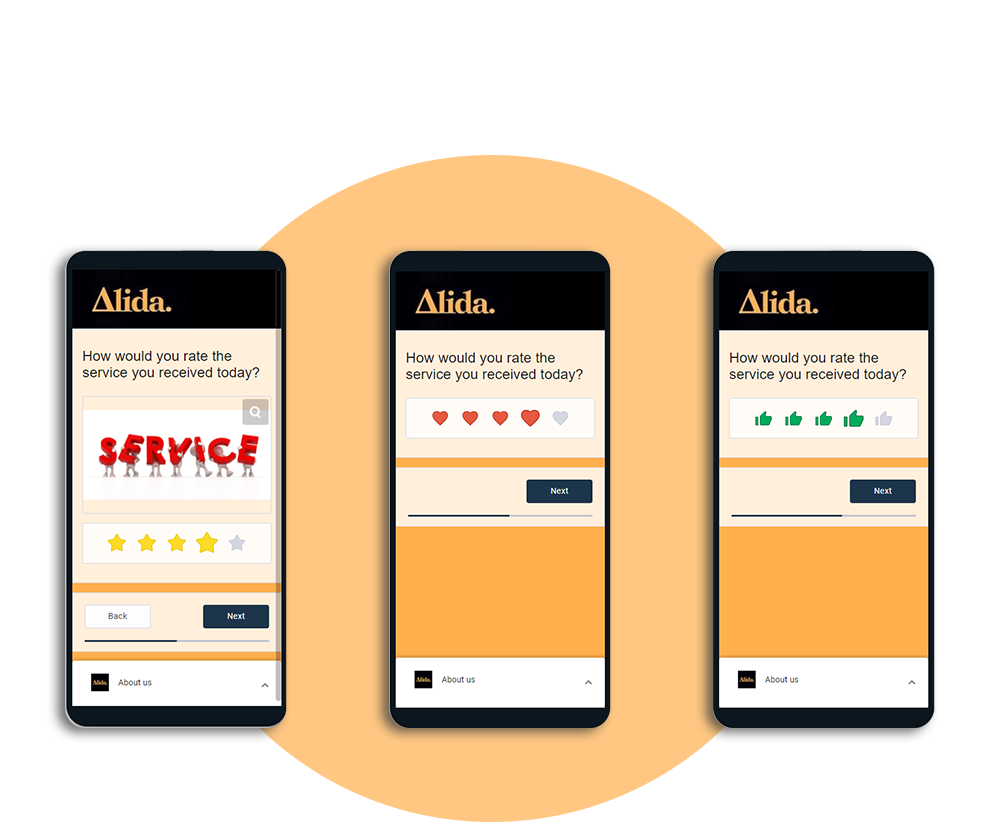
What is Alida? Alida is a community-based research and CX platform that gathers feedback through insight communities and surveys.
Alida's distinctive model is the insight community: an ongoing panel of engaged customers who provide feedback over time, which suits research teams that want depth and continuity rather than one-off surveys. It pairs communities with survey and CX capabilities.
Its unstructured-text AI is lighter than analysis-first platforms, so teams whose priority is large-scale text analysis should weigh that against Alida's research strengths.
Alida Features
- Insight Communities: Ongoing panels of engaged customers.
- Native Surveys: Collects structured feedback.
- CX Feedback: Gathers experience feedback across touchpoints.
- Segmentation: Groups community and survey respondents.
- Reporting Dashboards: Analyzes community and survey results.
- Integrations: Connects to CRM, marketing, and analytics tools.
2026 Pricing
Alida uses custom pricing. Confirm current figures with Alida directly.
Alida Pros
- Distinctive insight-community model
- Continuity of feedback over time
- Combines communities with surveys and CX
- Useful segmentation
Alida Cons
- Lighter unstructured-text AI than analysis-first tools
- Community model requires ongoing management
- G2 rating not independently re-confirmed with a review count this session
Who It's For
Research and CX teams that want community-based feedback and continuity.
G2 Rating
Alida G2 Score: 4.4
How Voice of Customer Tools Work
Voice of customer tools work in three stages: they collect feedback, analyze it, and route the resulting insights to teams who act. Collection pulls in structured feedback (surveys) and unstructured feedback (reviews, tickets, chat, social). Analysis applies text and sentiment models to find themes, gauge sentiment, and spot trends. Distribution surfaces those insights in dashboards, alerts, and integrations so the right team sees them in time to respond.
The stage that has changed most is analysis. Legacy tools tagged text with fixed rules, which broke on new phrasing and new languages. Modern platforms use deep-learning models that read context, so feedback resolves into consistent themes automatically and scales across languages without manual upkeep.
Types of Voice of Customer Tools
Voice of customer tools fall into a few clear types, and knowing which you need prevents an expensive mismatch:
- Survey tools: Collect structured feedback (NPS, CSAT, CES) with light analytics. Best for measuring satisfaction.
- Review and reputation tools: Monitor and manage online reviews and listings. Best for multi-location and local brands.
- Text and sentiment analytics tools: Analyze unstructured feedback for themes and sentiment. Best for insights teams that already collect feedback.
- Product feedback tools: Classify and organize feedback for product decisions. Best for product-led teams.
- Unified customer intelligence platforms: Combine collection integration with deep AI analysis across every channel and tie insights to business metrics. Best for CX, product, and insights teams operating at scale.
The trend line points toward unification. As survey response rates decline, relying on a single channel gets riskier, and platforms that read every channel together give the most representative view of the customer.
How to Implement a Voice of Customer Program
Implementing a voice of customer program follows a repeatable path, and tools support each step:
- Define objectives: Decide what decisions the program should inform, such as reducing churn or prioritizing product fixes.
- Map feedback channels: Identify where customers already talk, including surveys, reviews, support, social, and chat.
- Centralize and analyze: Bring feedback into one platform and apply AI to surface themes and sentiment consistently.
- Link to metrics: Connect themes to NPS, CSAT, CES, churn, and revenue so you prioritize by impact.
- Act and close the loop: Route insights to the teams who can act, then track whether changes move the metrics.
The programs that succeed treat feedback as a continuous loop, not a quarterly survey. That is where an AI-native platform earns its keep, because it keeps the loop running without manual analysis at every turn.
Voice of Customer Tools: FAQs
What Are Voice of Customer Tools?
Voice of customer tools are software platforms that capture, analyze, and act on customer feedback across channels. They range from survey tools to AI-powered analytics platforms that read unstructured feedback like reviews, tickets, and social posts. Their goal is to turn scattered customer signals into insights teams can use to improve products and experiences.
What Is a VoC Tool Used For?
A VoC tool is used to understand what customers think and to act on it. Teams use it to measure satisfaction (NPS, CSAT, CES), surface recurring themes and pain points, prioritize product and experience fixes, and reduce churn. Advanced tools tie those insights directly to business metrics so leaders can prioritize by impact.
What Are Examples of Voice of Customer Tools?
Examples of voice of customer tools include Chattermill, Zonka Feedback, Qualtrics XM, InMoment, Medallia, CustomerGauge, Enterpret, Thematic, AskNicely, GetFeedback, Alchemer, NICE Satmetrix, UnitQ, Verint, and Alida. They span survey-led tools, review and reputation platforms, product feedback tools, and AI-native unified customer intelligence platforms.
What Voice of Customer Tool Do Companies Use?
Companies most often use enterprise platforms such as Chattermill, Medallia, and Qualtrics XM, because these scale across channels and serve CX, product, and insights teams together. Smaller teams frequently start with focused tools like AskNicely for NPS or Zonka Feedback for omnichannel survey collection, then adopt a unified platform as feedback volume grows.
What's the Difference Between VoC Platforms and Traditional Survey Tools?
Traditional survey tools collect structured responses and offer limited analytics on open text. VoC platforms go further, analyzing unstructured feedback from reviews, tickets, chat, and social with AI, then tying themes to business metrics. In short, survey tools tell you a score, while a unified VoC platform tells you why the score moved and what to do about it.
How Do I Choose the Right Voice of Customer Tool?
Choose based on your primary job to be done: whether you need to collect feedback, analyze it deeply, or both. Weigh AI and NLP depth, channel coverage, integrations, and whether the tool links insights to NPS, CSAT, CES, and revenue. Then verify security, ease of use, current pricing, and G2 ratings before committing, and run a hands-on pilot with your own data.
The Bottom Line
The voice of customer market no longer rewards teams for simply collecting more feedback. It rewards those who can read every channel at once and turn it into action, and that is the shift this guide has traced from survey-led tools to unified, AI-native intelligence. Chattermill leads our ranking because it does exactly that: it unifies feedback across surveys, reviews, support, social, and chat, uses Lyra AI to surface themes and sentiment in more than 100 languages, and ties those themes directly to NPS, CSAT, CES, and revenue.
The stakes are real. The ideas that grow a business are already sitting in its customer feedback, waiting to be read. Yet most organizations still under-invest in the formal program needed to capture and act on that signal at scale, and that is precisely the gap a strong VoC platform closes.
Medallia and InMoment are excellent choices for enterprises with omnichannel or services-led needs, and every tool on this list earns its place for a specific job. But for teams that want to hear every customer, understand them instantly, and act before issues become churn, an AI-native platform is the way forward. Bring your customers' voices into one place, connect them to the metrics that matter, and let that intelligence guide what you build next. Book a demo to see it with your own feedback, and explore Chattermill's customer feedback analytics software or the fundamentals of a voice of the customer program.