


Chattermill vs Yogi: Which Customer Feedback Analysis Platform Should You Choose


The CX intelligence
platform that's AI-native by design
Book a demoThe right customer feedback platform turns scattered opinions into strategic clarity. The wrong one leaves you drowning in data while competitors act on insights you never surfaced.
Chattermill and Yogi both promise AI-powered feedback intelligence, but they solve fundamentally different problems. This comparison breaks down how each platform approaches data sources, AI capabilities, integrations, and pricing so you can determine which fits your team's actual needs.
Chattermill vs Yogi: Features at a glance
Chattermill and Yogi are both AI-powered customer feedback analytics platforms, but they solve different problems. Chattermill unifies feedback from surveys, support tickets, reviews, and social media to give CX teams a complete view of the customer journey. Yogi focuses specifically on product reviews, using SKU-level analysis to help CPG and e-commerce teams optimize product listings and track competitor performance.
What is Chattermill
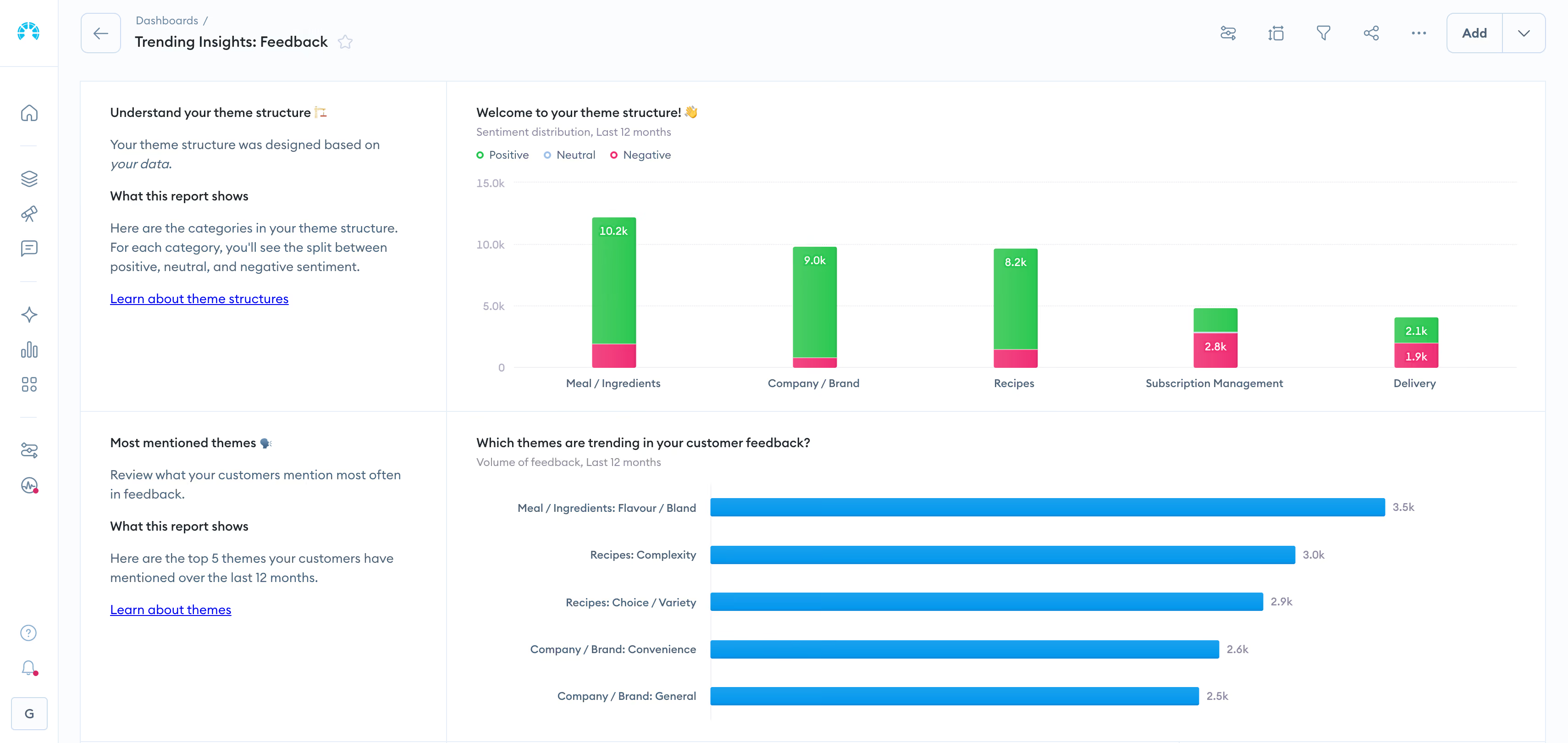
Chattermill is an AI-powered voice of customer platform that consolidates feedback from every channel into one place. CX, insights, and product teams use it to analyze surveys, support tickets, app reviews, social mentions, and chat transcripts together rather than in feedback silos.
The platform connects feedback themes directly to business metrics like NPS, CSAT, and CES. When satisfaction scores drop, teams can trace the decline to specific customer pain points and quantify the impact of addressing them.
What is Yogi
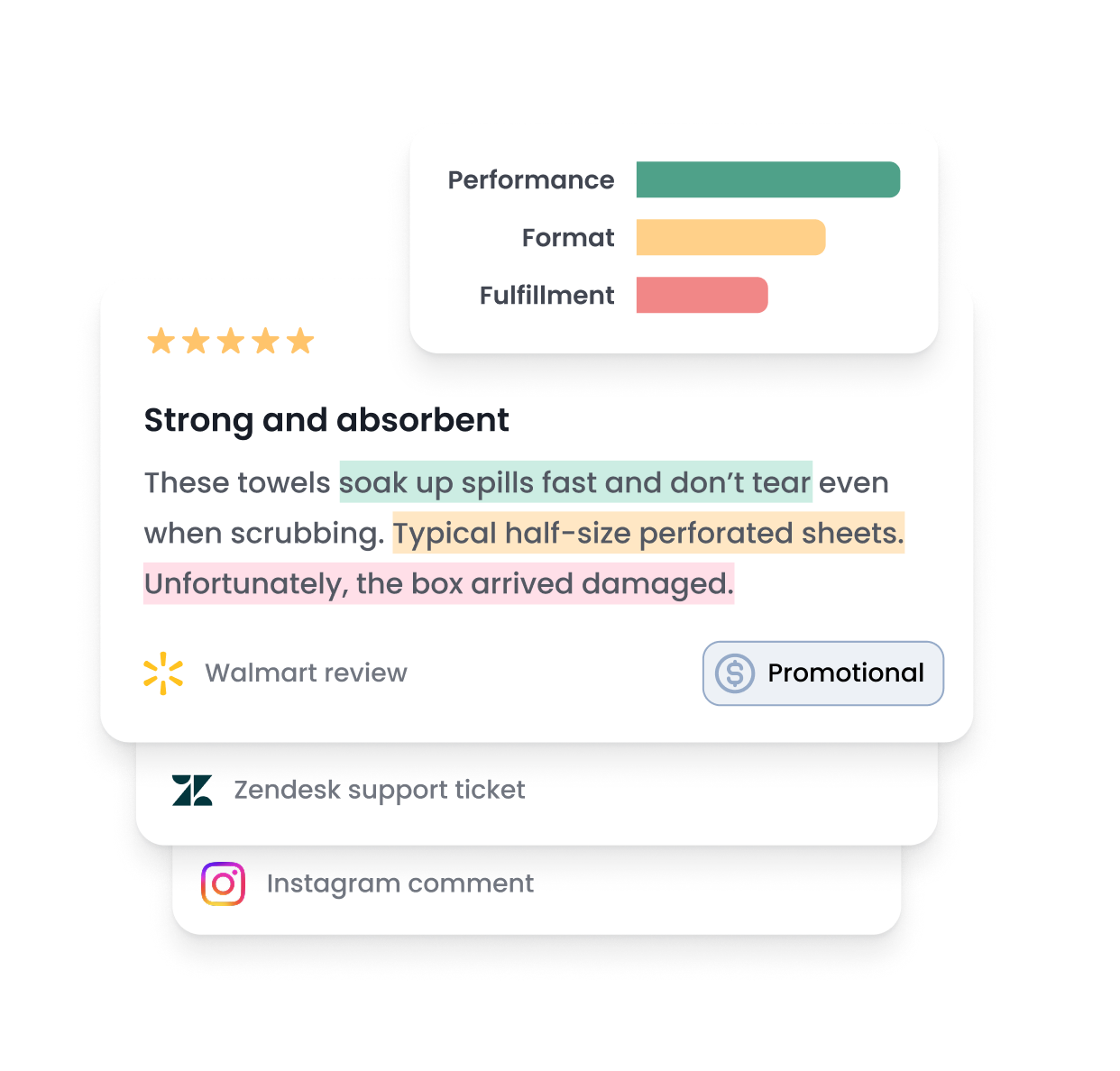
Yogi is a consumer insights platform built for analyzing product reviews and ratings at scale. It pulls data from over 350 global retailers, making it particularly useful for CPG brands, consumer electronics companies, and e-commerce teams focused on shelf performance.
The platform extracts product-specific sentiment, identifies feature-level complaints, and benchmarks products against competitors. Yogi also offers "Ask Yogi," a conversational AI feature for getting immediate, text-based answers about product perception.
Key differences between Chattermill and Yogi
The core distinction comes down to scope versus depth. Chattermill maps the full customer experience across every touchpoint. Yogi goes deep on product review intelligence. Your choice depends on whether you want to understand the complete customer journey or focus specifically on how products perform in the market.
AI-powered feedback analysis approach
Chattermill uses deep learning to detect themes, sentiment shifts, and anomalies across all feedback types automatically. The AI learns your business language without requiring manual rule configuration, and accuracy improves over time as the system processes more of your data.
Yogi's NLP is purpose-built for parsing product reviews. It extracts feature-level attributes like "battery life" or "packaging quality" and tracks how sentiment around those attributes changes. The models are trained on millions of CPG data points, making them particularly accurate for consumer goods categories.
Feedback channel and data source coverage
Chattermill ingests feedback from multiple sources:
- Surveys: NPS, CSAT, CES, and custom surveys
- Support: Tickets, chat transcripts, call summaries
- Reviews: App stores, product reviews, third-party sites
- Social: Mentions, comments, direct messages
Yogi concentrates on product reviews from e-commerce platforms and retail sites. If reviews are your primary feedback source, this specialization delivers depth. If you want to understand how support issues relate to survey feedback relates to social sentiment, you'll want broader coverage.
Target customer and industry fit
Chattermill serves enterprise CX programs across industries including financial services, subscription businesses, e-commerce, and technology. Teams running comprehensive VoC initiatives typically find the unified approach essential for connecting feedback across the customer lifecycle.
Yogi targets CPG brands, consumer electronics companies, and retail product teams. If success metrics center on shelf performance, product detail page optimization, and competitive positioning, Yogi speaks that language fluently.
Taxonomy customization and insight granularity
Chattermill allows teams to build custom taxonomies that reflect their unique business terminology. You define the themes and sub-themes that matter, and the AI learns to categorize feedback accordingly. This flexibility becomes important as organizations scale and their feedback analysis requirements grow more sophisticated.
Yogi categorizes product attributes and features based on its CPG-trained models. This works well for standard product categories, though teams with highly specialized products may find less room for customization.
AI and sentiment analysis capabilities compared
Both platforms leverage AI, but their models serve different purposes. The right choice depends on what kind of feedback you're analyzing and what questions you're trying to answer.
Chattermill advanced AI for customer experience insights
Chattermill's unified AI engine processes feedback across channels, surfaces themes and sub-themes, detects sentiment shifts, and identifies anomalies automatically. This customer experience analytics approach means the system gets smarter over time as it learns your specific context and business language.
The platform handles diverse feedback formats equally well, whether analyzing a three-word app review or a detailed support ticket. This consistency matters when you're trying to build a complete picture of customer sentiment.
Yogi AI for consumer product review analysis
Yogi's AI specializes in parsing product reviews, extracting feature-level sentiment, and benchmarking against competitor products. The models understand product-specific language and can distinguish between complaints about a product's design versus complaints about shipping or packaging.
The "Ask Yogi" feature lets users query the platform conversationally, getting immediate answers about product perception without building custom reports.
Multilingual support and global accuracy
Chattermill supports numerous languages with native-level accuracy for global CX programs. Feedback in German, Japanese, Portuguese, or any supported language receives the same analytical depth as English, which matters for organizations operating across markets.
Yogi offers multilingual capabilities focused on international product review markets, though the breadth of language support may differ depending on your specific requirements.
Feedback channel coverage and data unification
Raw feedback scattered across systems creates blind spots. The question is whether you want to unify everything into one view or go deep on a single source.
Supported feedback sources and native integrations
Chattermill connects to survey platforms like Qualtrics and SurveyMonkey, CRM systems like Salesforce and HubSpot, support tools like Zendesk and Intercom, app stores, and social listening platforms. These native integrations mean feedback flows automatically without manual data transfers.
Yogi connects to e-commerce platforms, retail review sites, and product data feeds. The integration landscape reflects its focus on product intelligence rather than broad CX workflows.
Building a single source of customer truth
Chattermill's philosophy centers on unifying all customer voices into one view. Think of it as seeing the whole forest, understanding how different feedback sources connect and influence each other across the customer journey.
Yogi creates a comprehensive product perception database. It's studying specific trees in extraordinary detail, which is exactly what you want when product performance is your primary concern.
Real-time feedback consolidation
Chattermill enables real-time alerting when sentiment shifts or critical issues emerge. Teams receive proactive notifications rather than discovering problems during monthly reporting cycles.
Yogi tracks review velocity and rating changes, alerting teams when product perception shifts on retail platforms.
Root cause analysis and actionable customer insights
Raw feedback is worthless without understanding why issues occur. Both platforms help teams move from data to action, though they approach root cause analysis differently.
How Chattermill surfaces root causes
Chattermill drills down from high-level themes to specific driver analysis. If NPS drops, you can trace the decline to specific customer pain points and their underlying causes across the journey. The platform connects qualitative feedback to quantitative metrics, enabling teams to prioritize based on business impact rather than volume alone.
How Yogi identifies product and brand issues
Yogi flags product defects, feature complaints, and competitive weaknesses based on review patterns. If customers consistently mention packaging problems or compare your product unfavorably to a competitor, the platform surfaces those insights and tracks them over time.
Connecting feedback to NPS CSAT and business outcomes
Chattermill links feedback themes directly to metric movements. You can see exactly which issues drive detractors and quantify the potential impact of addressing them.
Yogi focuses on product-level metrics like ratings, review sentiment, and competitive positioning rather than traditional CX metrics like NPS or CSAT.
Integration capabilities and tech stack compatibility
No feedback platform operates in isolation. Integration depth determines how actionable insights become across your organization.
CRM and customer support platform integrations
Chattermill offers native connections to Salesforce, Zendesk, Intercom, and similar tools. Feedback flows automatically into existing workflows without manual data transfers or custom development.
Yogi integrates with product and retail systems, though the integration landscape differs given its focus on e-commerce and CPG workflows.
Business intelligence and analytics connections
Both platforms export insights to BI tools like Tableau, Looker, or Power BI. This enables broader organizational visibility and integration with existing reporting infrastructure.
API access and custom workflow automation
Chattermill provides API access for custom data pipelines and workflow automation. Teams with specific integration requirements can build exactly what they want.
Yogi offers data export and integration options appropriate for product intelligence workflows.
Dashboard customization and customer feedback reporting
Insights are only valuable if teams can access and act on them. The reporting experience shapes how effectively organizations respond to customer feedback.
Building custom views and reports
Chattermill's dashboard builder creates role-specific views. CX leaders see strategic trends, product managers see feature-level feedback, executives see business impact summaries. Each stakeholder gets the view that matters most to their work.
Yogi provides reporting capabilities focused on product performance, competitive benchmarking, and review analytics.
Automated alerts and anomaly detection
Chattermill proactively alerts teams when sentiment shifts or new themes emerge. You don't have to remember to check dashboards because the platform tells you when something requires attention.
Yogi notifies teams when review patterns change, ratings shift, or competitive dynamics evolve.
Sharing voice of customer insights across teams
Chattermill enables sharing insights with stakeholders who don't log into the tool daily through scheduled reports, shareable dashboards, and integration with communication tools.
What users love and hate about each platform
Balanced perspective builds trust. Here's what actual users report about each platform.
Chattermill user reviews and feedback
Users consistently praise AI accuracy and theme detection, the unified view across feedback sources, responsive customer success support, and the intuitive dashboard experience. Common critiques include a learning curve for advanced features and enterprise pricing that may challenge smaller teams.
Yogi user reviews and feedback
Users appreciate deep product review expertise, competitive benchmarking capabilities, and the Ask Yogi conversational interface. Limitations noted include narrower feedback scope beyond reviews and less suitability for comprehensive CX programs.
Common limitations to consider
- Implementation time: Both platforms require setup investment for taxonomy and integration configuration
- Data quality dependency: Outputs are only as good as the feedback inputs
- Cross-functional adoption: Success requires buy-in beyond the purchasing team
Pricing models and total cost of ownership
Pricing in this category is rarely straightforward. Understanding total cost requires looking beyond list prices.
How Chattermill pricing works
Chattermill offers customized pricing based on feedback volume, modules, and integration requirements. Scoping requirements accurately upfront prevents surprises later.
How Yogi pricing works
Yogi's pricing structure reflects its focus on product review intelligence. Factors influencing cost typically include retailer coverage and analysis depth.
Hidden costs and value considerations
- Implementation and onboarding: Professional services fees vary by complexity
- Integration development: Custom connector costs if native integrations don't exist
- Scaling costs: How pricing changes as feedback volume grows
- Training and adoption: Internal resource investment for team enablement
Which platform fits your team and use case
Rather than declaring a universal winner, consider which platform aligns with your specific situation.
Best for CX and voice of customer teams
Chattermill serves teams running enterprise VoC programs who want unified feedback across all customer touchpoints. If you're measuring NPS, CSAT, and CES while trying to understand the complete customer journey, the omnichannel approach delivers.
Best for product and consumer insights teams
Product teams focused on broad customer feedback like feature requests, usability issues, and satisfaction drivers typically benefit from Chattermill's comprehensive view. Teams focused specifically on product review intelligence may find Yogi's specialization valuable.
Best for enterprise customer experience programs
Organizations with complex, multi-channel feedback ecosystems requiring governance, scalability, and cross-functional visibility typically choose Chattermill. The platform scales with enterprise requirements.
Best for CPG and retail product review analysis
CPG brands and retailers whose primary concern is understanding product performance through review data find Yogi's specialization compelling. If shelf performance and PDP optimization drive your success metrics, the focused approach makes sense.
How to choose the right customer feedback analytics platform
The decision framework matters more than any vendor recommendation:
- Define your primary use case: Full customer journey mapping or product review intelligence?
- Audit your feedback sources: Which channels matter most to your business?
- Assess integration requirements: What systems connect to your feedback platform?
- Evaluate scalability: Will your feedback volume grow significantly?
- Request pilot programs: Test with real data before committing
For teams seeking unified customer feedback analytics across every channel, book a personalized Chattermill demo to see how the platform transforms feedback into actionable insights.
FAQs about Chattermill and Yogi
How long does implementation typically take for Chattermill and Yogi?
Implementation timelines vary based on integration complexity and taxonomy customization. Most teams achieve initial value within weeks rather than months for both platforms, though enterprise deployments with extensive integrations may require additional time.
Can Chattermill and Yogi analyze customer feedback in multiple languages?
Chattermill supports extensive multilingual analysis with native-level accuracy for global CX programs. Yogi offers multilingual capabilities focused on international product review markets, though coverage breadth may differ.
What security and compliance certifications do Chattermill and Yogi hold?
Both platforms maintain enterprise-grade security standards. Verify specific certifications like SOC 2, GDPR compliance, and data residency options during vendor evaluation based on your organization's requirements.
Do Chattermill and Yogi offer free trials or pilot programs?
Both vendors typically offer pilot programs or proof-of-concept engagements. Contact sales teams directly to discuss evaluation options using your own feedback data.
Which platform is better for analyzing e-commerce product reviews at scale?
Yogi specializes in product review intelligence for e-commerce and retail. Chattermill can analyze product reviews as part of a broader omnichannel feedback strategy, making it suitable when reviews are one of several important feedback sources.
Can Yogi handle feedback sources beyond product reviews?
Yogi focuses primarily on product reviews and ratings. Organizations wanting to analyze surveys, support tickets, chat transcripts, and other feedback types alongside reviews may require a broader platform like Chattermill.



See Chattermill in action on your own feedback
Book a demo


