


Chattermill vs SentiSum: Which Feedback Analytics Tool Wins in 2026



The CX intelligence
platform that's AI-native by design
Book a demoIf both Chattermill and SentiSum promise to turn unstructured feedback into insight, how do you tell them apart? The answer lies in how deeply each platform reads your data and what it does with what it finds. Chattermill is an enterprise-grade feedback analytics platform built to unify every channel and language at scale, while SentiSum positions itself as AI-native CX intelligence software that quantifies operational issues in recoverable revenue. This guide breaks down where each platform leads, where it lags, and which one fits your team.
Quick Summary
- Analytical approach: Chattermill uses Lyra AI with aspect-based sentiment analysis (ABSA), phrasal analysis, and GenAI clustering. SentiSum uses its Kyo AI engine with four specialized agents (Quality, Insights, Automation, Early Warning).
- Best for: Chattermill suits enterprise and mid-market teams unifying feedback across 90+ integrations and 99+ languages. SentiSum suits mid-market support and CX teams that want fast time-to-value and dollar-impact sizing.
- Language coverage: Chattermill supports 99+ languages natively. SentiSum's Growth plan supports two languages; broader coverage requires higher tiers.
- Social CX analytics: Chattermill offers native social CX analytics across Facebook, Instagram, TikTok, X, YouTube, and Reddit with competitor benchmarking. SentiSum ingests social data but lacks dedicated social analytics or benchmarking.
- Speech analytics: Chattermill provides native speech analytics with transcription, ABSA, and theme analysis. SentiSum offers voice analysis as an add-on at higher tiers.
- Pricing: Chattermill uses custom enterprise pricing. SentiSum starts at $1,000/month (Growth), $3,000/month (Pro), and custom for Enterprise.
- Verified reviews: Chattermill has 355 verified reviews across G2 (4.4/5, 237 reviews), Capterra (4.5/5, 25 reviews), and Gartner Peer Insights (4.5/5, 93 reviews). SentiSum has 14 verified reviews on G2 (4.8/5, 14 reviews).
- Security: Chattermill holds GDPR, SOC 2 Type II, and ISO 27001 certifications. SentiSum holds GDPR and SOC 2 Type II.
Why Listen to Us
Chattermill powers feedback analytics for enterprise brands including HelloFresh, Booking.com, Amazon, Uber, and H&M. We built this guide to give CX, product, and insights leaders a transparent comparison of both platforms, covering features, pricing, verified review ratings, strengths, and limitations so you can make a confident decision.

What Is SentiSum?
SentiSum is an AI-native CX intelligence platform that analyses support tickets, surveys, voice calls, reviews, and social posts to surface operational issues and quantify them in recoverable revenue. The platform centres on its Kyo AI engine, which powers four specialized agents: a Quality Agent for predictive CSAT and BPO scoring, an Insights Agent for plain-English root cause analysis, an Automation Agent that identifies what to automate next, and an Early Warning Agent for real-time anomaly detection.
SentiSum serves mid-market CX and support teams at companies such as Schuh, Gousto, JustPark, Ticketmaster, Wallapop, and Butterbox. The platform emphasises speed, claiming drillable insights delivered within 48 hours, and delivers findings through its own app, Slack alerts, weekly email briefs, and MCP integrations with Claude and ChatGPT.
Key capabilities include dollar-impact quantification of every finding, predictive CSAT scoring without surveys, BPO partner quality scoring, and real-time anomaly detection. SentiSum integrates with support platforms like Zendesk, Intercom, Dixa, Gorgias, and Freshdesk, with survey tools such as Typeform and SurveyMonkey, and offers Salesforce and 100+ custom integrations at the Enterprise tier. The platform holds GDPR and SOC 2 Type II certifications.
How Does SentiSum Compare to Chattermill?
The core distinction comes down to scope and depth. SentiSum excels at turning support operations into dollar-denominated action items quickly, while Chattermill unifies feedback from every channel, language, and source into a single analytical layer that connects themes to business metrics like NPS, CSAT, and CES. Both platforms use AI-driven analysis, but they serve different strategic needs. So which approach matches yours?
Head-to-Head Comparison Table: Chattermill vs SentiSum
| Dimension | Chattermill | SentiSum |
|---|---|---|
| Core Strength | Unified feedback analytics across all channels, languages, and business metrics | Dollar-impact quantification of CX issues with fast time-to-value |
| Native Integrations | 90+ (Zendesk, Trustpilot, Intercom, Aircall, Gong, Salesforce, Dixa) | Support platforms (Zendesk, Intercom, Dixa, Gorgias, Freshdesk); Salesforce and 100+ custom at Enterprise tier |
| Multilingual Support | 99+ languages natively | 2 languages on Growth; broader coverage at higher tiers |
| Sentiment Analysis | Aspect-based sentiment analysis (ABSA) with phrasal analysis and GenAI clustering | Topic + sentiment tagging; ABSA not confirmed |
| Feedback Response / Close-the-Loop | Alerts, anomaly detection, workflow triggers | Early Warning Agent for real-time anomaly detection; Slack and email alerts |
| Speech Analytics | Native transcription, ABSA, and theme analysis | Add-on at higher tiers |
| Social CX Analytics | Native analytics across Facebook, Instagram, TikTok, X, YouTube, Reddit + competitor benchmarking | Ingests social data; no dedicated analytics or benchmarking |
| AI Agent Integration | Chattermill MCP server for agentic AI workflows | MCP support for Claude and ChatGPT |
| G2 Rating / Reviews | ||
| Notable Customers | HelloFresh, Booking.com, Amazon, Uber, H&M | Schuh, Gousto, Ticketmaster, JustPark, Wallapop |
| Best For | Enterprise and mid-market teams needing full-channel VoC with multilingual depth | Mid-market support and CX teams prioritising speed and dollar-impact insights |
| Pricing | Custom enterprise pricing | From $1,000/mo (Growth), $3,000/mo (Pro), custom (Enterprise) |
Chattermill Review

Overview
Chattermill is a Voice of the Customer platform that unifies feedback from surveys, support tickets, reviews, social media, voice calls, and more into a single analytical layer. Its Lyra AI engine uses aspect-based sentiment analysis, phrasal analysis, and generative AI clustering to surface themes, sentiment shifts, and emerging trends across every feedback source.
What sets Chattermill apart is the depth of its analysis. Think of it like the difference between a doctor noting "the patient has pain" and one identifying "inflammation in a specific joint — here is the treatment plan." Rather than tagging feedback into broad categories, Lyra AI identifies granular aspects within each piece of feedback and maps them to business outcomes like NPS, CSAT, and CES impact. This lets teams move from "customers are unhappy with delivery" to "late delivery between days 5-7 drives 23% of NPS detractors in the UK market."
The platform also includes Ask Lyra and AI CoPilot, which let teams query their feedback data in natural language and get instant, contextualised answers. Combined with automated alerts and anomaly detection, Chattermill is built for organisations that need to act on insight at scale rather than simply report on it.
Chattermill Features
- Lyra AI engine: ABSA, phrasal analysis, and GenAI clustering for granular theme and sentiment detection
- Ask Lyra + AI CoPilot: Natural-language querying of feedback data with contextualised answers
- 90+ native integrations: Zendesk, Trustpilot, Intercom, Aircall, Gong, Salesforce, Dixa, and more
- Social CX analytics: Native analysis across Facebook, Instagram, TikTok, X, YouTube, and Reddit with competitor benchmarking
- Speech analytics: Transcription, ABSA, and theme analysis for voice calls
- 99+ languages: Native multilingual support without translation dependencies
- Automated alerts: Anomaly detection and workflow triggers for real-time response
- Business metric correlation: Connects feedback themes to NPS, CSAT, and CES impact
- Chattermill MCP: MCP server for agentic AI workflows
- Reporting and dashboards: Customisable views with trend tracking and team-level filtering
2026 Pricing
Chattermill offers custom enterprise pricing tailored to feedback volume, channels, and team size; contact sales for a quote.
Chattermill Pros
- Unifies feedback from every channel, including social media and voice, into one platform
- Aspect-based sentiment analysis delivers granular, actionable insight beyond simple topic tagging
- 99+ native languages eliminate translation bottlenecks for global teams
- 90+ integrations connect to the tools CX and product teams already use
- Business metric correlation ties themes directly to NPS, CSAT, and CES movement
- Enterprise-grade security with GDPR, SOC 2 Type II, and ISO 27001
- 355 verified reviews across G2, Capterra, and Gartner Peer Insights provide strong third-party validation
Chattermill Cons
- Custom pricing means no self-serve starting point for smaller teams
- The platform's depth can require onboarding investment for teams new to advanced feedback analytics
- Primarily designed for enterprise and mid-market; may be more than lean startups need
Who It's For
Chattermill is built for CX, product, and insights teams at enterprise and mid-market organisations that need to unify, analyse, and act on feedback from every channel and language at scale.
Review Ratings
Chattermill holds a 4.4 out of 5 rating on G2 based on 237 reviews, a 4.5 out of 5 on Capterra based on 25 reviews, and a 4.5 out of 5 on Gartner Peer Insights based on 93 reviews. That totals 355 verified reviews across three major platforms, giving enterprise buyers a broad base of peer validation to draw from.
SentiSum Review
Overview
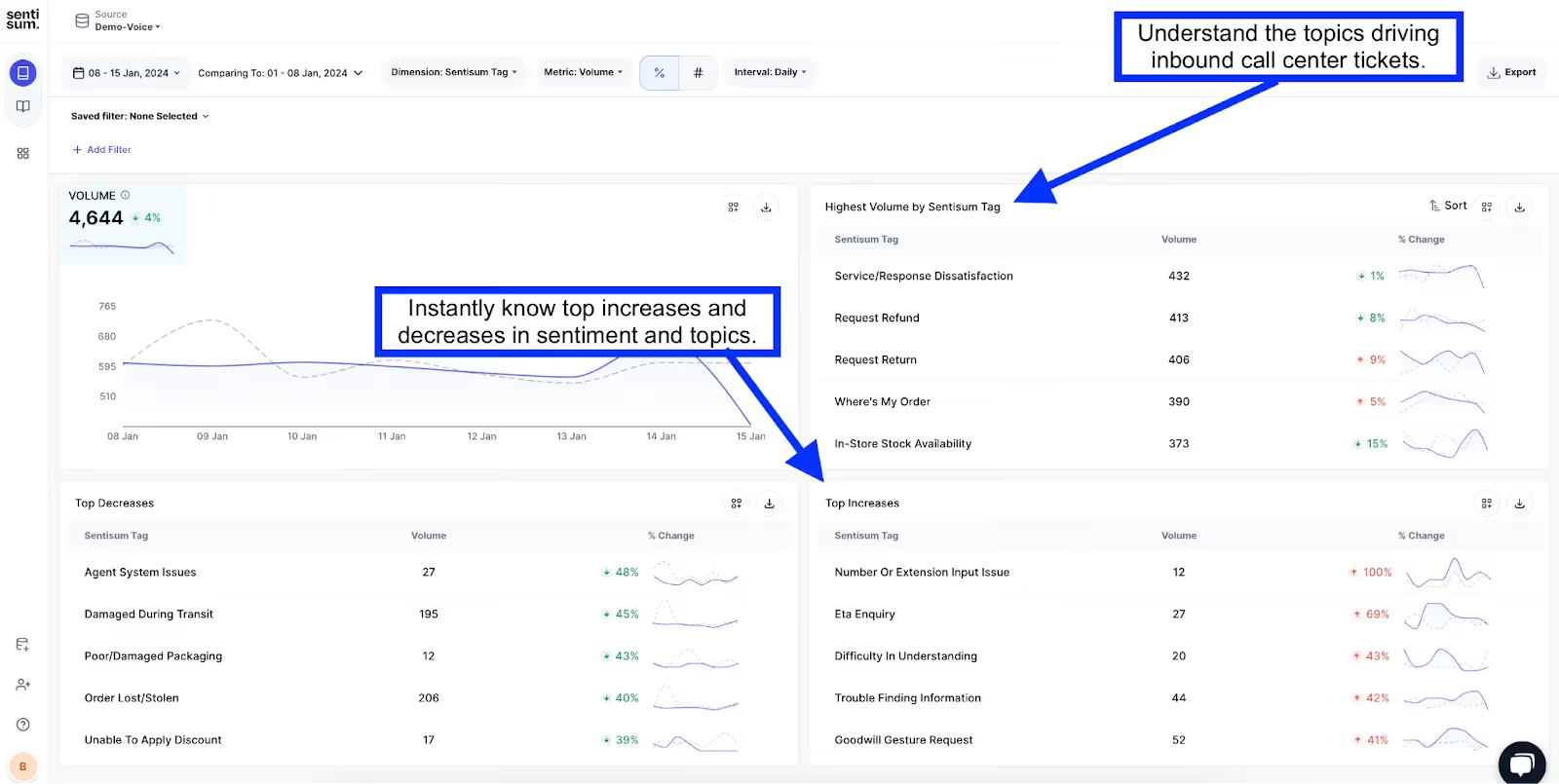
SentiSum is an AI-native CX intelligence platform built around its Kyo AI engine, which powers four specialized agents — essentially a team of AI specialists, each focused on one slice of the CX operation: Quality, Insights, Automation, and Early Warning. The platform analyses support tickets, surveys, voice calls, reviews, and social posts, then quantifies every finding in terms of recoverable revenue.
SentiSum's strength is operational speed. The platform claims drillable insights within 48 hours of setup and delivers findings through its own app, Slack push alerts, weekly email briefs, and MCP integrations with Claude and ChatGPT. The dollar-impact framing is distinctive: instead of reporting that "shipping complaints increased 15%," SentiSum aims to tell you that "shipping complaints are costing $1.82M annually and here is what to fix first."
The platform serves mid-market CX and support teams, with named customers including Schuh, Gousto, JustPark, Ticketmaster, Wallapop, and Butterbox. SentiSum holds GDPR and SOC 2 Type II certifications.
SentiSum Features
- Kyo AI engine: Four specialized agents (Quality, Insights, Automation, Early Warning) for targeted CX analysis
- Dollar-impact quantification: Every finding is sized in recoverable revenue
- Quality Agent: Predictive CSAT scoring, BPO partner quality scoring, AHT analysis with churn-risk correlation
- Early Warning Agent: Real-time anomaly detection before issues compound
- Automation Agent: Identifies automation opportunities and sizes them in dollars
- MCP integration: Plain-English queries via Claude and ChatGPT
- Support platform integrations: Zendesk, Intercom, Dixa, Gorgias, Freshdesk
- Survey integrations: Typeform, SurveyMonkey (Pro); Qualtrics and 100+ custom (Enterprise)
- Delivery channels: SentiSum app, Slack alerts, weekly email briefs, MCP
2026 Pricing
SentiSum offers three tiers: Growth at $1,000/month (5,000 conversations, 10 users, 2 languages), Pro at $3,000/month (5,000+ conversations, 5 users, support + surveys, Insights and Early Warning agents), and Enterprise at custom pricing (unlimited users, all 4 agents, API, SSO, Salesforce).
SentiSum Pros
- Dollar-impact quantification makes it easy to build business cases from CX data
- Fast time-to-value with claims of drillable insights within 48 hours
- Early Warning Agent provides genuine real-time anomaly detection
- Predictive CSAT and BPO quality scoring are useful for outsourced support teams
- Transparent published pricing at Growth and Pro tiers
- MCP integration with Claude and ChatGPT for AI-native workflows
SentiSum Cons
- Limited multilingual support: Growth plan covers only 2 languages, with broader coverage unconfirmed at scale
- No native social CX analytics or competitor benchmarking
- Speech analytics available only as an add-on at higher tiers
- ABSA not confirmed; analysis uses topic and sentiment tagging
- No business metric correlation connecting themes to NPS, CSAT, or CES impact
- Small review footprint: 14 verified reviews on G2, no Capterra rating, and no Gartner Peer Insights listing
- ISO 27001 certification not listed
Who It's For
SentiSum is built for mid-market CX and support teams that want to quantify operational issues in dollar terms and act on them quickly, particularly those with outsourced support operations or a focus on support ticket analytics.
Review Ratings
SentiSum holds a 4.8 out of 5 rating on G2 based on 14 reviews. The platform is listed on Capterra but does not have a published rating. SentiSum does not have a listing on Gartner Peer Insights. With 14 total verified reviews, the sample size is significantly smaller than platforms with hundreds of reviews, which is worth considering when evaluating peer sentiment.
Who Should Use SentiSum?
SentiSum is a strong fit if your team matches several of these criteria:
- You need to quantify CX issues in dollar terms to secure executive buy-in for fixes
- Your primary feedback source is support tickets from platforms like Zendesk, Intercom, or Freshdesk
- You want drillable insights fast, with minimal onboarding investment
- You manage outsourced support teams and need BPO quality scoring and predictive CSAT
- You operate in two or fewer languages at the Growth tier
- Real-time anomaly detection for operational issues is a top priority
SentiSum delivers focused value for support-centric CX teams that prioritise speed and revenue-impact framing. If your needs extend to multilingual analysis across dozens of languages, native social CX analytics, speech analytics, or connecting feedback themes to survey metrics like NPS and CSAT, you may find yourself outgrowing what SentiSum offers at its current tiers.
Who Should Use Chattermill?
Chattermill is the stronger fit if your team matches several of these criteria:
- You need to unify feedback from surveys, support, reviews, social media, and voice calls into a single platform
- You operate across multiple markets and need native support for 99+ languages
- You want aspect-based sentiment analysis that goes beyond topic tagging to reveal granular drivers
- Your teams need to correlate feedback themes with business metrics like NPS, CSAT, and CES
- You need native social CX analytics with competitor benchmarking across major platforms
- You want speech analytics built into your feedback analytics workflow, not bolted on as an add-on
- Enterprise-grade security matters: you require ISO 27001 alongside GDPR and SOC 2 Type II
Chattermill is built for organisations that treat customer feedback as a strategic asset, not just an operational input. If your goal is to connect every voice, in every language, across every channel to the business outcomes that matter, book a personalised demo to see how it works.
Choosing the Right Feedback Analytics Platform
Picking the right platform is less about features and more about fit. Here is a framework for evaluating your options:
Feedback volume and channels. Where does your feedback actually live? Start by mapping it. If it is concentrated in support tickets, a support-centric platform may suffice. If it spans surveys, social media, reviews, voice calls, and support across multiple teams, you need a platform that unifies all of those sources without siloed data.
Language requirements. If you operate in one or two markets, language coverage may not be a deciding factor. If you serve customers across multiple regions, native multilingual analysis, rather than translation-dependent processing, becomes essential. Chattermill supports 99+ languages natively; SentiSum's Growth tier supports two.
Analysis depth. Does your team need headlines or the full story? Consider whether topic-level tagging meets your needs or whether you need aspect-based sentiment analysis that reveals granular drivers within each theme. The difference determines whether your team gets "delivery is a problem" or "late delivery between days 5-7 from warehouse X is driving detractors in the UK."
Team structure. Who will actually log in and act on the data? If insights need to reach CX, product, marketing, and executive teams, you need customisable dashboards and flexible reporting. If the primary users are support operations, a more focused tool may deliver faster value.
Automation goals. Both platforms offer anomaly detection and alerting. The question is whether you need automation that identifies operational fixes sized in dollars (SentiSum's approach) or automation that connects anomalies to broader business metric movement across the entire feedback landscape (Chattermill's approach).
Enterprise validation. Review ratings and peer feedback matter when making a platform decision. Look for a meaningful sample size: 355 verified reviews across three platforms provides a different level of confidence than 14 reviews on one platform.
Security and compliance. Both platforms hold GDPR and SOC 2 Type II certifications. If your procurement process requires ISO 27001, that narrows the field. Chattermill holds all three; SentiSum lists GDPR and SOC 2 Type II.
Get Started With Chattermill
Choosing a feedback analytics platform is a strategic decision that shapes how your organisation listens, learns, and acts on customer feedback. If you need a platform that unifies every channel and language, delivers aspect-based sentiment analysis, connects themes to business metrics, and scales with your team, Chattermill is built for exactly that.
See how Chattermill can transform your feedback into actionable insight. Book a personalised demo to explore how Lyra AI works with your data.
Feedback Analytics Platforms: FAQs
What is the main difference between Chattermill and SentiSum?
Chattermill is an enterprise-grade feedback analytics platform that unifies surveys, support tickets, reviews, social media, and voice calls across 99+ languages using aspect-based sentiment analysis. SentiSum is an AI-native CX intelligence platform that focuses on quantifying operational issues in dollar-impact terms through its Kyo AI engine and four specialized agents. The core distinction is scope: Chattermill connects feedback to business metrics like NPS, CSAT, and CES across every channel, while SentiSum focuses on turning support-centric data into revenue-recovery action items.
Is SentiSum good for enterprise teams?
SentiSum offers an Enterprise tier with custom pricing, unlimited users, all four Kyo AI agents, API access, SSO, and Salesforce integration. However, it has a limited third-party review footprint with 14 verified reviews on G2 and no Gartner Peer Insights listing. Its named customers, including Schuh, Gousto, and Ticketmaster, are primarily mid-market. For enterprise teams that need 99+ languages, native social CX analytics, speech analytics, ISO 27001 certification, and 90+ integrations, Chattermill offers broader enterprise-grade coverage with 355 verified reviews across G2, Capterra, and Gartner.
How do Chattermill and SentiSum compare on pricing?
SentiSum publishes tiered pricing: Growth at $1,000/month (5,000 conversations, 10 users, 2 languages), Pro at $3,000/month (5,000+ conversations, Insights and Early Warning agents), and Enterprise at custom pricing. Chattermill uses custom enterprise pricing tailored to feedback volume, channels, and team size. SentiSum's published pricing provides a lower entry point, while Chattermill's custom model is typical for enterprise platforms where scope and scale vary significantly between customers.
Can SentiSum replace a full VoC platform?
SentiSum has expanded beyond support ticket tagging and now ingests surveys, voice calls, reviews, and social posts at higher tiers. However, it does not offer native social CX analytics with competitor benchmarking, native speech analytics in base plans, confirmed ABSA, or business metric correlation connecting themes to NPS, CSAT, and CES. Its multilingual coverage starts at two languages on the Growth plan. For teams that need a full Voice of the Customer platform spanning every channel and language with deep analytical capabilities, SentiSum may not fully replace a dedicated VoC solution.
What are the G2, Capterra, and Gartner ratings for Chattermill and SentiSum?
Chattermill holds a 4.4 out of 5 on G2 (237 reviews), 4.5 out of 5 on Capterra (25 reviews), and 4.5 out of 5 on Gartner Peer Insights (93 reviews), totalling 355 verified reviews across three platforms. SentiSum holds a 4.8 out of 5 on G2 (14 reviews), is listed on Capterra without a published rating, and is not listed on Gartner Peer Insights, totalling 14 verified reviews.
Does Chattermill support agentic AI workflows?
Yes. Chattermill offers a dedicated MCP server that enables agentic AI workflows, allowing teams to query feedback data and insights programmatically through AI tools. SentiSum also offers MCP integration with Claude and ChatGPT. Both platforms support AI-native access patterns, though Chattermill's MCP server is built around its full unified feedback analytics layer including social CX, speech, and multilingual data.



See Chattermill in action on your own feedback
Book a demo


